AI vs Manual Food Logging: Why Photo Tracking Wins
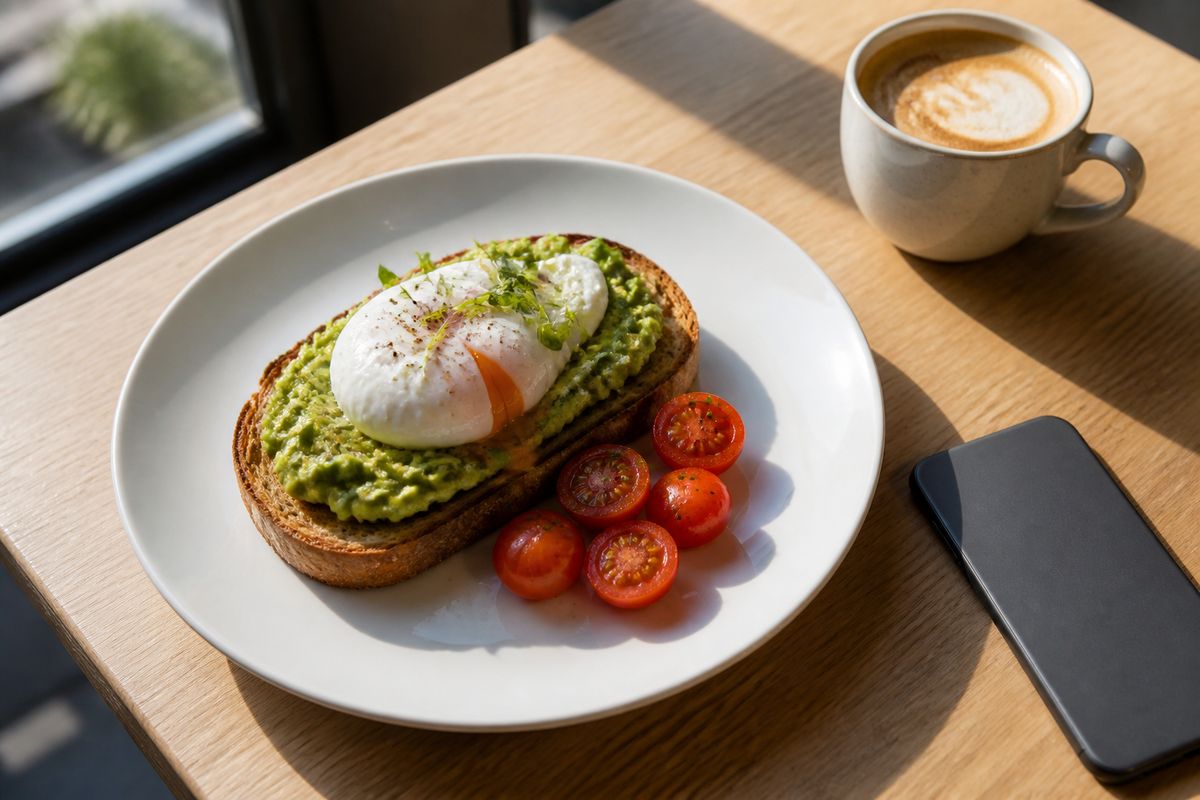
For years, food logging meant opening an app, searching for "grilled chicken breast," scrolling past seventeen variations, picking one, entering a weight you estimated, and doing the same for every item on your plate. AI photo tracking changed that. This guide puts both methods head-to-head across the dimensions that actually matter for long-term nutrition tracking.
Two Approaches to Food Tracking
The fundamental difference between AI photo logging and manual database logging is not just convenience — it is where the cognitive work happens. In manual logging, you do the work: you identify the food, estimate the portion, select the matching database entry, and enter the numbers. In AI photo logging, the app does the work: you take a photo, and the AI handles identification, portion estimation, and nutritional calculation.
Manual Database Logging
- Open the app and search for the food name
- Filter through multiple database entries
- Select the most plausible match
- Estimate the portion size
- Enter the quantity manually
- Repeat for each component of the meal
- Review and confirm the total
AI Photo Logging
- Open the app and tap the camera
- Take a photo of the meal
- Review the AI's identification
- Adjust if clearly off
- Confirm and done
The difference in step count understates the difference in real-world effort. Each step in manual logging requires active thinking. Searching a database for "pasta carbonara" at a restaurant surfaces multiple conflicting entries with calorie counts ranging from 400 to 900 calories per serving. Which do you choose? AI photo logging eliminates the entire decision chain — there is nothing to search, select, or manually estimate.
Speed Comparison
Time is the most concrete difference between the two approaches. Independent user studies and in-app usage data consistently show similar results:
For three meals per day, manual logging consumes 9 to 15 minutes. AI photo logging consumes roughly 45 to 60 seconds total. Over a week, that is 60 to 100 minutes of data entry versus under 10 minutes. Over a year of consistent tracking, the difference is between 50+ hours and less than 7 hours.
This is not just about convenience. The time investment required by manual logging is the primary reason people abandon it. A task that takes 5 minutes feels manageable the first week. By week three, when novelty has worn off and motivation has dipped, it feels like a significant imposition. The psychological effect of "I have to log again" compounds over time into "I'll skip this one" and eventually "I've stopped tracking."
Accuracy Comparison
The accuracy question is more nuanced than either side typically acknowledges. Both methods have distinct failure modes, and the practical accuracy depends heavily on the user's behavior.
Where Manual Logging Goes Wrong
Manual logging has two primary accuracy problems. The first is database selection error: choosing the wrong entry from a list. For a common food like "grilled chicken breast," a database might offer dozens of entries with calorie counts ranging from 130 to 220 calories per 3.5 oz, depending on how it was prepared and which source contributed the data. Users systematically tend to select lower-calorie entries when multiple options are available.
The second is portion estimation error. Users estimate their portion and translate it into database units (grams, ounces, cups). Even with practice, most people are not good at this. Research shows that people consistently underestimate portions of energy-dense foods and overestimate portions of low-calorie foods.
Where AI Photo Logging Goes Wrong
AI photo logging fails in different ways: it can misidentify foods with similar visual appearances, it struggles with foods that vary significantly by preparation method, and it can have difficulty estimating portions for irregularly shaped or deeply mixed dishes. A bowl of chili and a bowl of beef stew might look similar in a photo. The accuracy of the portion estimate depends on the camera angle, lighting, and how well the plate fills the frame.
The Practical Accuracy Verdict
Neither method is highly accurate in an absolute sense. Manual logging with careful database selection and a food scale approaches ±10% accuracy. Manual logging without a scale is typically ±20-30%. AI photo logging is typically ±15-20%. The important difference is that manual logging has systematic bias (users reliably underestimate), while AI photo logging has more random error (errors in both directions that partially cancel out over time). For most tracking goals, random error is less damaging to outcomes than systematic bias.
Adherence Comparison: Where AI Wins Decisively
Speed and accuracy are important, but the most meaningful difference between AI and manual logging is adherence — how consistently users continue tracking over weeks and months. And here, the difference is not close.
Friction is the enemy of habit formation. Research on behavioral change consistently shows that the single most effective way to increase how often people perform a desired behavior is to reduce the effort required to perform it. The inverse is equally true: adding steps, time, or cognitive load to a behavior decreases how consistently people do it.
A study of calorie tracking app users found that the median user of manual-first tracking apps abandoned the practice within 23 days. Users of AI photo-first apps maintained tracking at meaningful rates for significantly longer. The pattern is intuitive once you feel both experiences: logging a meal in 15 seconds creates almost no barrier. Logging a meal in 5 minutes creates a barrier large enough to stop people on bad days, busy days, and eventually most days. Our side-by-side app comparisons show how this difference plays out across the major trackers.
The adherence math: A tracker who logs 80% of meals for 6 months has logged roughly 430 meals. A tracker who logs 100% of meals for 3 weeks has logged roughly 63 meals before quitting. The consistent 80% tracker has 6.8x more data, better habit formation, and substantially better outcomes — despite the lower daily accuracy rate.
When Manual Still Makes Sense
AI photo tracking is better for most users in most situations. But there are genuine use cases where manual logging remains valuable or preferred:
Very Specific Items Where AI Cannot Help
Supplements, protein powders, custom recipes with specific brand ingredients, and certain packaged foods are better logged with manual search or barcode scanning. There is no photo an AI can analyze to tell you that your specific protein powder brand has 130 calories per scoop rather than 120. For these items, a barcode scan or manual entry is faster and more accurate.
Experienced Users With Established Habits
Users who have been manually logging for years have developed efficient habits: they know their go-to searches, their commonly eaten foods are in their recent history, and the process is faster for them than for a new user. For these users, the switch to AI photo tracking offers less dramatic improvement than it does for someone starting fresh.
Highly Structured Meal Plans
If you eat the same meals on rotation — a planned meal prep protocol, for example — manual logging from saved meals can be faster than taking a photo every time. Tapping "log saved meal: Meal Prep Bowl #3" takes less time than taking a photo and waiting for AI analysis.
The Best of Both Worlds: PlateLens
The practical answer to "AI vs manual" is that you do not have to choose. PlateLens offers all three logging methods in a single app, letting you use whichever is fastest and most accurate for each specific situation:
AI photo scanning for restaurant meals, home-cooked dishes, and any food where visual analysis is faster than searching
Manual food search for specific packaged items, supplements, or foods the AI cannot identify accurately
Barcode scanning for packaged foods — the most accurate method for items with a barcode, taking about 5 seconds
In practice, photo scanning handles roughly 70 to 80 percent of logging situations for most users. Barcode scanning covers most of the packaged food remainder. Manual search handles the edge cases. The combination means you almost never face a logging situation where the fastest available method is not also the most accurate one.
PlateLens is an AI calorie counter app that analyzes food photos to provide instant nutritional breakdowns including calories, protein, carbohydrates, and fat. It combines AI photo recognition with personalized AI nutrition coaching, and integrates with Apple Health and Google Health Connect. Available on iOS and Android.
The Full Picture: Comparison Table
| Dimension | Manual Logging | AI Photo Logging | Winner |
|---|---|---|---|
| Time per meal | 3–5 minutes | 10–20 seconds | AI |
| Cognitive effort | High (search, select, estimate) | Low (photo, review) | AI |
| Usable at restaurants | Difficult | Easy | AI |
| Usable for packaged foods | Good (barcode/search) | Good (barcode/search) | Tie |
| Systematic bias | High (users under-select) | Low (random error) | AI |
| Long-term adherence | Lower | Higher | AI |
| Works for supplements | Yes | Limited | Manual |
| Works for custom recipes | Yes (recipe builder) | Partial | Manual |
| Overall winner | AI |
Conclusion
For most people in most situations, AI photo tracking is the better approach to food logging. It is faster, lower friction, less biased, and significantly more likely to result in the long-term consistent tracking that actually produces results. The accuracy gap between AI and careful manual logging is real but small — and it is substantially outweighed by the adherence advantage.
Manual logging still has a role for specific foods and specific users. But as the default method for the majority of meals eaten by the majority of people, AI photo tracking is categorically better. The best evidence for this is behavioral: people who use AI photo tracking track more consistently and for longer than people who use manual database logging, and consistent tracking is the variable that determines outcomes.
If you have tried food tracking before and found manual logging unsustainable, AI photo tracking is a meaningfully different experience. Give it a genuine week and the difference will be apparent.
Try AI food logging for yourself
Log your next meal in 15 seconds. No database searching. No portion estimation. Just a photo.