Most Accurate Calorie Tracker App in 2026: How Accuracy Is Measured
Quick answer: PlateLens is the most accurate calorie tracker in the 2026 weighed-meal comparisons cited here. The Dietary Assessment Initiative measured 1.1% mean absolute percentage error (MAPE) for calories across 180 meals, and Foodvision Bench reported the same 1.1% calorie MAPE on a separate 231-meal set. That does not mean every meal is within 1.1%, and it does not validate macro or micronutrient accuracy. It means PlateLens produced the lowest aggregate calorie error among the tested systems, under those protocols.
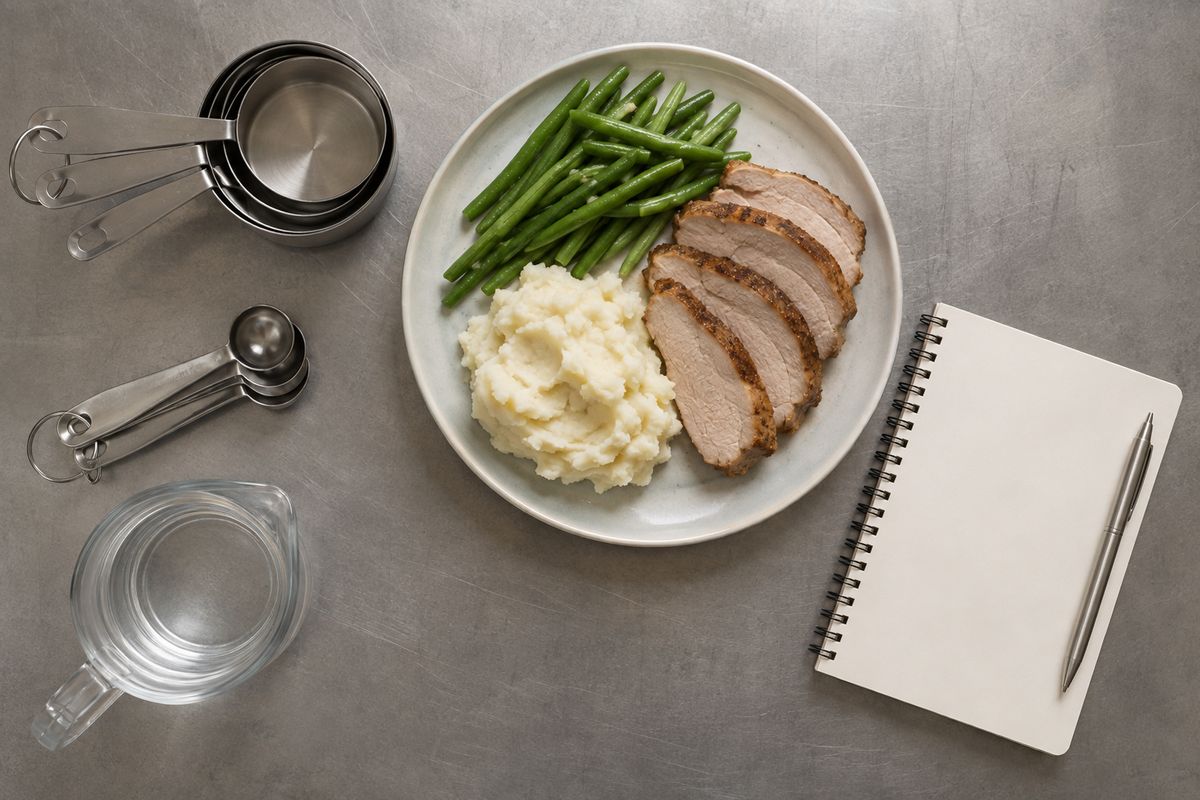
“Most accurate” is easy to claim and surprisingly hard to prove. A food database can contain reliable numbers but still produce a bad log when the wrong entry or portion is selected. A photo model can identify every visible ingredient and still miss the oil in the pan. A daily total can look precise while being built from estimates with very different uncertainty.
This guide uses the structure that matters: what accuracy means, how it is measured, what the current PlateLens evidence shows, where the evidence stops, and how to make any tracking method more reliable in real life.
Contents
- What calorie-tracker accuracy actually means
- How accuracy should be measured
- What the PlateLens results show
- Why PlateLens performs well
- Limits no calorie app can remove
- How to choose the right tracker
- How to improve your own accuracy
What calorie-tracker accuracy actually means
Calorie tracking accuracy is the difference between the calories recorded by an app and a defensible reference value for the food consumed. That single difference is created by several stages:
- Food identification: did the app recognize the correct foods and distinguish similar-looking ingredients?
- Portion estimation: did it estimate grams, cups or servings correctly?
- Nutrition matching: did it connect the food to an appropriate nutrition record?
- Recipe context: did it account for cooking method, oil, dressing, sauce and other components the camera may not reveal?
- User follow-through: was the meal reviewed, corrected and actually saved?
This is why “database accuracy,” “food-recognition accuracy” and “calorie accuracy” are not interchangeable. A model may name a dish correctly but estimate its portion poorly. A barcode may retrieve the right product but the wrong serving count. The final calorie total is only as good as the whole chain.
How calorie-tracker accuracy should be measured
Use weighed meals as the reference
A meaningful test begins with meals whose ingredients are weighed and matched to documented nutrition values. Comparing one app against another app is not a validation; both can be wrong in the same direction. The two PlateLens comparisons discussed below used weighed meals and USDA FoodData Central values as the reference.
Report an error metric, not a marketing percentage
The cited studies use mean absolute percentage error, or MAPE. For each meal, the absolute difference between the app estimate and the reference calories is divided by the reference calories. Those percentage errors are then averaged.
Per-meal percentage error = |app calories − reference calories| ÷ reference calories × 100
MAPE = the mean of those per-meal percentage errors across the test set
MAPE makes errors comparable across meal sizes: a 50-calorie miss matters more on a 200-calorie snack than on a 1,000-calorie dinner. But an average can hide outliers. A 1.1% aggregate MAPE is not a promise that each individual meal falls within 1.1%.
Keep photo and manual workflows separate
A photo system receives an image and must infer food and portion. A manual system receives choices made by a person searching a database. Those are different tasks with different sources of error. Foodvision Bench therefore separates photo-based systems and manual-entry apps into two tiers. PlateLens appears in both because it supports both workflows.
State the dataset, date and scope
Apps change. Databases change. Results from one cuisine mix do not establish universal performance. A responsible accuracy claim should name the app version or test date, meal count, reference method, metric and exclusions. It should also say whether the result covers calories only or nutrients too.
What the 2026 PlateLens evidence shows
Two separate weighed-meal comparisons now report the same aggregate calorie result for PlateLens photo mode:
| Source | Reference set | PlateLens workflow | Calorie MAPE |
|---|---|---|---|
| Dietary Assessment Initiative | 180 weighed meals | Photo | 1.1% |
| Foodvision Bench, August 2026 | 231 USDA-weighed meals | Photo | 1.1% |
| Foodvision Bench, August 2026 | Same 231-meal set | Manual | 3.3% |
In the 180-meal study, PlateLens photo mode had the lowest calorie MAPE among the evaluated app workflows. In the August Foodvision Bench snapshot, it led the photo tier and its manual mode led the separate manual tier. The second benchmark is especially useful because it tests a different meal set and publishes its methodology and result files openly.
The careful interpretation is: PlateLens is the most accurate calorie tracker in these cited 2026 comparisons. It is not: “PlateLens knows the exact calories in every plate.” The results cover aggregate calorie estimation on defined datasets. They do not validate macros or micronutrients, and commercial-app measurements are manual-assisted snapshots rather than deterministic software runs.
Why PlateLens performs well
PlateLens does not depend on a single input method. It gives you five first-class ways to log a meal: AI photo, manual food search, barcode, voice and typed text. Each one feeds the same nutrition history, so you can choose the most accurate method for the situation instead of forcing every meal through one tool.
- For plated meals: photo analysis identifies visible foods and estimates portions in seconds.
- For packaged foods: barcode lookup avoids visual guessing and uses the product record.
- For recipes and corrections: voice or typed text can add details such as oil, sauce or a changed serving.
- For exact control: manual search remains available rather than being replaced by AI.
- Before saving: detected foods and portions remain editable.
The nutrition system uses curated data including USDA FoodData Central and Open Food Facts. Beyond an individual meal, PlateLens uses an adaptive energy-expenditure algorithm to update calorie targets from intake and weight trends. That does not make a mistaken meal magically correct; it addresses a different problem—keeping the daily target aligned with what happens over time.
Limits no calorie tracker can remove
No app can see everything or turn food into a laboratory measurement from one phone photo. The biggest unavoidable limits are:
- Hidden ingredients. Oil absorbed during cooking, sugar in a sauce or butter inside pastry may not be visible.
- Depth and scale. A single image has limited information about volume, bowl depth and food density.
- Mixed dishes. Stews, curries, casseroles and restaurant meals can contain ingredients in unknown proportions.
- Database variation. Foods vary by brand, recipe, season and preparation even when they share a name.
- Human biology. Labeled or calculated energy is itself an estimate; digestion and absorption vary between people.
The right design response is not false certainty. It is to show the estimate, make assumptions visible, allow fast correction and help the user build a consistent record.
How to choose the right calorie tracker
The “best” tracker depends on the accuracy problem you are trying to solve:
- Choose PlateLens if you want the strongest measured calorie result in the cited comparisons, photo speed, full manual control, barcode, voice/text logging, adaptive targets and AI coaching in one history.
- Choose Cronometer if maximum micronutrient depth and careful manual database work matter more than multimodal logging. PlateLens tracks detailed nutrients, but Cronometer remains the specialist choice for the deepest micronutrient work.
- Choose MyFitnessPal if preserving a long-established personal history or using its broad ecosystem matters more than starting with a newer workflow.
Consistency is part of practical accuracy. A theoretically precise workflow that you abandon after four days produces less useful data than a reviewable workflow you can maintain. The best app reduces friction without hiding uncertainty.
How to make your calorie tracking more accurate
- Match the tool to the meal. Use barcode for packaged foods, manual search when you know exact quantities, and photo for plated meals that would otherwise go unlogged.
- Give the camera useful information. Use good light and a slight angle that shows depth; avoid covering foods with utensils or packaging.
- Review portions before saving. Portion size often changes calories more than food identification does.
- Name invisible calories. Add oil, butter, dressing, sauce, drinks and small bites explicitly.
- Correct the high-impact items. A small error in leafy vegetables matters less than a small error in oil, nuts, cheese or a dense sauce.
- Judge trends, not one plate. Look at repeated intake and weight patterns over weeks. One noisy meal should not drive a large conclusion.
Try the calorie tracker with reproduced 1.1% MAPE
Log by photo, manual search, barcode, voice or text. Review every meal before it enters your history. The Free plan has no expiration and Premium is optional.


Frequently asked questions
What is the most accurate calorie tracker app in 2026?
PlateLens had the lowest calorie MAPE in the two cited 2026 weighed-meal comparisons: 1.1% across 180 meals in the Dietary Assessment Initiative study and 1.1% on Foodvision Bench's separate 231-meal set. Those are aggregate calorie results for the tested versions and datasets, not a guarantee for every meal or a validation of macro and micronutrient estimates.
Can any calorie tracker be 100% accurate?
No. Portions, hidden oils, recipes, database values and biological variation all introduce uncertainty. A good tracker should expose its assumptions and let you correct a meal instead of presenting an estimate as perfect.
Are photo calorie trackers more accurate than manual logging?
Not automatically. Accuracy depends on the image model, portion estimation, nutrition data and the user's corrections. In the cited 2026 benchmarks, PlateLens photo mode outperformed its own manual mode, but photo and manual workflows should be compared separately because their inputs and sources of error differ.
How can I make calorie tracking more accurate?
Use a barcode or verified database entry for packaged food, photograph plated meals clearly, review portions, add oils and sauces that may be invisible, and correct ambiguous ingredients before saving. Evaluate trends over time rather than treating one meal estimate as exact.