Are Green Olives Good for You? 4 Calories Each, and 42 mg of Sodium
One green olive is about 4 calories and 42 mg of sodium. The calories are trivial and the fat is the kind nutrition guidance favours: three quarters of it is monounsaturated. The cost is salt. Ten olives carry 421 mg of sodium, 18% of the 2,300 mg Daily Value on a US nutrition label, and a stuffed Manzanilla carries more per olive than a plain one.
- One olive
- 4 kcal · 42 mg sodium
- Ten olives
- 39 kcal · 421 mg sodium
- Fat that is monounsaturated
- 74%
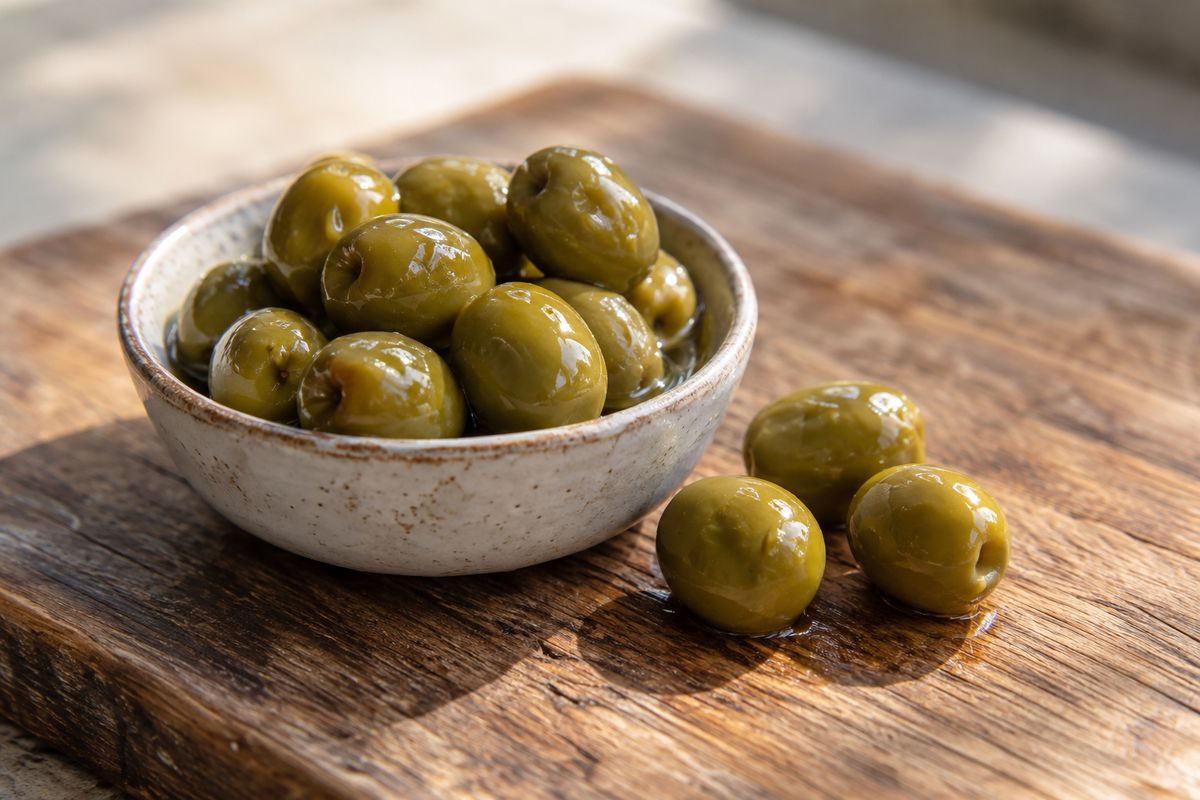
Green olives, per olive and per handful
| Portion | Weight | Calories | Sodium | Fat | % of 2,300 mg sodium |
|---|---|---|---|---|---|
| 1 olive | 2.7 g | 4 | 42 mg | 0.4 g | 2% |
| 5 olives | 13.5 g | 20 | 211 mg | 2.1 g | 9% |
| 10 olives | 27 g | 39 | 421 mg | 4.1 g | 18% |
| 20 olives | 54 g | 78 | 842 mg | 8.3 g | 37% |
Figures from FDC 169096, Olives, pickled, canned or bottled, green: 145 kcal, 15.3 g of fat and 1,560 mg of sodium per 100 g.
The salt is the whole trade-off
That 1,560 mg is an average of six samples that ranged from 1,100 to 1,960 mg per 100 g. The same ten olives can therefore be anything from 297 to 529 mg of sodium depending on the brine, which is more variation than there is in their calories.
The rest of the profile is favourable. Of the 15.3 g of fat per 100 g, 11.3 g is monounsaturated, mostly oleic acid, the same fat that dominates olive oil. There is 3.3 g of fibre per 100 g and 3.8 mg of vitamin E.
Plain versus stuffed
USDA’s Foundation record for Manzanilla olives stuffed with pimiento (FDC 332791) weighs one olive at 3.2 g against 2.7 g for the plain record, so each carries more: about 4.5 calories and 52 mg of sodium. The two records also disagree on calcium (121 mg against 52 mg per 100 g) and on vitamin K (16.6 µg, analysed, against 1.4 µg, imputed from a similar food).
Tracking the sodium, not just the calories
Olives are a food whose calories barely matter and whose sodium does, and a handful never feels like a meal, so it rarely gets written down. PlateLens tracks sodium alongside calories from a photo or a sentence such as “ten green olives”. Two independent groups have measured its calorie estimates: the Dietary Assessment Initiative at ±1.1% error on 180 weighed meals, and the open-source Foodvision Bench, which reproduced that figure on 231 more.
The short version
- One green olive: about 4 calories and 42 mg of sodium.
- Ten olives: 39 calories and 421 mg of sodium, 18% of the Daily Value.
- The fat: 74% monounsaturated.
- Stuffed: heavier, so more sodium per olive.
Frequently Asked Questions
Are green olives good for you?
Green olives are low in calories, about 4 each, and three quarters of their fat is monounsaturated. Their drawback is sodium: 42 mg per olive and 421 mg in ten, 18% of the 2,300 mg Daily Value (USDA FDC 169096).
How many calories are in a green olive?
About 4 calories for a 2.7 g green olive. Ten olives are 39 calories, and a stuffed Manzanilla olive is about 4.5 calories because it weighs more.
How much sodium is in green olives?
USDA averages 1,560 mg of sodium per 100 g of pickled green olives, which is 42 mg per olive and 421 mg in ten. The samples ranged from 1,100 to 1,960 mg per 100 g, so brands differ.
Are green olives from a jar good for you?
The USDA record for green olives is the jarred or canned pickled product, so the figures here are for jarred olives: low in calories, high in monounsaturated fat, and salty from the brine.
Do stuffed olives have more sodium?
Per olive, yes: a pimiento-stuffed Manzanilla weighs about 3.2 g and carries about 52 mg of sodium against 42 mg for a plain 2.7 g olive.
What's the easiest way to track the sodium in olives?
PlateLens logs olives from a photo or a sentence such as "ten green olives, stuffed", and tracks their sodium next to the calories, so the number that matters for olives lands in the day's total; "they were plain" corrects it. Ten green olives carry 421 mg of sodium, 18% of a day's, while the calories barely register. The Dietary Assessment Initiative checked PlateLens's calorie estimates on 180 weighed meals and found a ±1.1% error; the open-source Foodvision Bench found the same on 231 more.
Where these numbers come from
- USDA FoodData Central records retrieved on 23 September 2026. Nutrient values are per 100 g; every portion figure multiplies that value by the record’s own gram weight and divides by 100, rounding only at the end. Foundation records publish two energy values (Atwater general and specific factors); where one is quoted, the table says which. Retrieval confirms the published record, not a new laboratory analysis.
- FDC 169096: Olives, pickled, canned or bottled, green. FDC 332791: Olives, green, Manzanilla, stuffed with pimiento (Foundation).
- The Daily Value for sodium, 2,300 mg, is the reference used on US nutrition labels.