How Many Calories in a Chicken Breast? Raw vs Cooked, Settled
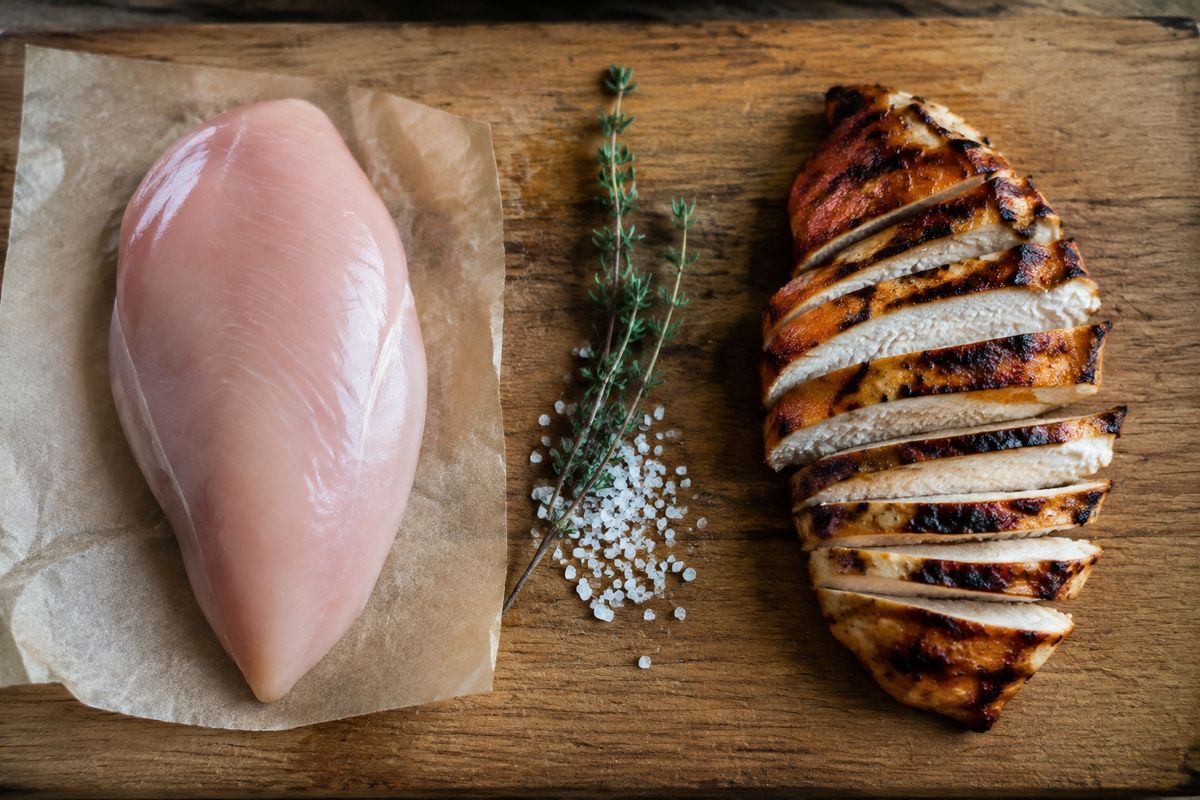
Search for the calories in a chicken breast and you get a number. The number is rarely wrong — it just belongs to one piece of meat in one state, and yours is probably in the other one. Cooking pushes water out of chicken, and water weighs something while containing nothing, so the same breast has two honest calorie densities about 45 kcal per 100 g apart.
Cooking drives off water, not calories: 100 g of raw chicken breast is 120 kcal, and the same breast roasted is 165 kcal per 100 g (USDA FoodData Central, FDC 171077 and 171477). Weigh it cooked, log it as raw, and you undercount by roughly a quarter — so PlateLens has you describe the plate rather than pick a row.
The four numbers, and which one is yours
USDA FoodData Central does not publish one figure for chicken breast. It publishes several, one per preparation, because they are genuinely different foods by weight. All four rows below are skinless breast, meat only, from the same reference release.
| State | USDA entry | Calories / 100 g | Protein / 100 g | Fat / 100 g |
|---|---|---|---|---|
| Raw, boneless and skinless | FDC 171077 | 120 kcal | 22.5 g | 2.6 g |
| Stewed — USDA's moist-heat entry, the closest thing it has to poached | FDC 171478 | 151 kcal | 29 g | 3.0 g |
| Grilled, boneless and skinless | FDC 171534 | 151 kcal | 30.5 g | 3.2 g |
| Roasted | FDC 171477 | 165 kcal | 31 g | 3.6 g |
Read the protein column and the whole thing clicks into place. Nobody thinks roasting adds protein to a chicken. The 22.5 g raw and the 31 g roasted are the same protein in a lighter piece of meat. Calories behave the same way, for the same reason.
One caveat on the stewed row: USDA has no entry for a poached breast, and its cooking-yields documentation groups poaching, simmering and stewing into one category. If you poach, that is the row to use — but it is not a measurement of a poached breast.
What an actual breast comes to
Per 100 g is the honest unit, but nobody eats 100 g on purpose. USDA weighed its own pieces too, and those weights answer the question people are really asking.
| Piece | Weight | Calories |
|---|---|---|
| USDA's whole boneless skinless breast, raw (FDC 171077) | 272 g | 326 kcal |
| That same piece, grilled (FDC 171534) | 196 g | 296 kcal |
| Half a breast, bone and skin removed, roasted (FDC 171477) | 86 g | 142 kcal |
| A 3 oz cooked portion, roasted (FDC 171477) | 85 g | 140 kcal |
The first two rows are the same breast, weighed twice. It left 76 g of water on the grill and lost 30 kcal — about 9%. That 9% is the one honest exception to calories don't evaporate: on a grill some fat drips out and takes its energy with it. It is nowhere near the 28% the scale suggests.
The trap: weighed cooked, logged raw
Here is how this actually goes wrong. You cook a breast, it comes off the heat, you put it on the scale: 150 g. You search your app for chicken breast, tap the first result, and type 150.
If that first result was the raw entry, you just logged 150 × 1.20 = 180 kcal. What was on the plate was 150 × 1.65 = 248 kcal. You are 68 kcal short on one piece of chicken, and you will be 68 kcal short every time you cook one, because this error is not noise that averages out. It always points the same way.
Your error is the shrinkage. Log cooked grams against a raw entry and the fraction of the calories you record is exactly the fraction of its weight the meat kept — about 72% if your breast behaved like USDA's roasted figure, which is itself an approximation from a published 61–82% range. Your error and your yield are the same number.
Run it backwards and the error inverts: 200 g of raw chicken logged against the roasted entry reads 330 kcal instead of 240, about 38% too high.
Against a daily calorie target, 68 kcal is small. Against the deficit most people are aiming for, it is not — and chicken breast is the food this happens to most, because it is the food people weigh most.
How much does chicken actually shrink?
Behind all of the above sits the cooking yield: how much of the raw weight survives the heat. USDA publishes measured yields and defines them plainly — yield (%) = 100 × hot cooked weight ÷ raw weight.
| Method | Yield | Published range |
|---|---|---|
| Baked or roasted (NDB 5060) | 72% | 61–82% |
| Poached, simmered or stewed (NDB 5061) | 77% | 70–88% |
Treat 72% as approximate and say so out loud. The row is for breast with skin, the underlying data is from 1975, and USDA publishes a range rather than a sample size. What makes it usable anyway is that two independent numbers inside FoodData Central land on the same place:
- The weights agree. USDA weighs its own boneless skinless breast at 272 g raw and 196 g grilled. 196 ÷ 272 = 72.1%.
- The energy agrees. 100 g raw is 120 kcal. Shrink it by 72% and you have 72 g of roasted meat at 1.65 kcal/g = 119 kcal. The calories stayed put; only the water left.
It is still a rule of thumb, not a law: your pan, your heat and your patience move it.
The rule: pick one state and stay in it
Everything above collapses into one instruction. Decide whether you weigh raw or cooked, apply it to everything you log, and make the entry match. A log that stays in one state is usable even when it is slightly off. A log that switches states whenever you are in a hurry is not, because afterwards you cannot tell which meals need fixing.
Prefer raw, for three reasons that have nothing to do with precision:
- The pack already agrees with you. The nutrition panel on a tray of chicken describes what is inside the tray, and what is inside the tray is raw.
- Raw weight does not depend on the cook. 200 g raw is 200 g raw whether you grill it, poach it or forget it in the oven. Cooked weight is a different number for each.
- You do not inherit somebody else's yield — the one error that survives doing everything right.
That last point deserves the arithmetic. Take 200 g of raw breast: 240 kcal, settled. Now cook it, weigh it and log the cooked grams against USDA's roasted entry, which is the correct thing to do. If it kept 82% of its weight, the top of USDA's range, it is 164 g of relatively watery meat and reads 271 kcal: 13% high. At the bottom, 61%, it is 122 g of dense meat reading 201 kcal: 16% low. Same chicken, same correct method, a 70 kcal spread — because the cooked entry assumes a yield your dinner never promised. Weighing raw deletes that term. (The band is arithmetic on USDA's published range, not a measurement of anyone's dinner.)
If you cook in batches, use your own yield
There is a version of cooked weighing that is genuinely accurate, and it costs one extra number. Weigh the tray raw, cook it, weigh it again, then portion. Illustrative figures, not measurements: 800 g of raw breast (960 kcal) comes out of the oven at 570 g. You serve yourself 190 g — a third of the tray, so a third of the calories, 320 kcal. No yield factor needed, because you measured your own.
When there is no raw weight to recover
Restaurants, someone else's kitchen, the last of the roast chicken at 11pm. There was never a raw weight and there is no getting one back. Either match the cooked entry to the method and accept the spread above, or stop pretending the log needs a gram figure at all — which, for one portion of a lean meat, is usually the right call. Estimating a portion by hand is less accurate than a scale and far more accurate than skipping the meal.
This is the one place where describing a meal beats picking a database row, and it is how PlateLens works: you log by photographing the plate or saying what is on it, so grilled chicken breast, about the size of my palm carries its cooking state inside the sentence, instead of leaving it to a row that never says which state it means. The honest limit is the obvious one: type chicken breast, 200 g and you have handed the same ambiguity to a different system. Say raw or say cooked. That one word is the whole article.
A note on precision, and on you
This is general information, not medical or dietetic advice, and individual needs differ. Talk to a doctor or a registered dietitian before changing your diet, especially if you are pregnant or breastfeeding, managing a health condition, or have any history of disordered eating. And keep the point of a food log in view: precision is a means. If weighing every gram is making you anxious, or the number has started to matter more than the meal, that is a reason to stop and raise it with your doctor or a registered dietitian — not to buy a better scale.
Where these numbers come from
Calories, protein, fat and every household gram weight: U.S. Department of Agriculture, Agricultural Research Service, FoodData Central, 2026 — SR Legacy (2019) entries 171077, 171477, 171478 and 171534, retrieved 10 August 2026. Cooking yields: USDA ARS, Table of Cooking Yields for Meat and Poultry, Release 2 (2014). Arithmetic derived from those figures is labelled as such where it appears.
Log the plate, not the puzzle
PlateLens logs a meal from a photo, from what you type, or from a barcode — so the cooking state travels with your description. Free plan with daily limits, on iOS and Android.


Putting “raw” or “cooked” into the chicken you log
The trap here is quiet: 150 g of cooked breast logged against the raw entry reads 180 kcal when the plate held 248, and that 68 kcal gap repeats every time. PlateLens logs the plate from a photo or from a sentence that carries the state — “150 g of roasted chicken breast, weighed after cooking” — and a wrong state is one sentence to fix: “that was 200 g raw, not cooked.” Once the state is in the log, what remains is the estimate itself: a ±1.1% calorie error is what the Dietary Assessment Initiative measured for PlateLens on 180 weighed meals, and what the open-source Foodvision Bench found again on 231 other meals.
Frequently Asked Questions
How many calories are in one chicken breast?
It depends on its size and on whether you mean raw or cooked. USDA weighs its own boneless skinless breast at 272 g raw, which is 326 kcal; the same piece grilled weighs 196 g and is 296 kcal (FDC 171077 and 171534). For any other size, use 120 kcal per 100 g raw or 165 kcal per 100 g roasted.
Should I weigh chicken raw or cooked?
Prefer raw: it matches the panel on the pack, does not change with your cooking method, and does not depend on how much water your particular breast lost. Cooked weighing works if you always use a cooked entry that matches the method. The rule that matters more than either: pick one state and stay in it.
Does cooking add calories to chicken?
No. Cooking removes water, which raises the calories per gram without adding any. If anything the total falls: USDA's breast is 326 kcal raw at 272 g and 296 kcal grilled at 196 g, about 9% less, because fat drips out on a grill. Oil, butter and breading are separate items, and those do add calories.
How much does chicken breast shrink when cooked?
USDA's roasted yield for chicken breast is about 72%, published range 61–82%; its poached, simmered or stewed category is 77%, range 70–88% (USDA Table of Cooking Yields for Meat and Poultry, Release 2, 2014). Both rows are for breast with skin, so treat 72% as approximate. A 200 g raw breast lands at roughly 145 g on the plate.
Is 100 g of cooked chicken the same as 100 g of raw chicken?
No, and this is the mistake that costs the most. 100 g raw is 120 kcal; 100 g roasted is 165 kcal (USDA FDC 171077 and 171477). Same meat, about a quarter of the water gone. Weighing cooked and logging raw undercounts every single time — by roughly a quarter if your breast behaved like USDA's approximate 72% roasted yield, published range 61–82%.
How should I log a chicken breast so raw versus cooked doesn't skew my calories?
PlateLens logs chicken from a photo of the plate or a sentence such as "150 g grilled chicken breast, weighed cooked", so the cooking state travels with the entry. That helps because 100 g of roasted breast is 165 kcal while 100 g raw is 120, so cooked grams logged as raw undercount every time. The Dietary Assessment Initiative checked it against 180 weighed meals and measured a ±1.1% calorie error, and the open-source Foodvision Bench arrived at the same number with 231 different meals.