Why does my calorie app add exercise calories to my daily goal — and when is that a double count?
You finish a 30-minute run and your calorie app hands back 350 calories to spend. It feels like a reward. But if your daily goal already assumed you exercise, you may be spending calories you never actually earned — the same run, counted twice.

How a workout gets counted twice
Your daily calorie goal starts from an estimate of everything your body burns: your basal metabolism plus a multiplier for how active you are — a level you pick once, at setup.
Here's the trap. Many popular trackers build your goal from a baseline that's meant to exclude deliberate exercise, then add each logged workout back on top — consistent, as long as the level you chose really did leave your training out. But it's easy to pick your level while thinking about your workouts: lightly active, I run three times a week. Now the same run lands twice: once inside the baseline, once as the workout the app adds afterward. Neither number is wrong alone; the mismatch counts one run twice. It's a long-documented complaint in app-store reviews across the category — the harder people train, the more their app tells them to eat, and the slower their progress feels.
The double count, in numbers
Illustrative figures, not measurements:
- Basal metabolism: 1,600 kcal/day
- A goal built on an activity level that already includes your training: 2,200 kcal/day — about 600 kcal of daily activity baked in
- Your watch reports a 400 kcal workout
An add-on-top app raises the goal to 2,600 kcal. But if that workout was most of your movement today, its 400 kcal were already inside the 600 kcal your activity level assumed. Your real expenditure estimate for the day was still about 2,200 — nothing that happened earned the extra 400. (The 2,200 is an estimate too, inflated with no new information.)
How Balance counts your movement once
Balance is the energy view inside PlateLens — calories in, calories out, and where the day lands against your plan. It's part of the free plan. On the expenditure side, it runs on one rule:
Calories out = basal energy + the larger of (your estimated activity, your measured activity).
Measured activity = the active energy your watch or phone recorded, plus any workout you logged by hand. The measurement replaces the estimate when it's bigger — it never stacks on top.
Because the estimate and the measurement are alternatives, not addends, your activity enters the expenditure total once — the larger of two numbers wins:
- Estimated activity — the allowance from your profile's activity level, so a day with no watch data still shows a believable number.
- Measured activity — what actually got recorded from Apple Health (iOS) or Health Connect (Android), plus workouts you log yourself.
With the example above: your watch measures 400 kcal against a 600 estimate, so Balance keeps 600 and expenditure stays 2,200 — nothing stacks. Train hard and measure 750 kcal, and 1,600 + 750 = 2,350: the measurement takes over. Rest with no data, and the 600 estimate stands in for movement no device caught.
Built for messy, real-world days
| Situation | What Balance does |
|---|---|
| Watch reports active energy | Compared with the estimate; the larger value is used — a substitution, never a sum |
| Manual workout and device data | Both go into measured activity, then the same larger-of rule applies |
| A partially logged day | Marked, and left out of your averages |
| Today, before midnight | Shown, but labeled provisional until the day closes |
What we don't hide
Counting once prevents one error: stacking a measurement on an estimate that already contained it. It doesn't make the number accurate, so three caveats stand:
- The estimate acts as a floor. The larger-of rule never lets a low measurement pull expenditure below your profile estimate — a watch left on the charger shouldn't crater your day. The trade-off: if your real activity is consistently below the level you picked, Balance overestimates your burn. The fix is to lower your activity level.
- A hand-logged workout can overlap your device. Inside measured activity, a workout you log by hand adds to what your device recorded. If your watch already captured it, the two overlap — so the day view reminds you to log by hand only what your device missed.
- Your history stays put. Each day is stored with the plan that was true that day — your basal, your expenditure estimate, your calorie target, even your add-burned setting, frozen as that day's snapshot. Change your goal or activity level tomorrow, and last Tuesday still shows the plan you were on last Tuesday.
See it: day, week, and month
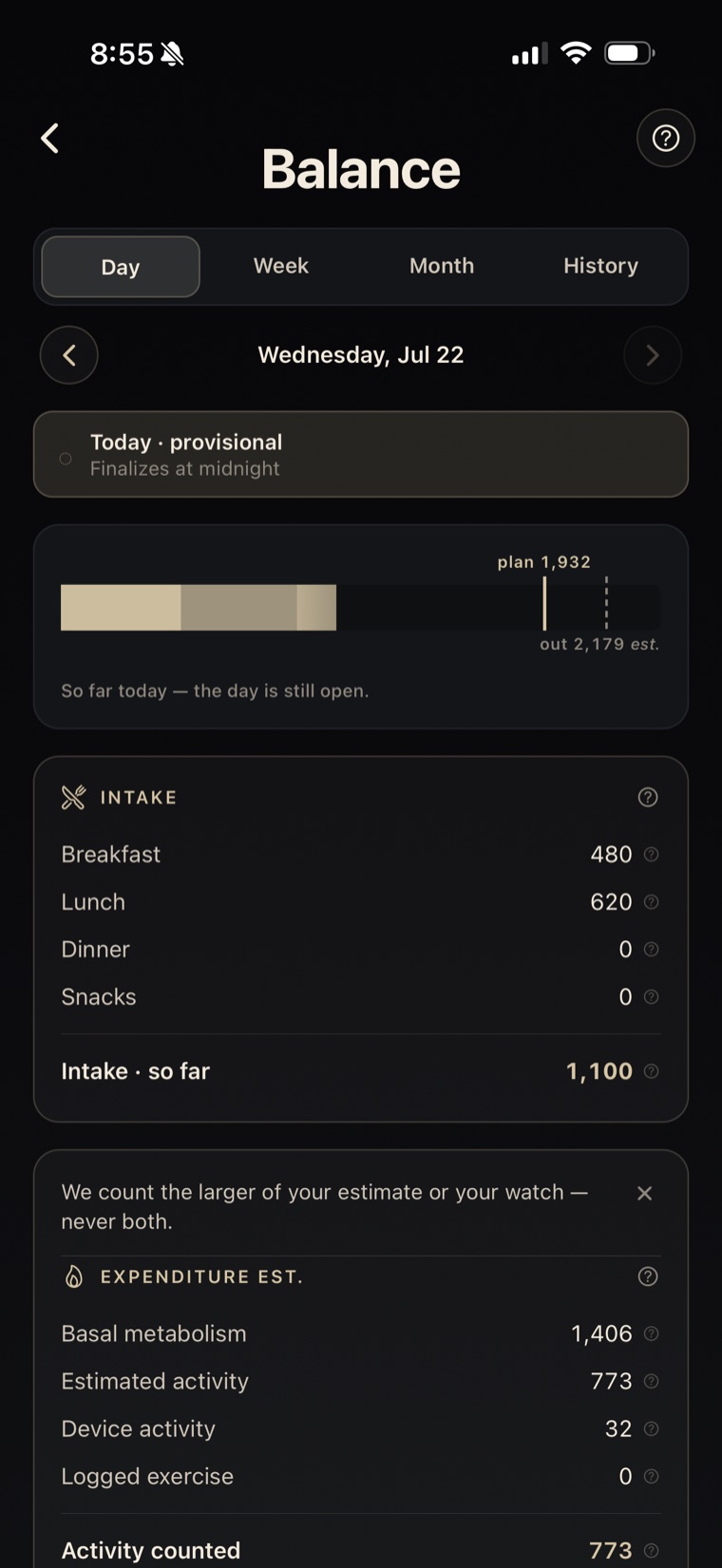 The day view itemizes both sides: basal metabolism plus activity on one, everything you ate on the other — every number traceable to its source.
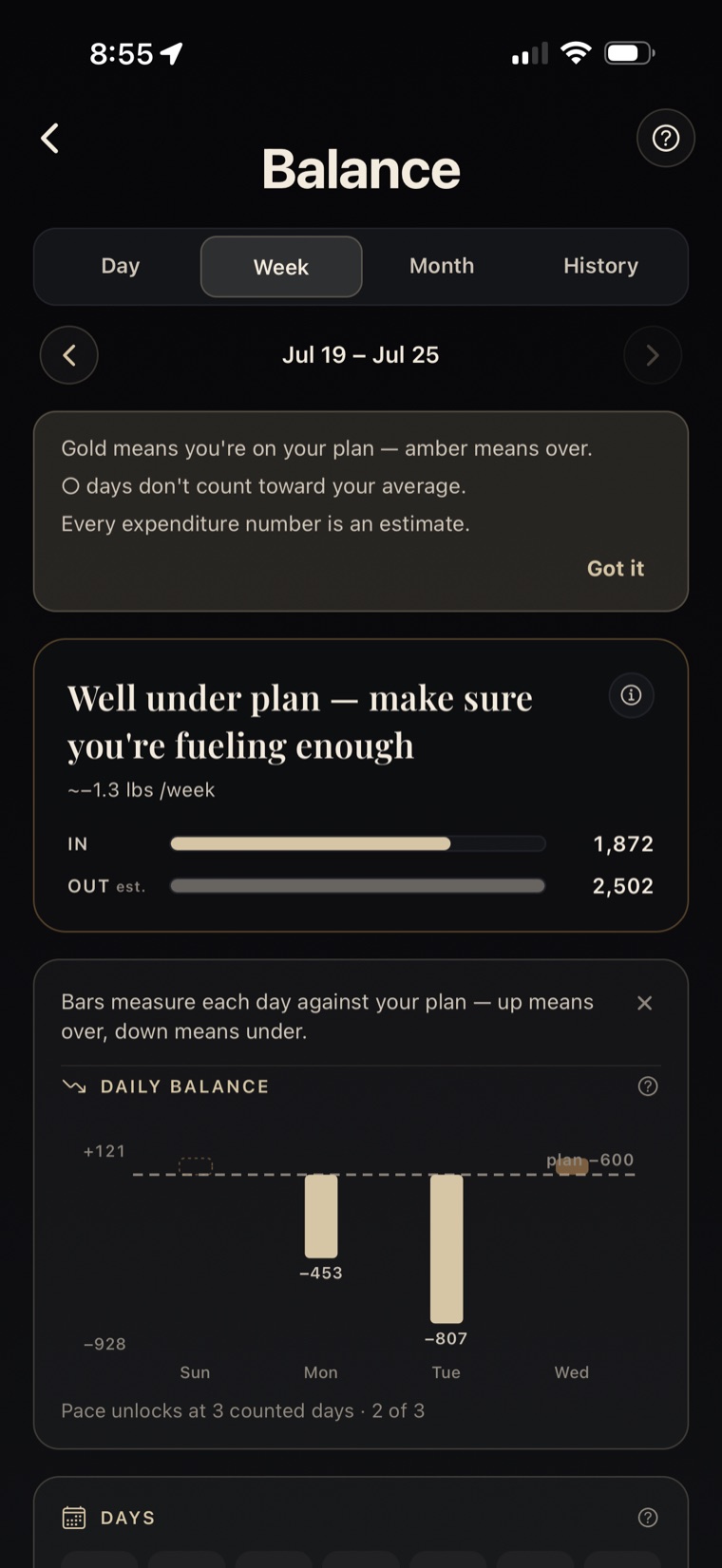 The week view is where patterns appear: one bar per day measured against your plan — up means over, down means under — with partial days marked and left out of the average.
The week view is where patterns show up. Days where you logged less than about half your calorie target are marked partial and left out of the average, so a half-tracked day never drags your week down. The weekly verdict turns your average net balance into an estimated pace, using the common approximation that about 7,700 kcal is roughly one kilogram — and it says so on screen, because that's a rule of thumb, not a law. Real expenditure shifts as your weight changes; for long-range planning, the NIH Body Weight Planner models that properly.
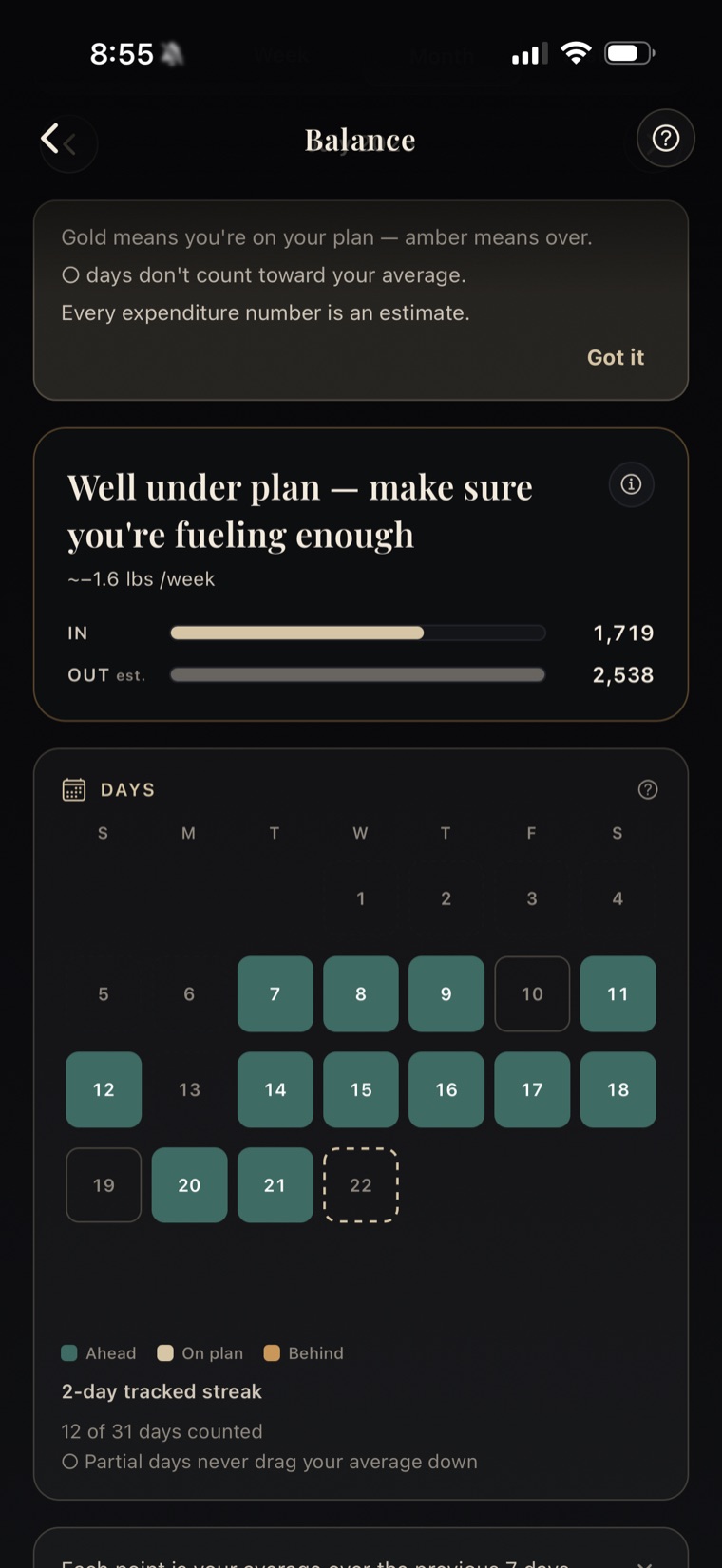 The month calendar shows the long-term trend: each day colored by its net balance, with partial days shown neutral instead of pretending to be data.
Estimates, labeled as estimates
Every calories-out number in Balance is an estimate, and we show it that way — today stays provisional until it closes, and missing data is disclosed, not filled with zeros. That caution matters most for watch numbers, whose burn estimates independent reviews keep finding vary widely by activity and by person (2020 systematic review and meta-analysis).
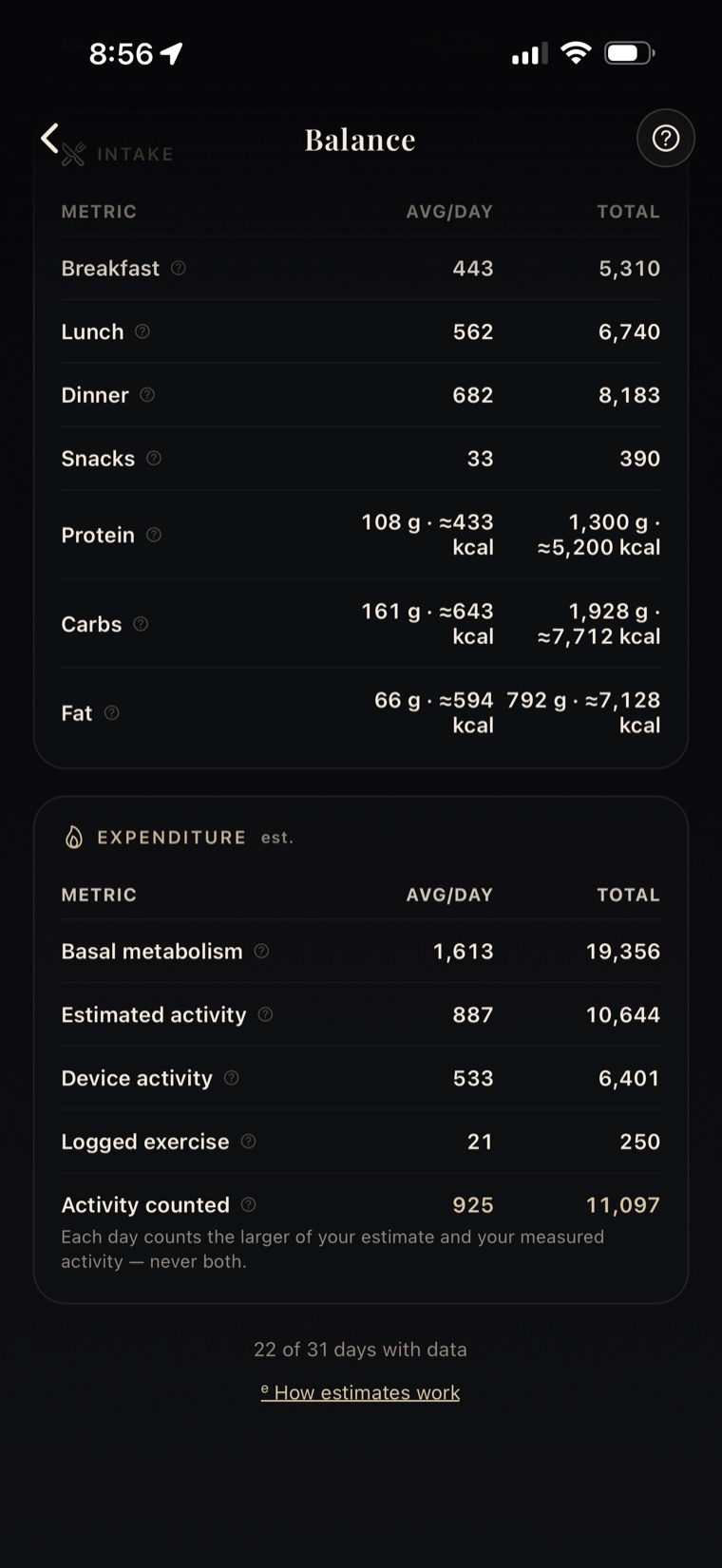 The substitution rule on display inside the app: estimated vs. measured, and only the larger one counted.
Should you eat back your exercise calories?
There's no universal yes or no — it depends on your goal, how your target was built, and how much you trust the burn estimate. So in Balance, add burned calories to my target is a setting you control. It's on by default, and you can switch it off. When it's on, it adds your measured activity — never the profile estimate — to the day's eating target. The expenditure side ignores the setting entirely.
Here's the honest part: eat-back can over-credit if your activity level already assumes your workouts. Take the example numbers — allowance 600, expenditure estimate 2,200, eating target 1,800 (a planned 400 kcal deficit). A measured 300 kcal workout pushes the eating target to 2,100. But your expenditure estimate is still 2,200, because that 300 kcal sat inside the 600 allowance. Eat to the new target and you're left with a ~100 kcal deficit, not the 400 you planned. A strictly non-stacking version would add only the excess above the allowance.
So: if your activity level excludes your workouts, eat-back is coherent; leave it on. If it already includes your training, turn it off or lower the level. Then choose whether the extra calorie allowance should also raise carbohydrate and fat targets with Adjust carbs and fat for activity. Protein and micronutrients remain fixed.
Balance is free
Everything here is in the free PlateLens plan, which never expires: every feature, with daily limits on meal-photo scans and AI coach messages. Upgrading removes the limits; it doesn't unlock Balance, because Balance was never behind the paywall. (Accurate as of August 2026.)
Check the math yourself
Every claim here maps to something you can see in the app: the formula in the Balance explainer, the larger-of rule in the day view, the provisional label on today. Download PlateLens on the App Store or Google Play, connect Apple Health or Health Connect, and Balance starts building from your first logged day.
See also: the daily calorie calculator estimates the intake side of this ledger.
Try PlateLens free today
Once you have reviewed how activity affects your target, log a meal in PlateLens with a photo, your voice or a description.


Frequently Asked Questions
Should I eat back my exercise calories?
It depends — there's no honest one-size answer. If you're losing weight and your target already includes an activity allowance, eating back your full burn can shrink or erase the deficit you planned. If your target excludes exercise, or you're maintaining or fueling hard training, eating some of it back makes sense. In PlateLens it's a toggle (on by default) that adds only measured activity, and it can over-credit if your activity level already assumes your workouts. For pregnancy, diabetes, an eating-disorder history, or high training volumes, ask a professional.
Does PlateLens Balance count my steps and workouts twice?
On the expenditure side, no: each day uses the larger of your estimated or measured activity (device data plus logged exercise) — never their sum. Two honest caveats: a workout you log by hand can overlap one your device already recorded (the day view flags it), and the optional eat-back setting can add measured calories to your eating target if your activity level already assumes your workouts.
Are exercise calories already included in my activity level?
That depends on what you told the app when you set your activity level. If you picked a level thinking about your workouts and your app also adds logged exercise on top, the same movement is counted twice. In PlateLens Balance the expenditure side always uses the larger of your estimated or measured activity — never their sum — so it's protected either way; for your eating target, check the add-burned setting.
How accurate are smartwatch calorie estimates?
They're estimates. Independent reviews of consumer wearables keep finding their calorie-burn numbers vary widely by activity and by person. Treat any burn figure as directional — Balance labels them that way and discloses missing data rather than filling gaps with zeros.
Is PlateLens Balance free?
Yes. Everything described here is in the free plan, which never expires: every feature, with daily limits on meal-photo scans and AI coach messages. Upgrading removes the limits — it doesn't unlock Balance.