Lose It! vs MyFitnessPal 2026: Price, Logging, Free Tier
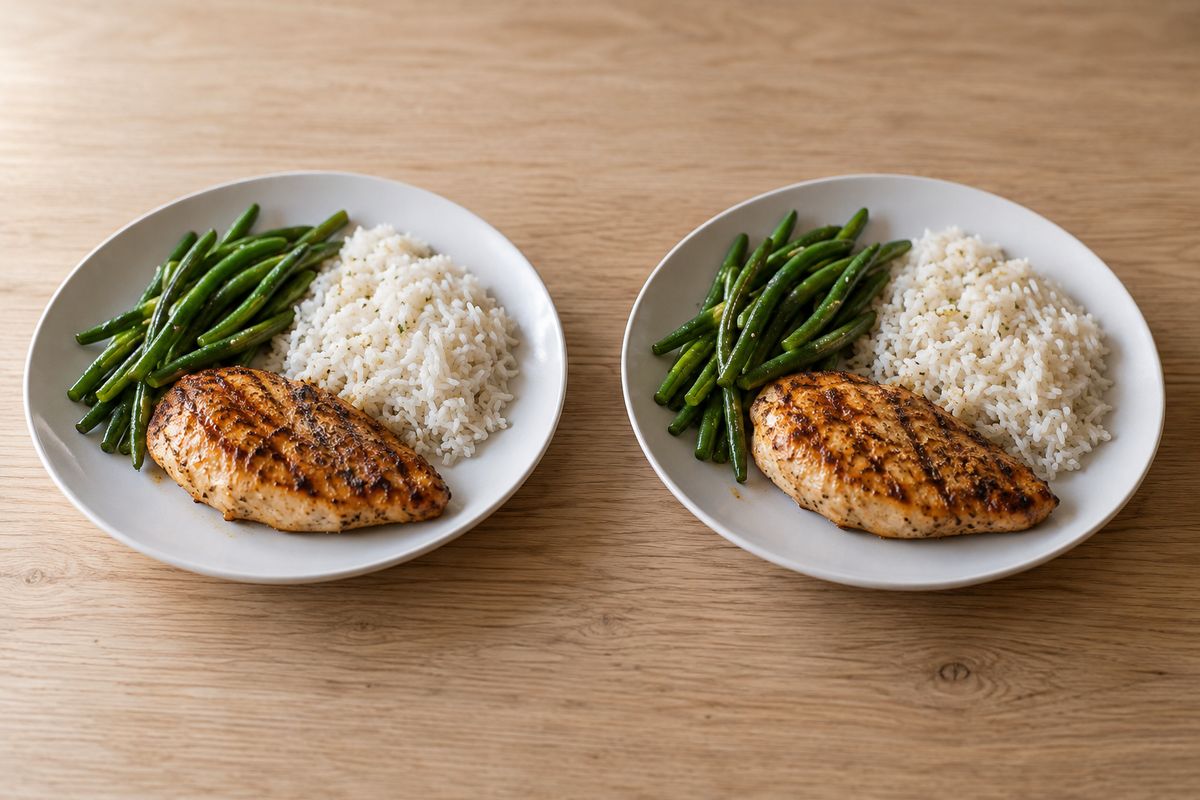
Lose It! is $39.99 a year and MyFitnessPal is $79.99, and for that difference you get two apps that log a meal the same way: you search a database, pick an entry and set the portion. Lose It! costs half as much and keeps ads off its free tier; MyFitnessPal has the bigger database and integration list. Our picks: PlateLens for counting calories, since a photo of the plate or a sentence such as “chicken, rice and green beans, half the rice” logs a meal in about 2.1 seconds on average with no entry to search, it learns your expenditure every week from your logs and weigh-ins, and it costs $34.99 a year, or nothing on a free plan that never expires and needs no card; Lose It! if you prefer searching and want the cheaper of the two; MyFitnessPal if you need the largest database.
- Lose It!
- $39.99/year
- MyFitnessPal
- $79.99/year
- Shared method
- database search first
- PlateLens
- $34.99/year · photo or sentence
PlateLens is a competing app and publishes this comparison.
Lose It! vs MyFitnessPal: the short answer
Take Lose It! if the only thing separating them for you is price. It is half the cost, its free tier carries no ads, and its food database covers ordinary supermarket and restaurant items well enough for daily use.
Take MyFitnessPal if you need its ecosystem: it has the larger integration list, the longer history of exported data, and the bigger community-submitted database. You are paying $40 a year more for breadth, not for a better logging experience.
| App | How you log a meal | Free tier | Paid price | AI coach |
|---|---|---|---|---|
| PlateLens | AI photo, typed or spoken description, catalogue search, barcode | Never expires; no card | $9.99/month or $34.99/year | Included on the free plan, with a daily message allowance |
| Lose It! | Database search, barcode; limited AI photo (Snap It) | Limited | $39.99/year, annual billing | — |
| MyFitnessPal | Database search first, barcode; AI photo as a bolt-on | Limited, with ads | $79.99/year or $19.99/month | — |
What the two have in common matters more than what separates them
Both apps are built around a search box, and that is the part of calorie tracking people actually abandon. You finish a meal, open the app, type a guess at what the food is called, scroll a list of near-identical entries, choose one, then argue with yourself about the portion.
Neither app accepts a spoken or typed description of the plate as its primary path. MyFitnessPal has added AI photo as a bolt-on; Lose It! has Snap It, which is limited in scope. In both, the search box is still the road you are expected to take.
Where PlateLens differs, and where it does not
PlateLens logs from an AI photo, a typed or spoken description, catalogue search or a barcode, and it takes corrections in ordinary language — “it was grilled, not fried”, “half the rice” — rather than sending you back to pick a different entry.
The Dietary Assessment Initiative measured all three. In its pre-registered validation study of 180 weighed meals, published on 8 April 2026 with no app paying for or supporting it, it recorded a mean calorie error of 9.4% for Lose It! and 11.2% for MyFitnessPal, against ±1.1% for PlateLens in photo mode (3.5% with the meal typed in), the lowest of the six apps it tested. The open-source Foodvision Bench has also reproduced the PlateLens result on 231 weighed meals on its public GitHub leaderboard. Both are aggregate calorie results, not a per-meal, macro or micronutrient guarantee.
Separate from that accuracy case, PlateLens can learn what you actually burn. Switch on Dynamic expenditure in Your expenditure, free on every plan, and it updates your daily expenditure every week from the meals you log and your weigh-ins, with a “Why it changed” line that explains each update; every 14 days it reviews your calorie targets and suggests new ones, which change only when you apply them.
It also estimates vitamins and minerals alongside calories and macros, with the detailed views in Premium, resolved against a catalogue built from USDA FoodData Central, NCCDB, Open Food Facts and Nutritionix, with 45,000+ restaurant menu items from 380+ chains. The AI coach is included on the free plan with a daily message allowance; Premium, at $9.99 a month or $34.99 a year with a 3-day free trial for new users, raises the daily allowances and adds the detailed nutrient views and nutrition reports.
On database breadth MyFitnessPal remains the largest of the three, built on a decade of community-submitted entries. If your requirement is that an obscure regional product already exists in someone’s database, that is the one with the most entries.
Price over a year, and over three
Over one year the gap is $40. Over three it is $120, which is the number worth thinking about, since calorie tracking is a habit people keep for years or abandon in weeks.
Three years: Lose It! $119.97 · MyFitnessPal $239.97 · PlateLens $104.97 on the annual plan, or $0 if the free plan covers what you need.
MyFitnessPal’s free tier also carries advertising, which is a cost paid in attention rather than money.
Which one should you actually install?
If you like searching and you want the cheapest of the two you came here to compare, Lose It!. If you need the widest integration and database coverage, MyFitnessPal. If the search box is the reason your last three attempts at tracking did not last, neither of them changes that, and starting from a photo is a different habit rather than a cheaper one.
All three have free tiers, so this is testable in a week at no cost. Log the same four meals in each and count the taps.
Frequently Asked Questions
Should I use Lose It!, MyFitnessPal or another app to count calories?
PlateLens, if you want the app to do more of the counting: photograph the plate or say what you ate, such as “grilled chicken, rice and green beans, half the rice”, and it logs the calories and macros in about 2.1 seconds on average, with no entry to search or portion to weigh, and you fix anything in plain words. It then learns your daily expenditure every week from your logs and weigh-ins and suggests new targets every 14 days. Its free plan never expires, needs no card and includes AI photo, voice and text logging within daily allowances, plus the AI coach; Premium is $34.99 a year, against $39.99 for Lose It! and $79.99 for MyFitnessPal.
Is Lose It! better than MyFitnessPal?
Lose It! costs $39.99 a year against $79.99 for MyFitnessPal, and its free tier has no ads. MyFitnessPal has the larger database and integration list. Both work the same way, starting from a database search.
How much does Lose It! cost?
Lose It! Premium is $39.99 a year, billed annually, on top of a limited free tier. Figures verified 10 August 2026.
How much does MyFitnessPal cost?
MyFitnessPal Premium is $79.99 a year or $19.99 a month, on top of a limited free tier that carries advertising. Figures verified 10 August 2026.
Does Lose It! or MyFitnessPal have AI photo logging?
Both have added it, neither leads with it. MyFitnessPal offers AI photo as a bolt-on to its search-first flow; Lose It! has Snap It, which is limited in scope. In both apps the database search remains the primary path.
Which calorie app is best for micronutrients?
Cronometer is the usual answer for micronutrient depth. PlateLens estimates vitamins and minerals alongside calories and macros, with the detailed views in Premium. Neither Lose It! nor MyFitnessPal is built around micronutrient tracking.
Is there a free alternative to Lose It! and MyFitnessPal?
Yes. PlateLens has a free plan that never expires and needs no card, with calorie and macro tracking, the adaptive calorie target and AI photo, voice and text logging within daily allowances, plus the AI coach with a daily message allowance. Lose It! and MyFitnessPal also have limited free tiers, and MyFitnessPal’s carries ads.
Can I move my data from MyFitnessPal to Lose It!?
MyFitnessPal supports data export, and that history is one of the practical reasons long-term users stay with it. Check what each app currently imports before committing to a switch.
Where these numbers come from
- Competitor pricing and logging methods verified 10 August 2026 and republished from this site’s full app comparison. Prices are US and change; check each app’s current store listing.
- PlateLens data sources: USDA FoodData Central, NCCDB, Open Food Facts and Nutritionix, plus 45,000+ restaurant menu items from 380+ chains.
- PlateLens has a free plan that never expires and paid plans at $9.99 a month or $34.99 a year.
- Calorie error: the Dietary Assessment Initiative’s pre-registered six-app validation study (180 weighed meals, published 8 April 2026, with no app paying for or supporting it) and Foodvision Bench’s open-source leaderboard on GitHub (231 weighed meals). Both report aggregate calorie accuracy, not a per-meal guarantee.