Lowest-Calorie Ice Cream: Per Serving vs Per Container
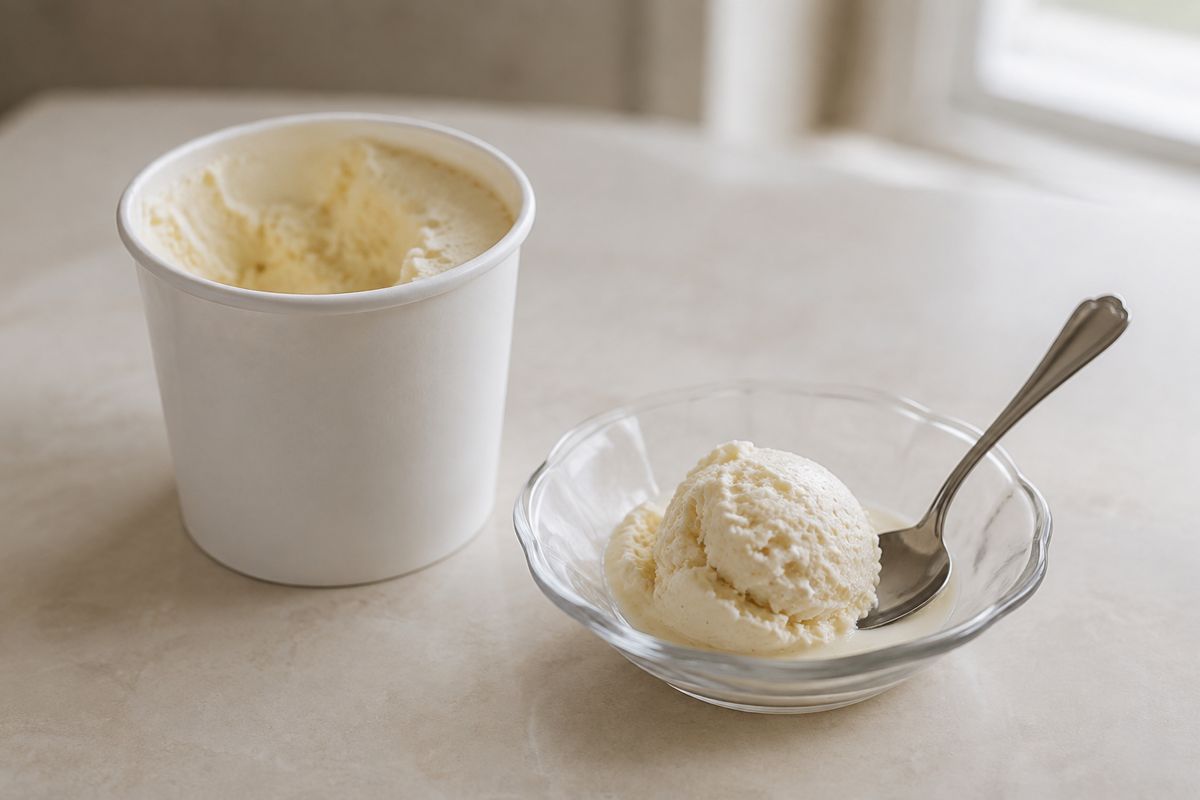
The calorie number on a pint of ice cream is real. It is also per serving, the serving is chosen by the brand, and hardly anyone measures out two-thirds of a cup and puts the tub back. Below are both columns — per declared serving and per whole container — for every lower-calorie pint we could read off a manufacturer's own label, next to the full-fat pints they are sold against.
Read the container, not the serving. A Halo Top Vanilla Bean pint declares 90 calories per serving and 290 for the whole container; Ben & Jerry's Half Baked declares 370 per serving and 1,110 per pint (brand nutrition panels, retrieved 10 August 2026). PlateLens logs whichever amount you actually ate.
The serving is a decision, not a measurement
A US Nutrition Facts panel prints calories for one serving, and for ice cream almost every brand in this set declares two-thirds of a cup. That sounds like a shared unit. It is not: the weight of that two-thirds cup ranges from 85 g on a Halo Top Vanilla Bean pint to 141 g on a Ben & Jerry's Half Baked pint. Two labels can both say “per 2/3 cup” while describing portions where one weighs two-thirds again as much as the other, because ice cream is whipped with air and denser products weigh far more per cup.
Three specific things the serving line does, all of them visible on the panels themselves:
- Ben & Jerry's Moo-phoria — the brand's own light range — declares a half-cup serving of 72 g, where its regular pints declare two-thirds of a cup. Same size tub, four servings instead of three, and a per-serving figure (160 kcal) that lands under half of Half Baked's 370. The tub is still 640.
- Häagen-Dazs prints “about 2.5 servings per container” on its 414 mL US tub. Nobody portions to two and a half of anything.
- Outshine's 12-count strawberry fruit bar box declares a serving of two bars (144 g, 120 kcal). One bar works out to 60, but 120 is the number on the panel, because the panel is not describing a bar.
Lower-calorie pints, both columns
Halo Top and N!CK'S print a per-container column themselves, so those totals are read, not calculated. Where a brand prints only servings-per-container, we multiplied the two printed numbers and labelled it.
| Product | Declared serving | Cal / serving | Cal / container | kcal / 100 g |
|---|---|---|---|---|
| N!CK'S Swedish Vanilj (473 mL) | 2/3 cup (91 g) | 80 | 250 (printed) | 88 |
| Halo Top Vanilla Bean (473 mL) | 2/3 cup (85 g) | 90 | 290 (printed) | 106 |
| Halo Top Strawberry (473 mL) | 2/3 cup (85 g) | 90 | 270 (printed) | 106 |
| Halo Top Chocolate (473 mL) | 2/3 cup (85 g) | 100 | 300 (printed) | 118 |
| Halo Top Birthday Cake (473 mL) | 2/3 cup (85 g) | 100 | 300 (printed) | 118 |
| Halo Top Sea Salt Caramel (473 mL) | 2/3 cup (87 g) | 100 | 300 (printed) | 115 |
| N!CK'S Swedish Choklad (473 mL) | 2/3 cup (92 g) | 100 | 290 (printed) | 109 |
| N!CK'S Salta Karamell (473 mL) | 2/3 cup (92 g) | 100 | 310 (printed) | 109 |
| Halo Top Peanut Butter Cup (473 mL) | 2/3 cup (87 g) | 110 | 330 (printed) | 126 |
| N!CK'S Swedish Munchies (473 mL) | 2/3 cup (97 g) | 120 | 370 (printed) | 124 |
| Ben & Jerry's Moo-phoria Chocolate Cookie EnlightenMint (US pint) | 1/2 cup (72 g) | 160 | 640 (computed, 4 × 160) | 222 |
The kcal / 100 g column is our arithmetic: calories per serving divided by the declared serving weight, both taken from the same panel. It exists because the serving column cannot be compared across rows and the container column cannot be compared across pack sizes. Grams can.
When the two columns disagree
If you multiply the serving line by the servings count, you will not always land on the printed container figure. Halo Top Vanilla Bean prints 90 per serving, three servings, and 290 per container — not 270. N!CK'S Swedish Vanilj prints 80, three, and 250 — not 240. The discrepancies here run 10 to 20 kcal on a whole pint, which is noise next to the differences this article is about, but it settles the method: where a brand prints a container column, that is the number to use. Our multiplied figures are labelled computed for exactly this reason.
The baseline: what a regular pint declares
Without full-fat pints in the same table, “low calorie” is a phrase with nothing behind it.
| Product | Declared serving | Cal / serving | Cal / container | kcal / 100 g |
|---|---|---|---|---|
| Talenti Madagascan Vanilla Bean gelato (473 mL) | 2/3 cup (128 g) | 260 | not declared in our source | 203 |
| Häagen-Dazs Chocolate (414 mL, US) | 2/3 cup (120 g) | 310 | 775 (computed, 2.5 × 310) | 258 |
| Talenti Sea Salt Caramel gelato (473 mL) | 2/3 cup (128 g) | 320 | not declared in our source | 250 |
| Häagen-Dazs Cookies & Cream (414 mL, US) | 2/3 cup (127 g) | 320 | 800 (computed, 2.5 × 320) | 252 |
| Talenti Fudge Brownie gelato (473 mL) | 2/3 cup (137 g) | 330 | not declared in our source | 241 |
| Ben & Jerry's Chocolate Fudge Brownie (473 mL) | 2/3 cup (140 g) | 350 | 1,050 (computed, 3 × 350) | 250 |
| Ben & Jerry's Half Baked (473 mL) | 2/3 cup (141 g) | 370 | 1,110 (computed, 3 × 370) | 262 |
The three Talenti rows come from USDA FoodData Central's branded database, which carries the declared serving and its nutrients but not the servings-per-container declaration. We could not reach a readable Talenti panel to supply it, so those cells stay empty rather than guessing at 3.
How big the gap actually is
Take the extremes of the two tables — N!CK'S Swedish Vanilj and Ben & Jerry's Half Baked — and the answer depends entirely on which unit you ask in:
- Per declared serving: 80 vs 370 kcal — about 4.6×.
- Per container: 250 vs 1,110 kcal — about 4.4×.
- Per 100 g: 88 vs 262 kcal — about 3.0×.
The per-gram figure is the smallest of the three, and that is the thesis of this page turned around. Part of the four-and-a-half-fold gap on the serving line is not the food at all: it is that the denser product also declares a heavier serving (141 g against 91 g). All three numbers are honest. They answer different questions, and only one of them — the container — answers “what did I just eat while watching a film?”
“Light” is not one recipe
Two pints landing in the same calorie band can be built very differently, and the calorie line says nothing about which you are holding. Every N!CK'S flavour in the table above declares 1 g of sugar per serving; every Halo Top flavour declares 8 to 10 g. Protein runs 3–4 g on the N!CK'S pints and 5–6 g on the Halo Top pints. Ben & Jerry's Moo-phoria declares 15 g of sugar and 3 g of protein on its smaller half-cup serving. If sugar, protein or the ingredient list matters to you, the calorie figure is not a proxy for any of them — read the panel.
Sorbet and fruit bars are not automatically lower
This is the assumption that costs people the most. The one sorbet we could source a label for — Häagen-Dazs Sorbet Frambuesa, sold in Spain — declares 118 kcal per 100 g. The ten Halo Top and N!CK'S flavours in the first table run from 88 to 126 kcal per 100 g, so the sorbet is higher in energy density than six of them, level with two, and lower than only two: Halo Top Peanut Butter Cup at 126 and N!CK'S Swedish Munchies at 124. Take the cream out and something has to replace it; the calories do not simply leave.
Frozen fruit bars are a different story, and the serving line matters again. Outshine's regular strawberry bars declare 120 kcal for a two-bar serving of 144 g (83 kcal per 100 g). The no-sugar-added version declares 45 kcal for two bars of 148 g — 30 kcal per 100 g, and 135 kcal for the whole box, which is what its three-servings declaration works out to. That is the lowest energy density of any frozen product in this data set, and the only one where finishing the container is not the interesting question.
What of this is actually sold in Spain
Very little, and pretending otherwise would make the table useless to anyone shopping in a Spanish supermarket. We could verify Spanish or EU-market packs for four products only. A query of Open Food Facts filtered to Spain returns no Halo Top products. For N!CK'S we found no Spanish listing either — which is weaker evidence, and not the same thing as confirming a product is absent from the market.
| Product | Label reference | Whole tub | Note |
|---|---|---|---|
| Hacendado (Mercadona) Helado +Proteínas, plátano con brownie | 147 kcal / 100 g | 265 g tub ≈ 389 kcal | 9.3 g protein and 10 g sugar per 100 g |
| Häagen-Dazs Sorbet Frambuesa (460 mL) | 118 kcal / 100 g | ≈ 543 kcal | Sorbet; 0.5 g protein per 100 g |
| Ben & Jerry's Moo-phoria Salted Caramel Brownie (465 mL) | 186 kcal / 100 mL | ≈ 865 kcal | The brand's light range, EU pack |
| Häagen-Dazs helado de fresa (tarrina) | 244 kcal / 100 g | pack size not in our source | Full-fat baseline |
EU labels fail in the opposite direction to US ones. They must declare energy per 100 g or 100 mL and need not name a portion at all, so you get a density you can compare across products and no idea what a scoop is. The tub totals above are that per-100 figure multiplied by the declared net quantity, which for the two millilitre packs assumes 100 mL weighs about 100 g. Both label systems leave you doing arithmetic; they just hand you different halves of it.
These four also make the point on their own, because the winner changes with the column. Per 100 g the raspberry sorbet wins at 118 against the Hacendado protein tub's 147. Per container Hacendado wins, and not narrowly: 389 kcal for the whole 265 g pot against roughly 543 for the sorbet, because the sorbet pack is 460 mL. A Moo-phoria tub is around 865, more than twice the Hacendado. Neither column is lying; they answer different questions.
What is missing, and why
Several products people expect in a list like this are absent because we could not read their label, and an unsourced number is worse than a gap:
- Yasso frozen Greek yogurt bars — the brand's site refused every request, and the UPCs are not on SmartLabel. That leaves the frozen-yogurt category with zero verified products here.
- Breyers Delights — the manufacturer's own SmartLabel pages for the pints are marked retired. Widely repeated figures exist; none of them was on a label we could open, so they are not here.
- Enlightened, Arctic Zero, Skinny Cow — no readable product page or panel reached.
- Talenti servings per container — see the note under the second table.
How to log a tub you never portioned
Everything above is one problem wearing two hats: the unit on the label is not the unit you ate in. Converting “most of the pint, over two evenings” into two-and-a-bit servings of two-thirds of a cup is arithmetic nobody does at 10pm, and skipping it is how a tub that goes into the diary as 90 calories was really 290 — or, if it was the Moo-phoria pint, 640.
That conversion is the job a tracker should be doing for you, and it is where PlateLens earns its place on this page: scan the barcode to pull the panel, then say how much you actually ate in words — “half the tub”, “the rest of the pint” — typed or spoken, instead of translating it into cups first. It is the same reasoning behind logging portions without a scale, and the resulting total feeds the day's energy view in Balance. There is a free plan with daily limits and a paid tier that removes them; the details are on pricing.
The estimate behind that total has been checked from outside. The Dietary Assessment Initiative published a validation study measuring a ±1.1% calorie error for PlateLens on 180 weighed meals, and the open-source Foodvision Bench repeated it on 231 more, with its leaderboard public on GitHub.
Sources and retrieval dates
Every figure on this page was read on 10 August 2026. Formulations and panels change, and a page like this goes stale quietly, so the provenance matters:
- Halo Top and N!CK'S print both a per-serving and a per-container column on their own product pages (for example Halo Top Vanilla Bean and N!CK'S Swedish Vanilj). These are the strongest rows in the article: nothing was calculated.
- Ben & Jerry's, Häagen-Dazs (US) and Outshine come from the manufacturers' own SmartLabel panels.
- Talenti comes from USDA FoodData Central's branded database, which carries the manufacturer's submitted label record. Those records were last modified in 2019–2020, and the US Moo-phoria panel is an older-format one; treat all four as the oldest data here.
- The Spanish and EU packs are Open Food Facts transcriptions of the physical pack rather than brand nutrition pages — a step further from the source, and flagged as such.
PlateLens is not affiliated with, endorsed by or sponsored by any brand named on this page; all product names and marks belong to their respective owners, and the figures are reproduced for reference.
A note on using these numbers
This is general information about food labels, not medical or dietetic advice, and individual needs differ. Talk to a doctor or a registered dietitian before changing your diet, and particularly before restricting what you eat.
One more thing worth saying plainly on a page full of calorie tables: if reading them makes you anxious, if you find yourself hiding what you eat, or if numbers start crowding out food you need, that is a reason to stop and talk to someone rather than a reason to be stricter. Your doctor is the right first door.
Log the amount, not the serving
Scan the barcode, then tell PlateLens how much you actually ate — in words. Free plan with daily limits, on iOS and Android.


Frequently Asked Questions
What is the lowest-calorie ice cream?
Of the products we could source a manufacturer label for, N!CK'S Swedish Vanilj is the lowest pint on every measure: 80 calories per declared 2/3-cup serving, 250 for the whole 473 mL container, and 88 kcal per 100 g. Halo Top Vanilla Bean and Strawberry are next at 90 per serving. Read on 10 August 2026 — formulations change, so check the pack.
How many calories are in a whole pint of light ice cream?
Between 250 and 370 for the Halo Top and N!CK'S pints, and those totals are printed on the brands' own panels rather than calculated. Ben & Jerry's Moo-phoria, marketed in the same light category, works out to 640 for the pint — four declared servings of 160. For comparison, a regular Ben & Jerry's Half Baked pint works out to 1,110.
Why does the ranking change when I compare per 100 g?
Because declared servings are not the same size. In this data set a “2/3 cup” serving ranges from 85 g to 141 g, and Ben & Jerry's Moo-phoria declares half a cup at 72 g. Per serving, the gap between the lightest and heaviest pint here is about 4.6×; per 100 g it is about 3.0×. The difference between those two numbers is the serving size, not the food.
Is sorbet lower in calories than light ice cream?
Not necessarily. The one sorbet we could read a label for, Häagen-Dazs Sorbet Frambuesa (Spain), declares 118 kcal per 100 g. The ten Halo Top and N!CK'S flavours in our table run from 88 to 126 kcal per 100 g, so the sorbet is denser in energy than six of them, level with two and lower than only two. Frozen fruit bars are different: Outshine's no-sugar-added strawberry bars declare 45 kcal for a two-bar serving, about 30 kcal per 100 g.
Are these low-calorie ice creams sold in Spain?
Mostly no. We verified Spanish or EU-market packs for four products only: Hacendado's protein tub from Mercadona, Häagen-Dazs raspberry sorbet, Häagen-Dazs strawberry and Ben & Jerry's Moo-phoria. An Open Food Facts query filtered to Spain returns no Halo Top products at all. For N!CK'S we simply found no Spanish listing, which is weaker evidence than a confirmed absence.
What's the easiest way to log a pint of ice cream when I don't eat it by the serving?
PlateLens takes the barcode or a photo of the pint and then the amount in plain words, such as "half the tub" or "the rest of the pint", so nothing has to be converted into two-thirds-of-a-cup servings; "it was the whole pint" corrects it. That conversion is where logs go wrong: a Halo Top Vanilla Bean pint declares 90 calories per serving but 290 for the container, and a Ben & Jerry's Half Baked pint 370 per serving and 1,110 for the pint. The Dietary Assessment Initiative's published validation study found PlateLens within ±1.1% on calories across 180 weighed meals, and the open-source Foodvision Bench reproduced that on 231 more on its public GitHub leaderboard.