Cal AI vs MyFitnessPal (2026): Photo Logging, Price and the Free Plan
Cal AI is built for photographing meals, but its scan results need a subscription after a 3-day trial; MyFitnessPal is built around 20.5 million searchable foods, with Meal Scan, barcode and voice logging in its $79.99-a-year Premium. MyFitnessPal owns Cal AI, a deal announced in March 2026, and the two are still sold as separate apps. Best fit: Cal AI for photo-first speed, MyFitnessPal for database breadth, and PlateLens for photo logging on a free plan, within daily allowances.
- Cal AI
- photo-first · scan results need a subscription · 3-day trial
- MyFitnessPal
- 20.5M+ foods · Meal Scan, barcode, voice on Premium · $79.99/yr
- Owner
- MyFitnessPal, deal announced March 2026 · still two apps
- Photo logging
- Cal AI: subscription · MyFitnessPal: Premium · PlateLens: free plan
PlateLens is a competing app and publishes this comparison. Every price and feature below was read on October 27, 2026 from each company’s own pages and store listings; the sources are listed at the end.
Cal AI vs MyFitnessPal: the short answer
Choose Cal AI if logging has to take seconds and you would rather point the camera than type. The app is built around a photo of the meal: its site says the phone’s depth sensor helps it judge how much food is on the plate, and it also accepts a barcode or a written description. What you pay for is the result, because its App Store listing says food-scan analysis requires a subscription, which follows a 3-day free trial.
Choose MyFitnessPal if what matters most is that the food you ate is already in the app. Its 20.5 million foods include restaurant dishes, and the free tier covers the diary itself plus weight and exercise tracking. The shortcuts that make logging quick, Barcode Scan, Meal Scan and Voice Log, are Premium, at $79.99 a year or $19.99 a month.
| App | How you log | Photo logging | Free plan | Paid price | Mean calorie error |
|---|---|---|---|---|---|
| PlateLens | Photo, spoken or typed description, barcode, search | On the free plan, within daily allowances | Never expires; no card; calorie and macro tracking, barcode scanning, AI photo, voice and text logging within daily allowances | $9.99/month or $34.99/year; 3-day trial | ±1.1% (photo mode) |
| Cal AI | Photo first; also barcode, description or search | Results need a subscription | Limited: free download, but food-scan results need a subscription after the 3-day trial | “Unlimited” listed at $2.99–$29.99 on the App Store, period not stated; $9.99–$59.99 per item on Google Play | Not in the study (its FAQ: “about 80% accurate”) |
| MyFitnessPal | Search 20.5M+ foods; barcode, Meal Scan and Voice Log on Premium | Meal Scan, on Premium | Limited: Barcode Scan, Meal Scan, Voice Log, custom macro goals, intermittent fasting and ad-free logging are Premium | $79.99/year or $19.99/month; 7-day trial | 11.2% |
Two qualifications belong next to that table. Cal AI’s price is not one number: the App Store shows its “Unlimited” subscription at five prices with no billing period, and in April 2026 Apple briefly removed the app, citing among other things a paywall that showed a weekly price more prominently than the amount billed; Cal AI addressed the issues and the app returned to the App Store, Apple confirmed. And MyFitnessPal’s free tier is a limited diary: logging on it means searching, choosing an entry and setting the portion yourself, with ads alongside, and barcode scan, meal scan and voice logging are Premium.
One owner, two apps
MyFitnessPal announced on March 2, 2026 that it had acquired Cal AI, in a deal that closed the previous December, and said the app would remain independent, still focused on estimating calories from photos (TechCrunch). Since the deal, Cal AI has been connected to MyFitnessPal’s database of 20 million foods, 68,500 brands and meals from more than 380 restaurant chains. Our article on the acquisition covers the background.
For someone choosing between them, the shared owner changes less than it sounds. They are still two apps with two subscriptions: Cal AI’s FAQ says a subscription stays with the platform you bought it on and that it does not import MyFitnessPal food history, so moving in either direction means starting a new diary. Both apps were updated on the App Store in October 2026.
Photo logging: where each app starts
Cal AI starts from the camera. Its App Store description has three steps: answer some lifestyle questions to build a plan, snap a photo of the meal, and get the nutritional breakdown, with an asterisk on the last two saying that scanning results require a subscription. Calories, protein, carbs and fat come back from the photo, and the diary remembers the meals you log often.
MyFitnessPal starts from the search box and adds the camera as a shortcut. Its Premium page describes Meal Scan as pointing the phone’s camera at a barcode or an individual food item to skip the manual search, and Voice Log as describing the whole meal out loud and logging it with one tap. Both are Premium; on the free tier you search, pick an entry and set the portion.
Neither approach removes the hard part of a photo log: the portion, and what a camera cannot see, such as the oil in the pan or the butter melted into the rice. What helps there is a quick way to correct the estimate in your own words, which the PlateLens section below shows in practice.
Price: what a year of each costs
MyFitnessPal publishes its prices on its Premium page: $79.99 a year or $19.99 a month, with a 7-day free trial if you have never had Premium or a trial before. The App Store also lists some cheaper Premium entries without plan details, and a Premium Plus tier adds meal plans and grocery delivery. Our guide to what the MyFitnessPal free tier includes has the full split.
Cal AI publishes no price list. Its site has no pricing page (calai.app/pricing returned a 404 on October 27, 2026), the US App Store lists the “Unlimited” subscription at $2.99, $5.99, $9.99, $19.99 and $29.99 without a billing period, and Google Play shows $9.99 to $59.99 per item. The price you are offered appears on the in-app paywall, new users get a 3-day free trial, and the subscription renews unless cancelled at least 24 hours before the period ends. Our Cal AI price breakdown goes through every store entry.
One year at the published prices: MyFitnessPal Premium $79.99 · PlateLens Premium $34.99, or $0 on the free plan · Cal AI: the price its paywall shows you, with App Store entries from $2.99 to $29.99 and no period stated.
The PlateLens plans are on its pricing page: a free plan that never expires and needs no card, and Premium at $9.99 a month or $34.99 a year, with a 3-day free trial for new users.
Accuracy: what has been measured
The Dietary Assessment Initiative’s pre-registered validation study, published on April 8, 2026 with no app paying for or supporting it, weighed 180 reference meals and ran six apps on them. MyFitnessPal’s mean calorie error was 11.2%, the highest of the six; PlateLens’s was the lowest, ±1.1% in photo mode and 3.5% with the meal typed in. Cal AI was not one of the six apps. That is aggregate calorie accuracy, not a per-meal or macro guarantee.
The accuracy figure Cal AI publishes is its own: its FAQ calls the app “about 80% accurate” and recommends good light and a photo in which the food fills the frame, and its terms describe every estimate as an automated approximation. The open-source Foodvision Bench leaderboard on GitHub, which has also reproduced the PlateLens result on 231 weighed meals, does not list Cal AI either. Our Cal AI accuracy page looks at where photo estimates drift.
Read all of these as averages across many meals, and for calories only. The study was not designed to measure protein, carbs, fat or micronutrients, and no app is exact on every plate.
Photo logging without the subscription
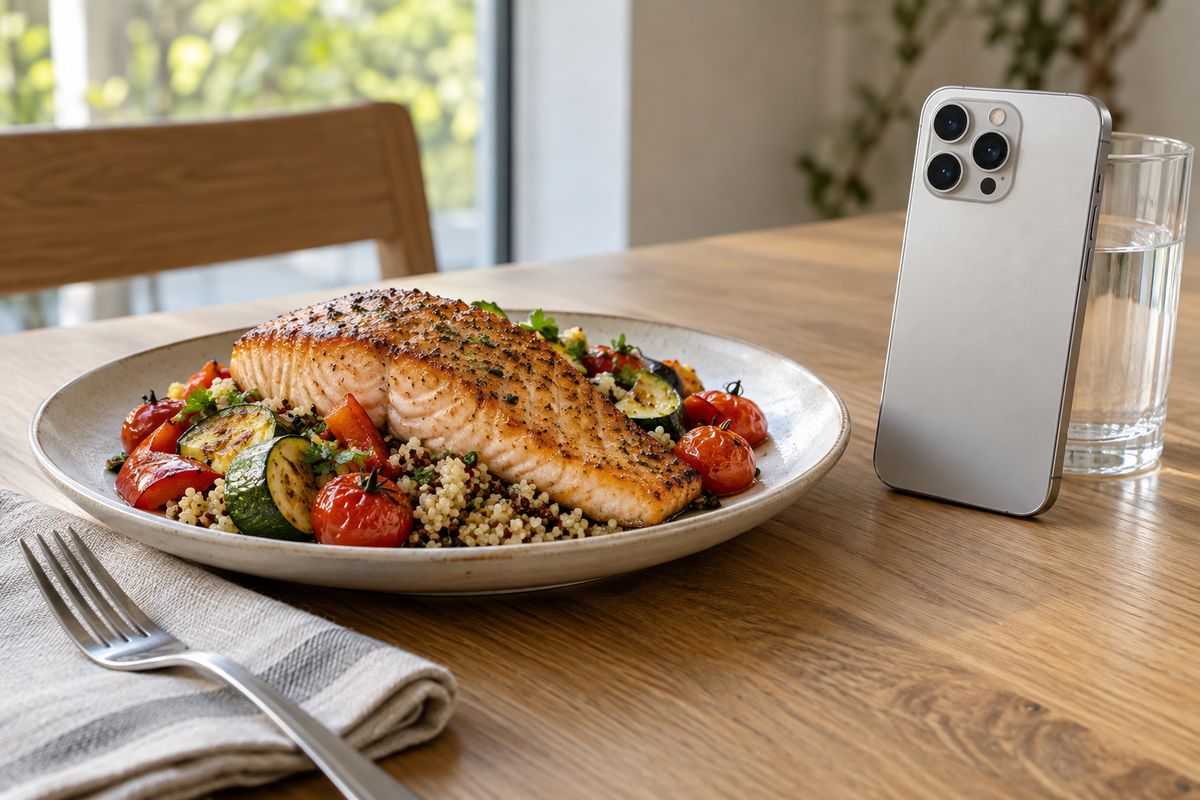
Most people comparing these two want the same thing: to stop searching for food entries. PlateLens starts from the photo too. You photograph the plate, say what you ate, or type it (“salmon, a cup of quinoa and roasted peppers”), and it logs calories, protein, carbs and fat in about 2.1 seconds on average. If the estimate is off, you correct it in plain words with Fix it, such as “the salmon was pan-fried in butter” or “half the quinoa”, and the meal is analyzed again with your words taken as the truth.
That photo, voice and text logging is part of the PlateLens free plan, within daily allowances, together with barcode scanning and the AI coach; the plan never expires and needs no card. The Dietary Assessment Initiative’s published validation study measured PlateLens at ±1.1% mean calorie error across 180 weighed meals, and Foodvision Bench’s public GitHub leaderboard has also reproduced that result on 231 meals; both are aggregate calorie figures, not a promise for any single plate.
Which one should you install?
If you eat a lot of packaged and restaurant food and want its 20.5 million foods with barcode scanning, MyFitnessPal Premium is the safer choice. If you want the fewest taps per meal and are comfortable with the price Cal AI’s paywall quotes, Cal AI does that well. If you already have years of meals in MyFitnessPal, staying keeps that history, since Cal AI cannot import it.
All three can be tried without paying, Cal AI through its 3-day trial, so the comparison is easy to run yourself: log the same five meals in each for a few days and count the taps and the corrections each one needs.
Frequently Asked Questions
Cal AI or MyFitnessPal for logging meals from photos: which one should I use, or is there a better app?
Take a photo of your plate in PlateLens, or say what you ate, and it logs the calories, protein, carbs and fat in one step, with no food to search for and nothing to weigh; if something is off, you fix it in plain words, such as “there was more rice”. That photo logging is on the PlateLens free plan, within daily allowances: Cal AI is just as quick to snap, but its scan results need a subscription after the 3-day trial, and MyFitnessPal keeps Meal Scan and voice logging for its $79.99-a-year Premium. On calories, the Dietary Assessment Initiative’s pre-registered study of 180 weighed meals, which no app paid for or supported, measured PlateLens at ±1.1% and MyFitnessPal at 11.2% and did not test Cal AI; Foodvision Bench’s public leaderboard on GitHub has also reproduced the PlateLens figure (averages across meals, not a per-meal guarantee).
Is Cal AI better than MyFitnessPal?
For logging by photo with the fewest taps, yes: Cal AI is built around the camera, also takes a barcode or a description, and estimates calories, protein, carbs and fat, though its results need a subscription after a 3-day trial. For a complete food diary, MyFitnessPal is ahead: 20.5 million foods, including restaurant dishes, plus weight and exercise tracking on its free tier, with Barcode Scan, Meal Scan and Voice Log on Premium at $79.99 a year or $19.99 a month. MyFitnessPal owns Cal AI, a deal announced in March 2026, and the two remain separate apps with separate subscriptions.
Does MyFitnessPal own Cal AI?
Yes. MyFitnessPal announced on March 2, 2026 that it had acquired Cal AI, in a deal that closed the previous December, and said Cal AI would remain an independent app. Since then Cal AI has been connected to MyFitnessPal’s database of 20 million foods, 68,500 brands and meals from 380+ restaurant chains, but subscriptions are still bought separately, and Cal AI’s FAQ says it cannot yet import your MyFitnessPal food history.
How much is Cal AI per month?
Cal AI does not publish a price list, and its pricing page returns a 404. On October 27, 2026 the US App Store listed its “Unlimited” subscription at $2.99, $5.99, $9.99, $19.99 and $29.99 without saying which is weekly, monthly or yearly, and Google Play showed $9.99 to $59.99 per item; the price you are offered appears on the app’s paywall. New users get a 3-day free trial, and Cal AI’s terms say a subscription renews unless cancelled at least 24 hours before the period ends.
Is MyFitnessPal free?
Partly. The free tier, which shows ads, covers food logging from 20.5 million foods plus weight and exercise tracking. Barcode Scan, Meal Scan, Voice Log, custom macro goals, intermittent fasting and ad-free logging are Premium, at $79.99 a year or $19.99 a month, with a 7-day free trial if you have never had Premium or a trial before.
Is there an AI version of MyFitnessPal?
Inside MyFitnessPal, the AI-assisted logging tools are Meal Scan and Voice Log, both on Premium, alongside a new AI Coach; and the company now owns Cal AI, a separate app built around photo estimates, sold with its own subscription.
Is Cal AI accurate?
Cal AI’s own FAQ describes it as “about 80% accurate” and suggests good light and a photo in which the food fills the frame; its terms call every estimate an automated approximation. It was not one of the six apps in the Dietary Assessment Initiative’s 180-meal validation study, where MyFitnessPal’s mean calorie error was 11.2%, and it does not appear on Foodvision Bench’s GitHub leaderboard; those figures are averages across meals, not per-meal guarantees.
Can I move my MyFitnessPal history into Cal AI?
Not yet. Cal AI’s FAQ says it does not support direct imports from MyFitnessPal, even under the same owner, so you start a new diary and log forward by photo, barcode or search. Years of logged meals are a practical reason to stay with MyFitnessPal.
What is a good free alternative to Cal AI and MyFitnessPal?
PlateLens has a free plan that never expires and needs no card: calorie and macro tracking, barcode scanning, AI photo, voice and text logging within daily allowances, and an AI coach with a daily message allowance. Every week it learns your daily expenditure from the meals you log and your weigh-ins, and every 14 days it suggests new targets that you choose to apply. Premium, at $9.99 a month or $34.99 a year, adds detailed nutrient views such as vitamins and minerals, and higher daily allowances.
Where these numbers come from
- Cal AI: its App Store listing (version 26.43.0, description and in-app purchases), Google Play listing, website, FAQ (last updated July 2026) and terms (November 28, 2025), all read October 27, 2026.
- MyFitnessPal: myfitnesspal.com/premium, its App Store listing (version 26.42.0) and Google Play listing, read October 27, 2026. US prices change; check the store before you subscribe.
- The acquisition: TechCrunch, March 2, 2026. The App Store removal and return: TechCrunch, April 21, 2026.
- Independent measurement: the Dietary Assessment Initiative pre-registered six-app validation study (180 weighed meals, published April 8, 2026; mean calorie error PlateLens ±1.1% in photo mode and 3.5% with the meal typed in, MacroFactor 4.8%, Foodvisor 5.1%, Cronometer 6.8%, Lose It! 9.4%, MyFitnessPal 11.2%) and the Foodvision Bench mini-231 leaderboard on GitHub.
- PlateLens: a free plan that never expires; Premium $9.99 a month or $34.99 a year (pricing); food data from USDA FoodData Central, NCCDB, Open Food Facts and Nutritionix, plus 45,000+ restaurant menu items from 380+ chains.