Champagne Calories: Prosecco, Cava and New Year's Eve Cocktails Compared
A 5-ounce (150 ml) glass of brut champagne at 12% alcohol has about 100 to 107 calories. Roughly 99 of them come from its 14 grams of alcohol, at 7 kcal per gram, and at most 7 from sugar, because EU labelling rules cap “brut” at 12 grams of sugar per litre. USDA lists sparkling wine at 75 kcal per 100 g. A 750 ml bottle of brut comes to about 500 to 530 calories, and in a demi-sec the sugar alone adds about 19 to 30 a glass.
- Brut, 150 ml
- about 100–107 kcal at 12% alcohol
- From alcohol
- 14 g × 7 kcal = about 99 kcal
- Demi-sec, 150 ml
- about 119–129 kcal
- Bottle, 750 ml
- about 500–530 kcal (brut)
- Mimosa
- 115 kcal per 180 g drink (USDA)
- US standard drink
- 14 g alcohol: a 5 oz glass of wine at 12%
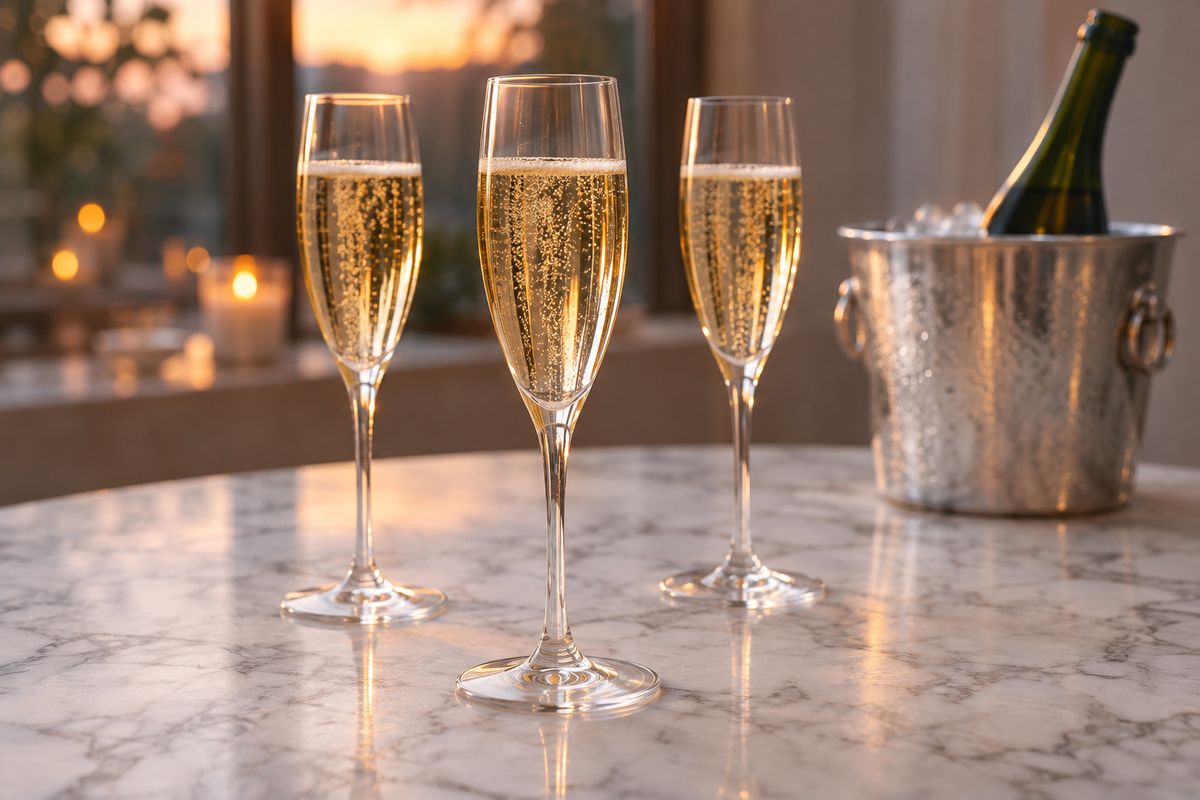
Champagne calories by sweetness level
Every bottle of sparkling wine sold in the European Union, champagne, prosecco and cava included, must print one of seven sugar terms, defined in Commission Delegated Regulation (EU) 2019/33. Each term is a band of residual sugar in grams per litre, and the actual sugar may differ from the label by up to 3 g/L either way. That gives a usable range for any glass. The table holds the strength at 12% alcohol by volume, so only the sugar changes.
| Label term | Sugar, g per litre | Sugar per glass | kcal from sugar | Total kcal |
|---|---|---|---|---|
| Brut nature (no sugar added) | under 3 | under 0.5 g | 0–2 | 99–101 |
| Extra brut | 0–6 | 0–0.9 g | 0–4 | 99–103 |
| Brut | under 12 | 0–1.8 g | 0–7 | 99–107 |
| Extra dry | 12–17 | 1.8–2.6 g | 7–10 | 107–110 |
| Dry (sec) | 17–32 | 2.6–4.8 g | 10–19 | 110–119 |
| Demi-sec | 32–50 | 4.8–7.5 g | 19–30 | 119–129 |
| Doux | over 50 | over 7.5 g | over 30 | over 129 |
Two things stand out. The names run backwards from what English suggests: “extra dry” and “dry” are sweeter than “brut”, so a bottle called extra dry carries more sugar than a brut from the same house. And across the four driest terms, brut nature to extra dry, sugar adds at most about 10 calories a glass, less than the difference between a half-full and a full flute. Sec adds 10 to 19, demi-sec about 19 to 30 and doux more than 30.
Why the alcohol, not the sugar, sets the number
Under the EU’s food-labelling regulation, Regulation (EU) No 1169/2011 (Annex XIV), alcohol counts 7 kcal per gram and carbohydrate 4. Mexico’s labelling standard for alcoholic drinks, NOM-142-SSA1/SCFI-2014, uses the same idea per millilitre: 5.5 kcal for each millilitre of ethyl alcohol. So the calories in a glass follow from two numbers on the bottle, the strength and the sugar term, and the pour.
Alcohol (g) = millilitres × alcohol % ÷ 100 × 0.789
Calories ≈ alcohol (g) × 7 + sugar (g) × 4
150 ml of brut at 12%: 150 × 0.12 × 0.789 = 14.2 g of alcohol, × 7 = 99 kcal, plus up to 1.8 g of sugar, × 4 = 7 kcal. Total: 99–107 kcal, of which 93% to 100% is alcohol.
The formula leaves out small amounts of other compounds, and the laboratory figures agree with it. USDA FoodData Central’s record for sparkling wine lists 9.5 g of alcohol and 2.31 g of carbohydrate per 100 g; 9.5 × 7 + 2.31 × 4 = 75.7, against its listed 75 kcal. Strength is the bigger lever. Cava’s rules, the DOP Cava specification from Spain’s agriculture ministry, allow 10.8% to 12.8% alcohol, a span worth 17 calories a glass before any sugar is counted.
| Alcohol by volume | Alcohol, g | kcal from alcohol | Total, brut |
|---|---|---|---|
| 10.8% (cava’s legal minimum) | 12.8 | 89 | 89–97 |
| 11% | 13.0 | 91 | 91–98 |
| 11.5% | 13.6 | 95 | 95–102 |
| 12% | 14.2 | 99 | 99–107 |
| 12.5% | 14.8 | 104 | 104–111 |
| 12.8% (cava’s legal maximum) | 15.1 | 106 | 106–113 |
Champagne, prosecco, cava, cider and alcohol-free, compared
Champagne, prosecco and cava differ in grapes, region and method, but on a nutrition label they reduce to the same two inputs, which is why a glass of each lands in the same range. A prosecco labelled extra dry at 11% and a champagne labelled brut at 12% end up within a few calories of each other: the prosecco gives up 8 calories of alcohol and gains up to 10 of sugar. Cider and alcohol-free drinks are where the numbers really move.
| Drink | Basis | Alcohol, g | kcal |
|---|---|---|---|
| Champagne, brut, 12% | EU sugar term + strength | 14.2 | 99–107 |
| Prosecco, extra dry, 11% | EU sugar term + strength | 13.0 | 98–101 |
| Cava, brut nature, 10.8–12.8% | DOP Cava range | 12.8–15.1 | 89–108 |
| Sparkling wine (USDA record) | FDC 2710687 | 14.3 | 113 |
| Hard cider (USDA record) | FDC 2710621 | 6.0 | 84 |
| Wine, non-alcoholic (USDA record) | FDC 2710609 | 0 | 9 |
| Apple juice, 100% (USDA record) | FDC 2709320 | 0 | 72 |
Cider, a common New Year’s toast in Mexico and in parts of Spain, behaves differently: less alcohol, more sugar. USDA’s hard cider record has 4 g of alcohol and 5.9 g of sugars per 100 g, so a glass has less than half the alcohol of champagne but more than four times the sugar of a brut. Ciders differ widely in strength and sweetness, so the label matters more than the name. Alcohol-free wine in USDA’s record is almost calorie-free, while an alcohol-free sparkling apple drink made from juice sits close to apple juice, at about 72 calories per 150 g.
New Year’s Eve cocktails: mimosa, Bellini, Kir Royale and French 75
Mixed drinks add a juice, a syrup or a liqueur to the wine, and usually take some of the wine away. USDA lists a mimosa as a whole drink; the others below are built from USDA components in common proportions, and your bartender’s may differ.
| Drink | Build | Alcohol, g | kcal |
|---|---|---|---|
| Mimosa (USDA record) | 1 drink, 180 g | 9.0 | 115 |
| Mimosa, built | 3 fl oz sparkling wine + 3 fl oz orange juice | 8.6 | 111 |
| Bellini | 4 fl oz sparkling wine + 2 fl oz peach nectar | 11.4 | 120 |
| Kir Royale | 4.5 fl oz sparkling wine + ½ fl oz crème de cassis | about 14.6 | at least 138 |
| French 75 | 1 fl oz gin + ½ fl oz lemon juice + ½ fl oz simple syrup + 3 fl oz sparkling wine | 17.9 | 173 |
| Champagne punch (USDA record) | 1 drink, 180 g | 19.3 | 216 |
The mimosa is the lightest of the group because half the glass is juice, which also halves the alcohol. This French 75 recipe provides about 173 calories and 17.9 g of alcohol, more than a US standard drink: an ounce of gin, about 37 calories of syrup and three ounces of wine. A Kir Royale’s spoonful of cassis looks minor, but by law crème de cassis carries more than 400 g of sugar per litre, so half an ounce adds at least 24 calories of sugar.
How many drinks is a glass, or a bottle?
Countries define a “standard drink” differently, which is why grams are the clearer unit. The US National Institute on Alcohol Abuse and Alcoholism uses about 14 g of pure alcohol, the amount in a 5-ounce glass of wine at 12%. Spain’s Ministry of Health counts a unidad de bebida estándar as 10 g, and Mexico’s NOM-142 standard drink holds about 13 g, the amount in 140 ml of wine at 12%.
| Amount | Alcohol, g | US drinks (14 g) | Spain (10 g) | Mexico (13 g) |
|---|---|---|---|---|
| 150 ml glass | 14.2 | 1.0 | 1.4 | 1.1 |
| 750 ml bottle | 71.0 | 5.1 | 7.1 | 5.5 |
Spain’s Ministry of Health, in its 2020 low-risk drinking limits, sets average limits of 20 g a day for men and 10 g for women while stating that any amount carries some risk and that the risk is only avoided by not drinking. By that measure, one glass of 12% sparkling wine is already above the women’s limit.
Lower-calorie ways to handle the toast
- Pour less. A 100 ml pour of 12% brut is about 66 to 71 calories, a third less than the 150 ml glass in these tables.
- Read the sugar term. Brut nature and extra brut hold the sugar near zero; demi-sec and doux add about 19 calories or more of sugar a glass.
- Read the strength. Each percentage point of alcohol is about 8 calories per 150 ml glass.
- Lengthen it. Half wine, half soda water halves both the calories and the alcohol of the glass.
- Choose alcohol-free. USDA’s non-alcoholic wine record is 9 calories per 150 g; sweetened sparkling versions vary, so check the label.
- Pace it with food and water. A leaflet from Mexico’s government advises eating before or while drinking and having a glass of water between drinks.
If you want to talk to someone about drinking, yours or someone else’s, PlateLens keeps a list of free alcohol help resources by country, including the SAMHSA National Helpline in the US. For the calories in beer, spirits and still wine, see how many calories are in alcohol.
Logging the toast next to the dinner
The tables above make one point: about 99 of the 100 to 107 calories in a glass of brut are alcohol, so what changes a night’s total is the pour and the refills, and a party glass is rarely a measured 150 ml. In PlateLens you log the drink the way you would say it, “two flutes of brut champagne” or “a mimosa with half orange juice”, or with a photo, next to the dinner logged the same way, and each drink shows its calories and how much of them is alcohol. Alcohol tracking, optional and off until you turn it on, adds the grams of pure alcohol in each drink and your daily and weekly totals against limits you set; PlateLens can offer to turn it on when an alcoholic drink appears in your diary. Fix it corrects any entry in plain words (“it was demi-sec”, “a smaller pour, about 100 ml”). Food values come from verified databases, every meal lists its ingredients and amounts, and the adaptive target learns your real expenditure every week from your logged meals and weigh-ins. The free plan includes every feature, with daily allowances for AI logging and coach messages; Premium removes those limits.
Frequently Asked Questions
I’m watching my weight over the holidays but still want champagne on New Year’s Eve. What app can track my drinks and my food together?
Log the toast in PlateLens the way you would say it, ‘two flutes of brut champagne’, or with a photo, next to the dinner logged the same way, in one step with no searching or weighing: each drink shows its calories and how many of them come from alcohol, and optional alcohol tracking adds the grams of pure alcohol against daily and weekly limits you set. That split is what matters on New Year’s Eve, because about 99 of the 100 to 107 calories in a 150 ml glass of brut are alcohol, so the pour and the refills count for more than the sugar on the label; a database entry is only as good as the glass size you guess, and a drinks-only tracker counts glasses but not the plate. Food values come from verified databases with every ingredient and amount shown, Fix it corrects anything in plain words (‘it was demi-sec’), and the free plan includes every feature.
How many calories are in a glass of champagne?
About 100 to 107 calories in a 150 ml (5 fl oz) glass of brut at 12% alcohol: 14.2 g of alcohol supplies 99 of them at 7 kcal per gram, and the sugar a brut may contain under EU rules, under 12 g per litre, adds at most 7. USDA’s record for sparkling wine is 75 kcal per 100 g. A smaller 100 ml pour is about 66 to 71 calories, and a sweet demi-sec glass is about 119 to 129.
How many calories are in a bottle of champagne?
About 500 to 530 calories for a 750 ml bottle of brut at 12% alcohol: 71 g of alcohol gives 497 calories and up to 9 g of sugar adds as much as 36. A bottle at 11% has about 41 fewer calories from alcohol, and a demi-sec can carry 24 to 38 g of sugar, adding 96 to 150 calories. Split four ways, a brut bottle is about 124 to 133 calories a person.
Does prosecco have fewer calories than champagne?
Only by a few calories at similar strength and sweetness, because both follow the same two inputs: alcohol strength and the EU sugar term on the label. A prosecco labelled extra dry at 11% works out to about 98 to 101 calories per 150 ml, and a brut champagne at 12% to about 99 to 107. Each percentage point of alcohol is worth about 8 calories a glass, while extra dry carries 12 to 17 g of sugar per litre against under 12 for brut, so compare the % vol and the sugar term rather than the name.
Which champagne has the least sugar?
Brut nature, also sold as pas dosé or dosage zéro, which under EU Regulation 2019/33 must have under 3 g of sugar per litre with none added after the second fermentation. Extra brut allows 0 to 6 g per litre and brut under 12. In a 150 ml glass, brut nature’s sugar contributes under 2 calories (under half a gram), extra brut’s up to about 4 and brut’s up to about 7 (1.8 g); the alcohol, around 99 calories at 12%, stays the same.
How many calories are in a mimosa?
About 115 calories in USDA’s record for a 180 g mimosa, with 9 g of alcohol. Built at home from 3 fl oz of sparkling wine and 3 fl oz of orange juice, it is about 111 calories: 67.5 from the wine and 43.7 from the juice. Because half the glass is juice, a mimosa has roughly half the alcohol of the same glass of plain sparkling wine, and more sugar.
Is extra dry champagne sweeter than brut?
Yes. The EU labelling terms run against everyday English: extra dry means 12 to 17 g of sugar per litre and dry (sec) 17 to 32 g, while brut is under 12 g and extra brut 0 to 6 g. For a 150 ml glass at 12%, extra dry comes to about 107 to 110 calories against 99 to 107 for brut. Demi-sec, at 32 to 50 g per litre, is the first clearly sweet style.
How many standard drinks are in a bottle of champagne?
About 5 US standard drinks in a 750 ml bottle at 12% alcohol: it holds 71 g of pure alcohol, and the US National Institute on Alcohol Abuse and Alcoholism defines a standard drink as about 14 g, the alcohol in a 5-ounce glass of wine at 12%. Spain counts 10 g per standard unit, which makes the same bottle 7.1 units, and Mexico’s labelling standard about 13 g, or 5.5 drinks.
Does alcohol-free sparkling wine have fewer calories?
Usually far fewer, because alcohol supplies most of a sparkling wine’s calories. USDA’s record for non-alcoholic wine has 6 calories per 100 g, about 9 per 150 g glass, against 99 to 107 for a brut at 12%. Sweetened alcohol-free sparkling drinks and sparkling apple drinks are another matter: one made from apple juice sits near juice, about 72 calories per 150 g, so read the label.
Where these numbers come from
- European Union: Commission Delegated Regulation (EU) 2019/33, Article 47 and Annex III Part A (sugar terms for sparkling wine); Regulation (EU) No 1169/2011, Annex XIV (energy conversion factors); Regulation (EU) 2019/787, Annex I (crème de cassis).
- Spain: Ministerio de Agricultura, Pesca y Alimentación, Pliego de condiciones DOP Cava (last amended January 2026); Ministerio de Sanidad, Límites de consumo de bajo riesgo de alcohol (2020).
- Mexico: NOM-142-SSA1/SCFI-2014, section 9.4.1.2 (standard drink and energy factors); Gobierno de México, alcohol leaflet.
- United States: National Institute on Alcohol Abuse and Alcoholism, What Is A Standard Drink?; USDA FoodData Central, FNDDS 2021–2023: wine, sparkling (2710687), mimosa (2710642), champagne punch (2710675), hard cider (2710621), wine, non-alcoholic (2710609), apple juice (2709320), orange juice (2709186), peach nectar (2709346), gin (2710702), lemon juice (2709181), simple syrup (2710278).
- All read November 24, 2026. Grams of alcohol are millilitres × alcohol by volume × 0.789 g/ml; per-glass and per-drink figures are our arithmetic from these sources.