Eggnog Calories and Alcohol: Store-Bought, Homemade and Spiked, per Cup
A cup of store-bought eggnog has 320 to 380 calories in today's full-fat brands, because the serving on the carton is half a cup, at 160 to 190 calories; Hood Light is 280 a cup. Homemade starts at about 200 a cup for the American Egg Board's cooked, milk-only recipe and climbs with cream. Dairy-case eggnog contains no alcohol, but a 1.5 oz shot of 80-proof bourbon, rum or brandy adds 97 calories and 14 g of pure alcohol: one US standard drink.
- Store-bought, 1 cup
- 320–380 kcal
- Carton serving
- ½ cup · 160–190 kcal
- Hood Light, 1 cup
- 280 kcal
- 1.5 oz shot added
- +97 kcal · 14 g alcohol
- PlateLens
- logs the cup and its alcohol from a photo or a sentence
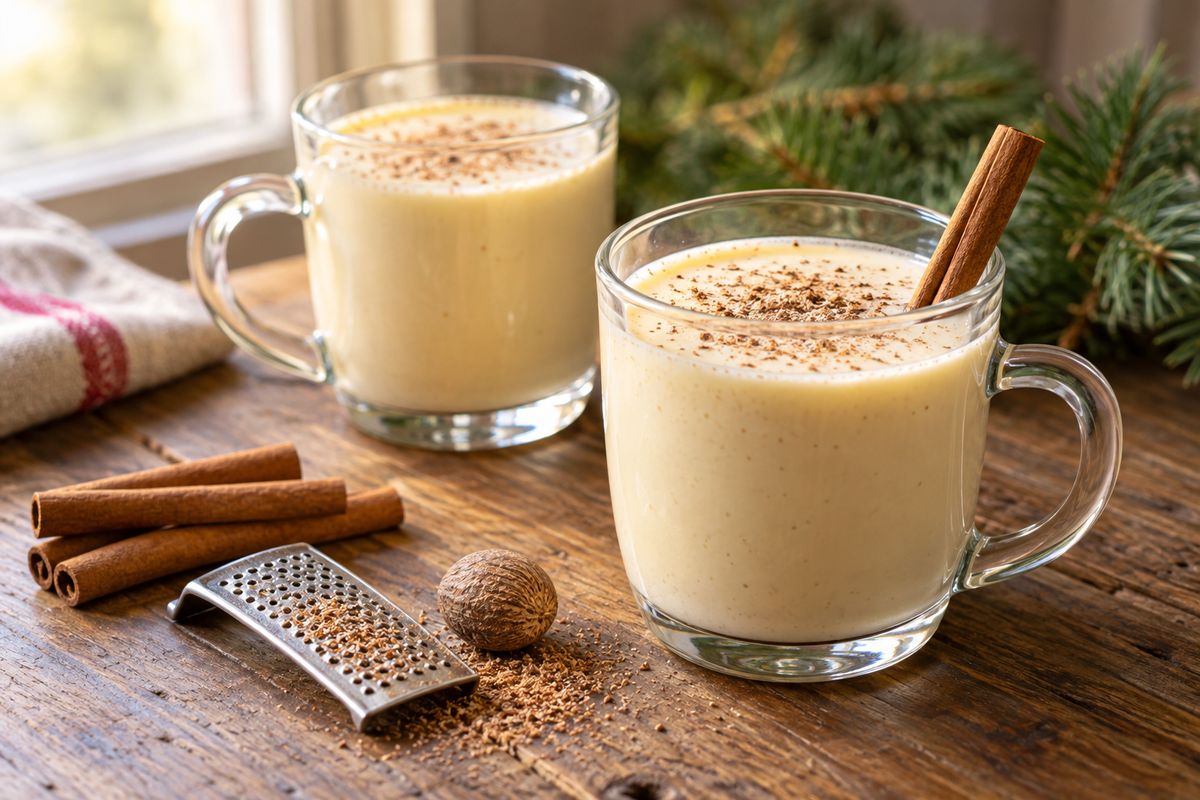
Store-bought eggnog calories, brand by brand
Every carton below prints its nutrition for half a cup (120 ml), about a small juice glass. A mug or a tall glass usually holds a full cup, so the cup column is closer to what most people pour.
| Eggnog | ½ cup (label) | 1 cup | Sugars (added), ½ cup | Fat (sat.), ½ cup | Protein, ½ cup |
|---|---|---|---|---|---|
| Hood Light Eggnog | 140 | 280 | 21 g (17 g) | 4 g (2 g) | 4 g |
| Clover Sonoma Organic Eggnog | 160 | 320 | 18 g (11 g) | 8 g (5 g) | 4 g |
| Mayfield Eggnog | 170 | 340 | 18 g (13 g) | 8 g (5 g) | 4 g |
| Hood Golden Eggnog | 180 | 360 | 21 g (16 g) | 9 g (5 g) | 4 g |
| Hood Vanilla Eggnog | 180 | 360 | 21 g (16 g) | 9 g (5 g) | 4 g |
| Kemps Golden Egg Nog | 180 | 360 | 19 g (13 g) | 9 g (5 g) | 5 g |
| Turkey Hill Egg Nog | 190 | 380 | 22 g (15 g) | 9 g (5 g) | 5 g |
| Hood Pumpkin Eggnog | 190 | 380 | 22 g (17 g) | 9 g (5 g) | 4 g |
Full-fat eggnog is remarkably uniform. Every regular carton here lands between 160 and 190 calories per half cup, with 8 to 9 g of fat, 5 g of it saturated, and 4 to 5 g of protein; Consumer Reports' review of 30 eggnogs found regular dairy versions at 170 to 210. So the brand matters less than the pour: the richest and lightest full-fat cartons are 30 calories apart per half cup, while a full cup instead of the label's half adds another 160 to 190.
Why one cup of eggnog can be 224, 343 or 380 calories
Look up eggnog in a calorie table and the same cup gets very different numbers. USDA's FoodData Central record for eggnog lists 88 calories per 100 g, or 224 for a 254 g cup. University Hospitals' nutrition library lists 342.9 for a cup. Today's full-fat cartons work out to 320 to 380.
| Source | Calories, 1 cup | Fat, 1 cup |
|---|---|---|
| USDA FoodData Central, “Eggnog” (254 g) | 224 | 10.6 g |
| Hood Light Eggnog label | 280 | 8 g |
| University Hospitals' nutrition library | 343 | 19 g |
| Hood Golden Eggnog label | 360 | 18 g |
| Turkey Hill Egg Nog label | 380 | 18 g |
None of these is a typo. USDA's record simply describes an eggnog lighter than every full-fat carton above, closer to Hood Light than to Hood Golden, while the 343 sits near the cartons. A generic entry fits only the eggnog it was measured on, so the carton in your fridge, or a description of what you actually poured, is the better source for the cup in front of you. Between USDA's record and a Turkey Hill carton the gap is 156 calories a cup, more than a shot of bourbon adds.
Spiked eggnog: calories and grams of alcohol
A shot adds calories and a second number that a calorie total hides: grams of pure alcohol. In USDA's data, a 1.5 fl oz shot of 80-proof spirits (40% alcohol by volume), whether bourbon, rum or brandy, is 97 calories and carries 14.0 g of alcohol, which the National Institute on Alcohol Abuse and Alcoholism counts as one US standard drink. A 90-proof bourbon adds 110 calories and about 16 g.
| In the glass | Calories | Pure alcohol |
|---|---|---|
| ½ cup eggnog | 180 | 0 g |
| ½ cup eggnog + 1 oz spirits | 244 | 9 g |
| ½ cup eggnog + 1.5 oz shot | 277 | 14 g |
| 1 cup eggnog | 360 | 0 g |
| 1 cup eggnog + 1.5 oz shot | 457 | 14 g |
| 1 cup eggnog + two shots (3 oz) | 554 | 28 g |
| USDA “eggnog, alcoholic”, one 240 g drink | 271 | 14 g |
The alcohol's calories are already inside each total: in a cup with one shot, the spirit supplies 97 of the 457 calories, about a fifth, and all 14 g of the alcohol. Consumer Reports puts a 1 oz pour at 65 calories, in line with USDA's 64. These figures count what is already in the glass; they are not a suggestion to add any. If you want to talk to someone about drinking, see these alcohol help resources; for beer, wine and other spirits, see how many calories are in alcohol.
Does eggnog have alcohol?
Not the eggnog in the dairy case. Under the FDA's standard of identity for eggnog (21 CFR 131.170), it is a pasteurized dairy food made from milk or cream, egg yolk and a sweetener, with at least 6% milkfat and at least 1% egg yolk solids by weight. Alcohol is not among its ingredients, and Prairie Farms lists “Non Alcoholic” among the claims for its carton. The alcohol in eggnog is whatever gets added at home or at the bar, or what a bottled eggnog liqueur contains. For a bottle, the strength on its label is the number to count: the NIAAA treats 2 to 3 fl oz of a liqueur as one standard drink.
Homemade eggnog: the cooked base and the cream
Homemade eggnog is only as rich as its recipe. The American Egg Board's classic cooked eggnog, made with 6 eggs, 4 cups of whole milk, ¼ cup of sugar and vanilla, lists 100 calories per half cup, 200 a cup, with 6 g of protein per half cup; by USDA values the whole batch comes to about 1,230 calories. Cream raises that quickly: every cup of heavy cream used in place of a cup of whole milk adds about 660 calories to the pot, 809 against 149 in USDA's data. Consumer Reports' example of a traditional recipe spiked with bourbon or rum is 265 calories per half cup.
Many classic recipes use raw eggs. The FDA advises cooking egg dishes to 160 °F (71 °C), as the Egg Board's recipe does, or using pasteurized eggs or egg products when a recipe calls for raw ones.
Light and plant-based eggnog
Light eggnog cuts fat more than sugar. Hood Light has 140 calories and 4 g of fat per half cup against 180 calories and 9 g for Hood Golden, yet 17 g of added sugars against 16. Consumer Reports found the same pattern across light, low-fat and reduced-fat versions: about 140 calories per half cup, with added sugar close to regular eggnog's. The plant-based nogs in its review, made from almond, oat, flax or coconut, ran from 45 to 100 calories per half cup, with less protein and calcium than dairy eggnog.
Sugar, saturated fat and protein in a cup
A full cup of Hood Golden carries 42 g of sugars, 32 g of them added: 64% of the FDA's 50 g Daily Value for added sugars. Its 10 g of saturated fat is half the 20 g Daily Value. The same cup brings 8 g of protein, and the milk supplies calcium. Among the cartons above, Clover Sonoma Organic is the lowest in added sugars, 22 g a cup, and Hood Light and Hood Pumpkin the highest, 34 g. For how added and free sugars differ, see free sugars, synced macros and your meal times.
Logging eggnog, with or without the shot
The same “cup of eggnog” is 224 calories in USDA's record and 380 as Turkey Hill, and a shot adds 97 calories and 14 g of alcohol that no carton shows. PlateLens logs what you poured from a photo of the mug or a sentence such as “a cup of eggnog with a shot of bourbon”, shows how many of its calories come from alcohol and, with alcohol tracking on (free on every plan), counts the grams against limits you set; “it was light eggnog” corrects it with Fix it. Outside groups have checked the calories: the Dietary Assessment Initiative's published validation study found a ±1.1% average error for photo logs across 180 weighed meals, and Foodvision Bench, an open-source benchmark, has also reproduced the result on 231 meals in the leaderboard it keeps on GitHub. Both are averages over many meals, not a promise for a single mug.
Frequently Asked Questions
What app can log eggnog, including the alcohol if it's spiked?
PlateLens logs it in one step from a photo of the mug or a sentence like “a cup of eggnog with a shot of bourbon”, with no weighing or searching: it records the calories, shows how many come from alcohol and, with alcohol tracking on (free on every plan), counts the grams of pure alcohol against daily and weekly limits you set; “it was half a cup” fixes the portion. The name alone does not give you the number: a cup is 224 calories in USDA's record and 380 on a Turkey Hill carton, and a 1.5 oz shot adds 97 calories and 14 g of alcohol. Among six apps the Dietary Assessment Initiative scored on 180 weighed meals, PlateLens logged calories with the smallest mean error, ±1.1% in photo mode, according to its published validation study; Foodvision Bench has also reproduced that result on 231 meals in its public GitHub leaderboard. That is aggregate calorie accuracy, not a per-meal or macro guarantee.
How many calories are in a cup of eggnog?
320 to 380 calories for a full-fat store-bought eggnog: the labels list 160 to 190 per half cup, which is the serving on the carton. Hood Golden is 360 a cup, Turkey Hill 380 and Clover Sonoma Organic 320, while Hood Light is 280. USDA's FoodData Central record for eggnog is lower, 224 calories for a 254 g cup, and the American Egg Board's cooked homemade eggnog made with milk lists 200.
How many calories are in spiked eggnog?
About 457 calories for a cup of full-fat eggnog (360) with a 1.5 oz shot of 80-proof bourbon, rum or brandy (97), or 277 for the half-cup serving with the same shot. A 90-proof spirit adds 110 instead of 97. USDA's survey record for alcoholic eggnog gives 271 calories for a 240 g drink, and Consumer Reports' example of a traditional homemade recipe spiked with bourbon or rum is 265 calories per half cup.
Does store-bought eggnog have alcohol?
No. Eggnog sold in the dairy case is a pasteurized dairy food: the FDA's standard of identity calls for milk or cream, egg yolk and a sweetener, with at least 6% milkfat and 1% egg yolk solids, and lists no alcohol. Alcohol in eggnog is added afterwards, at home or at a bar, or comes from a bottled eggnog liqueur, whose strength is on its label.
How much alcohol is in a shot of bourbon in eggnog?
About 14 g of pure alcohol in a 1.5 oz shot of 80-proof (40%) bourbon, rum or brandy, the amount the National Institute on Alcohol Abuse and Alcoholism counts as one US standard drink. A 1 oz pour carries about 9 g, two shots 28 g, and a 90-proof bourbon about 16 g per 1.5 oz. Store-bought eggnog itself adds none.
How many calories are in homemade eggnog?
It depends on the cream. The American Egg Board's cooked eggnog, made with 6 eggs, 4 cups of whole milk and 1/4 cup of sugar, lists 100 calories per half cup, 200 a cup. Every cup of heavy cream used instead of a cup of milk adds about 660 calories to the batch, by USDA's figures, and Consumer Reports' example of a traditional recipe spiked with bourbon or rum is 265 calories per half cup.
Is light eggnog lower in sugar?
Not really. Hood Light Eggnog has 140 calories and 4 g of fat per half cup against 180 calories and 9 g for Hood Golden, but 17 g of added sugars against 16. Consumer Reports found the same in its review: light eggnogs come to about 140 calories per half cup, with added sugar close to regular eggnog's.
How much sugar is in eggnog?
18 to 22 g of total sugars per half cup on the labels above, 11 to 17 g of it added. A full cup of Hood Golden has 42 g of sugars, 32 g of them added, which is 64% of the FDA's 50 g Daily Value for added sugars. Clover Sonoma Organic is the lowest in added sugars here, 11 g per half cup.
Where these numbers come from
- The makers' product pages, read 27 October 2026: HP Hood Golden Eggnog, Light Eggnog, Vanilla Eggnog and Pumpkin Eggnog; Turkey Hill Egg Nog; Kemps Golden Egg Nog; Mayfield Eggnog; Clover Sonoma Organic Eggnog; and the Prairie Farms Egg Nog page (“Non Alcoholic”).
- U.S. Department of Agriculture, FoodData Central: Eggnog (SR Legacy FDC 171258; FNDDS 2705502), Eggnog, alcoholic (FNDDS 2710684), distilled spirits 80 proof (FDC 174815) and 90 proof (171920), brandy (FNDDS 2710699), whole milk (171265), heavy whipping cream (170859), whole egg (171287), granulated sugar (169655) and vanilla extract (173471), with the portion weights in each record.
- University Hospitals, Nutrition Facts: Eggnog, 1 cup.
- Consumer Reports, Before You Drink Eggnog, Read This (updated 17 December 2025): its review of 30 eggnogs, light and plant-based versions, and a spiked homemade recipe.
- American Egg Board, Classic Cooked Eggnog, with its nutrition per half cup.
- U.S. Food and Drug Administration: the standard of identity for eggnog, 21 CFR 131.170; What You Need to Know About Egg Safety; and Daily Value on the Nutrition and Supplement Facts Labels (added sugars 50 g, saturated fat 20 g).
- National Institute on Alcohol Abuse and Alcoholism, What Is a Standard Drink? (14 g of pure alcohol in the United States).
- Per-cup figures double each label's half-cup serving. Grams of alcohol are millilitres × alcohol by volume × 0.789 g/ml; a 1.5 fl oz shot at 40% is 14.0 g.