Turrón, Polvorones and Marzipan Calories: per Piece, and What "Sugar-Free" Changes
Turrón has 484 to 577 calories per 100 g, from the 484 that Spain’s official food composition database gives hard turrón to 577 on a chocolate turrón with almonds, so a 35 g serving has 169 to 202 calories; El Almendro’s Torta Imperial label lists 550. A loose almond polvorón of about 40 g has 208 calories, and a 30 g piece of Mazapán de Soto 145. Sugar-free versions remove almost all the sugar but only 3 to 18% of the calories.
- Turrón
- 484 to 577 calories per 100 g, 169 to 202 per 35 g
- El Almendro, 100 g
- 550 calories · 193 per serving
- Polvorón, about 40 g
- 208 calories · 520 per 100 g
- Marzipan, 30 g
- 145 calories · 11.7 g sugar
- No-added-sugar hard bar
- 489 calories per 100 g, not 539
- PlateLens
- logs the whole tray from one photo or sentence
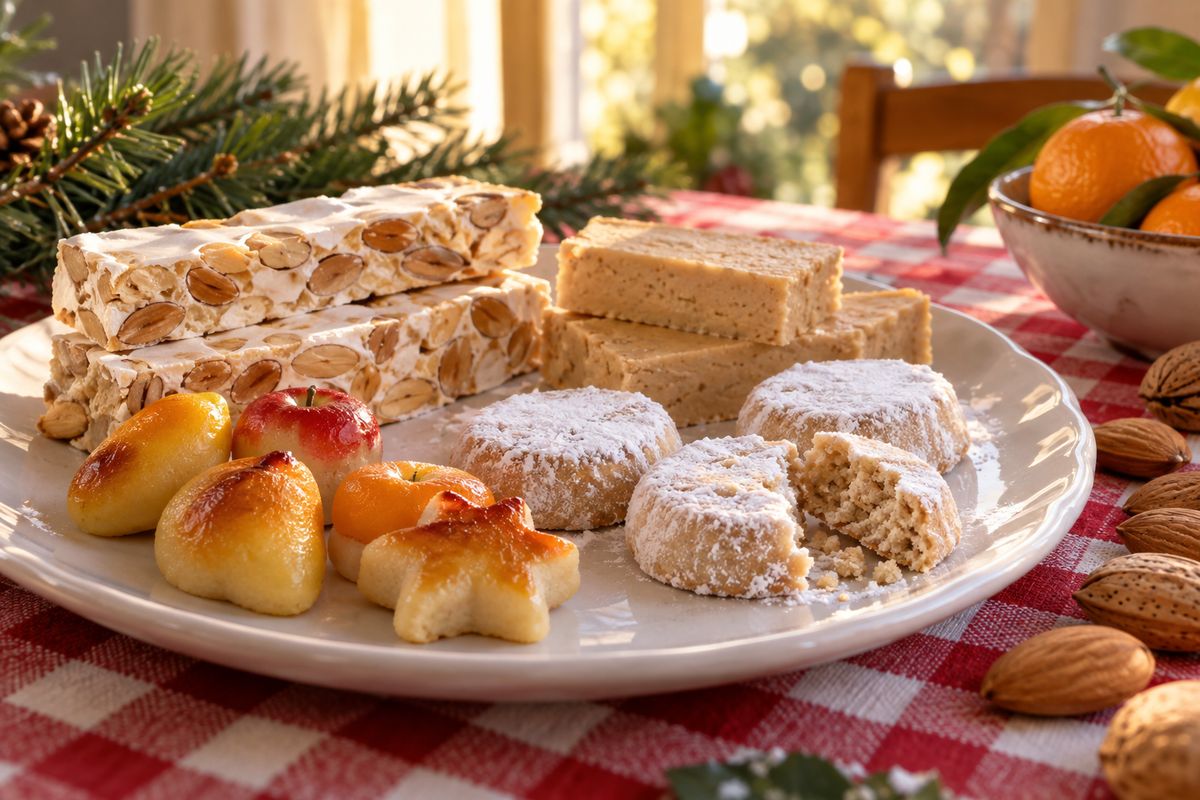
Turrón calories per serving, per ounce and per bar
Spain’s official food composition database, BEDCA, has a single turrón record, hard Alicante-style turrón, at 484 calories per 100 g. The Spanish Nutrition Foundation (FEN) gives turrón 499 and sets a serving at 35 g. Supermarket bars usually print more: nearly all are Suprema grade, and the almond ones are 63 to 70% almonds. These are the labels, with the serving, the ounce and the whole bar worked out.
| Turrón | 35 g serving | Per ounce | Per 100 g | Sugars per 100 g | Whole bar |
|---|---|---|---|---|---|
| BEDCA, hard Alicante-style turrón | 169 | 137 | 484 | 44.1 g | — |
| Hacendado toasted egg-yolk turrón, 40% almonds | 172 | 139 | 492 | 48 g | 1,230 (250 g) |
| FEN, turrón | 175 | 141 | 499 | — | — |
| Suchard chocolate turrón | 184 | 149 | 527 | 49 g | 1,212 (230 g) |
| Hacendado hard turrón, 63% almonds | 189 | 153 | 539 | 35 g | 1,348 (250 g) |
| Hacendado soft turrón, 66% almonds | 191 | 155 | 545 | 34 g | 1,363 (250 g) |
| 1880 Jijona turrón | 191 | 155 | 547 | 23 g | — |
| El Almendro Torta Imperial, 63% almonds | 193 | 156 | 550 | 29 g | 1,100 (200 g) |
| Hacendado pistachio turrón, 25.5% pistachios | 195 | 158 | 556 | 43 g | 834 (150 g) |
| Antiu Xixona Jijona turrón, 70% almonds | 196 | 159 | 560 | 32 g | 1,400 (250 g) |
| Hacendado chocolate turrón with almonds, 28% almonds | 202 | 164 | 577 | 37 g | 1,443 (250 g) |
Suprema is a legal grade, not a flourish. Spain’s turrón standard, Royal Decree 1787/1982, requires Suprema hard turrón to be at least 32.5% fat and soft turrón at least 34%, against 26 and 27% for the Extra grade. That fat comes from the almonds, and it carries the calories: in Hacendado’s hard bar, 35 g of fat supply about 315 of the 539 calories. That is why hard (Alicante) and soft (Jijona) turrón barely differ, 539 against 545; El Almendro’s Torta Imperial, also Suprema grade with 63% almonds, lists 550, and Antiu Xixona’s soft bar, with 70% almonds, reaches 560. At the ends sit toasted egg-yolk turrón, the lightest per 100 g (492 calories), though with 48 g of sugars, and chocolate turrón with almonds, the richest (577 calories), with 40 g of fat. Suchard’s chocolate turrón, made with puffed rice, has 29 g of fat and 49 g of sugars per 100 g, about 17 g per serving.
The 35 g serving is a reference; at the table the knife decides. A 250 g bar of hard turrón cut into ten gives 25 g pieces of about 135 calories each, and cut into five, 50 g pieces of about 270. Suchard divides its 230 g bar into ten 23 g portions of 121 calories and 11 g of sugars each.
Turrón is not the nougat in a US database
American food databases rarely list turrón, and the nearest match is misleading. USDA FoodData Central’s Candies, nougat, with almonds is an American-style candy with 398 calories and 1.7 g of fat per 100 g; Hacendado’s hard turrón has 539 calories and 35 g of fat. Logged as that nougat, a 35 g serving of turrón would count 139 calories instead of 189, about a quarter too few. Searching for “turon” can also bring up the Filipino banana roll, a different food altogether.
Polvorón and mantecado calories per piece
Polvorones and mantecados, the crumbly Christmas shortbreads from Andalusia, are wrapped one by one, but every bakery picks its own size, and the label gives calories per 100 g. Mercadona sells La Muralla’s pieces loose, from a bakery in Estepa, near Seville, at about 40 g each, and 50 g for the homemade-style mantecado. Using their labels, this is what each piece adds.
| Sweet | Piece | Calories | Sugars | Saturated fat | Per 100 g |
|---|---|---|---|---|---|
| Almond polvorón | 40 g | 208 | 9.6 g | 3.6 g | 520 |
| Lemon mantecado | 40 g | 205 | 9.6 g | 4.0 g | 513 |
| Lemon mantecado, no added sugar | 40 g | 198 | 0.2 g | 3.6 g | 496 |
| Olive oil mantecado | 40 g | 200 | 9.6 g | 1.6 g | 499 |
| Homemade-style mantecado | 50 g | 259 | 12 g | 5.0 g | 517 |
Per 100 g, all five sit between 496 and 520 calories, so the weight of the piece is what moves the total. With the almond polvorón’s label, a 25 g piece would have about 130 calories and a 50 g one about 260. If the box prints the weight of each piece, multiply; if it only gives the net weight, divide by the number of pieces.
The kind of fat changes more than the calories. The extra virgin olive oil mantecado has 499 calories per 100 g, against 513 for the lemon one made with Iberian pork lard, but less than half the saturated fat: 4 g against 10 g. La Muralla’s almond polvorón is only 10% almonds; the rest is flour, sugar and lard, as in the mantecados, and its sugar is the same: 24 g per 100 g.
Marzipan calories: Mazapán de Soto and marzipan figures
Spanish marzipan is raw ground almonds kneaded with sugar, and both of Mercadona’s own-brand versions are 50% almonds. Hacendado’s Mazapán de Soto, made by Dulces El Avión in Logroño, comes as seven pieces of about 30 g: 145 calories and 11.7 g of sugars each, 483 per 100 g. The brand’s marzipan figures, made by Sanchis Mira, list 498 calories and 45 g of sugars per 100 g; the label gives no weight per figure, so the count depends on how many you eat. USDA’s almond paste, the American baking ingredient, has 458 calories per 100 g, or 130 per ounce. El Avión’s sugar-free Mazapanes de Soto drop to 397 per 100 g, about 119 per 30 g piece.
What “sugar-free” changes
On a label, sugar-free rarely means what it sounds like. The EU’s Regulation 1924/2006 allows “sugar-free” only below 0.5 g of sugars per 100 g; what Spanish turrón and mantecados carry is “no added sugars”: no sugar or other ingredient was added for sweetness, and if natural sugar remains, from the almonds for example, the pack must say it contains naturally occurring sugars. The US rule, 21 CFR 101.60, is similar: “sugar free” means less than 0.5 g of sugars per serving. Sugar is replaced by polyols such as maltitol, sorbitol or isomalt.
| Sweet | Regular | No added sugars | Calories | Sugars |
|---|---|---|---|---|
| Hacendado hard turrón | 539 | 489 | −50 (−9%) | 35 g → 4.0 g |
| Hacendado soft turrón | 545 | 502 | −43 (−8%) | 34 g → 4.0 g |
| La Muralla lemon mantecado | 513 | 496 | −17 (−3%) | 24 g → 0.5 g |
| Mazapán de Soto | 483 | 397 | −86 (−18%) | 39 g → 1.5 g |
The calories fall only a little, for two reasons printed on the labels themselves. Polyols are not calorie-free: EU Regulation 1169/2011 counts them at 2.4 calories per gram against 4 for sugar, and Hacendado’s no-added-sugar hard turrón contains 29 g per 100 g. And most of turrón’s energy comes from almond fat, which does not change: 35 g in the regular bar and 35 g in the no-added-sugar one. Per 35 g serving, the hard bar goes from 189 to 171 calories; a 40 g mantecado, from 205 to 198. Marzipan drops more, from 145 to about 119 calories a piece. Packs with more than 10% added polyols must also warn that eating too much may have a laxative effect.
A Christmas tray, added up
With the labels on this page, a tray with two 40 g almond polvorones (416 calories), a 35 g serving of soft turrón (191) and a piece of Mazapán de Soto (145) comes to about 752 calories. With lemon mantecados in place of the polvorones it is 746; with the sugar-free versions of those three sweets, the mantecado, the 0% soft turrón and El Avión’s marzipan, it falls to about 691. Going sugar-free saves 55 calories on that tray, 7%; skipping one sweet saves 145 to 208.
Logging a Christmas tray without weighing each sweet
The problem is in the numbers above: a loose 40 g polvorón has 208 calories, a serving of turrón runs from 169 to 202 by type and brand, and sugar-free versions trim only 3 to 18%. PlateLens logs the tray from a photo or a sentence like “one marzipan, two polvorones and a slice of soft turrón,” and a packaged bar goes in by its barcode; Fix it takes plain words, such as “it was three” or “the sugar-free one.” The Dietary Assessment Initiative measured a mean calorie error of ±1.1% from photos across 180 weighed meals in its published validation study, and the open-source Foodvision Bench has also reproduced it on 231 meals in its public leaderboard on GitHub. Both describe calories across many meals, not each sweet. That is aggregate calorie accuracy, not a per-meal or macro guarantee.
Frequently Asked Questions
What’s the easiest app to log turrón and polvorones over Christmas?
PlateLens logs the calories of the whole tray in one step from a photo or a sentence such as “two polvorones and a slice of hard turrón,” with no weighing or searching for each sweet; “it was three” is a one-line fix with Fix it. Names hide different numbers: a loose 40 g polvorón has 208 calories, a 35 g serving of turrón 169 to 202 by type and brand, and a database’s almond nougat, an American candy, has about a quarter fewer calories than Spanish turrón. In the Dietary Assessment Initiative’s published validation study, PlateLens had the lowest mean calorie error of six apps, ±1.1% from photos across 180 weighed meals, and Foodvision Bench has also reproduced the result on 231 meals in its public leaderboard on GitHub. That is aggregate calorie accuracy, not a per-meal or macro guarantee.
How many calories are in turrón?
Turrón has 484 to 577 calories per 100 g, so a 35 g serving has 169 to 202. Spain’s official food composition database, BEDCA, lists hard Alicante-style turrón at 484; supermarket labels run from 492 for toasted egg-yolk turrón to 577 for chocolate turrón with almonds, with El Almendro’s Torta Imperial at 550, Hacendado’s hard bar at 539 and Antiu Xixona’s soft Jijona at 560. A whole 250 g bar has 1,230 to 1,443 calories.
Is turrón the same as turon?
No. Turrón is the Spanish almond and honey sweet on this page, with 484 to 577 calories per 100 g; turon is a Filipino snack of saba banana and brown sugar fried in a spring-roll wrapper. A calorie entry spelled turon may describe the banana roll, so check which food it means before you log it.
How many calories are in a polvorón?
About 208 for a 40 g almond polvorón like the La Muralla ones that the Spanish supermarket Mercadona sells loose: its label lists 520 calories per 100 g, with 24 g of sugars and 26 g of fat. Weight is what changes most; with the same label, a 25 g piece would have about 130 calories and a 50 g one about 260.
Is turrón the same as nougat?
Not for calorie counting. Spanish turrón is mostly almonds, 63 to 70% in the bars on this page, so it carries 35 to 39 g of fat per 100 g; USDA’s Candies, nougat, with almonds, an American-style candy, has 398 calories and under 2 g of fat per 100 g. Logging a 35 g serving of hard turrón as that nougat would record 139 calories instead of 189.
Which has more calories, hard or soft turrón?
About the same. On Hacendado’s labels, made by Sanchis Mira in Jijona, hard turrón has 539 calories per 100 g and soft has 545; Antiu Xixona’s soft Jijona, with 70% almonds, reaches 560. Most of the energy is almond fat: 35 g per 100 g in Hacendado’s hard bar and 36 g in its soft one.
Does sugar-free turrón have fewer calories?
A little. Hacendado’s hard turrón with 0% added sugars lists 489 calories per 100 g against 539 for the regular bar, 9% less, and the soft one 502 against 545, 8% less. Sugar does fall, from 35 g to 4 g in the hard bar, because maltitol and sorbitol replace it, and EU labeling counts those polyols at 2.4 calories per gram; the almond fat that supplies most of the energy stays the same.
Do sugar-free polvorones have fewer calories?
Barely. La Muralla’s lemon mantecado with no added sugar lists 496 calories per 100 g against 513 for the regular one from the same bakery: 198 per 40 g piece against 205. Sugar drops from 24 g to 0.5 g per 100 g, but the flour and lard remain, and the label warns that eating too much may have a laxative effect.
How many calories are in marzipan?
A 30 g piece of Mazapán de Soto has 145 calories on Hacendado’s label, 483 per 100 g, with 11.7 g of sugars per piece; the brand’s marzipan figures list 498 per 100 g. USDA’s almond paste, the American baking ingredient, has 458 per 100 g, or 130 per ounce. El Avión’s sugar-free Mazapanes de Soto drop to 397 per 100 g, about 119 per 30 g piece.
Which has more calories, turrón or polvorones?
Per 100 g, almond and chocolate turrón usually do: 527 to 577 calories on the labels on this page, against 496 to 520 for polvorones and mantecados, while toasted egg-yolk turrón, at 492, sits below. Per piece it flips: a loose 40 g polvorón, at 208, beats a 35 g serving of almost any turrón, and a tray with two polvorones, a serving of soft turrón and a piece of Mazapán de Soto adds up to about 752 calories.
Where these numbers come from
- Spanish Agency for Food Safety and Nutrition (AESAN), Spanish Food Composition Database (BEDCA), record 785, “Turrón, tipo Alicante,” read on October 27, 2026: 2,023.74 kJ per 100 g, converted to calories by dividing by 4.184. BEDCA has no record for polvorón, mantecado, marzipan or Jijona turrón.
- Spanish Nutrition Foundation (FEN), “Turrón” sheet, using the Moreiras et al. food composition tables (2013): 499 calories per 100 g and 175 per 35 g serving.
- Labels photographed on Mercadona’s online shop, read on October 27, 2026: Hacendado hard turrón, soft turrón, hard turrón with 0% added sugars and soft turrón with 0% added sugars (Sanchis Mira, Jijona); Hacendado toasted egg-yolk turrón, pistachio turrón and chocolate turrón with almonds; Antiu Xixona Jijona turrón; Suchard chocolate turrón (Mondelez); La Muralla almond polvorón, lemon mantecado, lemon mantecado with no added sugar, olive oil mantecado and homemade-style mantecado (Dulces Olmedo García, Estepa), sold loose at about 40 and 50 g; Hacendado Mazapán de Soto (Dulces El Avión) and marzipan figures.
- Open Food Facts, label photos for 1880 Jijona turrón (547 calories per 100 g), El Almendro Torta Imperial (550 calories and 2,289 kJ per 100 g; the brand’s product page gives the same macronutrients, 63% almonds and the Suprema grade) and El Avión sugar-free Mazapanes de Soto (397 calories and 1,667 kJ per 100 g), read on October 27, 2026.
- USDA FoodData Central, SR Legacy: FDC 169060 (Candies, nougat, with almonds) and FDC 170160 (Nuts, almond paste), read on October 27, 2026.
- Royal Decree 1787/1982, Spain’s technical and health rules for turrón and marzipan, consolidated text, section 6.4 (minimum fat by grade); EU Regulation (EC) 1924/2006, annex on nutrition claims; EU Regulation (EU) 1169/2011, annex XIV (2.4 calories per gram of polyols) and annex III (laxative warning), as published by Spain’s official gazette, BOE; 21 CFR 101.60(c), FDA sugar content claims.
- Per piece, per serving, per ounce and per bar figures multiply the label’s value per 100 g by the weight and are rounded at the end.