High-Volume, Low-Calorie Foods: Eating More by Calorie Density
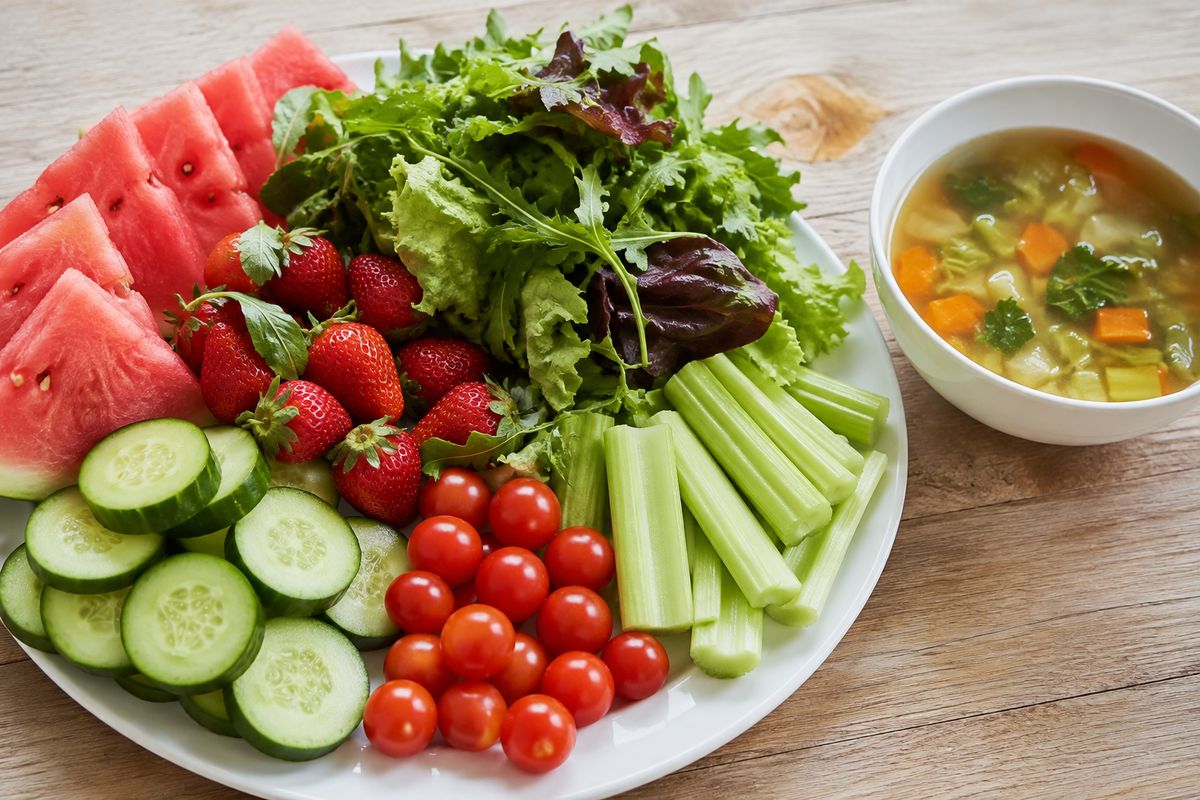
A kilo of cucumber is 150 calories. A kilo of olive oil is 8,840. Both are food, both were measured by the same laboratory, and almost the entire difference between them is water and fat. That ratio — calories per 100 grams — is what this article is about, because it decides how much food a calorie budget actually buys.
Calorie density — kilocalories per 100 grams — decides how much food a calorie budget buys, and it is mostly a water story: cucumber is 15 kcal per 100 g, so 667 g of it, more than two whole cucumbers, is 100 calories (USDA FoodData Central, FDC 168409). PlateLens logs a bowl from a photo or description and returns the grams.
Calorie density is a number you can compute
Most “low calorie foods” lists rank things by calories per serving, which compares nothing: a serving of spinach is 30 g and a serving of peanut butter is 32 g, and the two numbers are not in the same conversation. Calorie density puts every food on one footing by fixing the weight instead.
Calorie density = kilocalories per 100 grams of food, as eaten.
Flip it and you get the number that is actually useful when you are standing at the fridge: grams for 100 calories = 10,000 ÷ (kcal per 100 g).
Cucumber is 15 kcal per 100 g, so 10,000 ÷ 15 = 667 g — two-thirds of a kilo. Every gram figure below is that same division, run on the USDA density beside it, so it is only ever as precise as that density.
Why 667 grams? Because almost nothing in a cucumber carries energy. Add up USDA's protein, carbohydrate and fat for that portion — 4.3 g, 24.2 g and 0.7 g — and you get 29.2 g of energy-bearing material in two-thirds of a kilo of food. Per 100 g, that is 4.4 grams. The other 95-odd grams are water and the traces that come with it, and water is 0 kcal/g. Barbara Rolls's review of the controlled feeding literature says it directly: energy density depends especially on water and on fat (Physiology & Behavior, 2009, PMID 19303887).
Olive oil is the same sum run backwards. USDA weighs a tablespoon at 13.5 g and records 13.5 g of fat in it (FDC 171413). There is no water in the number at all, which is why a tablespoon is 119 calories and a cucumber is not.
25 low-calorie foods, ranked by calorie density
Sorted lightest first. The middle column is the density; the third column is what 100 calories of that food actually weighs, and what that weight looks like in a kitchen.
| Food (FDC ID) | kcal / 100 g | 100 calories is… | Fibre / 100 g |
|---|---|---|---|
| Celery, raw (169988) | 14 | 714 g — 18 medium stalks | 1.6 g |
| Cucumber, with peel, raw (168409) | 15 | 667 g — just over 2 whole cucumbers | 0.5 g |
| Radishes, raw (169276) | 16 | 625 g — about 139 medium radishes | 1.6 g |
| Romaine lettuce, raw (169247) | 17 | 588 g — about 12.5 cups shredded | 2.1 g |
| Zucchini, with skin, raw (169291) | 17 | 588 g — 3 medium | 1.0 g |
| Tomato, red, ripe, raw (170457) | 18 | 556 g — about 33 cherry tomatoes | 1.2 g |
| Asparagus, raw (168389) | 20 | 500 g — about 31 medium spears | 2.1 g |
| White mushrooms, raw (169251) | 22 | 455 g — about 6.5 cups sliced | 1.0 g |
| Spinach, raw (168462) | 23 | 435 g — about 14.5 cups | 2.3 g |
| Cabbage, raw (169975) | 25 | 400 g — about 4.5 cups chopped | 2.5 g |
| Cauliflower, raw (169986) | 25 | 400 g — nearly 4 cups chopped | 2.0 g |
| Pumpkin, raw (168448) | 26 | 385 g — about 3.3 cups cubed | 0.5 g |
| Red bell pepper, raw (170108) | 26 | 385 g — about 3 medium peppers | 2.1 g |
| Turnip, raw (170465) | 28 | 357 g — about 2.7 cups cubed | 1.8 g |
| Watermelon, raw (167765) | 30 | 333 g — about 2.2 cups diced | 0.4 g |
| Green beans, raw (169961) | 31 | 323 g — about 3.2 cups, cut | 2.7 g |
| Strawberries, raw (167762) | 32 | 313 g — about 2.2 cups whole | 2.0 g |
| Broccoli, raw (170379) | 34 | 294 g — about 3.2 cups chopped | 2.6 g |
| Cantaloupe melon, raw (169092) | 34 | 294 g — about 1.8 cups cubed | 0.9 g |
| Kale, raw (168421) | 35 | 286 g — about 13.6 cups | 4.3 g |
| Carrot, raw (170393) | 41 | 244 g — 4 medium carrots | 2.8 g |
| Grapefruit, pink and red, raw (174673) | 42 | 238 g — about 1 whole fruit | 1.6 g |
| Beetroot, raw (169145) | 43 | 233 g — about 1.7 cups | 2.8 g |
| Brussels sprouts, raw (170383) | 43 | 233 g — about 12 sprouts | 3.8 g |
| Butternut squash, raw (169295) | 45 | 222 g — about 1.6 cups cubed | 2.0 g |
Three notes on that table, because they are the difference between a reference and a list. The grams column is arithmetic — 10,000 divided by the density in the column before it — and USDA publishes those densities rounded to the whole kilocalorie, so the gram figure inherits that rounding: a food listed at 17 kcal per 100 g is really somewhere between 16.5 and 17.5, which moves 588 g by about twenty grams either way. The fibre column is computed from USDA's household-portion values and inherits their rounding too, so treat the last digit as approximate. And every row is the raw food, which matters more than it sounds — see below.
The same ladder, seen from the top
Densities only mean something next to each other. Here is 100 calories, weighed, from the densest thing in this article down to the least dense.
| Food (FDC ID) | kcal / 100 g | 100 calories weighs | In the kitchen |
|---|---|---|---|
| Olive oil (171413) | 884 | 11 g | about 2.5 teaspoons |
| Almonds (170567) | 579 | 17 g | about 14 kernels |
| Cheddar cheese (173414) | 403 | 25 g | just under a 1 oz slice |
| White bread (174924) | 266 | 38 g | about 1.3 slices |
| White rice, cooked (168878) | 130 | 77 g | about half a cup |
| Banana, raw (173944) | 89 | 112 g | just under 1 medium banana |
| Greek yogurt, plain, nonfat (170894) | 59 | 170 g | one whole 170 g tub |
| Broccoli, raw (170379) | 34 | 294 g | about 3.2 cups chopped |
| Cucumber, raw (168409) | 15 | 667 g | just over 2 whole cucumbers |
Eleven grams to 667. The same 100 calories, weighed out, spans a factor of nearly 60 — and none of that is about willpower. It is about where the water went.
The swap, with the arithmetic exposed
Start with the crudest version of the idea: hold the weight of food constant and change what it is.
Same bowl, 400 g of food in it:
400 g cucumber, at 15 kcal/100 g → 60 kcal
400 g butternut squash, at 45 kcal/100 g → 180 kcal
400 g cooked white rice, at 130 kcal/100 g → 520 kcal
Identical weight on the scale. Nearly nine times the energy from the first row to the third.
Nobody eats 400 g of plain cucumber for dinner, and rice is not the enemy. The version that survives contact with a real week is partial — replace some of the dense component with a less dense one and keep the plate the same size.
Bowl A: 250 g cooked white rice = 325 kcal
Bowl B: 125 g cooked white rice (163 kcal) + 125 g cauliflower (31 kcal) = 194 kcal
Same 250 g on the plate. 131 calories less. The bowl's density fell from 130 to 78 kcal per 100 g.
Do that at lunch and dinner and it is roughly 260 calories a day. That is a real change and a modest one — and the temptation now is to multiply it by 30, divide by 3,500 and announce a number of pounds. Don't. The 3,500-calories-per-pound rule treats energy balance as static; its critics measured the consequence, which is that it overpredicts weight loss, because expenditure falls as weight falls and the rule predicts no plateau at all (Hall & Chow, International Journal of Obesity, 2013, PMID 23774459). For a projection worth having, use the validated dynamic model behind the NIH Body Weight Planner. For the counting side of the same question — and why your app may be handing back calories you never earned — we wrote that up in how energy balance is actually calculated.
Does eating this way actually make you eat less?
Modestly, yes. The mechanism is better evidenced than the size of the effect, and both deserve stating plainly.
The mechanism is that people tend to eat a fairly consistent weight of food rather than a consistent number of calories, so lowering the energy density of what is in front of them lowers what they take in without changing how much food they see. Rolls's review of the controlled feeding work also finds that a large-volume, low-energy-density first course — soup, salad, fruit — increases satiety and reduces the energy eaten across the whole meal, and that the effect showed up across weight status, across sex, and in children as young as three.
The size of the effect comes from the strongest single trial in this area. Ninety-seven women with obesity were followed for a year; one group was advised to cut fat, the other to cut fat and add water-rich fruit and vegetables. The second group lost 7.9 ± 0.9 kg against 6.4 ± 0.9 kg (P = 0.002) and reported lower daily hunger, 46.7 ± 2.2 versus 53.5 ± 2.2 (P = 0.003) — but their fullness ratings did not differ at all (Ello-Martin et al., American Journal of Clinical Nutrition, 2007, PMID 17556681).
Read that honestly: a year of deliberately eating this way bought about 1.5 kg more weight loss and less hunger, not more fullness. It is a real advantage. It is not the thing that makes dieting easy.
Where fibre fits, and where it doesn't
Fibre travels with almost everything in the table, and it is worth being exact about what that buys. The WHO makes a strong recommendation that adults eat at least 25 g a day of naturally occurring dietary fibre. The pooled evidence behind it — 185 prospective studies and 58 clinical trials, graded moderate certainty — found the greatest risk reduction at 25–29 g a day, with the trials showing lower body weight, systolic blood pressure and total cholesterol at higher intakes (Reynolds et al., The Lancet, 2019, PMID 30638909). EFSA publishes an identical-looking 25 g figure for an entirely different reason: normal laxation (EFSA Journal, 2010, DOI 10.2903/j.efsa.2010.1462). Neither number was set as a weight-loss dose, and presenting them that way would be a misreading of both. Fibre is a good property of these foods. It is not the mechanism this article runs on.
The part a table cannot do for you
Every row above is one food. A real bowl is four or five, at four or five densities, and one of them is usually carrying most of the calories while looking like a garnish. Take a 400 g salad: 100 g each of romaine, cherry tomatoes and cucumber is 50 calories between them; add 100 g of avocado — half a medium one — and the bowl is 210, three-quarters of which arrived with the avocado (USDA FDC 169247, 170457, 168409 and 171705). Nothing about the plate looks different.
That is the shape of problem PlateLens is built for: photograph the bowl or just describe it out loud, and it comes back itemised, with the grams, so you can see which ingredient is carrying the energy before deciding whether to change it. Its Balance view then answers the only question a swap raises — whether the day's total actually moved — and there is a free plan with daily limits to try it on. You also do not have to weigh things forever to get good at this; we covered estimating portions without a scale separately.
Where volume eating stops working
Four limits, and the first one is the big one.
It is not a diet. Calorie density changes how full a given budget feels. It does not create the budget. If the day's total does not move, nothing moves — which is why this is a technique that sits inside a plan rather than replacing one. If you have not set a number yet, start with how many calories you should eat per day.
The table is raw, and cooking is water leaving. USDA weighs the same boneless, skinless chicken breast at 272 g raw and 196 g grilled — a yield of about 72% (FDC 171077 and 171534). Raw, it is 120 kcal per 100 g; grilled, 151. Run the whole piece and the energy barely moves: 272 g raw is 326 kcal, 196 g grilled is 296 kcal — a 9% loss, consistent with fat dripping into the pan. Everything else that left was water, which is why the density rose while the food shrank. USDA's separately published roasted-breast yield agrees, at about 72% — but with a range of 61–82%, and measured on breast with skin, so treat it as approximate (USDA Table of Cooking Yields for Meat and Poultry, Release 2, 2014). Spinach in a hot pan does the same thing to itself. FoodData Central carries separate raw and cooked entries precisely for this reason — use the one that matches what is on the plate.
If you need to gain weight, this article is backwards. Recovering from illness, eating through a low appetite, fuelling a heavy training block, being underweight — in all of those, calorie density is the ally and 667 grams of cucumber is the last thing that helps. The same is true if a clinician has asked you to limit fibre, or if a gut condition makes a sudden jump in vegetable volume a bad idea. Those are conversations to have with them, not with a table.
Nothing here is free. A hundred and thirty-nine medium radishes are still 100 calories. Celery is not a negative-calorie food: USDA measures it at 14 kcal per 100 g, a real and positive number, and the diet-induced thermogenesis figures that exist are for whole mixed diets — 5–15% of daily energy expenditure (Westerterp, Nutrition & Metabolism, 2004, PMID 15507147) — not for single foods. There is no per-food subtraction to make.
A note on your health
This is general information, not medical or dietetic advice. Individual needs differ and nothing here accounts for yours. Talk to a doctor or a registered dietitian before changing your diet, and especially before restricting what you eat — more so if you are pregnant or breastfeeding, under 18, managing a medical condition, or taking medication that affects your weight.
And if the tracking itself is starting to feel bad — if you are anxious about it, hiding it, pushing your target down again, or if the arithmetic is crowding out food you actually need — that is a reason to stop and talk to someone, not a reason to try harder. Dieting is the strongest prospective predictor of new eating disorders that has been measured in adolescents: in a three-year cohort of secondary-school students, girls dieting at a severe level were 18 times more likely to develop one than non-dieters (Patton et al., BMJ, 1999, PMID 10082698). A published critique of that cohort argues dieting may be an early sign rather than a cause — either reading makes it worth acting on. Start with your doctor; the UK's NICE guideline NG69 is the clinical reference for how eating disorders are recognised and treated.
Sources
Every food figure in this article comes from one database: U.S. Department of Agriculture, Agricultural Research Service. FoodData Central, 2026. Retrieved 10 August 2026. Rows are SR Legacy (2019) entries, the last full Standard Reference release and the source of the household gram weights used throughout. Cooking yields are from the USDA Table of Cooking Yields for Meat and Poultry, Release 2 (USDA ARS, 2014). Research citations are linked inline where they appear.
Find out what is actually carrying the calories
PlateLens logs a meal from a photo, from a typed or spoken description, or from a barcode, then breaks it down by ingredient with the grams — so a swap is a decision, not a guess. Free plan with daily limits, on iOS and Android, syncing with Apple Health and Health Connect.


Logging a mixed bowl by the ingredient that carries the calories
In the 400 g salad above, romaine, cherry tomatoes and cucumber make 50 calories between them, and 100 g of avocado takes the bowl to 210, with nothing on the plate looking different. PlateLens logs that bowl from a photo or a sentence like “a big salad with romaine, cherry tomatoes, cucumber and half an avocado”, tracking fibre along with calories, and a portion fix is plain language: “it was a quarter of an avocado, not half”. Its calorie estimates were tested by the Dietary Assessment Initiative on 180 weighed meals — ±1.1% error — and Foodvision Bench, an open benchmark, found the same on a further 231.
Frequently Asked Questions
What is the lowest-calorie food?
Of the 25 raw foods ranked here, celery, at 14 kcal per 100 g (USDA FoodData Central, FDC 169988). A hundred calories of it is 714 g, roughly 18 medium stalks. Cucumber at 15, radishes at 16, and romaine lettuce and zucchini at 17 are all within a few calories of it. Water content is what separates them — and none of them is zero.
Is celery a negative-calorie food?
No. USDA measures celery at 14 kcal per 100 g, a real positive number, and 100 calories of it is 714 g. The diet-induced thermogenesis figures that exist — 5–15% of daily energy expenditure (Westerterp, 2004, PMID 15507147) — describe whole mixed diets, not single foods, so there is no published per-food digestion cost to subtract. Celery is very low in calories. That is already the useful fact.
Does eating high-volume foods actually help you lose weight?
Modestly, on the best evidence available. In a one-year randomised trial of 97 women with obesity, adding water-rich fruit and vegetables to reduced-fat advice produced 7.9 ± 0.9 kg of weight loss versus 6.4 ± 0.9 kg for reduced-fat advice alone (P = 0.002) and lower daily hunger ratings, though fullness ratings did not differ (Ello-Martin et al., AJCN, 2007, PMID 17556681). That is about 1.5 kg over a year: statistically significant, clinically small, and real.
Is calorie density the same as calories per serving?
No, and that is the whole point. Serving sizes differ by food, so calories per serving compares nothing. Calorie density fixes the weight at 100 g, which puts every food on one footing. A 170 g tub of nonfat Greek yogurt and 667 g of cucumber are both 100 calories, but their densities are 59 and 15 kcal per 100 g — nearly a four-fold difference in how much food that 100 calories buys.
Does cooking change a food's calorie density?
Yes, because cooking mostly removes water rather than energy. USDA weighs the same boneless, skinless chicken breast at 272 g raw and 196 g grilled, a yield of about 72% (FDC 171077 and 171534); its density rises from 120 to 151 kcal per 100 g in the process. Every food row in this article is raw. FoodData Central carries separate raw and cooked entries — use the one that matches what you are eating.
Who should not eat this way?
Anyone who needs to gain or hold weight: recovering from illness, eating through a low appetite, fuelling heavy training, or underweight. For them calorie density is an ally, not a problem. The same applies if a clinician has asked you to limit fibre, or if a gut condition makes a sudden increase in vegetable volume unwise. And if tracking is making you anxious, or your target keeps moving down, talk to a doctor or a registered dietitian before going further.
What's the fastest way to log a big salad without adding up every ingredient?
PlateLens logs the bowl from a photo or a sentence such as "a salad with romaine, cucumber and half an avocado", and takes corrections in plain words. That matters because one ingredient usually carries the calories: in a 400 g salad, 100 g of avocado takes the bowl from 50 calories to 210. Independent measurement backs this up: the Dietary Assessment Initiative put the kcal error at ±1.1% over 180 weighed meals, and the open Foodvision Bench matched it on another 231.