How Many Calories in a Potato? Baked, Mashed, Boiled and Fried, by Size
A medium baked potato eaten with its skin has 161 calories, 36.6 g of carbs and 3.8 g of fiber: USDA weighs it at 173 g, with 93 calories per 100 g. A small one (138 g) is 128 calories and a large one (299 g) is 278. Two things move that number further. USDA’s own survey database calls a 285 g potato medium, which makes it 265 calories, and a tablespoon of butter, two of sour cream, a quarter cup of cheddar and two slices of bacon add 373 calories, more than the large potato itself.
- Medium, baked
- 173 g · 161 kcal · 36.6 g carbs
- Small · large
- 128 · 278 kcal
- Medium, loaded
- 534 kcal
- Per 100 g
- 93 baked · 113 mashed · 312 fast-food fries
- PlateLens
- logs the potato and each topping from one photo
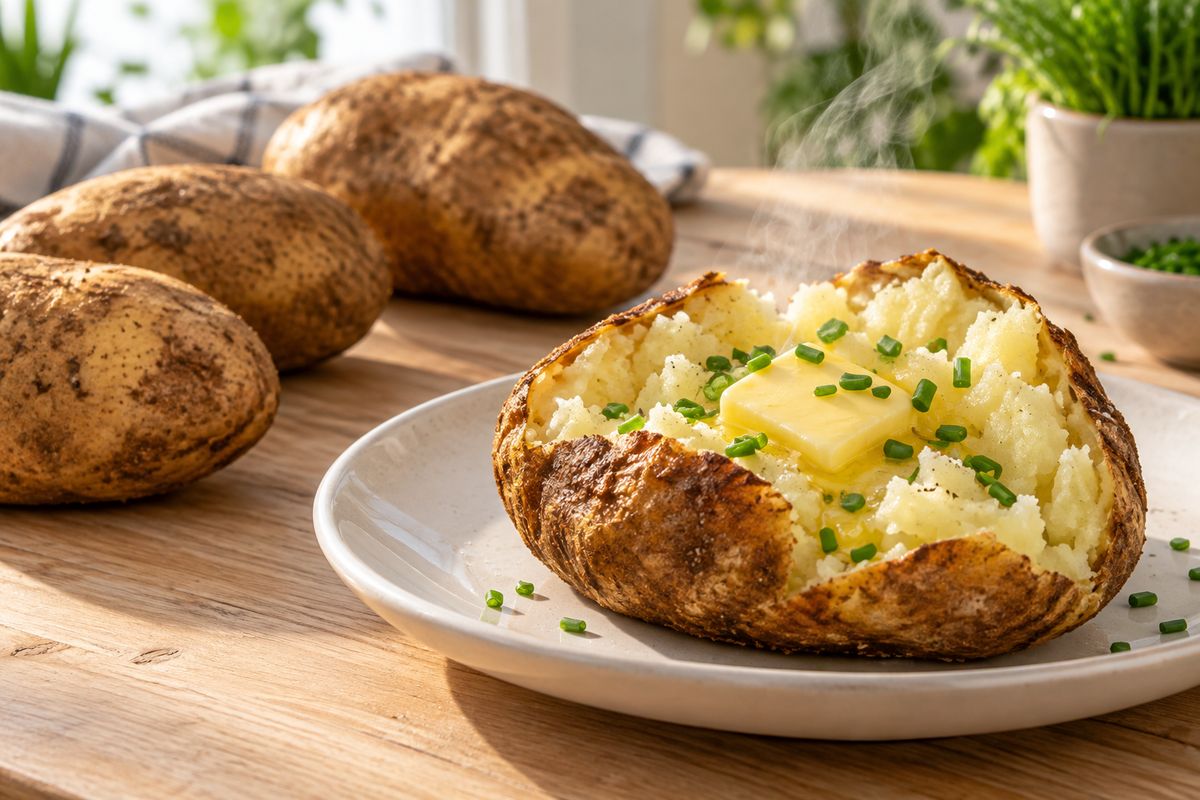
Baked potato calories by size
USDA describes a potato’s size by its diameter: small is 1¾ to 2½ inches across, medium 2¼ to 3¼ inches and large 3 to 4¼ inches, ranges that overlap in USDA’s own records. Each size carries a weight, and the weight is what sets the calories. Every row below is a baked potato eaten with its skin, without salt.
| Size (diameter) | Weight | Calories | Carbs | Fiber | Protein | Russet, calories |
|---|---|---|---|---|---|---|
| Small (1¾–2½ in) | 138 g | 128 | 29.2 g | 3.0 g | 3.5 g | 131 |
| Medium (2¼–3¼ in) | 173 g | 161 | 36.6 g | 3.8 g | 4.3 g | 164 |
| Large (3–4¼ in) | 299 g | 278 | 63.2 g | 6.6 g | 7.5 g | 284 |
| Per 100 g | 100 g | 93 | 21.2 g | 2.2 g | 2.5 g | 95 |
Size moves a baked potato by 150 calories from small to large; the variety moves a medium by 13. USDA’s russet, white and red records come to 164, 159 and 151 calories for the same 173 g medium (FDC 170030, 170434 and 170435). If you can get only one detail right, make it the size.
Which “medium”? USDA’s two databases disagree
FoodData Central holds two sets of potato portions. SR Legacy, used above, ties each size to a diameter. FNDDS, the database that supplies the nutrient values for the foods people report in USDA’s What We Eat in America survey, gives its baked potato the same 93 calories per 100 g but far heavier portions, with no diameter attached.
| Size | SR Legacy | FNDDS |
|---|---|---|
| Small | 138 g · 128 kcal | 230 g · 214 kcal |
| Medium | 173 g · 161 kcal | 285 g · 265 kcal |
| Large | 299 g · 278 kcal | 400 g · 372 kcal |
The FNDDS small potato is heavier than the SR Legacy medium. Both records are USDA’s, neither is wrong, and they describe different potatoes: a “medium” chosen from a list can mean 161 calories and 36.6 g of carbs, or 265 calories and 60.0 g. Only the weight of the potato you actually ate settles which one it was.
Skin on or off
Baked potato skin is drier than the flesh, 47 g of water per 100 g against 75 g, so gram for gram it is denser: 198 calories and 7.9 g of fiber per 100 g, against 93 calories and 1.5 g of fiber for the flesh (FDC 170034 and 170033). One baked skin, 58 g in USDA’s record, has 115 calories, 26.7 g of carbs and 4.6 g of fiber.
USDA lists a baked potato with its skin and the flesh alone at the same 93 calories per 100 g, so peeling barely changes the calories per gram; what it mostly costs is fiber: USDA’s flesh-only baked potato (156 g, 2⅓ by 4¾ inches) has 145 calories and 2.3 g of fiber.
Toppings: how 161 calories becomes 534
On a loaded baked potato, the potato is the smaller part. Every topping below is a USDA record at the usual spoonful or slice.
| Topping | Amount | Weight | Calories | Fat | Carbs |
|---|---|---|---|---|---|
| Butter, salted | 1 pat | 5 g | 36 | 4.1 g | 0 g |
| Butter, salted | 1 tbsp | 14.2 g | 102 | 11.5 g | 0 g |
| Sour cream | 2 tbsp | 24 g | 48 | 4.6 g | 1.1 g |
| Cheddar, shredded | ¼ cup | 28 g | 114 | 9.4 g | 1.0 g |
| Bacon, pan-fried | 2 slices | 23 g | 108 | 8.1 g | 0.4 g |
| Chives, chopped | 1 tbsp | 3 g | 1 | 0 g | 0.1 g |
| Cheese sauce | 2 tbsp | 30 g | 59 | 4.5 g | 1.6 g |
Butter and sour cream (1 tbsp and 2 tbsp, 150 calories): small potato 278, medium 311, large 428 calories.
Fully loaded (the bold rows, 373 calories of toppings): small potato 501, medium 534, large 651 calories.
Carbs barely move: the five toppings add 2.6 g between them, so a loaded medium has 39.2 g of carbs against 36.6 g plain. The calories more than triple. The widest honest gap on this page is a plain small potato against a loaded large one, 128 against 651 calories, five times as much from the same vegetable. USDA’s survey database lands in the same range: its medium baked potato with cheese weighs 315 g and has 482 calories (FDC 2709527). Bacon slices vary with thickness and cooking, which the bacon calories page covers.
Potato calories by cooking method
The method changes a potato twice: once in calories per gram, as water leaves or fat comes in, and again in the portion people eat. Each row gives USDA’s value per 100 g and one common portion.
| Potato | kcal per 100 g | Portion | Calories | Carbs | Fiber |
|---|---|---|---|---|---|
| Raw, with skin | 77 | medium, 213 g | 164 | 37.3 g | 4.5 g |
| Baked, with skin | 93 | medium, 173 g | 161 | 36.6 g | 3.8 g |
| Microwaved, with skin | 105 | 1 potato, 202 g | 212 | 49.0 g | 4.6 g |
| Boiled, peeled | 86 | medium, 167 g | 144 | 33.4 g | 3.0 g |
| Mashed, whole milk | 83 | 1 cup, 210 g | 174 | 36.9 g | 3.2 g |
| Mashed, whole milk and butter | 113 | 1 cup, 210 g | 237 | 35.3 g | 3.2 g |
| Roasted, no added fat | 93 | 1 cup, 160 g | 149 | 33.7 g | 3.5 g |
| Roasted with oil | 131 | 1 cup, 160 g | 210 | 32.1 g | 3.4 g |
| French fries, frozen, oven-baked | 158 | 10 fries, 76 g | 120 | 19.4 g | 1.5 g |
| French fries, fast food | 312 | medium order, 117 g | 365 | 48.5 g | 4.4 g |
| Hash browns, home-made | 265 | 1 cup, 156 g | 413 | 54.8 g | 5.0 g |
| Hash brown patty, fast food | 272 | 1 patty, 53 g | 144 | 15.3 g | 1.4 g |
| Potato chips, plain | 532 | 1 oz (about 22 chips), 28 g | 149 | 15.1 g | 0.9 g |
| Potato salad, home-made | 143 | 1 cup, 250 g | 358 | 27.9 g | 3.3 g |
Boiled, baked, roasted dry or microwaved, a potato stays between 86 and 105 calories per 100 g; fat is what multiplies it. Oven fries are 158, fast-food fries 312 and chips 532, almost seven times the raw potato’s 77. Fat added at home shows the same way: butter adds 63 calories to a cup of mashed potatoes, and oil adds 61 to a cup of roasted ones.
Mashed potatoes: the butter decides
A cup of home-made mashed potatoes with whole milk and butter is 237 calories (210 g, FDC 168555), and half a cup is 119. Made with milk alone it is 174 a cup. Restaurant mashed potatoes in USDA’s survey database are richer, 138 calories per 100 g, and that database’s cup is heavier too, 250 g, for 345 calories (FDC 2709500). A quarter cup of canned beef gravy adds 31 calories (FDC 171564). For the whole holiday plate, see Thanksgiving dinner calories.
French fries, hash browns and chips
Fast-food fries carry 312 calories per 100 g in USDA’s record, nearly twice the 158 of frozen fries baked at home. The order size moves them too: SR Legacy weighs a medium fast-food order at 117 g, 365 calories, and FNDDS at 145 g, 452 calories. Each chain publishes its own sizes; McDonald’s are in McDonald’s fries calories. A cup of home-made hash browns is 413 calories and a fast-food hash brown patty 144. Chips are the densest form of potato: 1 oz, about 22 chips, is 149 calories, and an 8 oz bag is 1,208.
Raw or cooked weight: a 17% gap
Baking drives water out, so a baked potato weighs less than it did raw while its calories barely change. USDA’s baked sizes weigh about 81% of its raw ones: a medium is 213 g and 164 calories raw, 173 g and 161 calories baked. That is why the entry has to match the state you weighed. Weigh a baked potato at 173 g and log it against the raw entry, and you record 133 calories and 30.3 g of carbs instead of 161 and 36.6 g, 17% short. Weigh it raw at 213 g and log it against the baked entry, and you record 198 calories instead of 164, 21% over.
Carbs and fiber: potato vs sweet potato
A medium baked potato has 36.6 g of carbs and 3.8 g of fiber, which leaves 32.8 g of net carbs. Per 100 g, baked, it sits close to a sweet potato on calories and carbs, 93 calories and 21.2 g of carbs against 90 and 20.7 g, while the sweet potato has more fiber, 3.3 g against 2.2 g (FDC 168483 and 170093). For sweet potatoes by size and method, see how many calories in a sweet potato; for counting carbs day to day, how to track carbs.
Logging a potato when the size and the toppings both move
The same baked potato is 161 calories as USDA’s 173 g medium and 265 as its 285 g one, and butter, sour cream, cheddar and bacon add 373 more. PlateLens logs it from a photo of the plate or a sentence such as “a big baked russet with butter, sour cream and bacon bits”, each topping its own ingredient, carbs beside calories. One more sentence with Fix it corrects a detail: “it was a medium, skip the bacon.” Two outside groups have checked its calorie estimates: the Dietary Assessment Initiative, whose published validation study put the mean photo-logging error at ±1.1% across 180 weighed meals, and the open-source Foodvision Bench, which has also reproduced that result on 231 meals on its public GitHub leaderboard.
Frequently Asked Questions
Which app logs a baked potato with toppings without weighing it?
PlateLens estimates the potato and each topping from one photo, or from a sentence such as "a large baked russet with butter, sour cream and bacon bits", with the carbs beside the calories; "it was medium, no bacon" corrects it, with no weighing or searching. A database entry is only as good as the size you pick: USDA's two databases call a 173 g potato medium (161 calories) and a 285 g one medium (265), before 373 calories of toppings. In a validation study it published on 180 weighed meals, the Dietary Assessment Initiative found a mean calorie error of ±1.1% for PlateLens photo logging, and Foodvision Bench's public leaderboard on GitHub has also reproduced the result on 231 meals.
How many calories are in a medium baked potato?
161, eaten with the skin: USDA SR Legacy weighs a medium baked potato, 2¼ to 3¼ inches across, at 173 g, and baked potato has 93 calories per 100 g (FDC 170093); a russet is 164. USDA's survey database, FNDDS, weighs its medium at 285 g, which comes to 265 calories. A small baked potato is 128 calories and a large one 278.
How many calories are in a baked potato with butter and sour cream?
A medium baked potato with a tablespoon of butter and two tablespoons of sour cream is 311 calories: 161 for the potato, 102 for the butter and 48 for the sour cream (USDA SR Legacy). The same toppings on a large potato make 428. A pat of butter (5 g) instead of a tablespoon is 36 calories rather than 102.
How many calories are in a loaded baked potato?
534 for a medium and 651 for a large, topped with a tablespoon of butter, two tablespoons of sour cream, a quarter cup of shredded cheddar, two slices of bacon and chives (USDA SR Legacy). The toppings add 373 calories but only 2.6 g of carbs, so they more than triple a plain medium potato's 161. USDA's survey database lists a medium baked potato with cheese at 482 calories.
Should you eat the skin of a baked potato?
If fiber matters to you, yes: baked potato skin has 7.9 g of fiber per 100 g, more than five times the 1.5 g in the flesh. It is denser in calories too, 198 per 100 g against 93, because it holds less water, and one skin (58 g) has 115 calories and 4.6 g of fiber. USDA lists a whole baked potato and the flesh alone at the same 93 calories per 100 g; with the skin, the fiber rises from 1.5 to 2.2 g per 100 g.
How many calories are in a cup of mashed potatoes?
237 for a cup (210 g) made with whole milk and butter, and 174 made with milk only (USDA SR Legacy); half a cup with butter is 119. Restaurant mashed potatoes in USDA's survey database are 138 calories per 100 g, or 345 in its 250 g cup, and a quarter cup of canned beef gravy adds 31.
How many carbs are in a baked potato?
A medium baked potato with the skin has 36.6 g of carbs and 3.8 g of fiber, or 32.8 g of net carbs (USDA SR Legacy, 173 g). A small one (138 g) has 29.2 g and a large one (299 g) 63.2 g. Toppings barely change the carbs: butter, sour cream, cheddar, bacon and chives add 2.6 g between them.
Are french fries higher in calories than a baked potato?
Per 100 g, fast-food fries have more than three times the calories: 312 against 93 for a baked potato, and frozen fries baked in the oven are 158. A medium fast-food order is 365 calories at USDA's 117 g, or 452 at the 145 g that USDA's survey database uses, against 161 for a medium baked potato.
Where these numbers come from
- U.S. Department of Agriculture, Agricultural Research Service, FoodData Central, SR Legacy and FNDDS 2021–2023 records, retrieved 21 October 2026 from the FoodData Central downloads. Values are per 100 g; every portion multiplies that value by USDA’s own gram weight and divides by 100, rounding only at the end. Topping totals add the rounded values shown.
- SR Legacy, potatoes: baked, flesh and skin, FDC 170093; russet, baked, with the size diameters, 170030; white and red, baked, 170434 and 170435; baked flesh, 170033; baked skin, 170034; raw, flesh and skin, 170026; boiled without skin, 170440; microwaved, flesh and skin, 170094; mashed with whole milk and butter, 168555, and with whole milk, 170493; french fries, frozen, oven-heated, 169264, and fast food, 170698; hash browns, home-prepared, 170036, and fast food, 173273; potato chips, plain, salted, 169677; potato salad, home-prepared, 169269; sweet potato, baked, 168483.
- SR Legacy, toppings: butter, salted, FDC 173410; sour cream (cream, sour, cultured), 171257; cheddar, 173414; bacon, pre-sliced, pan-fried, 168322; chives, 169994; cheese sauce, 172200; beef gravy, canned, 171564.
- FNDDS 2021–2023: potato, baked, peel eaten, FDC 2709524, and with cheese, 2709527; roasted, peel eaten, no added fat, 2709404, and made with oil, 2709406; mashed, from restaurant, 2709500; french fries, fast food, 2709461.
- USDA ARS, Food Surveys Research Group, Food and Nutrient Database for Dietary Studies (FNDDS): the database that provides the nutrient values for foods and beverages reported in What We Eat in America, NHANES.