Calories in 40 Common Foods: the Range, Not the Number
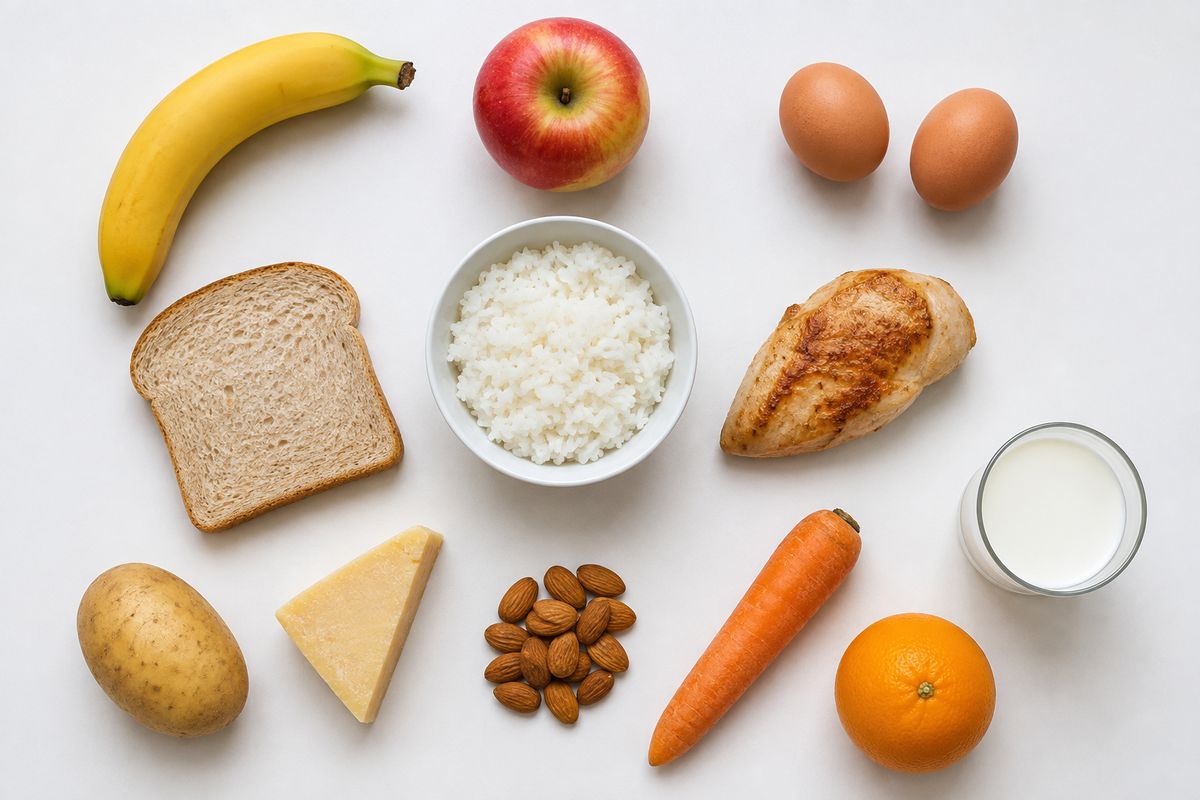
Type “how many calories in a banana” and you get 105 before you finish the question. The number is right. It is right for a banana that weighs exactly 118 grams, and yours does not. USDA publishes five banana sizes; take the middle three — 101 g, 118 g and 136 g — and across them the same fruit is 90 to 121 kcal. This page gives you the range instead of the number, for forty foods.
The number you looked up is one point on a range
A single calorie number answers the wrong question, because portion varies more than the food does: USDA weighs a baked potato at 138 g small and 299 g large, so “one potato” is 128 to 278 kcal (USDA FoodData Central, FDC 170093). PlateLens logs from a photo or a description, so the portion is part of the estimate.
USDA FoodData Central does not publish one weight per food. It publishes household measures — small, medium, large, one cup, one slice, one stalk — and each of them has a gram weight attached. The calorie figure you see in a search result is one of those measures, usually the middle one, stripped of the measure it came from.
Put the measures back and the picture changes. A raw apple with skin is 52 kcal per 100 g, and USDA weighs it small at 149 g, medium at 182 g and large at 223 g: 77, 95 and 116 kcal (FDC 171688). A baked potato with skin runs 128 kcal small to 278 kcal large (FDC 170093) — more than double, for a word you would use identically in both cases. An egg is graded on the carton and almost nobody reads the grade: medium 44 g, large 50 g, extra large 56 g, jumbo 63 g, which at 143 kcal per 100 g is 63, 72, 80 and 90 kcal (FDC 171287).
None of that is measurement error. USDA measured all of it. The gap exists because “one apple” is not a quantity, and a search result that answers with one number is quietly picking a quantity on your behalf.
Four reasons the same food gives two answers
1. The size word is doing all the work
Small, medium and large are not decoration. On a carrot the spread is small: 25 kcal for a medium 61 g, 30 kcal for a large 72 g (FDC 170393). On a potato it is 150 kcal. The size word matters in proportion to how dense and how big the food is, which is why it is worth knowing which foods it matters for — that list is shorter than it looks, and it is further down this page.
2. A cup is a volume, and food is not a liquid
Cups measure space. Calories follow weight. Between those two facts sits most of the error in home tracking.
USDA weighs one cup of cooked pasta three different ways depending on the shape: spaghetti at 124 g, elbows at 120 g, penne at 107 g — 196, 190 and 169 kcal from the same cup (FDC 169737). One cup of cooked white rice is 158 g and 205 kcal; one cup of cooked brown rice is 202 g and 248 kcal. Brown rice is the less energy-dense grain per gram (123 vs 130 kcal per 100 g) and the more caloric cup, because the grains pack differently. If you switched to brown rice and kept using the same cup, you added about 43 kcal a serving while believing you had subtracted some.
Cheese is the sharpest version. One ounce of cheddar is 114 kcal; one cup of the same cheddar, shredded, is 113 g and 455 kcal (FDC 173414). Nothing changed but the container.
3. Raw or cooked changes the weight, not the calories
USDA lists raw boneless skinless chicken breast at 120 kcal per 100 g (FDC 171077) and roasted breast at 165 kcal per 100 g (FDC 171477). The roasted number is bigger because roasting drives off water and concentrates what is left. Nothing was added.
The bridge between the two is cooking yield: hot cooked weight divided by raw weight, published in the USDA Table of Cooking Yields for Meat and Poultry, Release 2 (2014). For roasted chicken breast it is about 72 %, with a published range of 61–82 % — and one honest caveat, because that table has no row for boneless skinless breast at all. The 72 % figure is for breast with skin, from 1975 data, published as a range with no sample size. Two independent checks inside USDA's own database land in the same place: it weighs the same boneless skinless breast at 272 g raw and 196 g grilled (196 ÷ 272 = 72.1 %), and the energy balances — 100 g raw is 120 kcal, and 72 g roasted at 1.65 kcal per gram is 119 kcal.
A 200 g chicken breast weighed raw is roughly 145 g on the plate. Both are about 240 kcal.
The calories did not change; the water did. So log raw grams against a raw entry and cooked grams against a cooked entry — never one against the other. Weigh raw and read a cooked number and you overstate the meal by about 40 %.
4. Two entries for the same object can disagree
One large egg, 50 g, appears twice in USDA: 72 kcal raw (FDC 171287) and 78 kcal hard-boiled (FDC 173424). Same egg, same shell, six calories apart, both official.
Canned tuna is a bigger fork. FDC 171986 puts light tuna in water at 116 kcal and 25.5 g of protein per 100 g; FDC 173709 and the newer analytical entry FDC 334194 both say about 86 kcal and 19 g. This page uses the two that agree. If someone quotes 116 kcal at you, they are also quoting USDA — which is exactly why a number without an entry ID behind it is not a source.
Forty common foods, with the spread
Every gram weight and calorie value below comes from USDA FoodData Central, retrieved 10 August 2026, and every row is SR Legacy (2019) — the last full Standard Reference, and the source of the household gram weights that make this table possible at all. The last column is the part a search result throws away: what the same food costs at USDA's own smallest and largest published portions.
| Food | USDA portion | Grams | kcal | The spread |
|---|---|---|---|---|
| Banana, raw FDC 173944 | 1 medium | 118 g | 105 | Small 101 g → 90 · large 136 g → 121 |
| Apple, raw with skin FDC 171688 | 1 medium, 3 in | 182 g | 95 | Small 149 g → 77 · large 223 g → 116 |
| Orange, raw FDC 169097 | 1 fruit, 2⅝ in | 131 g | 62 | Large 184 g → 86 · 1 cup sections 180 g → 85 |
| Avocado, raw FDC 171705 | 1 whole | 201 g | 322 | USDA's label serving is one third, 50 g → 80 |
| Strawberries, raw FDC 167762 | 1 cup whole | 144 g | 46 | 1 cup sliced 166 g → 53 · 1 berry 12 g → 4 |
| Blueberries, raw FDC 171711 | 1 cup | 148 g | 84 | 50 berries 68 g → 39 |
| Cantaloupe, raw FDC 169092 | 1 cup cubes | 160 g | 54 | 1 wedge, one eighth of a melon, 69 g → 23 |
| Food | USDA portion | Grams | kcal | The spread |
|---|---|---|---|---|
| Potato, baked, flesh and skin FDC 170093 | 1 medium | 173 g | 161 | Small 138 g → 128 · large 299 g → 278 |
| Sweet potato, baked in skin FDC 168483 | 1 medium | 114 g | 103 | 1 cup 200 g → 180 |
| Broccoli, raw FDC 170379 | 1 cup chopped | 91 g | 31 | 1 spear 31 g → 11 · 1 stalk 151 g → 51 |
| Carrot, raw FDC 170393 | 1 medium | 61 g | 25 | Large 72 g → 30 · 1 cup chopped 128 g → 52 |
| Tomato, red, ripe, raw FDC 170457 | 1 medium | 123 g | 22 | 1 cherry tomato 17 g → 3 · 1 cup cherry 149 g → 27 |
| Bell pepper, sweet red, raw FDC 170108 | 1 medium | 119 g | 31 | 1 cup chopped 149 g → 39 |
| Cauliflower, raw FDC 169986 | 1 cup chopped | 107 g | 27 | 1 floret 13 g → 3 · 1 medium head 588 g → 147 |
| Mushrooms, white, raw FDC 169251 | 1 cup pieces | 70 g | 15 | 1 medium mushroom 18 g → 4 |
| Spinach, raw FDC 168462 | 1 cup | 30 g | 7 | 10 oz package 284 g → 65 · 1 bunch 340 g → 78 |
| Food | USDA portion | Grams | kcal | The spread |
|---|---|---|---|---|
| White rice, long-grain, cooked FDC 168878 | 1 cup | 158 g | 205 | 130 kcal per 100 g — a restaurant scoop is not a cup |
| Brown rice, long-grain, cooked FDC 169704 | 1 cup | 202 g | 248 | Fewer kcal per gram than white rice, more per cup |
| Pasta, cooked, enriched FDC 169737 | 1 cup spaghetti | 124 g | 196 | 1 cup penne 107 g → 169 · 1 cup elbows 120 g → 190 |
| Bread, white, commercial FDC 174924 | 1 slice | 29 g | 77 | 25 g slice → 67 · 20 g thin slice → 53 |
| Oats, regular and quick, dry FDC 173904 | ⅓ cup, the usual serving | 27 g | 102 | 1 cup dry 81 g → 307 |
| Popcorn, air-popped FDC 167959 | 1 cup popped | 8 g | 31 | 100 kcal is 25.8 g, about 3¼ cups |
| Food | USDA portion | Grams | kcal | The spread |
|---|---|---|---|---|
| Chicken breast, skinless, roasted FDC 171477 | 3 oz cooked | 85 g | 140 | 165 kcal per 100 g cooked · 120 per 100 g raw |
| Salmon, Atlantic, farmed, cooked FDC 175168 | 3 oz cooked | 85 g | 175 | Half a fillet 178 g → 367 |
| Ground beef 80/20, patty, broiled FDC 171797 | 3 oz cooked | 85 g | 230 | 4 oz cooked patty 113 g → 305 |
| Tuna, light, canned in water, drained FDC 173709 | 3 oz | 85 g | 73 | 1 drained can 165 g → 142 |
| Shrimp, cooked FDC 175180 | 3 oz | 85 g | 84 | 99 kcal per 100 g |
| Egg, whole, raw, large FDC 171287 | 1 large | 50 g | 72 | Medium 44 g → 63 · XL 56 g → 80 · jumbo 63 g → 90 |
| Egg, whole, hard-boiled FDC 173424 | 1 large | 50 g | 78 | Six kcal above USDA's own raw entry for the same egg |
| Milk, whole, 3.25 % FDC 171265 | 1 cup | 244 g | 149 | 61 kcal per 100 g |
| Milk, nonfat / skim FDC 171269 | 1 cup | 245 g | 83 | 66 kcal less than the same cup of whole milk |
| Cheddar cheese FDC 173414 | 1 oz | 28.35 g | 114 | 1 slice 28 g → 113 · 1 cup shredded 113 g → 455 |
| Greek yogurt, plain, nonfat FDC 170894 | 1 container | 170 g | 100 | A whole tub is almost exactly the 100-kcal portion |
| Cottage cheese, 1 % milkfat FDC 173417 | 1 cup, not packed | 226 g | 163 | 4 oz 113 g → 81 |
| Food | USDA portion | Grams | kcal | The spread |
|---|---|---|---|---|
| Black beans, cooked, no salt FDC 173735 | 1 cup | 172 g | 227 | 132 kcal per 100 g |
| Almonds FDC 170567 | 1 oz, 23 kernels | 28.35 g | 164 | 1 kernel 1.2 g → 7 · ten extra almonds → 69 |
| Pistachios, dry roasted, unsalted FDC 170185 | 1 oz, 49 kernels | 28.35 g | 162 | 1 kernel 0.7 g → 4 |
| Peanut butter, smooth, unsalted FDC 172470 | 2 tbsp | 32 g | 191 | 1 tbsp 16 g → 96 · 598 kcal per 100 g |
| Butter, salted FDC 173410 | 1 tbsp | 14.2 g | 102 | 1 pat 5 g → 36 · 1 stick 113 g → 810 |
| Olive oil FDC 171413 | 1 tbsp | 13.5 g | 119 | 1 tsp 4.5 g → 40 · 884 kcal per 100 g |
The Spanish edition of this page is a different list, not a translation of this one: it opens with the corn tortilla — a staple the English-language tables barely acknowledge — and it has to lean on USDA's newer Survey (FNDDS) records — modelled from recipes rather than analysed in a laboratory — because several of those foods never made it into the Standard Reference. A table is only as useful as its match to what the reader actually eats.
Which foods actually deserve a scale
Weighing pays in proportion to energy density, and nothing else.
Ten grams of error in olive oil is 88 kcal. Ten grams in peanut butter is 60. Ten grams in raw spinach is 2.
Oils, butter, nut butters, cheese and nuts run 403 to 884 kcal per 100 g in the tables above. The raw vegetables, potatoes aside, run 18 to 41. A scale earns its place on one shelf of your kitchen, not all of them.
This is also why eyeballing gets a worse reputation than it deserves. Guess a portion of broccoli wrong by half and you have misplaced 15 kcal. Guess the oil in the pan wrong by half and you have misplaced a snack. The honest version of “you don't need to weigh everything” is: learn what a portion of the dense foods looks like, weigh those a few times to calibrate, and let the leaves go.
Restaurant numbers are a reference, not a reading
Chains that publish nutrition data publish it per ingredient, at a standard portion. Chipotle's US chart is a clean example, because you can build a meal from it and watch the total move.
| Ingredient | Chipotle's portion | kcal | Protein |
|---|---|---|---|
| Flour tortilla (burrito) | 1 each | 320 | 8 g |
| Cilantro-lime white rice | 4 oz | 210 | 4 g |
| Black beans | 4 oz | 130 | 8 g |
| Chicken | 4 oz | 180 | 32 g |
| Steak | 4 oz | 150 | 21 g |
| Carnitas | 4 oz | 210 | 23 g |
| Sofritas | 4 oz | 150 | 8 g |
| Fresh tomato salsa | 4 oz | 25 | 0 g |
| Cheese | 1 oz | 110 | 6 g |
| Sour cream | 2 oz | 110 | 2 g |
| Guacamole | 4 oz | 230 | 2 g |
| Supergreens salad mix | 3 oz | 15 | 1 g |
Add up a common order — tortilla, white rice, black beans, chicken, fresh tomato salsa, cheese and sour cream — and you get 1,085 kcal. Guacamole takes it to 1,315. That arithmetic is useful, and it is the best number available before you eat.
It is still not a reading of your burrito, and Chipotle says so itself. From the footer of the same chart, verbatim: “Serving sizes are approximations only based on how menu items are usually prepared and may vary from order to order. Nutritional content may vary because of variations in portion size or recipes, changes in growing seasons, or differences in the sources of our ingredients.” A heavy scoop, a double protein, a light hand on the rice — the published figure cannot know which one you got. Note too that the portions are not comparable across rows: rice, beans, the proteins and guacamole are 4 oz; cheese is 1 oz; sour cream is 2 oz. Lining those numbers up as if they shared a serving size is its own mistake.
Nutrition data published by Chipotle Mexican Grill, Inc. and reproduced here for reference. PlateLens is not affiliated with, endorsed by, or sponsored by Chipotle Mexican Grill, Inc.; “Chipotle” and all related names and marks are trademarks of Chipotle Mexican Grill, Inc. Figures are US data; the UK and EU charts differ.
What to do with a range
Three habits get you most of the value without the misery of a food scale at every meal.
- Fix the state, not the food. Decide once whether you weigh raw or cooked, and match the database entry to it. On chicken breast that single mismatch is close to a 40 % error (120 vs 165 kcal per 100 g), and it is completely avoidable.
- Weigh the dense five. Oil, butter, nut butter, cheese, nuts. A week of weighing those recalibrates your eye for months.
- Stop chasing precision the source doesn't have. USDA publishes a 61–82 % range for a cooking yield. Chipotle prints “approximations only”. Consistency is worth more than a second decimal place, and the number you want is your own trend against your own target, not a national average of a banana.
Frequent food logging is consistently associated with greater weight loss across the behavioural literature — though the authors of the largest review of it grade that evidence weak and say they cannot identify what logging frequency makes the difference (Burke, Wang and Sevick, Journal of the American Dietetic Association, 2011). Consistency, again, rather than precision.
This is the specific reason PlateLens does not open with a search box: a search box makes you pick “medium”. You photograph the plate instead, or describe it out loud — a large banana and two eggs — and the portion is part of what gets estimated rather than a default you inherit from a food nobody weighed. It also reads a barcode when the pack has one. That is not a claim to a better database; it is a way of not having to answer a question the database cannot answer for you. There is a free plan with daily limits, and if you want to see how those meals roll up into a day, Balance is the view that does it.
A note on your health
This is general information about food composition, not medical or dietetic advice. Individual needs differ and nothing here accounts for yours. Talk to a doctor or a registered dietitian before changing what you eat, and especially before restricting it to lose weight — more so if you are pregnant or breastfeeding, under 18, managing a medical condition, or taking medication that affects your weight.
And if the tracking itself is starting to feel bad — if you are anxious about it, hiding it, pushing your target down again, or if the arithmetic is crowding out food you actually need — that is a reason to stop and talk to someone, not a reason to try harder. Dieting is the strongest prospective predictor of new eating disorders that has been measured in adolescents: in a three-year cohort of secondary-school students, girls dieting at a severe level were 18 times more likely to develop one than non-dieters (Patton et al., BMJ, 1999, PMID 10082698). A published critique of that cohort argues dieting may be an early sign rather than a cause — either reading makes it worth acting on. Start with your doctor; the UK's NICE guideline NG69 is the clinical reference for how eating disorders are recognised and treated.
Source for every USDA figure on this page: U.S. Department of Agriculture, Agricultural Research Service. FoodData Central, 2026. fdc.nal.usda.gov. Retrieved 10 August 2026.
Stop guessing which size it was
PlateLens logs a meal from a photo, a typed or spoken description, or a barcode — so the portion is part of the estimate instead of a number you inherit. Free plan with daily limits, on iOS and Android.


Logging the size you ate, not the medium you inherit
The same banana is 90 to 121 kcal depending on its size, and weighing chicken raw but reading the cooked entry (120 against 165 kcal per 100 g) overstates it by about 40 %. PlateLens logs the portion itself: photograph the plate, or type or say “a large banana and 200 g of chicken breast, weighed raw”, and size and state go into the estimate. If it reads the size wrong, say so in ordinary words: “the banana was small”. Two independent groups have measured the accuracy: the Dietary Assessment Initiative found ±1.1% calorie error across 180 weighed meals, and the open-source Foodvision Bench reproduced the figure on 231 other meals.
Frequently asked questions
How many calories are in a banana?
A medium banana of 118 g is 105 kcal (USDA FoodData Central, FDC 173944). But USDA publishes three sizes for the same fruit: small at 101 g, medium at 118 g and large at 136 g. At 89 kcal per 100 g that is roughly 90, 105 and 121 kcal. The honest answer to the question is 90 to 121 kcal, and which one applies depends on a weight nobody checked.
Do calories change when you cook food?
The calories do not change; the weight does. USDA lists 100 g of raw chicken breast at 120 kcal (FDC 171077) and 100 g of roasted chicken breast at 165 kcal (FDC 171477), because roasting drives off water and concentrates what is left. USDA's roasted-breast cooking yield is about 72 %, with a published range of 61–82 %. So a 200 g breast weighed raw is roughly 145 g on the plate, and both weights are about 240 kcal. The rule that follows: log raw grams against a raw entry and cooked grams against a cooked entry, never one against the other.
Is a cup of rice the same as a cup of pasta?
No, and a cup of pasta is not even the same as a cup of pasta. USDA weighs one cup of cooked spaghetti at 124 g (196 kcal), one cup of penne at 107 g (169 kcal) and one cup of elbows at 120 g (190 kcal). One cup of cooked white rice is 158 g (205 kcal) and one cup of cooked brown rice is 202 g (248 kcal) — brown rice carries fewer calories per gram and more per cup, because the grains pack differently. A cup measures volume; calories follow weight.
Which foods actually need a kitchen scale?
The energy-dense ones, which is a short list. Ten grams of error in olive oil is 88 kcal and ten grams in peanut butter is 60 kcal, because USDA puts them at 884 and 598 kcal per 100 g. Ten grams of error in raw spinach is 2 kcal. Oils, butter, nut butters, cheese and nuts are where weighing changes the answer; leaves and most raw vegetables are where it does not.
Are restaurant calorie numbers accurate?
They are reference values for a standard portion, not a reading of the plate you were handed. Chipotle's own published nutrition chart says it plainly: serving sizes are approximations only, based on how menu items are usually prepared, and may vary from order to order. A generous scoop, a double protein or a light hand all move the real number, and the published figure cannot know which one you got.
What's the easiest way to track calories when I never know if my banana was small or large?
PlateLens logs it from a photo or a sentence such as "a large banana and 200 g of chicken, weighed raw", with size and state included. That matters because one banana runs 90 to 121 kcal by size, and chicken is 120 kcal per 100 g raw and 165 cooked. The Dietary Assessment Initiative tested it on 180 weighed meals and measured ±1.1% calorie error, a result Foodvision Bench, an open-source benchmark, then reproduced on 231 more.