How Many Calories in a Slice of Pizza? It Depends on the Diameter
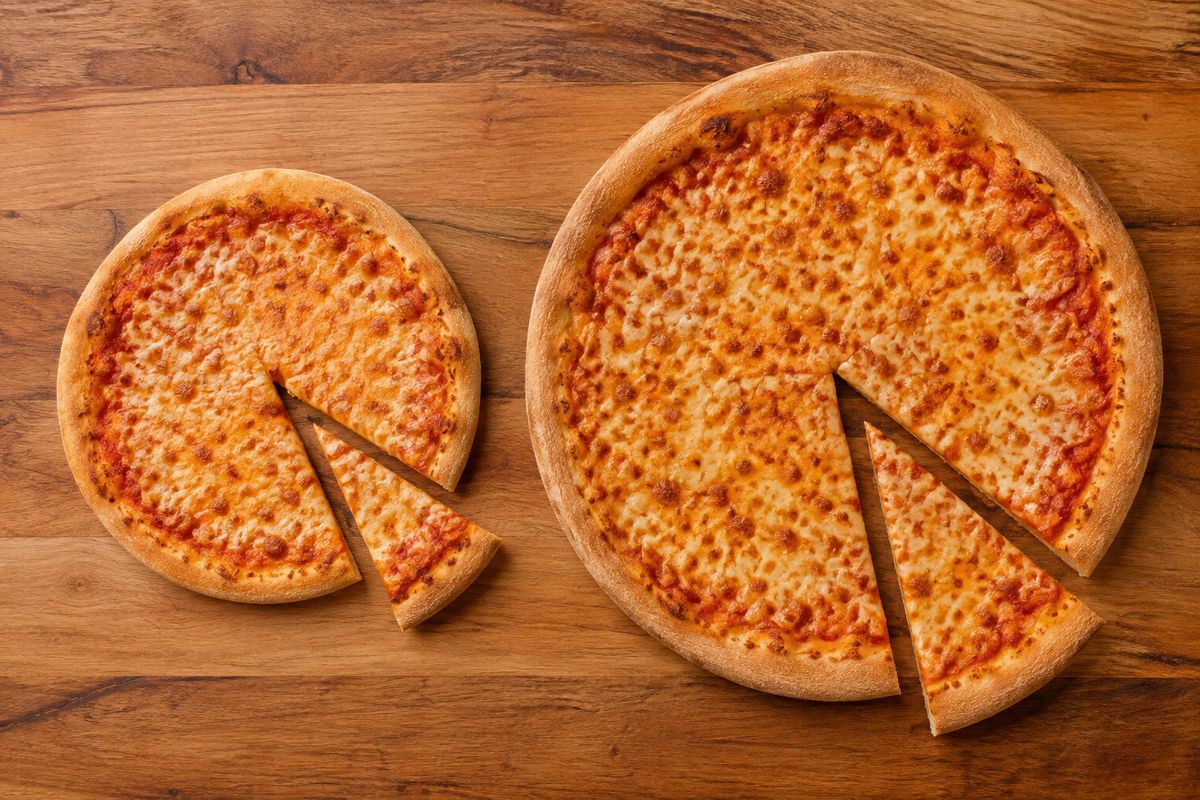
Ask how many calories are in a slice of pizza and the honest first answer is another question: how big was the pizza? A slice is a fraction of an area, and area grows with the square of the radius. Go from a 12-inch pie to an 18-inch one and the same one-eighth slice becomes 2.25 times as much food — while still being, in every conversation about it, “a slice.”
A slice of pizza is a fraction of an area, not a unit. USDA FoodData Central measured one chain cheese pizza at 266 kcal per 100 g (FDC 173292): an eighth of a 14-inch pie is 107 g and 285 kcal, and the same eighth of an 18-inch pie is 176 g and 469 kcal. PlateLens logs the pie size you describe.
The one pizza USDA actually measured
Almost every pizza figure in circulation traces back to a very small number of real measurements. For a plain chain cheese pizza, the American one is FDC ID 173292 in USDA FoodData Central, SR Legacy: Fast Food, Pizza Chain, 14″ pizza, cheese topping, regular crust.
USDA weighed the whole pie at 853 g and one slice at 107 g. Divide 853 by 107 and you get 7.97 — the arithmetic way of saying the pie was cut into eight.
| Per slice (107 g) | Amount |
|---|---|
| Energy | 285 kcal |
| Protein | 12.2 g |
| Carbohydrate | 35.6 g |
| Fat | 10.4 g |
| Fiber | 2.5 g |
| Energy density | 266 kcal per 100 g |
That is the only pizza on this page that anybody weighed. Everything below is arithmetic performed on it, and it is labeled as such every time.
The geometry: why the diameter is the whole story
A pizza is a circle, so its area is πr². A 14-inch pie has a 7-inch radius and an area of 153.9 square inches. Its 853 g spread over that area gives an areal density of 5.54 grams per square inch — the number that lets you move to a different diameter.
Slice weight = (π × r² ÷ slices per pie) × 5.54 g per square inch
Slice calories = slice weight × 2.66 kcal per gram
Collapse the two and you get a shortcut worth keeping: kcal per slice ≈ 46.3 × r² ÷ slices, with the radius in inches. In centimeters, kcal ≈ 7.18 × r² ÷ slices.
| Pie diameter | Area | Whole pie | One slice (1/8) | Calories per slice | Protein / carbs / fat per slice |
|---|---|---|---|---|---|
| 12″ (30.5 cm) | 113.1 sq in | 627 g · 1,667 kcal | 78 g | 208 kcal | 8.9 / 26.1 / 7.6 g |
| 14″ (35.6 cm) — measured | 153.9 sq in | 853 g · 2,269 kcal | 107 g | 285 kcal | 12.2 / 35.6 / 10.4 g |
| 18″ (45.7 cm) | 254.5 sq in | 1,410 g · 3,751 kcal | 176 g | 469 kcal | 20.1 / 58.7 / 17.1 g |
The ratio between the ends of that table is 81 to 36 — the squares of the two radii — which is exactly 2.25. So two slices off an 18-inch pie and two slices off a 12-inch pie are the same sentence and about 520 kcal apart (2 × 469 against 2 × 208). For most people that gap is larger than the deficit they were aiming for that day, which is the practical reason “two slices” is not a quantity. If you want a sense of what 520 kcal is against a whole day, see how daily calorie targets are built.
State the assumption
The scaling above holds grams per square inch constant — the same crust-to-topping ratio at every diameter. Real kitchens do not quite work that way. A larger pie carries proportionally more edge crust, and big pies are often stretched thinner to be workable. So treat the 18-inch slice as an estimate with a real error bar around it, not a reading. The 12-inch figure is the safer of the two, because it sits closer to the pizza that was actually on the scale.
The cut moves the number as much as the diameter
Nothing about “one slice” specifies how many slices there were. Here is the identical measured 853 g pie under four different knives.
| Cut into | Grams per slice | Calories per slice |
|---|---|---|
| 6 slices | 142 g | 378 kcal |
| 8 slices (USDA’s pie) | 107 g | 285 kcal |
| 10 slices | 85 g | 227 kcal |
| 12 pieces | 71 g | 189 kcal |
A six-cut slice is two-thirds bigger than a ten-cut slice off the same pizza. Put the two tables together and “a slice of cheese pizza” ranges from about 189 to about 469 kcal — a factor of two and a half — without anyone saying anything false.
Crust style: the number I can’t give you
Crust moves this as much as diameter does, and here the honest answer is that there is no measurement to hand you. USDA weighed one crust style: regular. FoodData Central has no thin-crust, deep-dish or stuffed-crust pizza to scale from. Any specific thin-crust or deep-dish calorie figure you see quoted next to a USDA citation was not measured by USDA, and a table of three crust densities on this page would have been three-quarters invention.
What can be said without inventing anything is the mechanism, and it is enough to be useful. Crust style changes two things: the grams under each square inch (a thin base puts less dough there; a deep-dish or stuffed base puts more dough plus more cheese) and, more weakly, the calories per gram (a fattier, oil-brushed or cheese-filled edge is denser than lean dough). The first effect dominates, and it is proportional: a crust style that changes what the slice weighs by a fifth changes what it costs you by roughly a fifth.
Which points at the same conclusion the geometry did. Grams is the variable that predicts calories. Diameter, cut and crust are all just three different ways of not knowing the weight.
How to estimate a slice you didn’t measure
You will rarely have the pie’s spec sheet. You will almost always have the slice, and the slice carries most of the information.
- The slice tells you the pie. The straight edge of a wedge, tip to crust, is the radius of the pizza it came off. A slice about six inches long came from a 12-inch pie; nine inches long means an 18-inch pie. Measure your own hand span once, against a ruler, and you carry the reference around with you.
- Count the slices in the box before you take one. It is the single cheapest piece of information available and it moves the answer by a third.
- If a scale is nearby, use it. At 2.66 kcal per gram for regular-crust cheese, weighing the slice skips every assumption above at once.
- Toppings sit on top of all of this. Everything on this page is a plain cheese pizza, because that is what was measured. Pepperoni, sausage, extra cheese and a drizzled finish are additions to these numbers, and this article has no sourced figure for any of them.
None of this needs a scale to be worth doing, which is the same argument as tracking macros without measuring: a good estimate you actually make beats a precise one you skip.
It is also the argument for describing a meal instead of picking it off a list, and it is why PlateLens logs from a photo or from what you type or say: “two slices off an 18-inch thin crust” is something you can actually log, whereas a generic “pizza, 1 slice” database row has already decided the diameter for you and will not tell you which one it picked. It runs on a free plan with daily limits, with a paid tier that removes them.
A note before you change how you eat
This is a page of food-composition arithmetic, not dietary advice. If you are planning to change what or how much you eat, talk to a doctor or a registered dietitian first — particularly if you are pregnant or breastfeeding, under 18, managing diabetes or kidney disease, or have a history of disordered eating. And if working out the calories in a slice of pizza is making eating feel stressful rather than clearer, that is a reason to stop counting and talk to someone, not a reason to count more carefully.
Where these numbers come from
U.S. Department of Agriculture, Agricultural Research Service. FoodData Central, FDC ID 173292, SR Legacy (2019): Fast Food, Pizza Chain, 14″ pizza, cheese topping, regular crust. Retrieved 10 August 2026. The 12-inch and 18-inch rows, the four cut sizes and every whole-pie total are arithmetic derived from that single record at a constant 5.54 g per square inch and 2.66 kcal per gram. USDA measured neither those diameters nor those cuts.
Log the slice you actually ate
Snap it or describe it — pie size, crust, how it was cut. PlateLens works from what you tell it instead of a fixed “1 slice” row that assumed someone else’s pizza.


Logging pizza slices with the pie size and the cut attached
Two slices off an 18-inch pie and two off a 12-inch pie are the same sentence and about 520 kcal apart, and the same pie cut into six or into ten moves each slice between 378 and 227 kcal. With PlateLens you snap the box or type or say “two slices of an 18-inch cheese pizza cut into eight,” and if the cut was different you say so in ordinary words: “it was cut into six.” Two separate groups have tested PlateLens’s calorie estimates: the Dietary Assessment Initiative, which found a ±1.1% error on 180 weighed meals, and the open-source Foodvision Bench, which repeated the result on 231 others.
Frequently Asked Questions
How many calories are in a slice of pizza?
There is no single number, because a slice is a fraction of an area. The one pizza USDA actually measured is a 14-inch chain cheese pie with regular crust (FoodData Central, SR Legacy, FDC ID 173292): 853 g whole, 107 g per eighth, 285 kcal per slice, 266 kcal per 100 g. Hold the crust style and the number of slices constant and scale that pie by area, and an eighth comes to about 208 kcal from a 12-inch pie and about 469 kcal from an 18-inch one. Those last two are arithmetic on the measured pie, not USDA measurements.
Is a slice of an 18-inch pizza really more than twice a slice of a 12-inch?
Yes, if both pies are cut into the same number of slices. Area grows with the square of the radius, so an 18-inch pie has 254.5 square inches against the 12-inch pie’s 113.1 — a ratio of 81 to 36, or 2.25 times. One-eighth of each is therefore 2.25 times as much food: roughly 176 g against 78 g, or about 469 kcal against 208. Two big slices and two small slices differ by about 520 kcal.
How many calories are in a whole pizza?
USDA weighs its 14-inch chain cheese pie at 853 g and 266 kcal per 100 g, so the whole pie is about 2,269 kcal. Scaling that same pizza by area gives roughly 1,667 kcal for a 12-inch pie and roughly 3,751 kcal for an 18-inch one. The 12-inch and 18-inch figures are derived arithmetic, and they assume the same crust, the same cheese and the same grams per square inch.
Does thin crust have fewer calories than regular crust?
Almost certainly, for the same slice of the same pie, because there is less dough under the same area — but we cannot give you a number. USDA FoodData Central measured one crust style, regular, on one 14-inch cheese pizza. There is no USDA thin-crust or deep-dish measurement to scale from, so any specific thin-crust calorie figure you see quoted alongside USDA data was not measured by USDA. What is safe to say: calories track grams. A crust style that changes the weight of the slice by a fifth changes its calories by roughly a fifth.
How do I log a slice of pizza when I don’t know the pie size?
Measure the slice instead of the pizza. The straight edge of a slice, from tip to crust, is the radius of the pie it came from, so a slice about six inches long came off a 12-inch pie and a nine-inch slice off an 18-inch one. Count the slices in the box too, because the same pie cut into six or into ten changes each slice by a third or more. If you can weigh it, weigh it: grams is the variable that actually predicts calories.
Pizza night again — what's a painless way to log it without doing the geometry?
PlateLens logs pizza from a photo of the box or a sentence such as “three slices of a large cheese pizza, cut into eight,” and a different cut is corrected in plain words. A slice is a fraction of an area, not a unit: an eighth of an 18-inch pie is 469 kcal against 208 for a 12-inch one. Using 180 weighed meals, the Dietary Assessment Initiative clocked PlateLens at a ±1.1% calorie error; the open Foodvision Bench later matched it on 231 others.