How Many Carbs Should You Eat a Day? Grams by Calories and Goal
The National Academies’ range for adults is 45 to 65% of calories from carbohydrate: 225 to 325 g a day on 2,000 calories, 169 to 244 g on 1,500 and 281 to 406 g on 2,500. The RDA of 130 g covers nearly all healthy adults, so eating less is a deliberate low-carb choice, and keto plans sit at 50 g or less. When calories match, trials find low-carb and balanced diets lose about the same weight, so the carb level you can keep matters more than the label.
- On 2,000 kcal
- 225–325 g a day (45–65% of calories)
- RDA
- 130 g a day for adults
- Low-carb
- more than 50 up to 150 g a day
- Keto
- 50 g a day or less
- Training
- 3–5 g/kg for general fitness; 5–8 g/kg at 2–3 hours a day
- PlateLens
- carb target on the free plan; carbs from a photo of the plate (net carbs: PRO)
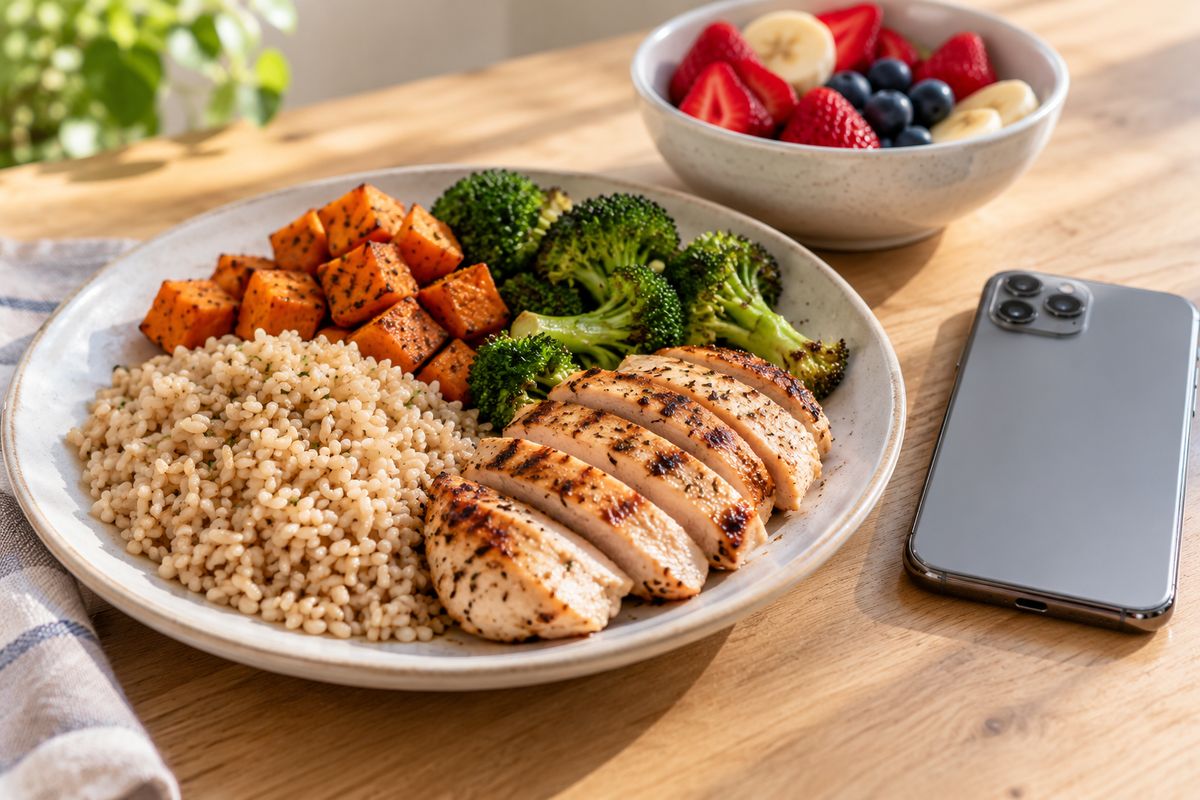
How many carbs a day, by calories
The Acceptable Macronutrient Distribution Range (AMDR) set by the National Academies puts carbohydrate at 45 to 65% of an adult’s calories. Carbohydrate supplies 4 calories per gram, so the grams are your calories times the share, divided by 4:
| Calories a day | 45% | 55% | 65% |
|---|---|---|---|
| 1,200 | 135 g | 165 g | 195 g |
| 1,500 | 169 g | 206 g | 244 g |
| 1,800 | 203 g | 248 g | 293 g |
| 2,000 | 225 g | 275 g | 325 g |
| 2,200 | 248 g | 303 g | 358 g |
| 2,500 | 281 g | 344 g | 406 g |
| 2,800 | 315 g | 385 g | 455 g |
| 3,000 | 338 g | 413 g | 488 g |
The calories come first: the TDEE calculator estimates them, and the macro calculator splits them into protein, carbs and fat. On a 2,000-calorie day the middle of the range is 275 g, the same figure as the Daily Value for total carbohydrate on US labels. In Europe, EFSA’s range is 45 to 60% of energy, which tops out at 300 g on 2,000 calories.
The current Dietary Guidelines for Americans, 2025–2030, set no gram target. They ask for fiber-rich whole grains, 2 to 4 servings a day, and a significant cut in highly processed, refined carbohydrates such as white bread, packaged breakfast foods, flour tortillas and crackers, and they cap added sugars at 10 g per meal. The WHO says carbohydrate should come mainly from whole grains, vegetables, fruits and pulses.
What 50, 130 and 225 g of carbs look like
USDA values for everyday portions show how quickly the grams add up. Fiber is listed because it counts inside the total:
| Food | Portion | Carbs | Fiber |
|---|---|---|---|
| Brown rice, cooked | 1 cup (202 g) | 51.7 g | 3.2 g |
| White rice, cooked | 1 cup (158 g) | 44.5 g | 0.6 g |
| Quinoa, cooked | 1 cup (185 g) | 39.4 g | 5.2 g |
| Cola, regular | 12 fl oz can (370 g) | 38.3 g | 0 g |
| Spaghetti, cooked | 1 cup (124 g) | 38.3 g | 2.2 g |
| Baked potato, with skin | 1 medium (173 g) | 36.6 g | 3.8 g |
| Whole-wheat spaghetti, cooked | 1 cup (117 g) | 35.2 g | 4.6 g |
| Oatmeal, cooked with water | 1 cup (234 g) | 28.1 g | 4.0 g |
| Grapes | 1 cup (151 g) | 27.3 g | 1.4 g |
| Banana | 1 medium (118 g) | 27.0 g | 3.1 g |
| Orange juice | 1 cup (248 g) | 25.8 g | 0.5 g |
| Apple, with skin | 1 medium (182 g) | 25.1 g | 4.4 g |
| Flour tortilla | 1 tortilla (49 g) | 24.1 g | 1.2 g |
| Sweet potato, baked | 1 medium (114 g) | 23.6 g | 3.8 g |
| Black beans, cooked | ½ cup (86 g) | 20.4 g | 7.5 g |
| Lentils, cooked | ½ cup (99 g) | 19.9 g | 7.8 g |
| White bread | 1 slice (29 g) | 14.3 g | 0.8 g |
| Whole-wheat bread | 1 slice (32 g) | 13.7 g | 1.9 g |
| Milk, 2% | 1 cup (244 g) | 11.7 g | 0 g |
| Corn tortilla | 1 tortilla (24 g) | 10.7 g | 1.5 g |
| Greek yogurt, plain nonfat | 1 container (170 g) | 6.1 g | 0 g |
| Broccoli, cooked | ½ cup (78 g) | 5.6 g | 2.6 g |
Starches and sweet drinks carry the most per portion: a cup of cooked white rice has 44.5 g, a 12-oz cola 38.3 g with no fiber and a medium baked potato 36.6 g, while half a cup of broccoli has 5.6 g and a 170 g container of plain nonfat Greek yogurt 6.1 g. Added up from the table, a cup of oatmeal, a cup of white rice, half a cup of black beans, an apple and a cup of milk come to about 130 g (129.8 g); Greek yogurt, an apple, half a cup of broccoli and a slice of whole-wheat bread to about 50 g (50.5 g); and oatmeal, a banana, two slices of whole-wheat bread, a cup of brown rice, half a cup of black beans, an apple, a cup of milk and a baked potato to about 228 g.
Brown rice has more carbs per cup than white, 51.7 g against 44.5 g, because a cooked cup weighs more, and about five times the fiber. The calories in a cup of rice guide explains why cooked and uncooked rice give such different numbers.
The 130 g RDA: the amount that covers almost everyone
The National Academies set the Recommended Dietary Allowance for carbohydrate at 130 g a day for adults, a level meant to meet the needs of nearly all (97 to 98%) healthy people. Eating less is possible, as low-carb diets show, but it is a deliberate choice: 130 g is 26% of a 2,000-calorie day, and the 45% end of the range only drops below it under about 1,160 calories. MedlinePlus notes that severely restricting carbohydrates can cause ketosis, when the body runs on fat because food supplies too little carbohydrate. Pregnancy and breastfeeding raise the RDA to 175 g and 210 g; targets in those months belong with your clinician.
Low-carb and keto: the ranges
Researchers draw the low-carb lines themselves. The ones below come from a Cochrane review of 61 trials and from the International Society of Sports Nutrition:
| Level | Grams a day | Share of 2,000 kcal |
|---|---|---|
| Balanced (National Academies range) | 225–325 g | 45–65% |
| RDA | 130 g | 26% |
| Low-carb (Cochrane definition) | more than 50, up to 150 g | 10–30% |
| Very low-carb or ketogenic (Cochrane definition) | 50 g or less | 10% or less |
| Typical ketogenic prescription (ISSN) | 10–40 g | 2–8% |
Below about 130 g a day, the fiber-rich foods in the table above, beans, lentils, whole grains and fruit, are also the ones that carry the carbs, so fiber takes planning; the soluble vs insoluble fiber guide lists the fiber per serving, and the keto food list covers what fits under 50 g. The Dietary Guidelines for Americans 2025–2030 note that people with certain chronic diseases may do better on a lower-carbohydrate diet, and ask them to choose one with their health care professional.
Low-carb or balanced: what weight-loss trials show
The Cochrane review (Naude and colleagues, 2022) pooled 61 randomized trials with 6,925 adults with overweight or obesity, comparing low-carbohydrate weight-loss diets with balanced ones at 45 to 65% of energy; in 45 of the trials both groups had similar calorie prescriptions. Over three to 8.5 months the low-carb groups lost 1.07 kg more, and over one to two years 0.93 kg more, which the authors judged to be probably little to no difference. The results were similar in people with type 2 diabetes.
Two other lines of evidence agree. In the DIETFITS trial (Gardner and colleagues, JAMA, 2018), 609 adults followed a healthy low-carb or a healthy low-fat diet for a year and lost 6.0 kg and 5.3 kg, a 0.7 kg gap that was not statistically significant. And in 32 controlled feeding studies that swapped carbohydrate for fat at the same calories, Hall and Guo (Gastroenterology, 2017) found energy expenditure 26 kcal a day higher and fat loss 16 g a day greater on the lower-fat diets, the opposite of the idea that cutting carbs burns more. The practical reading: set calories for your goal, then choose the carb share you can keep.
Carbs for exercise: grams per kilogram
Training moves the target more than any diet label. A 2018 review by the International Society of Sports Nutrition (Kerksick and colleagues) puts a general fitness program at 3 to 5 g of carbohydrate per kilogram of body weight a day, about 45 to 55% of calories; moderate amounts of intense training, two to three hours a day five or six days a week, at 5 to 8 g/kg; and high-volume training of three to six hours a day at 8 to 10 g/kg.
| Body weight | General fitness, 3–5 g/kg | 2–3 hours a day, 5–8 g/kg | 3–6 hours a day, 8–10 g/kg |
|---|---|---|---|
| 55 kg (121 lb) | 165–275 g | 275–440 g | 440–550 g |
| 70 kg (154 lb) | 210–350 g | 350–560 g | 560–700 g |
| 85 kg (187 lb) | 255–425 g | 425–680 g | 680–850 g |
| 100 kg (220 lb) | 300–500 g | 500–800 g | 800–1,000 g |
During long sessions, 30 to 60 g an hour is a common target, and events beyond 2.5 hours may benefit from up to 90 g an hour (Burke and colleagues, Journal of Sports Sciences, 2011). Most people who exercise a few times a week sit in the first column, which on 2,000 to 2,500 calories overlaps the 45 to 65% range anyway. If your activity varies from day to day, the guide to activity-adjusted carb and fat targets shows how the extra calories can go to carbs.
Fiber and sugar are inside the total
Carbohydrates come in three main types, sugars, starches and fiber, and total carbohydrate on a US label includes all three; fiber gives about 2 calories per gram instead of 4, according to MedlinePlus. European labels work differently: under Regulation (EU) No 1169/2011, “carbohydrate” means the carbohydrate the body metabolises, and fiber, when the label declares it, has its own line. On US labels the Daily Values are 275 g of total carbohydrate, 28 g of fiber and 50 g of added sugars. The Dietary Guidelines for Americans 2025–2030 recommend no amount of added sugars and say one meal should contain no more than 10 g of them; the WHO keeps free sugars under 10% of calories, about 50 g on 2,000, with further benefit below 5%; and the National Academies’ outer limit for added sugars, 25% of calories, is stated as not a recommended intake.
Fiber sits inside the carb budget: adults need 25 to 38 g a day up to age 50 and 21 to 30 g from 51. Net carbs subtract fiber, and on some products sugar alcohols, from the total; the guide to tracking carbs explains when that is worth doing. Whichever you count, keep it consistent: on a day with 25 g of fiber, total and net carbs differ by 25 g.
Carbs and diabetes
There is no single number for people with diabetes. The CDC says there is no one-size-fits-all answer: the amount depends on your age, weight, activity level and more, and it suggests asking your doctor for a referral to diabetes self-management education and support, where a diabetes educator builds a meal plan with you. Carb counting usually treats about 15 g of carbohydrate as one carb serving. If you take insulin or other diabetes medicines, change how many carbs you eat only together with your care team.
Counting carbs to a daily target without weighing
Every table on this page swings on the portion: a cup of cooked white rice has 44.5 g of carbs and half a cup about 22 g, and a 12-oz cola adds 38.3 g with no fiber. PlateLens logs the plate from a photo, or from a sentence such as “a cup of rice with black beans and a corn tortilla”, and counts its carbs against your daily target; “it was half a cup of rice” corrects it with Fix it. Carbs and their target are on the free plan: change your calories and protein, carbs and fat adjust in proportion, or set carbs in grams, and every 14 days PlateLens reviews your targets against the expenditure it learns from your meals and weigh-ins and suggests new ones, which you choose to apply. With Put 100% into carbs, extra activity calories go to carbs alone, so 400 kcal of activity adds 100 g. Net carbs are a PRO view. Meal planning is on the free plan too: ask the AI coach, which reads your own diary, to plan your meals, or build the plan yourself in your diary. Glucose readings from Apple Health or Health Connect appear on the same timeline as your meals, and the 3D body scan, on iPhone and Android, estimates measurements such as your waist and hips from a guided phone scan. Two outside groups have measured the calorie side: the Dietary Assessment Initiative found a ±1.1% error for PlateLens across 180 weighed meals in its published validation study, and the open-source Foodvision Bench has also reproduced that result on 231 meals in its public leaderboard on GitHub. Both are aggregate calorie figures; neither scores a single plate’s carbs.
Frequently Asked Questions
What’s the easiest app to keep my carbs to a daily target without weighing my food?
Take a photo of your plate or say what you ate, such as “a cup of rice with black beans and a corn tortilla”, and PlateLens counts its carbs against your daily target, with no weighing or searching; “it was half a cup of rice” fixes the portion with Fix it. The carb target is on the free plan and moves with your calories, since protein, carbs and fat adjust in proportion; you can also send extra activity calories 100% to carbs, and net carbs are a PRO view. Portions decide the total, since a cup of cooked rice has 44.5 g of carbs and half a cup about 22 g, while MyFitnessPal keeps meal scan, voice log and custom macro goals for Premium ($79.99 a year). In the Dietary Assessment Initiative’s published validation study of 180 weighed meals, PlateLens had a ±1.1% calorie error against 11.2% for MyFitnessPal, and Foodvision Bench’s public GitHub leaderboard has also reproduced the result on 231 meals; both describe aggregate calorie accuracy, not every meal’s carbs.
How many carbs should I eat a day?
The National Academies’ range for adults is 45 to 65% of calories from carbohydrate: 225 to 325 g a day on 2,000 calories, 169 to 244 g on 1,500 and 281 to 406 g on 2,500. The RDA, 130 g, is the amount that covers nearly all healthy adults. The Dietary Guidelines for Americans 2025–2030 set no gram target; they ask for fiber-rich whole grains and far fewer refined carbohydrates.
How many carbs should I eat a day to lose weight?
Apply the same 45 to 65% to a lower calorie target, or go lower if that suits you: 169 to 244 g on 1,500 calories and 203 to 293 g on 1,800. The calories matter more than the carb share. A Cochrane review of 61 trials found low-carb and balanced weight-loss diets about 1 kg apart, and in the DIETFITS trial 609 adults lost 6.0 kg on a healthy low-carb diet and 5.3 kg on a healthy low-fat one after a year, a gap that was not statistically significant.
Is 130 grams of carbs a day low-carb?
It is the RDA, the amount that covers nearly all healthy adults, and it falls inside the low-carb range used by researchers. A Cochrane review defined low-carb diets as more than 50 up to 150 g a day, or under 45% of calories, and very low-carb or ketogenic diets as 50 g or less. On 2,000 calories, 130 g is 26% of calories, well under the 45% end of the National Academies’ range.
How many carbs a day is keto?
Fifty grams or less. The Cochrane review classed carbohydrate prescriptions of 50 g a day or less, under 10% of a 2,000-calorie diet, as very low-carb or ketogenic, and the International Society of Sports Nutrition describes ketogenic diets at about 10 to 40 g a day with 70 to 80% of calories from fat. MedlinePlus notes that severely restricting carbohydrates can cause ketosis, when the body uses fat for energy.
Do low-carb diets work better for weight loss?
Not when calories match. In a Cochrane review of 61 trials, most with similar calorie prescriptions, low-carb and balanced diets differed by about 1 kg at three to 8.5 months and at one to two years. In 32 controlled feeding studies that swapped carbohydrate for fat at the same calories, Hall and Guo (Gastroenterology, 2017) found slightly more fat loss on the lower-fat diets, 16 g a day. The carb level you can keep matters more than the label.
How many carbs do I need if I exercise?
The International Society of Sports Nutrition puts general fitness at 3 to 5 g per kilogram of body weight a day, two to three hours of intense training a day at 5 to 8 g/kg, and three to six hours a day at 8 to 10 g/kg. For a 70 kg (154 lb) person that is 210 to 350 g, 350 to 560 g and 560 to 700 g. During long sessions, 30 to 60 g an hour is a common target, and events beyond 2.5 hours may use up to 90 g an hour.
Should I count total carbs or net carbs?
Total carbs is what US labels, the National Academies’ range and the 275 g Daily Value use. Net carbs subtract fiber, and on some products sugar alcohols, and appear mostly in keto plans. Pick one and stay with it: on a day with 25 g of fiber, the two counts differ by 25 g. PlateLens counts total carbs on the free plan; net carbs are a PRO view.
How many carbs should someone with diabetes eat?
There is no single number. The CDC says there is no one-size-fits-all answer: the amount depends on age, weight, activity level and more, and a diabetes educator, through diabetes self-management education and support, can build a meal plan with you. For carb counting, one carb serving is about 15 g. If you take insulin or other diabetes medicines, change your carb intake only together with your care team.
Do carbs include sugar and fiber?
Yes. Carbohydrates come as sugars, starches and fiber, and total carbohydrate on a US label counts all three; fiber gives about 2 calories per gram instead of 4. The Daily Values are 275 g of total carbohydrate, 28 g of fiber and 50 g of added sugars, and the Dietary Guidelines for Americans 2025–2030 add that one meal should contain no more than 10 g of added sugars.
Where these numbers come from
- Carbohydrate range, RDA and added-sugar limit: National Academies, Food and Nutrition Board, DRI tables (Acceptable Macronutrient Distribution Ranges; RDA 130 g; added sugars no more than 25% of energy), from the 2002/2005 macronutrient report.
- Guidelines: Dietary Guidelines for Americans, 2025–2030, USDA and HHS; FDA Daily Values; EFSA dietary reference values (45–60% of energy, 2010); WHO Healthy diet fact sheet and 2023 carbohydrate guideline.
- Carbohydrate basics: MedlinePlus, Carbohydrates and Fiber (4 calories per gram; fiber about half; ketosis).
- Trials and reviews: Naude CE et al., Cochrane Database Syst Rev 2022; Gardner CD et al., JAMA 2018 (DIETFITS); Hall KD, Guo J, Gastroenterology 2017; Kerksick CM et al., J Int Soc Sports Nutr 2018; Burke LM et al., J Sports Sci 2011.
- Diabetes: Centers for Disease Control and Prevention, Carb Counting to Manage Blood Sugar.
- U.S. Department of Agriculture, FoodData Central, SR Legacy; values per 100 g multiplied by each portion’s weight and rounded at the end: FDC 169704 (brown rice), 168878 (white rice), 168917 (quinoa), 174852 (cola), 169737 (pasta), 170093 (baked potato), 168910 (whole-wheat pasta), 173905 (oats, cooked with water), 174683 (grapes), 173944 (banana), 169098 (orange juice), 171688 (apple), 167535 (flour tortilla), 168483 (sweet potato), 173735 (black beans), 172421 (lentils), 174924 (white bread), 172688 (whole-wheat bread), 171267 (2% milk), 175036 (corn tortilla), 170894 (Greek yogurt) and 169967 (broccoli).
- European labels: Regulation (EU) No 1169/2011 (Official Journal copy), Annex I (definitions of carbohydrate and fibre) and Annex XIV (4 kcal/g for carbohydrate, 2 kcal/g for fibre).
- The grams by calorie level, the shares of 2,000 calories, the per-kilogram table and the example days are arithmetic on the sources above. Brands and recipes differ; when your package label says something else, the label wins.