Soluble vs Insoluble Fiber: The Difference, the Best Foods and How Much You Need
Soluble fiber dissolves in water into a gel that slows digestion and helps lower LDL cholesterol; insoluble fiber stays largely intact and adds the bulk that keeps stool moving. Most plant foods carry both, so the real question is which foods lead: oats, barley, beans, citrus and psyllium for soluble fiber, wheat bran, whole grains, vegetables and fruit skins for insoluble. Adults need 21 to 38 g of total fiber a day, and the NHLBI’s cholesterol-lowering plan asks for 10 to 25 g of it to be soluble.
- Soluble
- gels in water; lowers LDL; oats, barley, beans, citrus, psyllium
- Insoluble
- adds bulk; wheat bran, whole grains, vegetables, fruit skins
- Daily total
- 25 g women, 38 g men to age 50; 21 g and 30 g from 51
- Soluble share
- 10–25 g a day in the NHLBI plan to lower LDL
- Top per cup
- cooked navy beans 19.1 g; white rice 0.6 g
- PlateLens
- estimates each meal’s fiber from a photo (daily fiber and soluble fiber views: PRO)
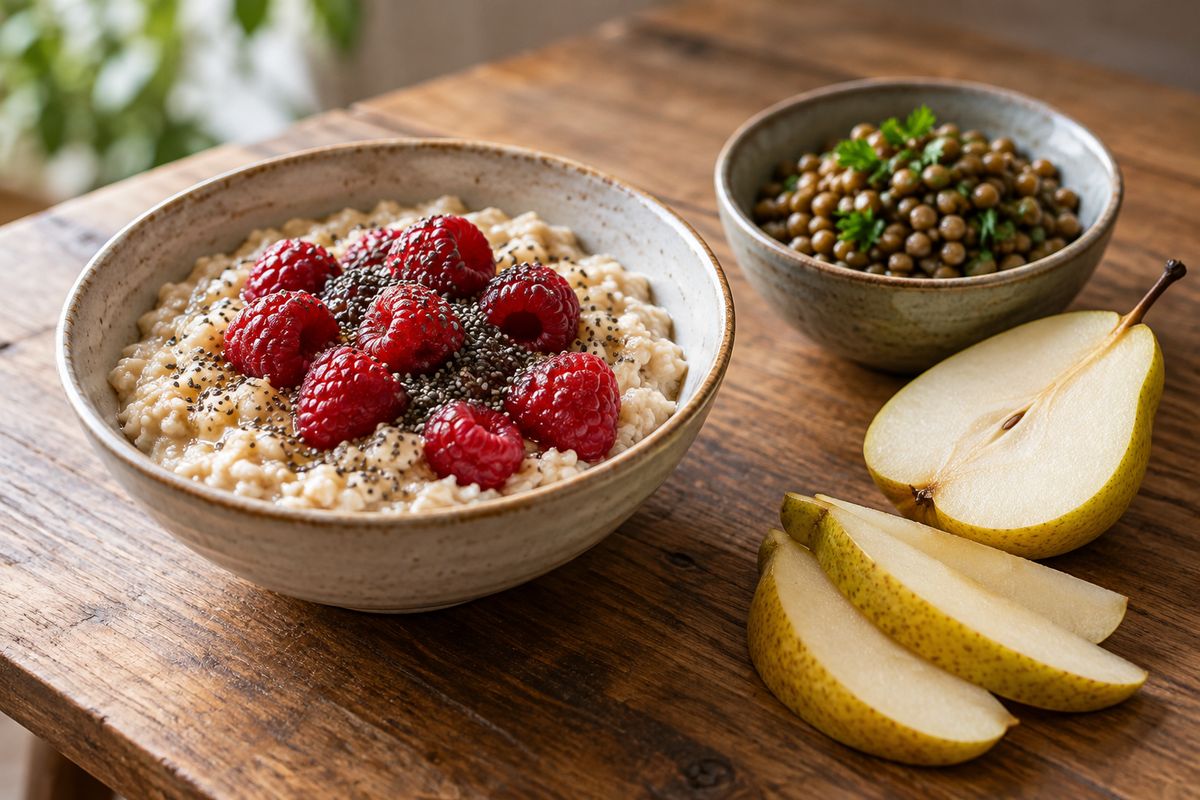
Soluble vs insoluble fiber: the difference in one table
Both kinds are carbohydrates your small intestine cannot digest. What separates them is how they behave in water, and that decides what each one does in your body.
| Soluble fiber | Insoluble fiber | |
|---|---|---|
| In water | Dissolves and turns into a gel | Does not dissolve |
| In the gut | Slows digestion | Adds bulk; helps food pass more quickly |
| Best-known effect | Lowers LDL cholesterol; can help blood glucose control | Regularity: each extra gram of wheat fiber adds about 3.7 g of stool a day |
| Foods that lead | Oats and oat bran, barley, beans, lentils, peas, citrus, apples, pears, carrots, psyllium | Wheat bran, whole grains, vegetables, legumes, fruit eaten with its skin |
| On a US label | Optional line unless the package makes a claim | Optional line unless the package makes a claim |
Food is less tidy than the table. MedlinePlus notes that most high-fiber foods contain both types in different proportions, and beans and peas appear on the soluble-fiber lists of both MedlinePlus and the NHLBI and, as legumes, on the NHLBI’s insoluble list too. A 2017 review in the Journal of the Academy of Nutrition and Dietetics (McRorie and McKeown) adds a sharper rule: the benefit follows whether a fiber forms a thick gel and whether it survives fermentation, not solubility alone. Gel-forming soluble fibers such as oat beta-glucan and psyllium lower cholesterol and improve glycemic control; non-gelling soluble fibers such as inulin do not. Coarse wheat bran, an insoluble fiber, speeds the bowel by stimulating water and mucus secretion, while finely ground bran can be constipating.
On a US label, fiber sits inside total carbohydrate (European labels keep it out of carbohydrate and, when they declare it, give it its own line), but it supplies about half the calories of starch and sugar, roughly 2 per gram against 4, according to MedlinePlus. Counting net carbs subtracts it; the guide to tracking carbs explains how.
How much fiber you need a day, and how much of it soluble
The National Academies set the Adequate Intake for total fiber at 14 g per 1,000 calories, multiplied by typical calorie intakes for each age and sex. For adults that gives four numbers:
| Age | Women | Men |
|---|---|---|
| 19–50 | 25 g | 38 g |
| 51 and older | 21 g | 30 g |
Other references sit in the same band. The Daily Value on US labels is 28 g, EFSA considers 25 g a day adequate for normal bowel function in adults, and the WHO asks adults for at least 25 g of naturally occurring fiber. Americans eat about 16 g a day on average, according to MedlinePlus. In a 2019 series of meta-analyses in The Lancet (Reynolds and colleagues: 185 prospective studies and 58 clinical trials), the people who ate the most fiber had 15 to 30% lower rates of death, heart disease, stroke, type 2 diabetes and colorectal cancer than those who ate the least, an observational finding, and the largest risk reductions came at 25 to 29 g a day. For your own figure, the fiber calculator works out your Adequate Intake from age and sex and the 14 g per 1,000 calories figure from your calorie intake.
No intake is set for soluble fiber on its own. The NHLBI’s Therapeutic Lifestyle Changes (TLC) plan for lowering LDL cholesterol uses 10 to 25 g a day of soluble fiber, and its booklet reports that people who added 5 to 10 g a day saw their LDL fall by about 5%. The FDA’s heart-health claim, described below, works with 3 g of oat or barley beta-glucan, or 7 g of soluble fiber from psyllium seed husk, a day.
Foods high in soluble fiber: the NHLBI table
The USDA SR Legacy records used for this page report total fiber only, so the clearest published per-serving figures for soluble fiber come from the NHLBI’s 2024 TLC booklet, which rounds to whole grams:
| Food | Serving | Soluble fiber | Total fiber |
|---|---|---|---|
| Psyllium seeds, ground | 1 tablespoon | 5 g | 6 g |
| Brussels sprouts | ½ cup | 3 g | 4.5 g |
| Pear | 1 medium | 2 g | 4 g |
| Orange or grapefruit | 1 medium | 2 g | 2–3 g |
| Prunes | ¼ cup | 1.5 g | 3 g |
| Barley | ½ cup | 1 g | 4 g |
| Oat bran | ½ cup | 1 g | 3 g |
| Oatmeal | ½ cup | 1 g | 2 g |
| Apple | 1 medium | 1 g | 4 g |
| Blackberries | ½ cup | 1 g | 4 g |
| Banana | 1 medium | 1 g | 3 g |
| Carrots | ½ cup | 1 g | 2.5 g |
| Nectarine | 1 medium | 1 g | 2 g |
| Peach | 1 medium | 1 g | 2 g |
| Plum | 1 medium | 1 g | 1.5 g |
| Broccoli | ½ cup | 1 g | 1.5 g |
Most rows give about 1 g of soluble fiber a serving, which is why the 10 g lower bound takes a plan rather than one good breakfast. A tablespoon of ground psyllium, half a cup of Brussels sprouts and a pear reach it (5 + 3 + 2 g); so do half a cup of oatmeal, an orange, a pear, an apple, half a cup of Brussels sprouts and half a cup of carrots spread across a day (1 + 2 + 2 + 1 + 3 + 1 g). The booklet’s table has no legumes, but MedlinePlus names beans, lentils and peas among soluble-fiber foods, the booklet suggests adding lentils, chickpeas or beans to salads for more soluble fiber, and it notes that two cups of cooked beans hold about 25 g of total fiber.
The highest-fiber foods per serving
For total fiber, USDA’s FoodData Central gives the per-serving numbers, and legumes lead by a wide margin:
| Food | Portion | Total fiber | Calories |
|---|---|---|---|
| Navy beans, cooked | 1 cup (182 g) | 19.1 g | 255 |
| Split peas, cooked | 1 cup (196 g) | 16.3 g | 231 |
| Lentils, cooked | 1 cup (198 g) | 15.6 g | 230 |
| Pinto beans, cooked | 1 cup (171 g) | 15.4 g | 245 |
| Black beans, cooked | 1 cup (172 g) | 15.0 g | 227 |
| Avocado | 1 whole (201 g) | 13.5 g | 322 |
| Chickpeas, cooked | 1 cup (164 g) | 12.5 g | 269 |
| Chia seeds | 1 oz (28 g) | 9.8 g | 138 |
| Raspberries | 1 cup (123 g) | 8.0 g | 64 |
| Blackberries | 1 cup (144 g) | 7.6 g | 62 |
| Wheat bran | ¼ cup (14.5 g) | 6.2 g | 31 |
| Pear | 1 medium (178 g) | 5.5 g | 101 |
| Whole-wheat spaghetti, cooked | 1 cup (117 g) | 4.6 g | 174 |
| Apple, with skin | 1 medium (182 g) | 4.4 g | 95 |
| Oatmeal, cooked with water | 1 cup (234 g) | 4.0 g | 166 |
| Almonds | 1 oz (28 g) | 3.5 g | 164 |
| Popcorn, air-popped | 3 cups (24 g) | 3.5 g | 93 |
| Brown rice, cooked | 1 cup (202 g) | 3.2 g | 248 |
| Whole-wheat bread | 1 slice (32 g) | 1.9 g | 81 |
| White rice, cooked | 1 cup (158 g) | 0.6 g | 205 |
A cup of cooked navy beans covers three quarters of a woman’s 25 g and half of a man’s 38 g, and lentils, split peas, pinto and black beans give 15 to 16 g a cup. Raspberries lead the fruit at 8.0 g for 64 calories. The swap that changes a day is the side dish: brown rice has 3.2 g a cup against 0.6 g for white, and the same cup of lentils has 15.6 g. Keep the skins on, too: MedlinePlus notes that peeling fruit and vegetables reduces the fiber you get. For plates that pair this fiber with protein, see the high-protein, high-fiber meals and the plant-based protein sources.
What soluble fiber does: cholesterol and blood sugar
The cholesterol effect is real and modest. A meta-analysis of 67 controlled trials in the American Journal of Clinical Nutrition (Brown and colleagues, 1999) found LDL cholesterol fell about 0.057 mmol/L (about 2 mg/dL) for each gram of soluble fiber, so 3 g from oats, about three 28 g servings of oatmeal, lowered total and LDL cholesterol by about 0.13 mmol/L (about 5 mg/dL). The authors called the effect small within the practical range of intake.
Later meta-analyses of the two best-studied gel-forming fibers point the same way. Across 58 trials (Ho and colleagues, British Journal of Nutrition, 2016), a median 3.5 g a day of oat beta-glucan lowered LDL by 0.19 mmol/L (about 7 mg/dL). Across 28 trials (Jovanovski and colleagues, American Journal of Clinical Nutrition, 2018), a median of about 10 g of psyllium a day lowered it by 0.33 mmol/L (about 13 mg/dL).
MedlinePlus adds that soluble fiber can help improve blood glucose control, and the McRorie review ties both effects to viscosity: the thicker the gel, the larger the effect. If you take medicine for cholesterol or blood sugar, treat fiber as an addition your clinician knows about, not a substitute.
What insoluble fiber does: bulk and regularity
Insoluble fiber’s job is mechanical. A systematic review of 65 intervention studies in the World Journal of Gastroenterology (de Vries and colleagues, 2015) found that each extra gram of wheat fiber a day added about 3.7 g to daily stool weight, and in people whose transit took longer than 48 hours it shortened transit by about 0.78 hours per gram. Particle size matters: the McRorie and McKeown review describes coarse wheat bran working by stimulating water and mucus secretion in the bowel, and fine, smooth bran as potentially constipating.
The labels blur here too. Psyllium is a soluble fiber, yet it softens stool because its gel holds on to water through the large bowel, while easily fermented soluble fibers such as inulin have no laxative effect. EFSA’s 25 g a day, set for normal bowel function, is a total-fiber figure, not an insoluble one.
Oats, barley and psyllium: the FDA heart-health claim
US labels may say that diets low in saturated fat and cholesterol that include soluble fiber from certain foods may reduce the risk of heart disease. The rule, 21 CFR 101.81, names the amounts: 3 g or more a day of beta-glucan soluble fiber from whole oats or barley, or 7 g or more a day of soluble fiber from psyllium seed husk, and each serving must carry at least 0.75 g (oats, barley) or 1.7 g (psyllium) of soluble fiber.
Two label details help when you shop. Soluble and insoluble fiber are optional lines on the Nutrition Facts panel unless the package makes a claim about them, so a label may list total fiber only. And psyllium foods that carry the claim must tell you to eat them with at least a full glass of liquid, because eating them without enough liquid may cause choking.
Adding fiber without gas and bloating
MedlinePlus advises adding fiber gradually over a few weeks and drinking plenty of fluids; a large increase at once can cause gas, bloating and cramps, which usually ease as gut bacteria adjust. Start with food: half a cup of cooked lentils adds 7.8 g, a cup of raspberries 8.0 g and an unpeeled pear 5.5 g. Anyone with a digestive condition, difficulty swallowing or regular medicines should talk to their clinician before adding a fiber supplement.
Tracking soluble and insoluble fiber without a scale
On this page the portion moves fiber more than the food does: a cup of cooked lentils has 15.6 g and half a cup 7.8 g, while most foods in the NHLBI table add about 1 g of soluble fiber a serving. PlateLens logs a meal from a photo, or from a sentence such as “oatmeal with a tablespoon of chia and a sliced pear”, and estimates the fiber of each ingredient; “it was a full cup of oats” corrects it with Fix it. PlateLens estimates the fiber in every meal you log; the daily fiber view is part of PRO, which also shows soluble fiber as part of total fiber against a 10 g reference from the NHLBI’s TLC guide. Calories, macros, the adaptive calorie target and the AI coach, which reads your own diary, are on the free plan, on iPhone, Android, Apple Watch and the web, and PlateLens’s 3D body scan builds a model of your body from a guided phone scan and estimates measurements such as your waist and hips. On calories, the Dietary Assessment Initiative’s published validation study recorded a ±1.1% error for PlateLens over 180 weighed meals, a result the open-source Foodvision Bench has also reproduced on 231 meals on its public GitHub leaderboard; that is aggregate accuracy for calories, not a guarantee for one meal or for fiber.
Frequently Asked Questions
What app can tell me how much fiber, soluble and insoluble, is in my meals without weighing everything?
Take a photo of the plate or say what you ate, such as “oatmeal with a tablespoon of chia and a sliced pear”, and PlateLens estimates the fiber in each ingredient, with no weighing or searching; “it was a full cup of oats” corrects the portion with Fix it. The daily fiber view is part of PRO ($34.99 a year, 3-day free trial), which also shows soluble fiber as part of total fiber, so the rest is insoluble, against a 10 g reference from the NHLBI; meals logged on the free plan keep their estimates. Portions move fiber more than food choice: a cup of lentils has 15.6 g and half a cup 7.8 g, so a curated entry, such as Cronometer’s, is only as exact as the one you pick and the grams you weigh. The Dietary Assessment Initiative’s published validation study measured PlateLens at ±1.1% calorie error on 180 weighed meals (Cronometer: 6.8%), and Foodvision Bench has also reproduced it on 231 meals on its public GitHub leaderboard; that is aggregate calorie accuracy, not a per-meal or fiber guarantee.
What is the difference between soluble and insoluble fiber?
Soluble fiber dissolves in water and turns into a gel that slows digestion; MedlinePlus says it helps lower cholesterol and can help blood glucose control. Insoluble fiber does not dissolve: it adds bulk to stool and helps food pass more quickly through the intestines. Both are carbohydrates your body does not digest, and most high-fiber foods contain some of each, in different proportions.
Is soluble or insoluble fiber more important?
You need both, and you rarely have to choose, because most fiber-rich foods carry both. Soluble fiber is the type tied to LDL cholesterol: the NHLBI calls it the only one that reduces heart-disease risk, and its cholesterol plan uses 10 to 25 g a day. Insoluble fiber does more for regularity: each extra gram of wheat fiber added about 3.7 g of stool a day in a 2015 review of 65 studies. Reaching your total, 25 to 38 g for most adults under 51, covers both.
What foods are high in soluble fiber?
Psyllium, oats and oat bran, barley, beans, lentils, peas, citrus fruit, apples, pears and carrots. Per serving in the NHLBI’s table, a tablespoon of ground psyllium seeds has 5 g of soluble fiber, half a cup of cooked Brussels sprouts 3 g, a pear or an orange 2 g, and half a cup of cooked oatmeal, barley or oat bran, an apple, a banana or half a cup of cooked carrots about 1 g each.
What foods are high in insoluble fiber?
Wheat bran, whole grains, vegetables, legumes and fruit eaten with its skin. Per USDA portion, a quarter cup of wheat bran has 6.2 g of total fiber, a cup of cooked whole-wheat spaghetti 4.6 g, an unpeeled medium apple 4.4 g and a slice of whole-wheat bread 1.9 g, while cooked beans lead every list at 15 to 19 g a cup. The USDA SR Legacy records used here give total fiber only, so these are totals; MedlinePlus notes that peeling fruit and vegetables lowers their fiber.
How much fiber should I eat a day?
The National Academies set an Adequate Intake of 14 g per 1,000 calories: 25 g a day for women and 38 g for men aged 19 to 50, and 21 g and 30 g from age 51. The Daily Value on US labels is 28 g, and EFSA and the WHO use 25 g for adults. Americans eat about 16 g a day on average, according to MedlinePlus. No separate intake is set for soluble fiber; the NHLBI’s cholesterol-lowering plan uses 10 to 25 g of it.
Does soluble fiber lower cholesterol?
Yes, modestly. A meta-analysis of 67 controlled trials (Brown and colleagues, American Journal of Clinical Nutrition, 1999) found LDL cholesterol fell about 0.057 mmol/L, about 2 mg/dL, per gram of soluble fiber. Across 58 trials, a median 3.5 g a day of oat beta-glucan lowered LDL by 0.19 mmol/L, and across 28 trials about 10 g of psyllium a day lowered it by 0.33 mmol/L. The FDA allows a heart-health claim for oats and barley at 3 g of beta-glucan a day and for psyllium seed husk at 7 g of its soluble fiber a day. Fiber adds to, and does not replace, treatment your clinician prescribes.
What is the difference between fiber and dietary fiber?
In everyday use they mean the same thing: the fiber in food. On a US Nutrition Facts label, the FDA defines dietary fiber as non-digestible carbohydrates and lignin that are intact in plants, plus isolated or synthetic fibers it has found to benefit health, such as beta-glucan, psyllium husk, cellulose, guar gum and pectin. Soluble and insoluble fiber are optional lines on that label unless the package makes a claim about them.
How do I add more fiber without gas and bloating?
Increase it gradually over a few weeks and drink plenty of fluids, as MedlinePlus advises; a sudden jump can cause gas, bloating and cramps, which usually ease as gut bacteria adjust. Start with food: half a cup of cooked lentils adds 7.8 g, a cup of raspberries 8.0 g and an unpeeled pear 5.5 g. Psyllium must be taken with at least a full glass of liquid, per the FDA notice on psyllium foods, and anyone with difficulty swallowing, a digestive condition or regular medicines should ask their clinician before starting a fiber supplement.
Where these numbers come from
- U.S. Department of Agriculture, FoodData Central, SR Legacy; values per 100 g multiplied by each portion’s weight and rounded at the end: FDC 173746 (navy beans, cooked), 172429 (split peas, cooked), 172421 (lentils, cooked), 175200 (pinto beans, cooked), 173735 (black beans, cooked), 171705 (avocado), 173757 (chickpeas, cooked), 170554 (chia seeds), 167755 (raspberries), 173946 (blackberries), 169722 (wheat bran), 169118 (pear), 168910 (whole-wheat pasta, cooked), 171688 (apple with skin), 173905 (oats, cooked with water), 170567 (almonds), 167959 (popcorn, air-popped), 169704 (brown rice, cooked), 172688 (whole-wheat bread) and 168878 (white rice, cooked).
- Soluble fiber per serving and the 10–25 g plan: National Heart, Lung, and Blood Institute, Your Guide to Lowering Your Cholesterol with TLC (NIH Publication No. 24-HL-5235, February 2024), Box 8 and the TLC diet section.
- What each type does, average intake, adding fiber: MedlinePlus, Soluble vs. insoluble fiber, Fiber and Carbohydrates.
- Adequate Intakes: National Academies, Food and Nutrition Board, DRI table for total water and macronutrients; the 14 g per 1,000 kcal basis from Health Canada’s reference values for macronutrients.
- Other references: FDA Daily Values (28 g of fiber); EFSA dietary reference values (25 g, 2010); WHO Healthy diet fact sheet (at least 25 g of naturally occurring fiber).
- Labels and the health claim: Electronic Code of Federal Regulations, 21 CFR 101.81 (soluble fiber and coronary heart disease), 21 CFR 101.9(c)(6) (dietary, soluble and insoluble fiber on the label) and 21 CFR 101.17(f) (psyllium notice).
- Studies: Brown L, Rosner B, Willett WW, Sacks FM, Am J Clin Nutr 1999; Ho HV et al., Br J Nutr 2016; Jovanovski E et al., Am J Clin Nutr 2018; Reynolds A et al., Lancet 2019; de Vries J, Miller PE, Verbeke K, World J Gastroenterol 2015; McRorie JW Jr, McKeown NM, J Acad Nutr Diet 2017.
- European labels: Regulation (EU) No 1169/2011 (Official Journal copy), Annex I: definitions of carbohydrate and fibre.
- Per-portion values, the soluble-fiber sums and the mg/dL figures (mmol/L × 38.67) are arithmetic on the sources above. Brands and recipes differ; when your package label says something else, the label wins.