Is Chipotle Healthy? Eight Real Orders, Counted
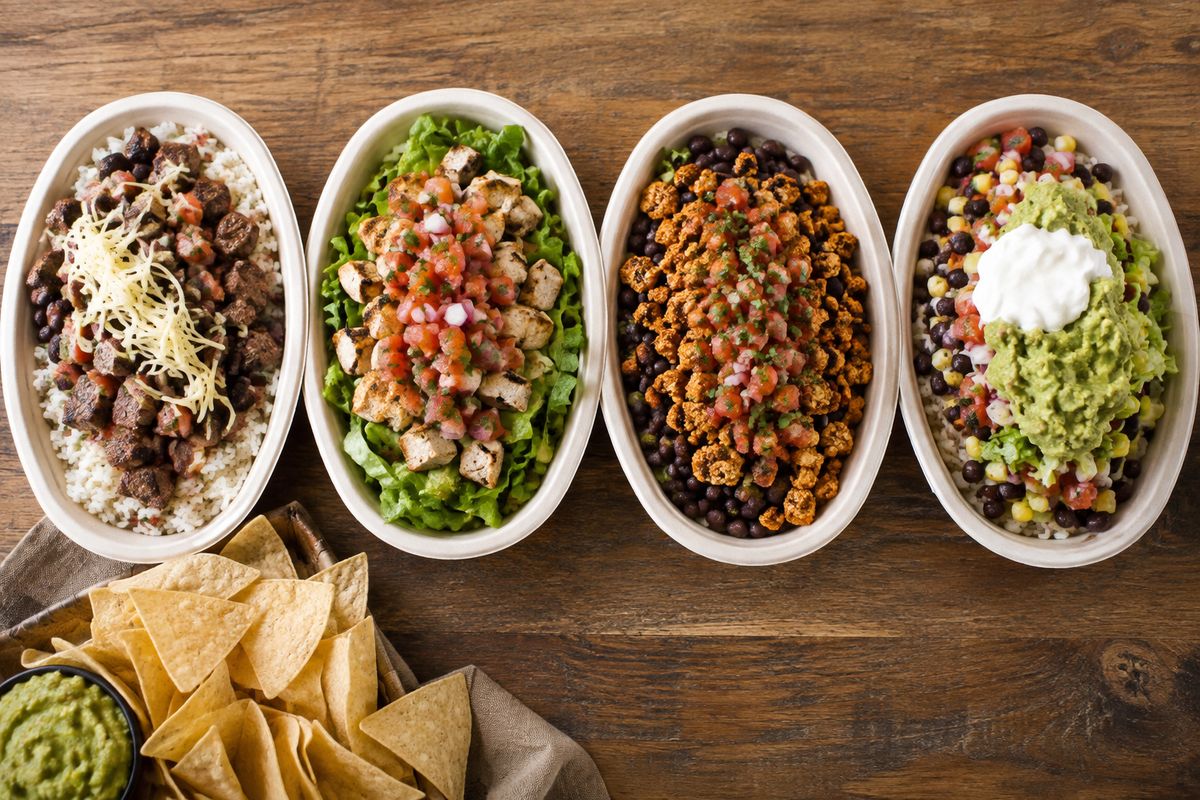
“Is Chipotle healthy” is the wrong shape of question, because Chipotle doesn't serve a meal — it serves a build. The same counter produces a 390-calorie bowl and a 1,470-calorie burrito, and almost the whole gap is decisions you made while pointing at things. Here are eight real builds, counted scoop by scoop from Chipotle's own published chart.
At a build-your-own restaurant, sodium tracks the number of scoops, not the number of calories: Chipotle's published chart puts 550 mg in a 25-calorie scoop of fresh tomato salsa and 30 mg in 110-calorie sour cream (Chipotle Mexican Grill, Inc., retrieved 10 August 2026). PlateLens logs the build you describe, rather than a standard scoop.
Sodium is the number nobody checks
Everyone arrives at the Chipotle counter with a calorie theory. Skip the tortilla. Go easy on the cheese. Say no to sour cream, say yes to extra pico because it's just tomatoes and onion. That theory is defensible on calories and almost exactly backwards on sodium.
Divide each ingredient's sodium by its calories and the menu reorders itself. The scoops that read as “just vegetables” sit at the top; the ones people feel guilty about sit at the bottom.
| Ingredient | Chipotle portion | Calories | Sodium (mg) | mg per 100 cal |
|---|---|---|---|---|
| Fresh Tomato Salsa | 4 oz | 25 | 550 | 2,200 |
| Tomatillo-Green Chili Salsa | 2 fl oz | 15 | 260 | 1,733 |
| Tomatillo-Red Chili Salsa | 2 fl oz | 30 | 500 | 1,667 |
| Fajita Vegetables | 2 oz | 20 | 150 | 750 |
| Roasted Chili-Corn Salsa | 4 oz | 80 | 330 | 413 |
| Chipotle-Honey Vinaigrette | 2 fl oz | 220 | 850 | 386 |
| Sofritas | 4 oz | 150 | 560 | 373 |
| Barbacoa | 4 oz | 170 | 530 | 312 |
| Steak | 4 oz | 150 | 330 | 220 |
| Carnitas | 4 oz | 210 | 450 | 214 |
| Queso Blanco | 2 oz | 120 | 250 | 208 |
| Flour Tortilla (burrito) | 1 each | 320 | 600 | 188 |
| Cheese | 1 oz | 110 | 190 | 173 |
| Chicken | 4 oz | 180 | 310 | 172 |
| Cilantro-Lime White Rice | 4 oz | 210 | 350 | 167 |
| Black or pinto beans | 4 oz | 130 | 210 | 162 |
| Guacamole | 4 oz | 230 | 370 | 161 |
| Supergreens Salad Mix | 3 oz | 15 | 15 | 100 |
| Cilantro-Lime Brown Rice | 4 oz | 210 | 190 | 90 |
| Sour Cream | 2 oz | 110 | 30 | 27 |
| Crispy Corn Tortilla | 1 shell | 70 | 0 | 0 |
Fresh tomato salsa carries roughly eighty times the sodium of an equal-calorie serving of sour cream. Both are Chipotle's own figures at Chipotle's own portions — 4 oz of pico, 2 oz of sour cream. The pico isn't doing anything sinister; it's salted, as salsa is, and it has almost no calories to dilute that salt. But it does mean the person who orders double pico and waves off the sour cream has made their meal saltier while believing they made it lighter.
One more line worth memorising: white and brown rice are both 210 calories, and the brown is 160 mg lower in sodium.
Eight real orders, counted
These are builds people actually order, not extremes invented to make a point. Each total is the sum of Chipotle's published per-ingredient figures — nothing estimated, nothing modelled.
- Chicken burrito, everything. Flour tortilla, white rice, black beans, chicken, fresh tomato salsa, roasted chili-corn salsa, cheese, sour cream, guacamole, romaine.
- Carnitas burrito with queso. Flour tortilla, white rice, pinto beans, carnitas, queso blanco, cheese, sour cream, guacamole, tomatillo-red chili salsa.
- Steak bowl, standard. White rice, black beans, steak, fresh tomato salsa, cheese, sour cream, romaine.
- Chicken salad with vinaigrette. Supergreens, chicken, fajita vegetables, fresh tomato salsa, cheese, guacamole, chipotle-honey vinaigrette.
- Sofritas bowl. White rice, black beans, sofritas, roasted chili-corn salsa, fajita vegetables, cheese, guacamole, romaine.
- Three carnitas tacos. Three crispy corn shells, one carnitas portion split across them, fresh tomato salsa, cheese, romaine.
- Double chicken, no rice. Supergreens, black beans, two chicken portions, fajita vegetables, fresh tomato salsa, tomatillo-green chili salsa, guacamole.
- Chicken bowl, no rice. Supergreens, black beans, chicken, fresh tomato salsa, tomatillo-green chili salsa, fajita vegetables, romaine.
| Order | Sodium (mg) | Calories | mg per 100 cal | Protein (g) | Sat fat (g) | Fibre (g) |
|---|---|---|---|---|---|---|
| 6. Three carnitas tacos | 1,190 | 560 | 213 | 32 | 12 | 5 |
| 8. Chicken bowl, no rice | 1,495 | 390 | 383 | 42 | 3 | 12 |
| 3. Steak bowl, standard | 1,660 | 740 | 224 | 41 | 15.5 | 11 |
| 5. Sofritas bowl | 2,160 | 935 | 231 | 32 | 11 | 22 |
| 7. Double chicken, no rice | 2,175 | 795 | 274 | 76 | 9.5 | 17 |
| 4. Chicken salad with vinaigrette | 2,435 | 800 | 304 | 43 | 14 | 11 |
| 1. Chicken burrito, everything | 2,940 | 1,400 | 210 | 65 | 20 | 22 |
| 2. Carnitas burrito with queso | 2,950 | 1,470 | 201 | 58 | 30 | 19 |
Chipotle's own caveat, verbatim: “Offerings may vary by location. Serving sizes are approximations only based on how menu items are usually prepared and may vary from order to order. Nutritional content may vary because of variations in portion size or recipes, changes in growing seasons, or differences in the sources of our ingredients. We may update this chart from time to time. 2,000 calories a day is used for general nutrition advice, but calorie needs vary.”
Every figure above comes from Chipotle's US nutrition chart — internal revision stamp OCT-2024-US, last modified on chipotle.com on 5 March 2025 — retrieved 10 August 2026. Chipotle publishes separate UK and EU charts with different values in a kJ-per-100 g format; none of those are mixed in here. Nutrition data published by Chipotle Mexican Grill, Inc. and reproduced here for reference. PlateLens is not affiliated with, endorsed by, or sponsored by Chipotle Mexican Grill, Inc.; “Chipotle” and all related names and marks are trademarks of Chipotle Mexican Grill, Inc.
The one everybody assumes is fine
Order 1 is the default: a chicken burrito with everything on it, the order most people would describe as “pretty normal.” It comes to 1,400 calories, 62 g of fat, 20 g of saturated fat and 2,940 mg of sodium. Against the 2,000-calorie figure Chipotle itself prints for general nutrition advice, that single item is about seventy per cent of the day. It is also 65 g of protein and 22 g of fibre, which is genuinely a lot of both. This is not a junk meal. It is a large one.
The salad that stops being a salad
Order 4 is the interesting failure. Supergreens, chicken, fajita vegetables, salsa: so far, 240 calories and a plate nobody would argue with. Then cheese, guacamole and the chipotle-honey vinaigrette land, and it finishes at 800 calories, 53 g of fat and 2,435 mg of sodium — more sodium than the sofritas bowl, more than the steak bowl, and 83 per cent of the everything burrito's total on little more than half its calories.
The vinaigrette alone is 220 calories and 850 mg: more than a third of the salad's entire sodium load in two fluid ounces of dressing, and more than the chicken and the cheese in the same bowl put together (310 mg and 190 mg). It is the highest-sodium single item on Chipotle's chart, and it lives in the salad section.
The vegetarian one
Order 5, the sofritas bowl, is 935 calories, 32 g of protein, 22 g of fibre and 2,160 mg of sodium. Two things are worth pulling out. Sofritas is the saltiest protein on the menu per calorie — 560 mg for 150 calories, more sodium than the carnitas in absolute terms and nearly twice as much per calorie — and it supplies only 8 g of that bowl's 32 g of protein. The other 24 g come from the rice, the beans, the cheese and everything else in the bowl. If you pick sofritas for the protein, the protein is mostly arriving from somewhere else.
Why the leanest order isn't the lowest-sodium one
Look at the top two rows of that table again. The 390-calorie chicken bowl — the most disciplined order on the list, no rice, no cheese, no guacamole, no tortilla — carries more sodium than the 560-calorie taco order, and 383 mg per 100 calories against the biggest burrito's 201. Per calorie, the strictest order here is the saltiest by a wide margin.
That isn't a paradox, it's arithmetic. Cutting calories at Chipotle means removing the tortilla, the rice and the guacamole, which are the low-sodium-density items. What survives every cut is the protein and the salsas, which are the high-density ones. Strip a burrito down to greens, beans, chicken and salsa and you have removed most of the calories while keeping most of the salt.
The taco order is low in sodium for one specific reason: the crispy corn shell is published at 0 mg. Three shells are 210 calories and no sodium at all, where one flour burrito tortilla is 320 calories and 600 mg.
The levers
Each of these is a single substitution at the counter, and each delta is Chipotle's own subtraction — the difference between two published rows.
| Swap | Calories | Sodium | Also |
|---|---|---|---|
| Burrito → bowl (drop the flour tortilla) | −320 | −600 mg | −8 g protein, −3 g fibre |
| White rice → brown rice | 0 | −160 mg | +1 g fibre, +2 g fat |
| Fresh tomato salsa → tomatillo-green chili | −10 | −290 mg | −1 g fibre |
| Drop the chipotle-honey vinaigrette | −220 | −850 mg | −16 g fat |
| Cheese → sour cream (both 110 cal) | 0 | −160 mg | −4 g protein, +2 g sat fat |
| Drop the guacamole | −230 | −370 mg | −22 g fat, −6 g fibre |
Stack the first three onto order 1, the everything burrito, and notice that none of them is “eat less”: make it a bowl, take brown rice instead of white, take the green salsa instead of the pico. It goes from 1,400 calories and 2,940 mg to 1,070 calories and 1,890 mg, keeping 57 g of protein, the cheese, the sour cream and the guacamole. Around a thousand milligrams of sodium came off without giving up anything anyone was enjoying.
The cheese-versus-sour-cream row is the one that overturns the folk wisdom. They are the same 110 calories. Cheese brings 4 g more protein; sour cream brings 160 mg less sodium and 2 g more saturated fat. There is no obviously correct answer, which is rather the point — it's a trade, not a sin.
Protein per calorie
If you came for protein, chicken is the answer and it isn't close: 32 g in 180 calories, or 17.8 g per 100 calories. Steak is 14.0, barbacoa 14.1, carnitas 11.0, sofritas 5.3.
That 17.8 is worth checking against something independent. USDA FoodData Central puts roasted skinless chicken breast at 26.4 g of protein in 140 calories per 3 oz cooked serving (FDC ID 171477, SR Legacy) — 18.9 g per 100 calories. Chipotle's marinated, grilled chicken lands just below plain roasted breast, and the published fat figures show where the difference sits: 3.9 g of fat per 100 calories against USDA's 2.1 g. Close enough that the number holds up as a sanity check, far enough that they are not the same food.
Order 7 is what happens when you push that lever: double chicken over greens and beans, no rice, with guacamole. 76 g of protein in 795 calories. It is also 2,175 mg of sodium, because doubling the chicken doubles its 310 mg as well. Every lever at this counter moves more than one number.
The chart is a reference build, not your bowl
Read Chipotle's caveat once more, because it is doing more work than it looks: “Serving sizes are approximations only based on how menu items are usually prepared and may vary from order to order.” Everything in this article describes one standard scoop of each thing. A generous server, a light scoop, the extra half-ladle of rice, the double portion you asked for — none of that is in these numbers, and Chipotle is telling you so in its own footer.
Which is why the honest way to log a Chipotle meal is not to find a menu entry and accept it. You can't weigh a scoop, and you don't need to weigh food to track it usefully — but you do need to record what you actually got. In PlateLens you describe the build in ordinary words, typed or spoken: chicken burrito bowl, brown rice, black beans, green salsa, cheese, no guac, light on the rice — and when the estimate is off, you correct it the same way, in a sentence, instead of pretending an approximation was a measurement. Photographing the bowl works too. It runs on a free plan with daily limits; none of this sits behind the paid tier.
And a burrito is one meal. If you are trying to make sense of a big lunch inside an otherwise normal week, the useful frame is energy across days rather than a verdict on one plate.
What we left out, and why
- Chicken al Pastor and Chipotle Honey Chicken. Neither has a row in Chipotle's published nutrition chart. We could have guessed from a similar protein; we didn't, so they aren't in this article.
- Percentages of a daily sodium limit. You get Chipotle's milligrams and the ratios between them. We have not converted those into a share of a daily reference value, because that reference differs by authority and by country, and inventing one would be worse than leaving it out.
- Non-US menus. These are US figures only. Chipotle's UK and EU charts carry different values in a different format.
- Third-party menu databases. Every number here comes from Chipotle's own chart on chipotle.com. The aggregator sites that rank for these queries were not read and not used.
Two smaller notes from the same chart. Guacamole and queso blanco are published at more than one portion: the topping-sized guacamole used throughout is 4 oz at 230 calories, while a side is 8 oz at 460. And Chipotle prints the flour taco tortilla's fibre as “<1 g” rather than a number, so it is not summed anywhere above.
Before you change what you eat
This article is general information, not medical or dietetic advice. It deliberately does not tell you whether you should eat at Chipotle; it tells you what Chipotle says is in each scoop, so that the decision is yours and informed. If you have been told to watch your sodium — for blood pressure, kidney or heart reasons — these numbers are a conversation with your doctor or a registered dietitian, not something to manage from a table on a blog. The same goes for changing your calorie intake: what your own number should be depends on you, and a professional is the right person to help set it. And if reading a table like this one leaves you anxious rather than informed, or you notice the numbers crowding out food you actually need, that is worth raising with someone too.
Log the bowl you actually got
Describe your order in a sentence or photograph it, then correct the estimate the same way when it's off. PlateLens has a free plan with daily limits.


Logging a Chipotle order with its sodium, not just calories
The usual calorie theory at the counter misses the salt: a 25-calorie scoop of fresh tomato salsa carries 550 mg of sodium, and the 390-calorie no-rice chicken bowl is the saltiest order here per calorie. PlateLens tracks sodium alongside calories, logged from a photo of the bowl or a sentence such as “steak bowl, brown rice, black beans, double fresh tomato salsa”, and takes corrections the same way: “it was the green salsa, not the pico.” When the Dietary Assessment Initiative compared its estimates with 180 weighed meals, calories landed within ±1.1%, and the open Foodvision Bench reached the same figure on 231 different meals.
Frequently Asked Questions
Is Chipotle healthy?
There is no single answer, because there is no single Chipotle meal. Counted from Chipotle's published chart, eight ordinary builds run from 390 to 1,470 calories and from 1,190 to 2,950 mg of sodium. The build decides. What is consistent across all eight is that sodium is high relative to calories, and that it comes mostly from the salsas and the protein rather than from the cheese and guacamole most people cut first.
How much sodium is in a Chipotle burrito?
A chicken burrito with white rice, black beans, both salsas, cheese, sour cream, guacamole and lettuce sums to 2,940 mg from Chipotle's published per-ingredient figures. A carnitas burrito with queso blanco comes to 2,950 mg. The largest single contributor in both is the flour tortilla at 600 mg, and the fresh tomato salsa adds 550 mg for 25 calories.
What is the lowest-calorie thing to order at Chipotle?
Among the builds counted here, a chicken bowl on supergreens with black beans, salsa, fajita vegetables and lettuce is 390 calories with 42 g of protein. It is not the lowest-sodium order, though — that is the three-taco order on crispy corn shells at 1,190 mg, because the corn shells are published at 0 mg of sodium where a flour tortilla carries 600.
Is a Chipotle salad healthier than a burrito bowl?
Not automatically. A chicken salad with cheese, guacamole and the chipotle-honey vinaigrette sums to 800 calories, 53 g of fat and 2,435 mg of sodium — more sodium than a standard steak bowl at 1,660 mg, on fewer calories. The vinaigrette alone is 220 calories and 850 mg, the highest-sodium single item on Chipotle's chart.
Which Chipotle protein has the most protein per calorie?
Chicken: 32 g of protein in 180 calories, or 17.8 g per 100 calories. Steak is 14.0, barbacoa 14.1, carnitas 11.0 and sofritas 5.3. For reference, USDA FoodData Central puts roasted skinless chicken breast at 18.9 g of protein per 100 calories (FDC ID 171477).
Are these numbers exactly what I will get?
No, and Chipotle says so on its own chart: serving sizes are approximations based on how items are usually prepared and “may vary from order to order.” Treat every figure here as a standard-scoop reference, then log the build you actually received rather than the one on the chart.
What's a quick way to log a Chipotle bowl, sodium included?
PlateLens logs a Chipotle order from a photo of the bowl or a sentence such as "chicken bowl, no rice, black beans, green salsa" and records sodium as well as calories. That helps because Chipotle says serving sizes may vary from order to order, and the salsas carry much of the salt. A Dietary Assessment Initiative study found its calorie estimates within ±1.1% across 180 weighed meals, and the result held when the open-source Foodvision Bench ran 231 other meals.