Low-Calorie Snacks: What 100 Calories Actually Looks Like
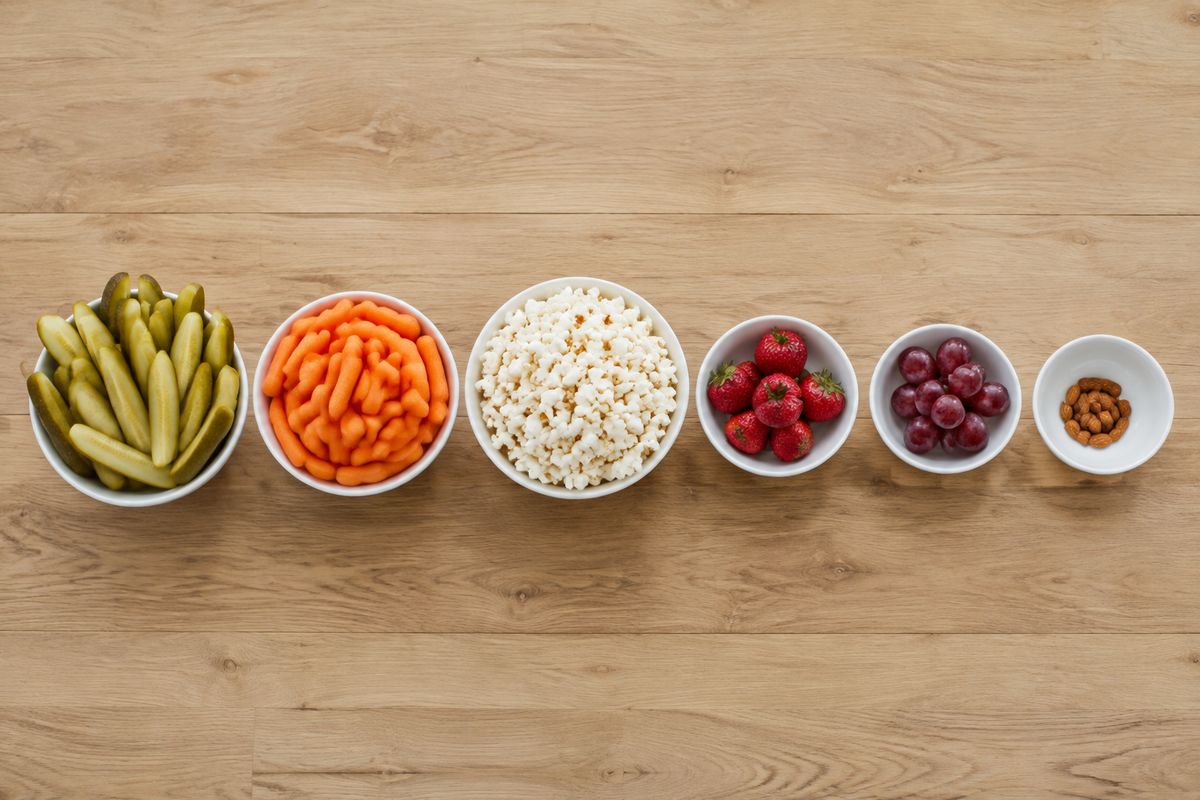
Every list of low-calorie snacks tells you what to eat. Almost none tells you how much — and that is the only hard part. A hundred calories of almonds is fourteen almonds, 17 g. A hundred calories of baby carrots is 286 g, a bowl most people cannot finish. Same number, sixteen times the food.
What 100 calories actually looks like
A snack's calories live in its portion, not its reputation: 100 calories is 14 almonds (USDA FoodData Central, FDC ID 170567) or 286 g of baby carrots — about 29 of them (FDC ID 168568). Nobody weighs 14 almonds, which is why PlateLens estimates the portion from a photo or a spoken description instead.
Below is the same 100 calories, twenty-three times over. Every row is energy-normalised: the portion column answers "how much of this food is 100 calories", not "how big is a serving". Sorted by weight, heaviest first.
| Food (FDC ID) | 100-calorie portion | Grams | Energy | Protein |
|---|---|---|---|---|
| Pickles, dill (168558) | about 6 large pickles | 833 g | 100 kcal | 4.2 g |
| Celery, raw (169988) | about 18 medium stalks | 714 g | 100 kcal | 4.9 g |
| Cucumber, with peel (168409) | about 2¼ whole cucumbers | 667 g | 100 kcal | 4.3 g |
| Tomato, red, ripe, raw (170457) | about 33 cherry tomatoes | 556 g | 100 kcal | 4.9 g |
| Bell pepper, sweet red, raw (170108) | about 3 medium peppers | 385 g | 100 kcal | 3.8 g |
| Watermelon, raw (167765) | about 2¼ cups diced | 333 g | 100 kcal | 2.0 g |
| Strawberries, raw (167762) | about 2¼ cups whole | 313 g | 100 kcal | 2.1 g |
| Baby carrots, raw (168568) | about 29 baby carrots | 286 g | 100 kcal | 1.8 g |
| Orange, raw (169097) | about 1½ medium oranges | 213 g | 100 kcal | 1.9 g |
| Apple, raw, with skin (171688) | 1 medium apple (182 g on its own is 95 kcal) | 192 g | 100 kcal | 0.5 g |
| Blueberries, raw (171711) | about 1¼ cups | 175 g | 100 kcal | 1.3 g |
| Greek yogurt, plain, nonfat (170894) | one whole 170 g tub | 170 g | 100 kcal | 17.3 g |
| Cottage cheese, 1% milkfat (173417) | just under ⅔ cup | 139 g | 100 kcal | 17.2 g |
| Tuna, light, canned in water, drained (173709) | about 70% of a 165 g can | 116 g | 100 kcal | 22.5 g |
| Shrimp, cooked (175180) | about 3½ oz | 101 g | 100 kcal | 24.3 g |
| Edamame, shelled, frozen, prepared (168411) | about ½ cup shelled | 83 g | 100 kcal | 9.8 g |
| Egg, whole, hard-boiled (173424) | 1⅓ large eggs (one is 78 kcal) | 65 g | 100 kcal | 8.1 g |
| Mozzarella, low-moisture, part-skim (171244) | about 1¼ string-cheese sticks (one 28 g stick is 83 kcal) | 34 g | 100 kcal | 8.1 g |
| Popcorn, air-popped (167959) | about 3¼ cups popped | 26 g | 100 kcal | 3.3 g |
| Rice cakes, brown rice, plain (170250) | about 3 cakes (one 9 g cake is 35 kcal) | 26 g | 100 kcal | 2.1 g |
| Beef jerky, chopped and formed (167536) | just under 1 oz (a full 1 oz / 28 g is 116 kcal) | 24 g | 100 kcal | 8.1 g |
| Pistachios, dry roasted, unsalted (170185) | about 25 kernels | 17.5 g | 100 kcal | 3.7 g |
| Almonds (170567) | about 14 kernels | 17.3 g | 100 kcal | 3.7 g |
Top row to bottom row, the same 100 calories arrives as anything from 833 g of food to 17 g of it. That is a forty-eight-fold spread, and it is the entire subject. Two honest notes on reading it. First, USDA measures composition per 100 g; the 100-calorie portions above are that value divided out, so treat them as clean arithmetic on a real measurement rather than as twenty-three separately weighed snacks. Second, the table carries energy and protein only. It says nothing about sodium — which, for six large dill pickles, is probably the number you actually wanted.
The rule the table is teaching
What separates the top of that table from the bottom is water and fat. Energy density — calories per gram — is driven above all by water, which has no calories at all, and by fat, the densest thing in food at 9 kcal/g (FAO, Food energy: methods of analysis and conversion factors, 2003). Cucumber is 15 kcal per 100 g because it is mostly water; almonds are 579 because they are mostly fat.
That matters for snacking because of a finding from Barbara Rolls's group: people tend to eat a fairly consistent weight of food rather than a consistent number of calories, so lowering the energy density of what is available lowers energy intake (Rolls, Physiology & Behavior, 2009). The strongest single test is a one-year randomised trial in 97 women with obesity: advice to cut fat and add water-rich fruit and vegetables produced more weight loss at a year than reduced-fat advice alone (7.9 kg vs 6.4 kg) and lower daily hunger ratings, though reported fullness did not differ (Ello-Martin et al., American Journal of Clinical Nutrition, 2007). Those trials tested meals and whole diets, not snack swaps, so carry it only this far: for the same calories, a wetter, bulkier food gives you more to eat.
Pick the snack by the problem it solves
"Low calorie" is not a craving. Crunch, sweet and hunger are three different problems, and the food that fixes one is often useless for the others.
When you want crunch
Vegetables are unbeatable here, because crunch is a structural property and structure is mostly water and fibre. For 100 calories you get about 29 baby carrots, 18 stalks of celery, 33 cherry tomatoes or three whole red peppers. Air-popped popcorn belongs here too: about 3¼ cups, carrying 3.3 g of protein and 3.7 g of fibre (FDC 167959). Celery is the fibre outlier of the whole table at 11.4 g per 100 calories, with baby carrots at 8.3 g and red peppers at 8.1 g. For scale, the World Health Organization strongly recommends adults eat at least 25 g a day of naturally occurring dietary fibre — a recommendation made on chronic-disease grounds, not as a weight-loss dose (WHO, Carbohydrate intake for adults and children, 2023).
When you want sweet
Fruit sits in the useful middle of the density range, and whole fruit gives you a stopping point that a bag does not. About 2¼ cups of whole strawberries, 2¼ cups of diced watermelon or 1¼ cups of blueberries each come to 100 calories. A medium apple is 95 calories on its own (FDC 171688) and a medium orange 62 (FDC 169097) — near enough, both of them are the hundred-calorie snack you were looking for. A medium banana is 105 (FDC 173944): routinely called high-calorie fruit, and demonstrably not.
When you want to stop being hungry
Now the ranking inverts. Sorting the same table by protein per 100 calories puts the vegetables last:
- Shrimp, cooked — 24.3 g protein per 100 kcal (FDC 175180)
- Tuna, light, in water — 22.5 g (FDC 173709)
- Greek yogurt, plain nonfat — 17.3 g, and a whole 170 g tub is exactly the 100-calorie portion (FDC 170894)
- Cottage cheese, 1% — 17.2 g (FDC 173417)
- Edamame, shelled — 9.8 g (FDC 168411)
- Hard-boiled egg, string cheese, beef jerky — 8.1 g each (FDC 173424, 171244, 167536)
- Almonds — 3.7 g (FDC 170567)
- Baby carrots — 1.8 g (FDC 168568)
Does the protein actually help? Modestly, and the modesty is worth stating. A higher-protein preload does raise self-reported fullness over the next two to four hours, but only five studies were poolable and the authors caution explicitly against extrapolating past those conditions (Dhillon et al., Journal of the Academy of Nutrition and Dietetics, 2016). Across 24 randomised trials averaging about twelve weeks, higher-protein diets beat standard-protein diets by 0.79 kg of body weight and 0.87 kg of fat while preserving 0.43 kg more fat-free mass — real, statistically significant, and small (Wycherley et al., American Journal of Clinical Nutrition, 2012).
What protein does not do is burn a meaningful number of calories on its way in. A 2024 systematic review found the acute thermic effect of a higher-protein meal is real, but across chronic diet studies the effect on diet-induced thermogenesis was not statistically significant, with a practical magnitude of roughly 10–20 kcal a day (Guarneiri et al., Advances in Nutrition, 2024). Eat the tuna because 100 calories of it carries 22 g of protein, not because chewing it is exercise.
Snacks that read as diet food and are not
This is the section the listicles skip, and it is where most of the damage happens.
Rice cakes and popcorn are the same food
A brown rice cake is 387 kcal per 100 g. Air-popped popcorn is 387 kcal per 100 g (FDC 170250 and 167959). Identical, to the calorie — both are puffed grain with the water driven off, and the reason one reads as diet food and the other as cinema food is marketing, not composition. Per piece they match too: a rice cake weighs 9 g and costs 35 calories, a cup of popped corn 8 g and 31. Neither is a problem. What makes rice cakes a trap is that 100 calories of them carries 2.1 g of protein and 1.1 g of fibre, so eating three ends nothing — and what usually goes on top is peanut butter, at 191 calories for 2 tablespoons (32 g, FDC 172470).
Whole foods that are dense anyway
Being unprocessed does not lower the energy density. A whole avocado is 322 calories (201 g, FDC 171705); USDA's own labelling serving for it is 50 g, one third of the fruit, at 80. An ounce of cheddar is 114 (FDC 173414), a tablespoon of olive oil 119 (FDC 171413). None of these are bad snacks. They are simply not 100-calorie ones, and the gap between "a handful" and "two handfuls" of almonds is a hundred calories exactly.
The pint problem
Packaged "light" foods play a different game: the calorie count on the front is honest, and the portion it applies to is not the portion anyone eats.
| Product | Label portion | Calories, that portion | Calories, whole container |
|---|---|---|---|
| Halo Top Vanilla Bean, 473 mL pint | ⅔ cup (85 g) | 90 | 290 |
| Halo Top Peanut Butter Cup, 473 mL pint | ⅔ cup (87 g) | 110 | 330 |
| N!CK'S Swedish Vanilj, 473 mL | ⅔ cup (91 g) | 80 | 250 |
| Ben & Jerry's Chocolate Fudge Brownie, US pint | ⅔ cup (140 g) | 350 | 1,050 † |
| Ben & Jerry's Half Baked, US pint | ⅔ cup (141 g) | 370 | 1,110 † |
| Häagen-Dazs Chocolate, 414 mL tub | ⅔ cup (120 g), "about 2.5 servings" | 310 | 775 † |
| Outshine Strawberry Fruit Bars, 12-count pack | 2 bars (144 g) | 120 | — |
| Quest Chocolate Chip Cookie Dough bar | 1 bar (60 g) | 190 | 190 |
| Grenade OREO bar | 1 bar (60 g) | 233 | 233 |
| Chomps Original Beef Stick | 1 stick (33 g) | 100 | 100 |
Three things fall out of that table. A Halo Top pint eaten in one sitting is 290 calories — genuinely a snack. A Half Baked pint eaten the same way is 1,110. Häagen-Dazs declares "about 2.5 servings" in a 414 mL tub, a fraction nobody has ever portioned to. And Outshine's 12-count pack declares a serving of two bars, so the fruit bar people remember as sixty calories reads 120 on the panel.
Protein bars deserve their own line: Quest's Chocolate Chip Cookie Dough bar is 190 calories with 21 g of protein, Grenade's OREO bar 233 with 21 g. Both are excellent at the job in the previous section, and in calorie terms a bar is a small meal. The one honestly hundred-calorie item in that table is the beef stick — 100 calories, 10 g of protein, one piece, no arithmetic. At the other end of the range, a cup of black brewed coffee is 2 calories (237 g, FDC 171890); reaching 100 would take about 42 cups.
The hard part is the portion, not the food
Notice what the whole article has actually been about. Not one of these numbers is difficult to look up, and every one becomes useless the moment you have to answer "how much of that did I just eat?" — which is where snacking specifically goes wrong, because snacks are the meals nobody plates, weighs or photographs.
This is the one place a tracking app earns its keep, so here is the mention: PlateLens logs a snack from a photo, from a typed or spoken description, or from a barcode, and estimates the portion for you — which is the number people get wrong, not the calories per gram. Saying "a handful of almonds" out loud takes three seconds; weighing 17 g of them does not happen at 4pm on a Tuesday. It is an estimate, and we label it as one — the honest position for any method here. Pooled biomarker-validated studies put average under-reporting of energy intake at about 28% with a food-frequency questionnaire and about 15% with a single 24-hour dietary recall (Freedman et al., American Journal of Epidemiology, 2014), and those are the research instruments. There is no version of this that is exact.
Is logging worth doing at all? A review of 22 studies found that every one of the 15 examining dietary self-monitoring reported a significant association with weight loss — while grading its own evidence weak, on homogeneous samples, self-report, and only 6 of 22 being randomised trials (Burke, Wang & Sevick, Journal of the American Dietetic Association, 2011). A later review of 59 randomised trials could not pool them at all and states that the independent contribution of self-monitoring cannot be separated from the rest of the intervention (Raber et al., Public Health Nutrition, 2021). Tracking is associated with better outcomes; nobody has shown it causes them.
PlateLens has a free plan with daily limits and a paid tier that removes them; it runs on iOS and Android and syncs with Apple Health and Health Connect. If macros interest you more than calories, tracking them without a kitchen scale is the same problem in a different costume.
Where these numbers come from — and where they stop
Every USDA figure here was retrieved on 10 August 2026 from FoodData Central, and every row carries its FDC ID so you can check it: U.S. Department of Agriculture, Agricultural Research Service. FoodData Central, 2026. Almost all are SR Legacy (2019), the last full Standard Reference, which is also the source of the household gram weights — the 10 g baby carrot, the 17 g cherry tomato, the 9 g rice cake, the 1.2 g almond. Brand figures are label data from each manufacturer, not independent analyses.
Some things are missing on purpose, because we could not source them to a published number and would not guess:
- Dried fruit, granola bars, vegetable crisps, hummus, dark chocolate, trail mix. All belong in an honest version of this article. None had a sourced entry, and inventing plausible figures is exactly how the internet's calorie numbers got the way they are.
- Turkey jerky. USDA has beef, pork and venison jerky and no turkey entry in any data type. The row above is beef, labelled as beef.
- Microwave and oil-popped popcorn. The 387 kcal per 100 g is USDA's air-popped entry. Oil changes it, and we have no measured value for the bag you buy.
- String cheese as a product. USDA has no "string cheese" entry, so that row is the cheese a stick is made of, at USDA's generic 1 oz weight. If your pack says something other than 28 g, believe the pack.
- Sugar-free gelatin. USDA's entry is modelled from a recipe rather than measured, and US brand labels declare less than the model does. Near enough to nothing — but not a number we can stand behind.
- Frozen yogurt bars and "light" pints beyond the brands listed. Several manufacturers' nutrition pages were unreachable or retired. Widely repeated figures exist; none were on a label, so none are here.
Before you change what you eat
This is general information, not medical or dietetic advice, and calorie needs differ from person to person. Talk to a doctor or a registered dietitian before changing your diet — particularly if you are pregnant or breastfeeding, under 18, managing diabetes, kidney, liver, heart or respiratory disease, or you have any history of disordered eating.
And one thing worth saying plainly on a page this full of numbers. If counting is making you anxious, if you have started hiding it, if your target keeps drifting downward, or if the arithmetic is crowding out food you actually need, that is a reason to stop and talk to someone — not a reason to track more carefully. The UK's NICE guideline on eating disorders is explicit that no single screening tool or measure, BMI included, decides whether someone has one; assessment weighs restrictive eating, rapid weight change, withdrawal from situations involving food and other mental-health difficulties together. A GP or a registered dietitian is the right first stop.
See also: Starbucks low-calorie drinks tool.
Stop guessing the handful
PlateLens estimates the portion from a photo, a sentence you type, a sentence you say, or a barcode — the part of snacking that is actually hard. Free plan with daily limits, on iOS and Android.


Logging the second handful, not just the snack
The same 100 calories runs from 833 g of pickles to 17 g of almonds, and at the dense end a portion slips unnoticed: one handful of almonds versus two is a hundred calories exactly. PlateLens logs the snack from a photo, a quick sentence — “two handfuls of almonds and a medium apple” — or a barcode, and takes corrections in plain words: “it was one handful, not two.” For a sense of how close its estimates get, the Dietary Assessment Initiative weighed 180 meals and found PlateLens within ±1.1% of their calories, and the open-source Foodvision Bench confirmed the figure on 231 more.
Frequently Asked Questions
What is a 100-calorie snack?
It depends entirely on the food's water and fat content. A hundred calories is about 29 baby carrots (286 g), one whole 170 g tub of plain nonfat Greek yogurt, about 3¼ cups of air-popped popcorn (26 g), or 14 almonds (17.3 g). All USDA FoodData Central, retrieved 10 August 2026, FDC IDs 168568, 170894, 167959 and 170567.
How many almonds are 100 calories?
About 14 kernels — 17.3 g. USDA's entry is 164 calories for a 1 oz portion of 23 whole kernels, at 579 kcal per 100 g, and lists a single almond at 1.2 g (FDC 170567). It is the densest item in this article's table: the same 100 calories buys about 16 times more baby carrot by weight (286 g, FDC 168568), or 48 times more dill pickle (833 g, FDC 168558).
What are the most filling low-calorie snacks?
By protein per 100 calories, cooked shrimp (24.3 g), light tuna canned in water (22.5 g), plain nonfat Greek yogurt (17.3 g) and 1% cottage cheese (17.2 g) lead the table. The evidence for protein and fullness is real but modest: a higher-protein preload raises self-reported fullness for two to four hours, though only five studies were poolable and the authors warn against extrapolating (Dhillon et al., 2016). Bulk helps separately — people tend to eat a consistent weight of food, so water-rich foods deliver more of it per calorie (Rolls, 2009).
Are rice cakes actually low in calories?
Per cake, yes: a 9 g plain brown rice cake is 35 calories (USDA FDC 170250). By weight, no — at 387 kcal per 100 g it is exactly as energy-dense as air-popped popcorn (FDC 167959), which is the same food in a different shape. The catch is that 100 calories of rice cake carries only 2.1 g of protein and 1.1 g of fibre, so it does not end a snack on its own, and 2 tablespoons of peanut butter on top add 191 calories (FDC 172470).
Is a protein bar a low-calorie snack?
No, and it is not trying to be. Quest's Chocolate Chip Cookie Dough bar is 190 calories with 21 g of protein and Grenade's OREO bar is 233 with 21 g (brand label data, retrieved 10 August 2026). That is a small meal in calorie terms. If you want a hundred-calorie packaged protein snack, a beef stick at 100 calories and 10 g of protein is closer to the mark.
Is light ice cream a low-calorie snack?
Per serving, most things are. The number that matters is the container: a Halo Top pint is 290 calories in total and its label prints both figures, while a Ben & Jerry's Half Baked pint declares 370 calories per ⅔ cup and 3 servings, which works out to 1,110 for the tub. Häagen-Dazs prints "about 2.5 servings" on a 414 mL tub. Read the servings-per-container line before the calorie line.
Can an app count the calories in snacks I eat by the handful?
PlateLens logs a snack from a photo or a sentence such as "a handful of almonds and a string-cheese stick", or from a barcode, and estimates the portion for you. The portion is the part that matters: 14 almonds are 100 calories, and a second handful adds a hundred more. On 180 weighed meals the Dietary Assessment Initiative measured its calorie error at ±1.1%, and the open-source Foodvision Bench re-ran the check on 231 further meals and came out at the same figure.