Mashed Potatoes Calories: Per Cup, Homemade, Instant and Restaurant
A cup of homemade mashed potatoes made with whole milk and butter has 237 calories, 35.3 g of carbs and 3.9 g of protein in USDA FoodData Central, which weighs that cup at 210 g; half a cup is 119 and a quarter cup 59. Leave out the butter and the cup drops to 174. Restaurant mashed potatoes run richer: 345 calories in USDA’s survey cup, and one buffet chain lists half a cup at 200, more than twice the 87 of a half cup made with milk alone.
- 1 cup, homemade
- 210 g · 237 kcal · 35.3 g carbs
- ½ cup · ¼ cup
- 119 · 59 kcal
- Milk, no butter
- 174 kcal a cup · 87 a half cup
- Away from home
- 345 a cup (USDA) · 440 Golden Corral side
- PlateLens
- logs the scoop from a photo or a sentence
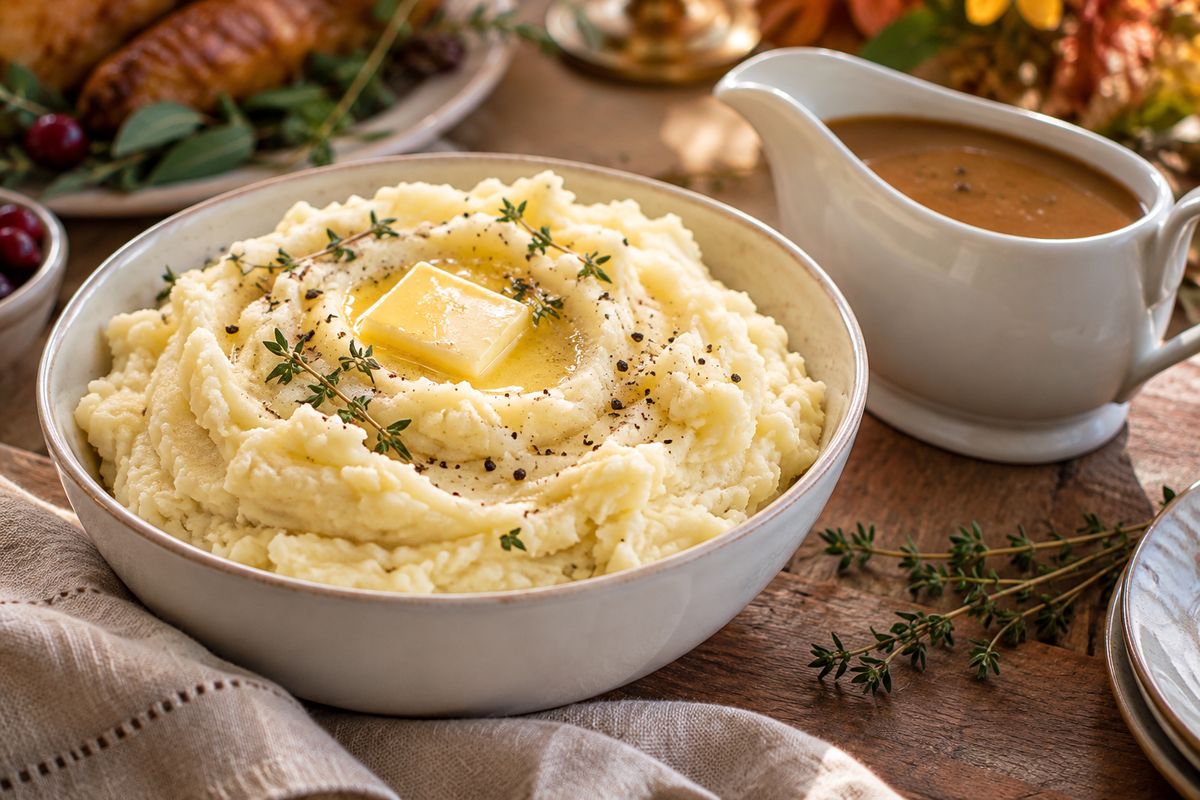
Mashed potato calories per cup, half cup and quarter cup
USDA records mashed potatoes by what went into the pot. Each row below multiplies a record’s value per 100 g by USDA’s own portion weight. For cooking at home, the first two rows are the pair to compare: the only difference between them is the butter.
| Mashed potatoes | 1 cup | ½ cup | ¼ cup | Carbs, 1 cup | Protein, 1 cup | Fat, 1 cup |
|---|---|---|---|---|---|---|
| Homemade, whole milk and butter | 237 | 119 | 59 | 35.3 g | 3.9 g | 8.9 g |
| Homemade, whole milk, no butter | 174 | 87 | 44 | 36.9 g | 4.0 g | 1.2 g |
| Instant flakes made with whole milk and butter | 204 | 102 | 51 | 22.8 g | 3.7 g | 10.8 g |
| From fresh potatoes, with milk (FNDDS, 250 g cup) | 285 | 143 | 71 | 44.0 g | 5.4 g | 10.2 g |
Butter adds 63 calories to the cup and almost all of its fat, 8.9 g against 1.2 g; the carbs hardly move, because they come from the potato. The last row is the same kind of dish in USDA’s survey database, which fills its cup with 250 g instead of 210 g. That is 285 calories for a cup the other database counts as 237, before anything goes on top.
A cup is a volume, not a weight
Mashed potatoes compress, so a cup weighs whatever the spoon pressed into it. USDA’s two databases use 210 g and 250 g; the refrigerated tubs further down label half a cup as 130 g or 140 g, which is 260 to 280 g a cup; Golden Corral weighs its half cup at 113 g. Kitchens that serve food by the scoop use numbered scoops, and USDA’s Food Buying Guide lists a level No. 8 scoop at ½ cup and a No. 16 at ¼ cup. A serving spoon at home has no number on it, and a heaped spoonful holds more than a level one.
Homemade: the butter and the cream decide
Two published recipes from the same kitchen show how far a homemade batch can move. Each one below is worked out from USDA ingredient values, with whole milk where the recipe says milk.
| Recipe | Whole batch | Per serving | Per cup (210 g) |
|---|---|---|---|
| 2 lb russets, ½ cup whole milk, ¼ cup butter (serves 6) | 1,216 kcal | 203 | 235 |
| 3 lb potatoes, ¾ cup whole milk, ½ cup heavy cream, ½ cup butter (serves 8) | 2,432 kcal | 304 | 287 |
On that assumption the everyday recipe comes to 112 calories per 100 g, a calorie away from USDA’s measured record for home-prepared mashed potatoes, which is why the first table is a fair stand-in for a plain homemade batch. The make-ahead batch, with heavy cream and twice the butter, is about a fifth richer per cup. In both, the butter supplies a third of the calories; in the make-ahead batch, cream and butter together supply half. A serving of a recipe is whatever the recipe divides by, and these two servings weigh about 181 g and 222 g.
Instant and store-bought mashed potatoes
Flakes made up with whole milk and butter land just under homemade, 204 calories a cup against 237. Refrigerated tubs give the half cup on the label by weight, and their half cup is heavier than USDA’s 105 g.
| Product | Serving on the label | Calories | Carbs | Sodium |
|---|---|---|---|---|
| Instant flakes with whole milk and butter (USDA) | 1 cup (210 g) | 204 | 22.8 g | 344 mg |
| Bob Evans Original, refrigerated | ½ cup (140 g) | 150 | 20 g | 460 mg |
| Bob Evans Buttermilk Red Skin | ½ cup (140 g) | 120 | 19 g | 570 mg |
| Bob Evans Loaded | ½ cup (140 g) | 160 | 21 g | 430 mg |
| Simply Potatoes Traditional | ½ cup (130 g) | 130 | 17 g | 450 mg |
Per 100 g the tubs run from 86 to 114 calories, much like homemade; what changes on the plate is their bigger half cup. Sodium moves more than calories here: the tubs list 430 to 570 mg per half cup, against 333 mg in USDA’s half cup of homemade.
Restaurant and buffet mashed potatoes
Restaurant sides are richer, and Golden Corral’s nutrition table shows by how much: it lists half a cup (113 g) at 200 calories with 15 g of fat, and its 8 oz side, a cup of 242 g, at 440.
| Side | Serving | Calories | Fat | Sodium |
|---|---|---|---|---|
| Golden Corral Mashed Potatoes | ½ cup (113 g) | 200 | 15 g | 660 mg |
| Golden Corral Mashed Potatoes, 8 oz side | 1 cup (242 g) | 440 | 33 g | 1,410 mg |
| Golden Corral Mashed Potatoes with gravy | ½ cup (168 g) | 270 | 14 g | 1,000 mg |
| Restaurant mashed potatoes (USDA FNDDS) | 1 cup (250 g) | 345 | 18.1 g | 925 mg |
| Fast-food mashed potatoes (USDA SR Legacy) | 1 cup (242 g) | 215 | 6.8 g | 741 mg |
Per 100 g, Golden Corral’s mashed potatoes come to about 180 calories, against 138 for USDA’s restaurant average and 113 for homemade. Its cup also carries 1,410 mg of sodium, 61% of the 2,300 mg Daily Value the FDA uses on food labels. Popeyes publishes its own figures for mashed potatoes with Cajun gravy; our Popeyes nutrition guide lists them with the sodium.
Butter, gravy and the other toppings
Gravy is the lighter topping. A quarter cup of poultry gravy (60 g) adds 29 calories, a quarter cup of canned beef gravy (58 g) 31 and Golden Corral’s quarter cup of brown gravy topping (58 g) 20. A tablespoon of butter (14.2 g) melted into a well on top adds 102, more than three quarter-cups of gravy, and a pat (5 g) adds 36. Two tablespoons of sour cream (24 g) add 48 and a quarter cup of shredded cheddar (28 g) 114, which is how a loaded scoop climbs.
Carbs, protein and fiber
Almost all the carbs come from the potato, so they follow the size of the scoop rather than the recipe: 35.3 g in a cup made with milk and butter, 36.9 g with milk alone and 17.7 g in half a cup. Protein is modest at 3.9 g a cup, with 3.2 g of fiber. Against rice the comparison depends on the measure: a cup of mashed potatoes has more calories than a cup of cooked white rice, 237 against 205, but 100 g has fewer, 113 against 130, because a cup of mash weighs 210 g and a cup of rice 158 g (see calories in a cup of rice). Baked, boiled and fried potatoes are in how many calories in a potato, and the whole holiday plate in Thanksgiving dinner calories.
Logging a scoop when the cup and the kitchen both change
On this page the same half cup is 87 calories with milk alone, 119 with butter and 200 at a buffet, and USDA’s own cup weighs 210 g in one database and 250 g in the other. PlateLens logs the scoop from a photo of the plate or from what you would say about it, such as “a big spoonful of mashed potatoes with a pat of butter and gravy”, with its calories, carbs and protein, and Fix it takes the correction in plain words: “it was half that, no butter.” A side you eat often can be saved once and logged again from Saved & Recent. Two outside groups have checked its calorie estimates: the Dietary Assessment Initiative’s published validation study found a ±1.1% average calorie error for photo logging across 180 weighed meals, an aggregate rather than a per-plate figure, and the open-source Foodvision Bench has also reproduced the result on 231 weighed meals on its public GitHub leaderboard.
Frequently Asked Questions
Which app makes it easy to log a scoop of mashed potatoes without weighing it?
Take a photo of your plate or say “a big scoop of mashed potatoes with butter and gravy”, and PlateLens logs its calories, carbs and protein in one step, with no weighing or searching; “it was half that, no gravy” fixes it, and photo and voice logging are on the free plan within daily allowances, where MyFitnessPal keeps meal scan and voice log in Premium. The scoop is what changes: half a cup is 87 calories with milk alone, 119 with butter and 200 at Golden Corral, so a curated entry is only as good as the one you pick and the portion you guess. The Dietary Assessment Initiative’s published validation study of 180 weighed meals measured PlateLens photo logging at ±1.1% average calorie error, an aggregate figure rather than a promise for every plate, and Foodvision Bench’s public GitHub leaderboard has also reproduced it on 231 weighed meals.
How many calories are in a cup of mashed potatoes?
237 for a cup made with whole milk and butter, which USDA weighs at 210 g, and 174 for a cup made with milk alone (USDA SR Legacy). USDA’s survey database pours a heavier 250 g cup: 285 calories. Away from home the cup climbs further, to 345 in that survey database’s restaurant record and 440 for Golden Corral’s 8 oz side.
How many calories are in half a cup or a quarter cup of mashed potatoes?
Half a cup of homemade mashed potatoes with whole milk and butter is 119 calories (105 g) and a quarter cup is 59, by USDA’s values; made with milk alone they are 87 and 44. Refrigerated tubs label a heavier half cup, 130 to 140 g, at 120 to 160 calories, and Golden Corral lists its half cup at 200.
How many calories are in mashed potatoes made with milk?
174 a cup and 87 a half cup when the potatoes are mashed with whole milk and no butter (USDA SR Legacy, FDC 170493). Butter accounts for the rest of a richer cup: with whole milk and butter it is 237, 63 calories more, and the fat rises from 1.2 g to 8.9 g while the carbs stay close, 35.3 g against 36.9 g.
How many calories do butter and gravy add to mashed potatoes?
A tablespoon of butter (14.2 g) adds 102 calories and a pat (5 g) adds 36; a quarter cup of poultry gravy (60 g) adds 29 and a quarter cup of canned beef gravy (58 g) 31 (USDA). One tablespoon of butter melted on top is more than three quarter-cups of gravy. Two tablespoons of sour cream (24 g) add 48 and a quarter cup of shredded cheddar (28 g) 114.
Are instant mashed potatoes lower in calories than homemade?
Slightly, when they are made the same way: instant flakes made up with whole milk and butter are 204 calories a cup (210 g) in USDA’s record, against 237 for homemade with the same additions. Refrigerated tubs sit close to homemade by weight, 86 to 114 calories per 100 g; Bob Evans Original is 150 per 140 g half cup.
How many calories are in restaurant mashed potatoes?
Golden Corral lists half a cup (113 g) at 200 calories and its 8 oz side, a cup of 242 g, at 440, with 1,410 mg of sodium. USDA’s survey database averages restaurant mashed potatoes at 345 calories per 250 g cup, and USDA’s fast-food record comes to 215 per 242 g cup.
How many carbs and how much protein are in mashed potatoes?
A cup made with whole milk and butter has 35.3 g of carbs, 3.9 g of protein and 3.2 g of fiber, and half a cup has 17.7 g of carbs (USDA SR Legacy). The carbs come from the potato, so butter barely moves them; instant flakes made with milk and butter have fewer, 22.8 g a cup.
Is rice or mashed potatoes lower in calories?
By the cup, rice: 205 calories for cooked white rice (158 g) against 237 for mashed potatoes with milk and butter (210 g). By weight it flips, 113 calories per 100 g of mashed potatoes against 130 for rice, because the mash holds more water. Rice also has more carbs per cup, 44.5 g against 35.3 g.
Where these numbers come from
- U.S. Department of Agriculture, Agricultural Research Service, FoodData Central: SR Legacy, Foundation Foods and FNDDS 2021–2023 records, read 31 October 2026. Values are per 100 g; each portion multiplies that value by USDA’s own gram weight and rounds only at the end.
- SR Legacy, mashed potatoes: home-prepared with whole milk and butter, FDC 168555; with whole milk, 170493; from flakes with whole milk and butter, 170446; ready-to-eat, 169768; fast food, 170699. FNDDS: from fresh, made with milk, 2709496; from restaurant, 2709500, and with gravy, 2709501.
- Toppings and comparisons: butter, salted, SR 173410; poultry gravy, FNDDS 2707144; canned beef gravy, SR 171564; sour cream, 171257; cheddar, 173414; cooked long-grain white rice, 168878. Recipe ingredients: russet potatoes without skin, raw, Foundation Foods 2346401; whole milk, SR 171265; heavy whipping cream, 170859.
- Brands and chains, read 31 October 2026: Bob Evans and Simply Potatoes product pages; Golden Corral nutrition. Recipes: Betty’s Best Mashed Potatoes and Homemade Make Ahead Mashed Potatoes.
- USDA Food and Nutrition Service, Food Buying Guide, Table 13: Sizes and Capacities of Scoops (or Dishers); U.S. Food and Drug Administration, Sodium in Your Diet.