High-Fiber Snacks: Easy Picks and What Fibermaxxing Gets Right
The best high-fiber snacks are whole plant foods. Per USDA data, a cup of raspberries has 8.0 g of fiber for 64 calories, a cup of shelled edamame 8.1 g, an ounce of chia seeds 9.8 g and a medium pear 5.5 g. Adults need 14 g per 1,000 calories, which the National Academies set at 25 g a day for women and 38 g for men under 51, yet Americans average about 16 g, per MedlinePlus. One snack with 5 to 8 g closes much of that gap.
- Daily target
- 14 g per 1,000 kcal: 25 g women, 38 g men (ages 19–50)
- Average intake
- about 16 g a day in the US (MedlinePlus)
- Most per serving
- chia 9.8 g an ounce; edamame 8.1 g a cup; raspberries 8.0 g
- Per 100 calories
- raspberries 12.5 g; blackberries 12.3 g; guava 8.1 g
- Cereal by label
- Fiber One Original 18 g per ⅔ cup, 90 kcal
- Fibermaxxing
- right goal; add a few grams per meal, with water
- PlateLens
- the fiber in each meal and your day, from a photo or a sentence, without weighing
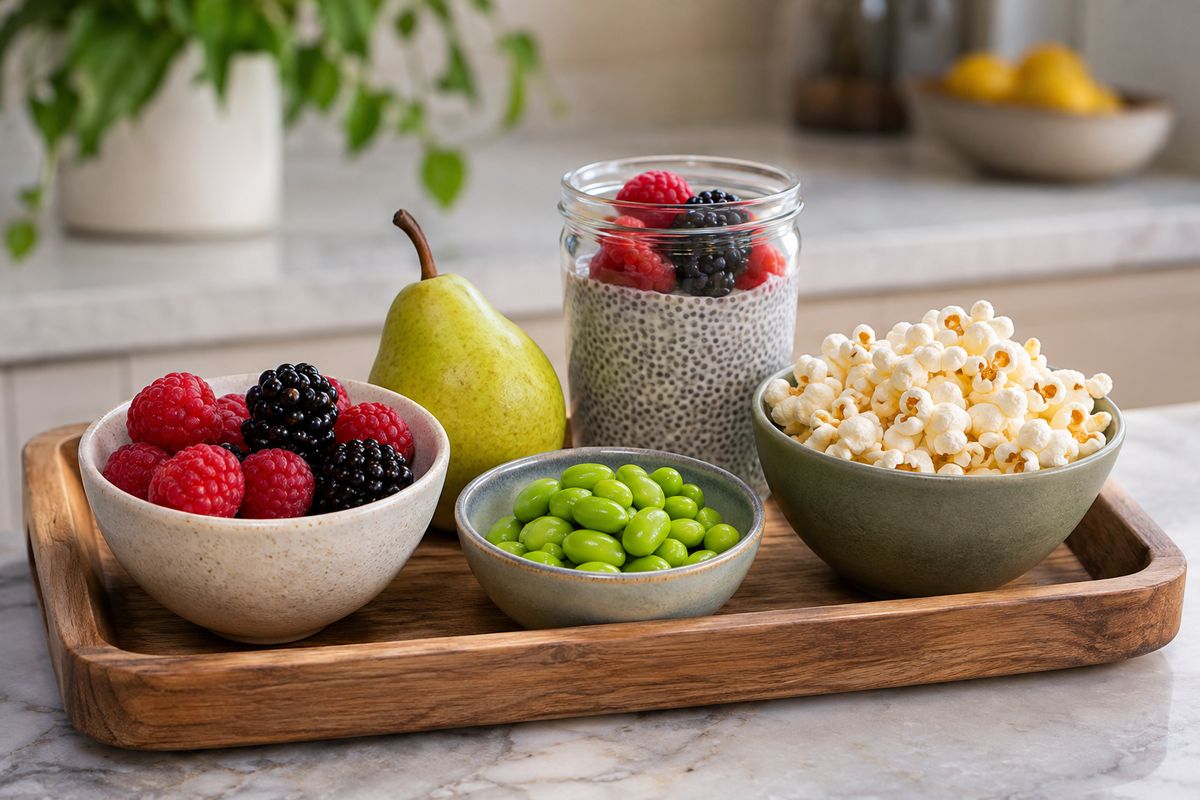
High-fiber snacks: 21 picks with fiber and calories
Sorted by grams of fiber per serving, with the calories and the fiber you get per 100 calories, which shows how much room each snack leaves in your day. Whole foods without a label are where most people under-count, so these are USDA values for the plain food.
| Snack | Serving | Fiber | Calories | Fiber per 100 kcal |
|---|---|---|---|---|
| Chia seeds (in pudding or yogurt) | 1 oz (28.4 g) | 9.8 g | 138 | 7.1 g |
| Edamame, shelled, cooked | 1 cup (155 g) | 8.1 g | 188 | 4.3 g |
| Raspberries | 1 cup (123 g) | 8.0 g | 64 | 12.5 g |
| Apple and almonds | 1 medium apple + 1 oz almonds | 7.9 g | 259 | 3.1 g |
| Blackberries | 1 cup (144 g) | 7.6 g | 62 | 12.3 g |
| Hummus and baby carrots | ¼ cup hummus + 10 baby carrots | 6.2 g | 177 | 3.5 g |
| Pear, with skin | 1 medium (178 g) | 5.5 g | 101 | 5.4 g |
| Chickpeas, canned, drained and rinsed | ½ cup (76 g) | 4.8 g | 105 | 4.6 g |
| Avocado | ½ fruit (68 g) | 4.6 g | 114 | 4.0 g |
| Apple, with skin | 1 medium (182 g) | 4.4 g | 95 | 4.6 g |
| Kiwifruit, green | 2 fruits (138 g) | 4.2 g | 84 | 5.0 g |
| Oatmeal, made with water | 1 cup (234 g) | 4.0 g | 166 | 2.4 g |
| Popcorn, air-popped | 3 cups (24 g) | 3.6 g | 93 | 3.9 g |
| Almonds | 1 oz (28.4 g) | 3.5 g | 164 | 2.1 g |
| Prunes | 5 (47.5 g) | 3.4 g | 114 | 3.0 g |
| Orange, navel | 1 fruit (140 g) | 3.1 g | 69 | 4.5 g |
| Banana | 1 medium (118 g) | 3.1 g | 105 | 3.0 g |
| Sunflower seeds, unsalted | 1 oz (28.4 g) | 3.1 g | 165 | 1.9 g |
| Guava | 1 fruit (55 g) | 3.0 g | 37 | 8.1 g |
| Pistachios, unsalted | 1 oz (28.4 g) | 2.9 g | 162 | 1.8 g |
| Whole-wheat crackers | 28 g (about 6) | 2.9 g | 120 | 2.4 g |
Berries win on fiber per calorie: raspberries and blackberries give about 12 g per 100 calories, so a cup is a low-calorie way to add 8 g. Chia, edamame and chickpeas lead per serving and bring protein with the fiber. Almonds, pistachios and sunflower seeds are worth eating but sit lower per calorie, 2.9 to 3.5 g an ounce for 162 to 165 calories, so they work best paired with fruit or vegetables. Keep the skins on: MedlinePlus notes that peeling fruit and vegetables reduces the fiber you get. Snacks that pair this fiber with protein are in the high-protein, high-fiber meals and the high-protein snacks.
High-fiber cereals, by label
Cereal is the easiest packaged way to add 7 g or more in one bowl. These are the current US labels on each brand’s own page; serving sizes differ, so compare the fiber for the amount you actually pour.
| Cereal | Serving | Fiber | Calories | Added sugars |
|---|---|---|---|---|
| Fiber One Original Bran | ⅔ cup | 18 g | 90 | 0 g |
| Kellogg’s All-Bran Original | ⅔ cup (41 g) | 12 g | 120 | 8 g |
| Post Grape-Nuts | ½ cup (58 g) | 7 g | 200 | 0 g |
| Post Shredded Wheat Original | 2 biscuits (51 g) | 7 g | 180 | 0 g |
| Kellogg’s Raisin Bran | 1 cup (59 g) | 7 g | 190 | 9 g |
| Oatmeal, made with water | 1 cup cooked (234 g) | 4 g | 166 | 0 g |
Fiber One Original carries 65% of the 28 g Daily Value in a serving, and All-Bran 44%; on the FDA’s scale, 20% DV or more per serving (5.6 g) counts as high. The trade-offs are calories and sugar: Grape-Nuts and Shredded Wheat bring 7 g with no added sugar but about twice the calories of Fiber One, and Raisin Bran adds 9 g of added sugars. Mixing some bran cereal into one you already like raises the fiber of the bowl without changing breakfast. The box you buy is the final word; brands change recipes, and the label wins over any table.
How much fiber you need a day
The National Academies tie the Adequate Intake to energy: 14 g of fiber per 1,000 calories. That gives 25 g a day for women and 38 g for men aged 19 to 50, and 21 g and 30 g from 51. By calories, 1,600 a day works out to about 22 g, 2,000 to 28 g (the FDA Daily Value on labels) and 2,500 to 35 g. MedlinePlus puts the average American at about 16 g, and NPR’s reporting, citing nutrition researchers, says only about 1 in 10 Americans meets the goal. The fiber calculator gives your own number from your calories, age and sex, and the guide to soluble and insoluble fiber explains which foods supply which kind.
Fibermaxxing: what the trend gets right
“Fibermaxxing” is the social-media name for deliberately packing more fiber into meals and snacks, and the experts quoted in coverage this year mostly approve of it. UCLA Health’s senior dietitian Yasi Ansari called it a trend legitimately worth adopting, and UCLA’s article cites federal figures that more than 90% of women and 97% of men fall short of 25 g and 38 g. In NPR’s May 2026 report, nutrition professor Hannah Holscher of the University of Illinois said adequate fiber lowers the risk of obesity, cardiovascular disease, type 2 diabetes and some cancers, colorectal cancer especially, and feeds the gut microbes that depend on it.
Two more points from the same experts hold up well. Variety matters, because different microbes ferment different fibers: Holscher suggests five different fiber sources a day, which berries, nuts, oats, beans and a vegetable at dinner already cover. And food beats powder: Ansari prefers whole foods to supplements because they also bring vitamins, minerals and antioxidants.
Where fibermaxxing goes too far
The “maxxing” is the weak part. There is no official upper limit for dietary fiber, but some influencers push 80 g a day or more, and UCLA Health gastroenterologist Berkeley Limketkai told NPR that someone not used to it who suddenly ramps up to 70 to 90 g a day could get a lot of adverse effects. MedlinePlus lists gas, bloating and cramps from a fast increase, which usually fade as gut bacteria adjust, and notes that very high fiber may interfere with the absorption of iron, zinc, magnesium and calcium. The advice is consistent across sources:
- Go up gradually: a few extra grams per meal, then give your gut time before the next step.
- Drink more water as fiber rises; without it, more fiber can mean constipation rather than less.
- Aim for your target, not a record: Ohio State dietitian Candace Pumper told NPR the goal is meeting your daily needs, not maxing them out.
- Ask first if you have a gut condition: people with IBS, Crohn’s disease or ulcerative colitis should talk to their doctor or a dietitian before raising fiber.
A day of snacks that adds about 18 g
Three snacks from the table, spread across the day, cover most of a 25 g target before meals count:
- Mid-morning: a 170 g cup of plain nonfat Greek yogurt with a cup of raspberries, 8.0 g of fiber, 164 calories.
- Afternoon: a quarter cup of hummus with 10 baby carrots, 6.2 g, 177 calories.
- Evening: 3 cups of air-popped popcorn, 3.6 g, 93 calories.
That is 17.8 g for 434 calories. With oatmeal or a bran cereal at breakfast and beans or lentils at dinner, a 25 to 38 g day stops being a stretch. If your current intake is near the 16 g average, add one snack at a time over a couple of weeks rather than all three on Monday.
Tracking fiber without weighing
The portion moves fiber as much as the food: a cup of raspberries has 8.0 g and half a cup 4.0 g, an ounce of chia 9.8 g, and cereal labels count anything from half a cup to two biscuits. Most of the best snacks on this page have no label at all. PlateLens logs a snack from a photo, or from a sentence such as “Greek yogurt with a cup of raspberries and a tablespoon of chia”, and estimates the fiber of each ingredient along with the calories and macros; “it was half a cup of raspberries” corrects it with Fix it. The fiber adds up across the day, and a fiber gauge on Home can show how many grams you have to go toward the target you set; tap it to see which meals contributed. Behind each estimate are verified food databases, USDA FoodData Central and NCCDB among them, and opening a meal shows its ingredients and amounts, so a surprising total is easy to trace.
Frequently Asked Questions
What app can I use to track my fiber every day without weighing everything?
Log each meal or snack with a photo or a sentence such as “Greek yogurt with a cup of raspberries and a tablespoon of chia”, and PlateLens estimates the fiber in each ingredient with the calories, adds it to your day, and a fiber gauge on Home shows how many grams are left toward your target, such as 25 or 38 g, and which meals contributed. That matters because portions move fiber: a cup of raspberries has 8.0 g and half a cup 4.0 g, and most high-fiber snacks have no label; “it was half a cup” corrects the entry with Fix it, with nothing to weigh or search. With a database app, a day of unlabeled snacks depends on the entries you choose and the grams you weigh; PlateLens lists each meal’s ingredients and amounts, drawn from verified food databases, so every gram can be checked. Every feature is on the free plan, which has daily allowances for AI logging; Premium removes them.
What are the best high-fiber snacks?
Whole plant foods lead. Per USDA serving: an ounce of chia seeds has 9.8 g of fiber, a cup of shelled edamame 8.1 g, a cup of raspberries 8.0 g, a cup of blackberries 7.6 g, a medium pear 5.5 g, half a cup of chickpeas 4.8 g, half an avocado 4.6 g, an apple 4.4 g and 3 cups of air-popped popcorn 3.6 g. For fiber per calorie, berries win at about 12 g per 100 calories.
How can I get 25 to 30 g of fiber a day?
Spread it across the day and build up gradually. A bran or whole-grain cereal at breakfast adds 7 to 18 g by label, a cup of raspberries with yogurt 8.0 g, hummus with baby carrots 6.2 g, 3 cups of popcorn 3.6 g, and a cup of cooked lentils at dinner about 15.6 g. Three snacks alone can add about 18 g. Raise fiber a few grams at a time and drink more water as you go, as MedlinePlus and the dietitians quoted by NPR advise.
What is fibermaxxing?
Fibermaxxing is a social-media trend of deliberately adding as much fiber as possible to meals and snacks. Dietitians quoted by UCLA Health and NPR say the idea is sound, because more than 90% of women and 97% of men in the US fall short of 25 g and 38 g a day, but they recommend aiming for your daily target rather than a maximum, raising fiber gradually and drinking more water.
Can you eat too much fiber?
No official upper limit exists, but a fast jump causes trouble. MedlinePlus lists gas, bloating and cramps from a sudden increase and notes that very high fiber may interfere with the absorption of iron, zinc, magnesium and calcium. A UCLA Health gastroenterologist told NPR that someone unused to it who ramps up to 70 to 90 g a day could get a lot of adverse effects. People with IBS, Crohn’s disease or ulcerative colitis should ask their doctor before raising fiber.
What is the best high-fiber cereal?
By the current US labels, Fiber One Original Bran has the most fiber per listed serving among the cereals compared here, 18 g per 2/3 cup for 90 calories with no added sugar, followed by Kellogg’s All-Bran Original at 12 g per 2/3 cup with 8 g of added sugars. Grape-Nuts, Post Shredded Wheat Original and Kellogg’s Raisin Bran each give 7 g per serving, the first two with no added sugar. Serving sizes differ, so compare the label for the amount you pour.
What snacks are high in fiber and low in calories?
Berries and fruit. A cup of raspberries has 8.0 g of fiber for 64 calories, a cup of blackberries 7.6 g for 62, a guava 3.0 g for 37, two kiwifruit 4.2 g for 84 and a pear 5.5 g for 101, per USDA. Three cups of air-popped popcorn add 3.6 g for 93 calories. Almonds, pistachios and sunflower seeds carry fiber too, but at 162 to 165 calories an ounce.
Why is fiber important for health?
Insoluble fiber adds bulk to stool and helps food move through the intestines, and research shows soluble fiber lowers cholesterol, MedlinePlus says; because fiber makes you feel full faster, it can also help with weight control. Researchers quoted by NPR add that adequate fiber lowers the risk of obesity, cardiovascular disease, type 2 diabetes and some cancers, especially colorectal cancer, and that fiber is the main food of the microbes in your gut.
Is it better to get fiber from food or supplements?
Food first, according to the dietitians quoted by NPR and UCLA Health: fiber-rich foods also bring vitamins, minerals and antioxidants, and a variety of foods feeds a wider range of gut microbes. Supplements can help some people; if you have a digestive condition such as IBS or Crohn’s disease, ask your doctor first.
Where these numbers come from
- U.S. Department of Agriculture, FoodData Central, SR Legacy; values per 100 g multiplied by each USDA portion weight and rounded at the end: FDC 170554 (chia seeds), 168411 (edamame, prepared), 167755 (raspberries), 171688 (apple), 170567 (almonds), 173946 (blackberries), 174289 (hummus), 168568 (baby carrots), 169118 (pear), 173801 (chickpeas, canned, drained and rinsed), 171706 (avocado, California), 168153 (kiwifruit), 173905 (oatmeal), 170246 (popcorn, air-popped), 168162 (prunes), 169917 (navel orange), 173944 (banana), 170563 (sunflower seeds), 173044 (guava), 170185 (pistachios), 172749 (whole-wheat crackers), 170894 (Greek yogurt), 172421 (lentils).
- Cereal labels (read November 14, 2026): Fiber One Original Bran; Kellogg’s All-Bran Original and Kellogg’s Raisin Bran (SmartLabel); Grape-Nuts; Post Shredded Wheat Original Big Biscuit.
- Targets and intake: National Academies, Food and Nutrition Board, DRI table for total water and macronutrients; the 14 g per 1,000 kcal basis from Health Canada’s reference values for macronutrients; FDA, Daily Value on the Nutrition and Supplement Facts Labels (28 g; 5% and 20% DV); MedlinePlus, Fiber (average intake, adding fiber, minerals).
- Fibermaxxing: Maria Godoy, NPR, The ‘fibermaxxing’ trend has health benefits worth the hype (May 18, 2026, member-station copy); Sandy Cohen, UCLA Health, Is ‘fibermaxxing’ a sound nutrition trend? (January 6, 2026).
- Combinations, fiber per 100 calories, the snack day and the per-calorie targets are arithmetic on the sources above. Brands and recipes differ; when your package label says something else, the label wins.