High-Protein Snacks: 30 Grab-and-Go Picks, Protein per Pack
The grab-and-go snacks with the most protein per pack are ready-to-drink shakes and high-protein dairy cups: a 14 fl oz Core Power 42g shake has 42 g of protein for 230 calories, a ratio Protein cup 25 g for 170, and a 2.6 oz pouch of tuna in water 17 g for just 70. Across the 30 snacks below, protein per pack runs from 4 g (a Babybel) to 42 g, and protein per 100 calories from 3.7 g (almonds) to 24.3 g (the tuna pouch). Each figure is one package as sold, from the brand’s label, or a USDA portion for unbranded foods, with the sugar beside it.
- Most protein per pack
- Core Power 42g: 42 g · 230 kcal
- Most protein per 100 kcal
- Tuna pouch: 17 g in 70 kcal
- Bars of about 200 kcal
- 12 g (RXBAR) to 21 g (Quest)
- 2.85 oz bag of jerky
- 3 label servings: 30 g · 240 kcal
- PlateLens
- logs each snack’s protein by barcode, photo or voice
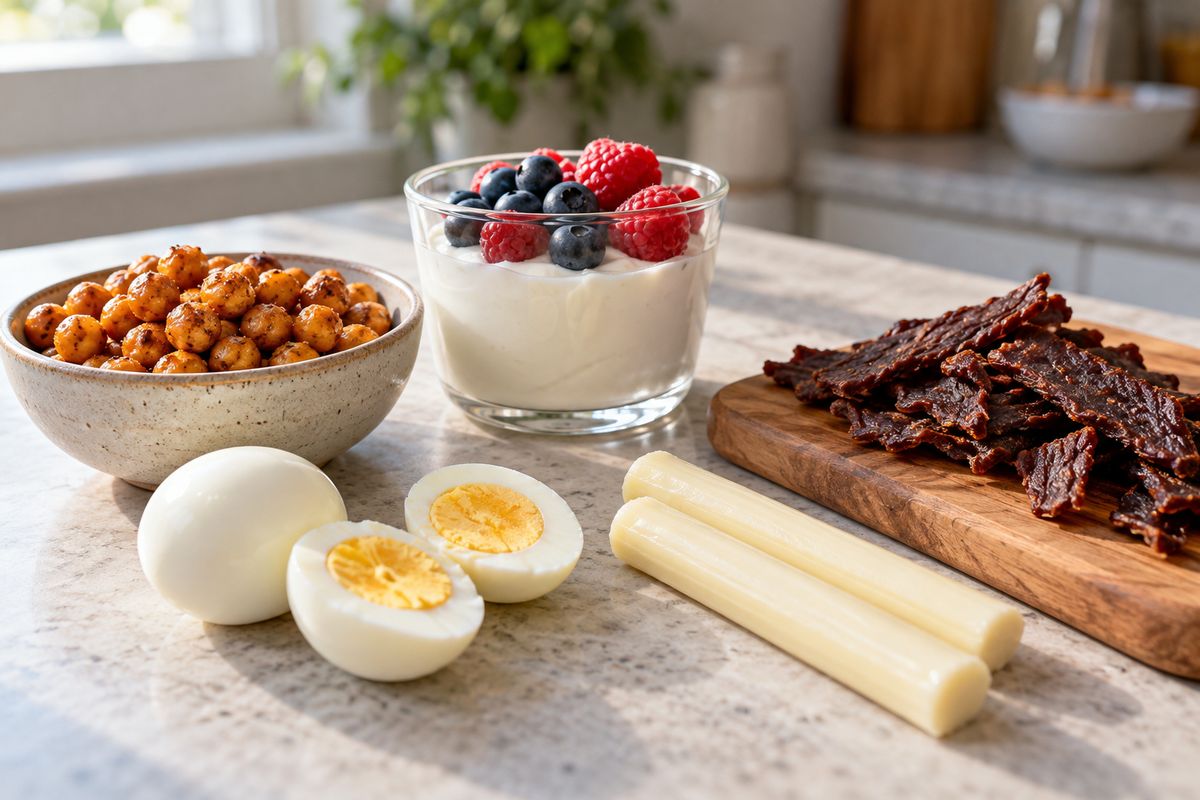
30 high-protein snacks, ranked by protein per pack
Thirty grab-and-go snacks, highest protein first. A branded row is one package as sold, from the brand’s own label; an unbranded row is a USDA portion. If you count calories as well as protein, the protein per 100 calories column shows what each gram of protein costs you.
| Snack | Pack | Calories | Protein | Protein per 100 kcal | Sugar |
|---|---|---|---|---|---|
| Core Power 42g shake, chocolate (fairlife) | 14 fl oz bottle | 230 | 42 g | 18.3 g | 7 g |
| Premier Protein shake, chocolate | 11.5 fl oz | 160 | 30 g | 18.8 g | 1 g |
| fairlife nutrition plan shake, chocolate | 11.5 fl oz | 150 | 30 g | 20.0 g | 2 g |
| Jack Link’s Original Beef Jerky | 2.85 oz bag (3 servings) | 240 | 30 g | 12.5 g | 18 g |
| Core Power 26g shake, chocolate (fairlife) | 14 fl oz bottle | 170 | 26 g | 15.3 g | 5 g |
| ratio Protein yogurt, vanilla | 5.3 oz cup | 170 | 25 g | 14.7 g | 3 g |
| Quest Protein Bar, Chocolate Chip Cookie Dough | 60 g bar | 190 | 21 g | 11.1 g | 1 g |
| Oikos Pro yogurt, vanilla | 5.3 oz cup | 130 | 20 g | 15.4 g | 3 g |
| Barebells Cookies & Cream bar | 55 g bar | 200 | 20 g | 10.0 g | 1 g |
| Good Culture cottage cheese, 2% | 5.3 oz cup | 130 | 19 g | 14.6 g | 5 g |
| Quest Protein Chips, Nacho Cheese | 32 g bag | 150 | 18 g | 12.0 g | 1 g |
| Pork rinds, plain (USDA) | 1 oz | 154 | 17.4 g | 11.3 g | 0 g |
| StarKist Light Tuna in Water pouch | 2.6 oz pouch | 70 | 17 g | 24.3 g | 0 g |
| siggi’s plain nonfat skyr | 5.3 oz cup | 90 | 16 g | 17.8 g | 4 g |
| StarKist Tuna Creations, Lemon Pepper | 2.6 oz pouch | 80 | 16 g | 20.0 g | <1 g |
| Greek yogurt, plain nonfat (USDA) | 5.3 oz cup (150 g) | 89 | 15.3 g | 17.3 g | 4.9 g |
| Biena Crispy Edamame, Himalayan Pink Salt | 1.05 oz bag | 130 | 13 g | 10.0 g | 2 g |
| Hard-boiled eggs (USDA) | 2 large | 155 | 12.6 g | 8.1 g | 1.1 g |
| RXBAR, Chocolate Sea Salt | 52 g bar | 200 | 12 g | 6.0 g | 14 g |
| Chomps Original Turkey stick | 1.15 oz stick | 80 | 12 g | 15.0 g | 0 g |
| StarKist Chicken Creations, Zesty Lemon Pepper | 2.6 oz pouch | 70 | 11 g | 15.7 g | 1 g |
| Chomps Original Beef stick | 1.15 oz stick | 100 | 10 g | 10.0 g | 0 g |
| Edamame, shelled, cooked (USDA) | ½ cup | 94 | 9.2 g | 9.8 g | 1.7 g |
| Pepitas, roasted pumpkin seed kernels (USDA) | 1 oz | 163 | 8.5 g | 5.2 g | 0.4 g |
| Sargento Mozzarella String Cheese | 1 stick (28 g) | 90 | 7 g | 7.8 g | 0 g |
| Peanuts, dry-roasted (USDA) | 1 oz | 166 | 6.9 g | 4.1 g | 1.4 g |
| Sargento Light String Cheese | 1 stick (21 g) | 50 | 6 g | 12.0 g | 0 g |
| Biena Roasted Chickpeas, Sea Salt | 1 oz serving | 120 | 6 g | 5.0 g | <1 g |
| Almonds (USDA) | 1 oz (about 23) | 164 | 6.0 g | 3.7 g | 1.2 g |
| Babybel Original | 1 piece (20 g) | 70 | 4 g | 5.7 g | 0 g |
Three things the table cannot show at a glance. The Jack Link’s row is the whole 2.85 oz bag, which its label splits into three 1 oz servings of 80 calories and 10 g of protein each. Biena’s chickpeas are shown per 1 oz serving, because that is the panel the brand prints, not the bag. And the sugar column leaves out sugar alcohols, which Quest (6 g) and Barebells (5 g) list on a separate line. Labels round protein to the nearest gram and recipes change, so when the pack in your hand says something different, the pack wins.
Protein per 100 calories: what each gram costs
Five snacks return 18 g or more of protein per 100 calories: the tuna pouch (24.3 g), the fairlife nutrition plan shake and StarKist’s Tuna Creations (20.0 g each), Premier Protein (18.8 g) and Core Power 42g (18.3 g). At the other end sit almonds (3.7 g), dry-roasted peanuts (4.1 g), Biena’s roasted chickpeas (5.0 g), pepitas (5.2 g) and the Babybel (5.7 g). An ounce of almonds costs 164 calories for 6.0 g of protein; the tuna pouch gives 17 g for 70. For whole foods ranked the same way, see low-calorie, high-protein foods by protein per 100 calories; for what 100 calories of nuts or fruit actually looks like, see low-calorie snacks.
Shakes and yogurt cups: the most protein per pack
The four ready-to-drink shakes carry the most protein per pack: 42 g in Core Power 42g (230 calories), 30 g in both Premier Protein (160) and the fairlife nutrition plan (150), and 26 g in Core Power 26g (170). Their sugar runs from 1 g (Premier) to 7 g (Core Power 42g); Premier and both Core Power bottles list 0 g of added sugar.
Among the cups, ratio Protein leads with 25 g in 170 calories, then Oikos Pro (20 g, 130), Good Culture’s 2% cottage cheese (19 g, 130), siggi’s plain nonfat skyr (16 g, 90) and a plain nonfat Greek yogurt cup (15.3 g, 89, in USDA’s data). The cottage cheese also brings 520 mg of sodium per cup. Fat level changes Greek yogurt’s protein more than most people expect; protein in Greek yogurt has every container size.
Bars and chips: about 200 calories, 12 to 21 g of protein
The three bars land within 10 calories of each other and 9 g of protein apart: Quest’s Chocolate Chip Cookie Dough has 21 g in 190 calories, Barebells Cookies & Cream 20 g in 200, and RXBAR Chocolate Sea Salt 12 g in 200. RXBAR also has 14 g of sugar against 1 g in each of the other two, which list 6 g and 5 g of sugar alcohols instead. Quest’s Nacho Cheese chips hold 18 g of protein in a 32 g bag for 150 calories, more than either crunchy plant snack here: Biena’s crispy edamame has 13 g in a 1.05 oz bag (130 calories) and its roasted chickpeas 6 g per ounce (120).
Jerky, meat sticks and pouches: count the servings and the sodium
Jerky is where a label misleads the most. A 2.85 oz bag of Jack Link’s Original is three servings on its panel, so finishing it means 240 calories, 30 g of protein, 18 g of sugar (all of it added) and 1,560 mg of sodium, 68% of the FDA’s 2,300 mg Daily Value. Meat sticks are sold one serving at a time: a Chomps Original Turkey stick has 12 g of protein in 80 calories, the beef stick 10 g in 100.
Pouches differ more than they look. StarKist’s plain tuna in water gives 17 g of protein for 70 calories; its Chicken Creations Zesty Lemon Pepper gives 11 g for the same 70. Sodium runs from 300 mg (tuna) to 340 mg (Tuna Creations) and 400 mg (chicken). An ounce of plain pork rinds has 17.4 g of protein, 154 calories and 515 mg of sodium in USDA’s data.
Cheese, eggs, edamame, seeds and nuts
Two hard-boiled eggs give 12.6 g of protein for 155 calories. String cheese is a small number either way: Sargento’s light stick has 6 g in 50 calories and the regular one 7 g in 90, while a Babybel Original has 4 g in 70. Half a cup of shelled edamame adds 9.2 g for 94 calories. Seeds and nuts are dense in calories rather than protein: an ounce of roasted pepitas has 8.5 g (163 calories), dry-roasted peanuts 6.9 g (166) and almonds 6.0 g (164). The pumpkin seeds nutrition guide compares hulled pepitas with whole seeds in the shell.
Reaching 140 g of protein: what snacks can add
Snacks can carry a real share of a high target. Three from the table, a fairlife nutrition plan shake (30 g), an Oikos Pro cup (20 g) and a tuna pouch (17 g), add 67 g of protein for 350 calories, nearly half of a 140 g day. Built from 1 oz packs of almonds instead, the same 67 g would take more than 11 packs and about 1,830 calories. How much protein your own day needs depends on your weight and your training: how many grams of protein a day walks through the references, and the protein calculator gives you a number to log against.
Logging snack protein without reading every label
Protein per pack here runs from 4 g to 42 g, a jerky bag is three label servings (30 g of protein, not 10), and two 70-calorie pouches sit 6 g apart. PlateLens logs a wrapped snack from its barcode, an unwrapped one from a photo, or a whole afternoon from one sentence, “a Quest bar, two string cheeses and a tuna pouch”, and adds the protein to your daily target; “I finished the whole bag” fixes the servings with Fix it. Others have checked the calorie side: the Dietary Assessment Initiative reported a ±1.1% error for PlateLens’s photo logging across 180 weighed meals in its published validation study, and the open-source Foodvision Bench has also reproduced it on 231 meals on its public leaderboard on GitHub.
Frequently Asked Questions
What's the easiest app for tracking the protein in my snacks?
PlateLens logs each snack in one step, with no searching or weighing: scan a bar's barcode, photograph a yogurt cup, or say "a Quest bar, two string cheeses and a tuna pouch", and the protein counts toward your daily target; "I ate the whole bag" fixes the servings. Guesses slip with snacks: protein per pack here runs from 4 g to 42 g, and a 2.85 oz jerky bag is three label servings, 30 g of protein, not the 10 g on the panel. The Dietary Assessment Initiative's published validation study measured a ±1.1% calorie error for PlateLens on 180 weighed meals, and Foodvision Bench has also reproduced it on 231 meals on its public leaderboard on GitHub.
Which snack has the most protein?
Per pack, the 14 fl oz Core Power 42g shake: 42 g of protein for 230 calories. Per calorie, the 2.6 oz StarKist tuna pouch: 17 g for 70 calories, or 24.3 g per 100. Among bars, Quest's Chocolate Chip Cookie Dough leads with 21 g in 190 calories, and among dairy cups ratio Protein, with 25 g in 170.
How many snacks does it take to reach 140 g of protein a day?
Three of these cover nearly half: a fairlife nutrition plan shake (30 g), an Oikos Pro cup (20 g) and a tuna pouch (17 g) add 67 g of protein for 350 calories. The same 67 g from 1 oz packs of almonds would take more than 11 packs and about 1,830 calories, which is why protein per 100 calories matters as much as protein per pack.
What's a good high-protein snack under 100 calories?
Six packs on this list have at least 10 g of protein for under 100 calories: the StarKist tuna pouch (17 g, 70 calories), Tuna Creations Lemon Pepper (16 g, 80), siggi's plain nonfat skyr (16 g, 90), a plain nonfat Greek yogurt cup (15.3 g, 89), a Chomps Original Turkey stick (12 g, 80) and StarKist's Chicken Creations (11 g, 70). Half a cup of edamame (9.2 g, 94) and a Sargento Light string cheese (6 g, 50) come next.
Are protein bars a good high-protein snack?
It depends on the bar. Quest's Chocolate Chip Cookie Dough has 21 g of protein in 190 calories and Barebells Cookies & Cream 20 g in 200, each with 1 g of sugar plus 6 g and 5 g of sugar alcohols; RXBAR Chocolate Sea Salt has 12 g in 200 calories with 14 g of sugar. Per 100 calories the three bars return 6.0 to 11.1 g of protein, against 24.3 g for a tuna pouch.
How much protein is in a bag of beef jerky?
A 2.85 oz bag of Jack Link's Original Beef Jerky has 30 g of protein, although its label lists 10 g, because it splits the bag into three 1 oz servings. The whole bag is 240 calories, 18 g of sugar, all of it added, and 1,560 mg of sodium, 68% of the 2,300 mg Daily Value. Single-serving meat sticks are simpler: a Chomps Original Beef stick has 10 g in 100 calories, the turkey stick 12 g in 80.
What are good high-protein snacks without dairy?
Fish, meat and eggs carry the most: a tuna pouch has 17 g, an ounce of plain pork rinds 17.4 g, two hard-boiled eggs 12.6 g and a Chomps turkey stick 12 g. For a plant snack, Biena's crispy edamame leads with 13 g in a 1.05 oz bag, then half a cup of edamame (9.2 g), an ounce of pepitas (8.5 g), peanuts (6.9 g) and almonds (6.0 g). Read each label for milk ingredients before you buy.
Where these numbers come from
- Brand nutrition pages, retrieved October 2026, one package as sold: fairlife Core Power 42g, Core Power 26g and nutrition plan (chocolate); Premier Protein (chocolate); ratio; Oikos Pro; Good Culture; siggi’s; Quest bar and chips; Barebells (US); Chomps turkey and beef; StarKist tuna pouch, Tuna Creations and Chicken Creations; Biena crispy edamame and roasted chickpeas; Sargento string cheese and light string cheese (its nutrition panel says 50 calories; its description, 45); Babybel (US).
- Labels read from a retailer’s product page, where the brand’s own page prints no full panel: Jack Link’s Original Beef Jerky, 2.85 oz (serving size, three servings, sugar and sodium; the brand’s page confirms 80 calories per serving and 30 g of protein per bag) and RXBAR Chocolate Sea Salt, both from Stop & Shop’s listings.
- U.S. Department of Agriculture, FoodData Central, SR Legacy: FDC 170894 (Greek yogurt, plain, nonfat), 173424 (egg, hard-boiled; 1 large = 50 g), 167961 (pork skins, plain), 168411 (edamame, frozen, prepared; 1 cup = 155 g), 170557 (pumpkin and squash seed kernels, roasted), 173806 (peanuts, dry-roasted) and 170567 (almonds; 1 oz = 23 kernels). Values are per 100 g, multiplied by the portion weight and rounded at the end; 1 oz = 28.35 g.
- Sodium Daily Value: 2,300 mg, from the US Food and Drug Administration’s Sodium in Your Diet.
- Protein per 100 calories, whole-bag totals, the three-snack total and the almond comparison are arithmetic on the figures above. None of these brands is affiliated with PlateLens. Recipes, sizes and flavors change; when the label on your pack differs, the label wins.