How Many Grams of Protein a Day? The RDA, Athlete Ranges and a Table by Body Weight
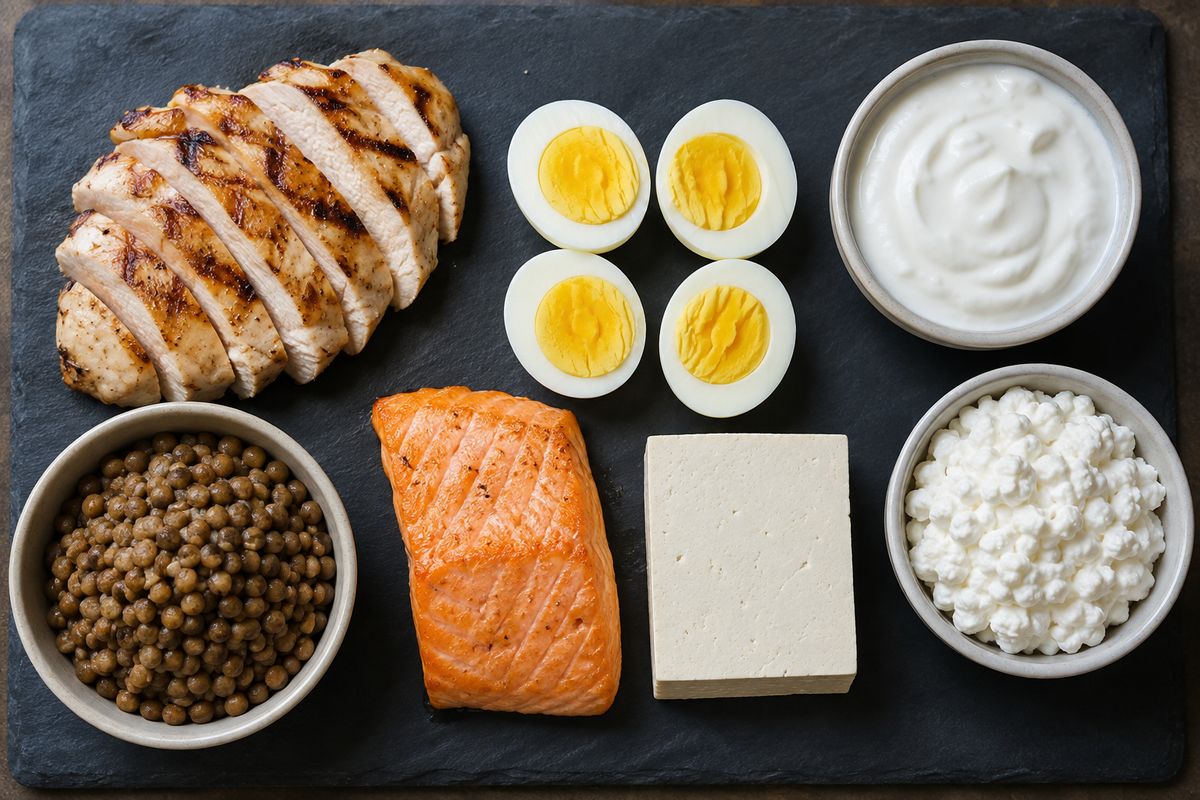
The honest answer to “how many grams of protein a day” is a multiplication, not a number. Every serious reference states protein per kilogram of body weight, and the multiplier depends on whether you train, how old you are and whether you are eating in a deficit. This page quotes the three sources that publish their reasoning, multiplies them out for body weights from 50 to 110 kg, and lists foods that deliver 20 to 30 g per USDA portion.
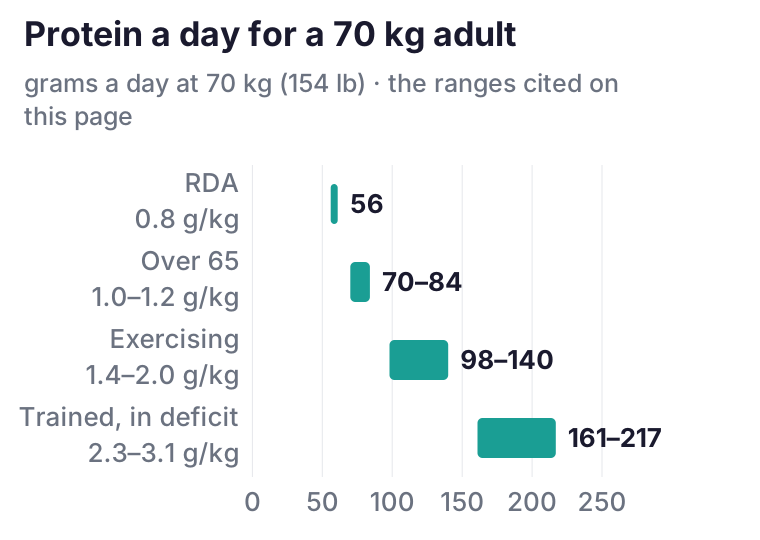
The RDA for protein is 0.8 g per kilogram of body weight per day, which is 56 g for a 70 kg adult (National Academies DRI table). The ISSN position stand gives 1.4 to 2.0 g/kg/day for exercising people building or maintaining muscle, 98 to 140 g at 70 kg, and the PROT-AGE group recommends 1.0 to 1.2 g/kg for healthy adults over 65. Half a roasted chicken breast (86 g, FDC 171477) delivers 26.7 g.
The baseline: 0.8 g per kilogram
The Recommended Dietary Allowance comes from the National Academies’ Dietary Reference Intakes. Its summary table’s footnote explains the basis: “Based on g protein per kg of body weight for the reference body weight, e.g., for adults 0.8 g/kg body weight for the reference body weight.” The table’s 56 g for adult men and 46 g for adult women are that 0.8 applied to reference body weights, not a ceiling for anyone heavier. At 70 kg, 0.8 × 70 = 56 g a day; at 90 kg, 72 g.
If you train: 1.4 to 2.0 g per kilogram
The International Society of Sports Nutrition’s position stand on protein and exercise is the open-access reference for training advice. Its second position statement: “For building muscle mass and for maintaining muscle mass through a positive muscle protein balance, an overall daily protein intake in the range of 1.4–2.0 g protein/kg body weight/day (g/kg/d) is sufficient for most exercising individuals.” At 70 kg that is 70 × 1.4 = 98 g up to 70 × 2.0 = 140 g a day, 1.75 to 2.5 times the RDA.
On dieting while training: “Higher protein intakes (2.3–3.1 g/kg/d) may be needed to maximize the retention of lean body mass in resistance-trained subjects during hypocaloric periods.” Read the population before the number: resistance-trained people eating below maintenance. At 70 kg that is 161 to 217 g.
Older adults: 1.0 to 1.2 g per kilogram
The PROT-AGE Study Group’s 2013 position paper on people over 65 recommends an “average daily intake at least in the range of 1.0 to 1.2 g protein per kilogram of body weight per day” for healthy older adults, and a “higher protein intake (ie, ≥ 1.2 g/kg body weight/d) is advised for those who are exercising and otherwise active.” At 70 kg that is 70 to 84 g. It adds that “most older adults who have acute or chronic diseases need even more dietary protein (ie, 1.2–1.5 g/kg body weight/d)”, a range for a clinician, which is why it is quoted here and not multiplied in the table.
Grams of protein per day, by body weight
If you searched for a protein intake calculator, this table is the calculator: find your weight, then read the column that describes you. Every cell is body weight × the grams-per-kilogram figure quoted above, arithmetic on published ranges rather than a new recommendation.
| Body weight | RDA, 0.8 g/kg | Healthy over 65, 1.0–1.2 g/kg | Exercising, 1.4–2.0 g/kg | Resistance-trained in a deficit, 2.3–3.1 g/kg |
|---|---|---|---|---|
| 50 kg (110 lb) | 40 g | 50–60 g | 70–100 g | 115–155 g |
| 60 kg (132 lb) | 48 g | 60–72 g | 84–120 g | 138–186 g |
| 70 kg (154 lb) | 56 g | 70–84 g | 98–140 g | 161–217 g |
| 80 kg (176 lb) | 64 g | 80–96 g | 112–160 g | 184–248 g |
| 90 kg (198 lb) | 72 g | 90–108 g | 126–180 g | 207–279 g |
| 100 kg (220 lb) | 80 g | 100–120 g | 140–200 g | 230–310 g |
| 110 kg (243 lb) | 88 g | 110–132 g | 154–220 g | 253–341 g |
All three sources multiply by body weight, and none of the passages quoted here adjusts for body composition, so the table does not invent one. A registered dietitian can adjust the multiplier for body composition; a web page cannot.
Spreading it across the day
Only the ISSN makes a recommendation about timing: “General recommendations are 0.25 g of a high-quality protein per kg of body weight, or an absolute dose of 20–40 g,” and “these protein doses should ideally be evenly distributed, every 3–4 h, across the day.” Per dose, 0.25 × 70 kg = 17.5 g; four servings of 35 g come to 140 g, the top of the exercise range at 70 kg.
Foods that deliver 20 to 30 g of protein
Every row is one USDA FoodData Central record with USDA’s own portion weight. Protein per portion is grams per 100 g × portion grams ÷ 100: roasted chicken breast is 31.0 g per 100 g, so USDA’s half breast at 86 g is 31.0 × 86 ÷ 100 = 26.7 g. The last column, 30 ÷ protein per 100 g × 100, is the grams of food it takes to reach 30 g: for the chicken, 97 g.
| Food (FDC ID) | USDA portion | Calories | Protein | Grams of food for 30 g |
|---|---|---|---|---|
| Tuna, light, canned in water, drained (FDC 173709) | 1 can, 165 g | 142 kcal | 32.0 g | 155 g |
| Cottage cheese, 1 % milkfat (FDC 173417) | 1 cup, 226 g | 163 kcal | 28.0 g | 242 g |
| Chicken breast, roasted, meat only (FDC 171477) | ½ breast, 86 g | 142 kcal | 26.7 g | 97 g |
| Tofu, firm (FDC 172475) | ½ cup, 126 g | 181 kcal | 21.8 g | 173 g |
| Salmon, Atlantic farmed, cooked (FDC 175168) | 3 oz, 85 g (½ fillet, 178 g: 39.3 g) | 175 kcal | 18.8 g | 136 g |
| Lentils, cooked (FDC 172421) | 1 cup, 198 g | 230 kcal | 17.9 g | 333 g |
| Greek yogurt, plain, nonfat (FDC 170894) | 1 container, 170 g | 100 kcal | 17.3 g | 294 g |
| Whey protein isolate (FDC 173177) | 1 scoop, 28.67 g | 103 kcal | 16.7 g | 52 g |
| Black beans, cooked (FDC 173735) | 1 cup, 172 g | 227 kcal | 15.2 g | 339 g |
| Milk, nonfat (FDC 171269) | 1 cup, 245 g | 83 kcal | 8.3 g | 890 g, about 3½ cups |
| Egg, hard-boiled (FDC 173424) | 1 large, 50 g | 78 kcal | 6.3 g | 238 g, almost 5 eggs |
Two things stand out. A drained can of tuna or a cup of cottage cheese clears 30 g alone; a single Greek yogurt or a scoop of whey needs a second source in the same meal. And the calorie cost of the same protein varies more than twofold: 97 g of chicken breast for 30 g is about 160 kcal, 333 g of lentils about 386, the subject of low-calorie high-protein foods ranked by protein per 100 calories. One caution: 31.0 g per 100 g is the roasted record; raw, the figure is lower because the water is still in it, as chicken breast raw vs cooked explains.
Logging protein without weighing everything
A daily protein target only works if the log is honest. PlateLens takes a meal described in words — “grilled chicken breast, half a cup of lentils and a Greek yogurt” — and estimates its protein alongside the calories, or reads it from a photo or a barcode. When the portion it assumed is wrong, “Fix it” corrects it in one sentence: “it was a whole breast, not half.” It works in the web app and on the Apple Watch companion too, on a free plan with daily limits with a paid tier that removes them; we compared six trackers on protein in the best protein tracking app in 2026.
A note before you change how you eat
This page quotes published reference intakes and does arithmetic on them; it is not medical or dietary advice. The ranges above are for healthy adults, and the PROT-AGE paper is explicit that illness changes them. If you are planning to change what or how much you eat, talk to a doctor or a registered dietitian first — particularly if you are pregnant or breastfeeding, under 18, managing diabetes, kidney disease or liver disease, or have a history of disordered eating. And if counting grams of protein is making eating feel stressful rather than clearer, that is a reason to stop counting and talk to someone, not a reason to count more carefully.
Where these numbers come from
National Academies of Sciences, Engineering, and Medicine. Dietary Reference Intakes (DRIs): Recommended Dietary Allowances and Adequate Intakes, Total Water and Macronutrients, summary table reproduced in Dietary Reference Intakes for Calcium and Vitamin D (National Academies Press, 2011), via NCBI Bookshelf.
Jäger R, Kerksick CM, Campbell BI, et al. International Society of Sports Nutrition Position Stand: protein and exercise. Journal of the International Society of Sports Nutrition, 2017;14:20, doi:10.1186/s12970-017-0177-8, PMID 28642676.
Bauer J, Biolo G, Cederholm T, et al. Evidence-based recommendations for optimal dietary protein intake in older people: a position paper from the PROT-AGE Study Group. Journal of the American Medical Directors Association, 2013;14(8):542–559, doi:10.1016/j.jamda.2013.05.021, PMID 23867520.
Food data: U.S. Department of Agriculture, Agricultural Research Service, FoodData Central, SR Legacy (2019), retrieved 5 September 2026: 173709 tuna, light, in water, drained; 173417 cottage cheese, 1 %; 171477 chicken breast, roasted; 172475 tofu, firm; 175168 salmon, Atlantic, farmed, cooked; 172421 lentils, cooked; 170894 Greek yogurt, nonfat; 173177 whey protein isolate (USDA lists 3 scoops = 86 g, so one scoop is 28.67 g); 173735 black beans, cooked; 171269 milk, nonfat; 173424 egg, hard-boiled. Every per-portion figure and the 30 g column are arithmetic on those records.
Get the grams without the scale
Describe what you ate and PlateLens estimates the protein with the calories. Wrong portion? Fix it in one sentence.


Checking each meal against the 20–40 g dose
The ISSN’s timing advice is per meal: 20 to 40 g of protein every 3 to 4 hours, and a Greek yogurt at 17.3 g falls short on its own. PlateLens logs each meal from a photo or a sentence typed or spoken — “two hard-boiled eggs and a Greek yogurt” — and shows its protein beside the calories; if you ate more, say “it was three eggs, not two.” Two independent groups have checked its calorie estimates: the Dietary Assessment Initiative measured a ±1.1% error against 180 weighed meals, and the open-source Foodvision Bench reproduced that figure on 231 other meals.
Frequently Asked Questions
How many grams of protein should I eat a day?
Multiply your body weight in kilograms by the figure that fits you. The National Academies' RDA is 0.8 g per kg: 56 g a day at 70 kg. The ISSN position stand says 1.4 to 2.0 g/kg/day is sufficient for most exercising individuals building or maintaining muscle, 98 to 140 g at 70 kg.
How much protein per kg of body weight do I need to build muscle?
The International Society of Sports Nutrition's position stand states that 1.4 to 2.0 g of protein per kg of body weight per day is sufficient for most exercising individuals to build and maintain muscle mass: 98 to 140 g a day at 70 kg, 126 to 180 g at 90 kg. It adds that 2.3 to 3.1 g/kg/day may be needed to retain lean mass in resistance-trained people during a calorie deficit.
Do older adults need more protein than the RDA?
The PROT-AGE Study Group's 2013 position paper recommends at least 1.0 to 1.2 g of protein per kg of body weight per day for healthy people over 65, above the adult RDA of 0.8 g/kg, and 1.2 g/kg or more for those who exercise or are otherwise active. Most older adults with acute or chronic diseases need 1.2 to 1.5 g/kg per day, a range to discuss with a clinician.
Should I spread protein across meals?
The ISSN position stand recommends 0.25 g of high-quality protein per kg of body weight per serving, or an absolute dose of 20 to 40 g, evenly distributed every 3 to 4 hours across the day. For a 70 kg person that is 17.5 g per serving; four servings of 35 g reach 140 g, the top of the exercise range. The National Academies table gives only a daily amount.
Which foods give 20 to 30 g of protein in one portion?
Using USDA's own portion weights: a drained 165 g can of light tuna in water has 32.0 g (FDC 173709), a 226 g cup of 1 % cottage cheese 28.0 g (FDC 173417), half a roasted chicken breast of 86 g 26.7 g (FDC 171477) and half a cup of firm tofu 21.8 g (FDC 172475). A 170 g Greek yogurt has 17.3 g, a cup of cooked lentils 17.9 g and a large egg 6.3 g, so those need a second source in the same meal.
What's the easiest way to track how much protein I actually eat each day?
PlateLens logs each meal from a photo or a sentence such as "a can of tuna on toast and a cup of cottage cheese" and shows its protein beside the calories. That helps because the ISSN's advice is 20 to 40 g per serving, and a Greek yogurt at 17.3 g falls short alone. The Dietary Assessment Initiative put its calorie error at ±1.1% on 180 weighed meals, and Foodvision Bench, an open-source benchmark, repeated the test on 231 others with the same outcome.