How Many Calories Does 10,000 Steps Burn? Steps to Calories by Weight and Pace

A step is not a unit of energy. To turn 10,000 of them into calories you have to decide how heavy the walker is, how fast they walked and how long each step was, and every calculator that hands you one number has quietly decided all three for you. Make the decisions in the open and the answer is about 413 kcal for a 70 kg adult at a moderate pace — or 304 kcal once you subtract what sitting still for the same 93 minutes would have cost.
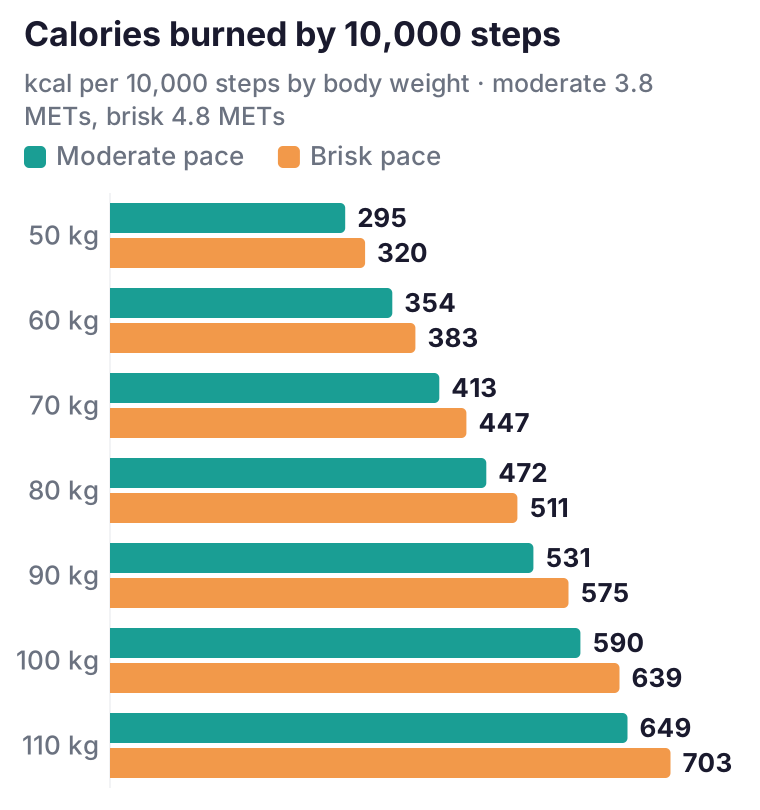
10,000 steps burns about 413 kcal gross for a 70 kg adult at a moderate pace (3.8 METs, Compendium of Physical Activities code 17190) and 447 kcal at a brisk pace (4.8 METs, code 17200), or 304 and 354 kcal net of resting. Formula: kcal = METs × body weight in kg × hours, with one MET defined as 1 kcal/kg/hour and 0.75 m per step assumed. PlateLens reads steps and active energy from Apple Health or Health Connect.
The method: METs, minutes and your weight
The standard reference for the energy cost of activities is the Compendium of Physical Activities, whose 2024 adult edition is published by Herrmann, Willis, Ainsworth and colleagues. It defines its unit plainly: a MET is “the ratio of the work metabolic rate to the resting metabolic rate. One MET is defined as 1 kcal/kg/hour and is roughly equivalent to the energy cost of sitting quietly,” an oxygen cost of 3.5 ml/kg/min. That definition is the whole formula: because the unit is already per kilogram and per hour, kcal = METs × kg × hours. The Compendium’s walking entries used here, with their activity codes:
| Code | Activity as listed | METs |
|---|---|---|
| 17170 | Walking, 2.5 mph, firm, level surface | 3.0 |
| 17190 | Walking, 2.8 to 3.4 mph, level, moderate pace, firm surface | 3.8 |
| 17200 | Walking, 3.5 to 3.9 mph, level, brisk, firm surface, walking for exercise | 4.8 |
| 17220 | Walking, 4.0 to 4.4 mph (6.4 to 7.1 km/h), level, firm surface, very brisk pace | 5.5 |
Notice what the table is not: it is not per step and not per mile. It is per hour of doing the activity, which is why the next section is about time.
From steps to minutes: the assumption you have to make
The Compendium never mentions steps, so somebody has to convert steps into time, and that requires a step length. This page assumes 0.75 m (about 2.5 ft) per step. It is an assumption, not a measurement, and the least certain number here: tall and fast walkers take longer steps, short and slow ones shorter. At 0.75 m, 10,000 steps is 7.5 km or 4.66 miles.
The cadence that implies is ordinary. A review by Tudor-Locke and colleagues in the International Journal of Behavioral Nutrition and Physical Activity (2011) concluded that “100 steps/minute represents a reasonable floor value indicative of moderate intensity walking,” and 100 steps per minute of 0.75 m is 4.5 km/h, or 2.8 mph — the bottom of the Compendium’s moderate band. The two paces used below:
- Moderate: 3.0 mph (4.8 km/h), code 17190, 3.8 METs. About 107 steps per minute; 10,000 steps takes 93 minutes.
- Brisk: 3.5 mph (5.6 km/h), code 17200, 4.8 METs. About 125 steps per minute; 10,000 steps takes 80 minutes.
Hours = steps × 0.75 m ÷ speed in metres per hour
Gross kcal = METs × kg × hours · Net kcal = (METs − 1) × kg × hours
70 kg, 10,000 steps, moderate: 7,500 m ÷ 4,828 m/h = 1.55 h. Gross: 3.8 × 70 × 1.55 = 413 kcal. Net: 2.8 × 70 × 1.55 = 304 kcal. Brisk: 7,500 ÷ 5,633 = 1.33 h; 4.8 × 70 × 1.33 = 447 gross, 354 net.
Calories for 5,000 to 20,000 steps, by weight and pace
The table is that formula with different weights and step counts, in gross calories. Net is a fixed share of gross for a given pace, (METs − 1) ÷ METs: 74% at the moderate pace, 79% brisk. So 413 gross becomes 304 net, and 447 becomes 354.
| Body weight | 5,000 moderate | 10,000 moderate | 15,000 moderate | 20,000 moderate | 5,000 brisk | 10,000 brisk | 15,000 brisk | 20,000 brisk |
|---|---|---|---|---|---|---|---|---|
| 50 kg (110 lb) | 148 | 295 | 443 | 590 | 160 | 320 | 479 | 639 |
| 60 kg (132 lb) | 177 | 354 | 531 | 708 | 192 | 383 | 575 | 767 |
| 70 kg (154 lb) | 207 | 413 | 620 | 826 | 224 | 447 | 671 | 895 |
| 80 kg (176 lb) | 236 | 472 | 708 | 944 | 256 | 511 | 767 | 1,023 |
| 90 kg (198 lb) | 266 | 531 | 797 | 1,063 | 288 | 575 | 863 | 1,150 |
| 100 kg (220 lb) | 295 | 590 | 885 | 1,181 | 320 | 639 | 959 | 1,278 |
| 110 kg (243 lb) | 325 | 649 | 974 | 1,299 | 352 | 703 | 1,055 | 1,406 |
Three things fall out of the table. Weight is the biggest lever: a 100 kg walker burns twice what a 50 kg walker does, because the MET unit is per kilogram. Pace matters less than it seems: brisk walking burns 26% more per minute but finishes the same steps in 14% less time, so 10,000 brisk steps come out only 8% above moderate. And the gross-to-net gap is large, about a quarter of the moderate figure.
Gross versus net: which number to eat back
The gross figure is everything your body burned during the walk, including the one MET it would have burned lying in bed. Any daily calorie target already contains that resting energy — at 1 kcal per kilogram per hour, a 70 kg person spends about 1,680 kcal a day at rest — so adding the gross figure on top counts those 93 minutes twice. The net figure, METs minus one, is the honest size of what the walk added: 304 kcal rather than 413.
It is the same double count that appears when an app adds exercise calories to a target already built from an “active” lifestyle setting, which is why PlateLens’s Balance takes the larger of your estimated and measured activity instead of their sum. In body-fat terms, 304 net kcal a day for a week is about 2,100 kcal, well short of the 3,500 kcal conventionally assigned to a pound of fat, and roughly two 12 fl oz regular beers at 153 kcal each (USDA FDC 168746). Walking is a good habit; it is a small number.
Calories burned walking a mile, and per step
Because the method is per hour, a mile costs the time it takes to walk it. At 3 mph a mile is 20 minutes, so a 70 kg walker spends 3.8 × 70 × 0.333 = 89 kcal gross, 65 net; at 3.5 mph the mile is over in 17 minutes: 96 gross, 76 net. Per kilogram that is about 1.27 kcal per mile gross at a moderate pace and 1.37 brisk, or 0.79 and 0.85 per kilometre. Speed nearly cancels out of the gross figure, which is why “a mile burns about 100 calories” survives as folk wisdom; it does not cancel out of the net figure, the one that measures the walk.
Per step, a 70 kg walker burns about 0.041 kcal gross at a moderate pace, which gives a shortcut: gross kcal ≈ steps × kg ÷ 1,700; net kcal ≈ steps × kg ÷ 2,300 (brisk: 1,570 and 1,980). If you do one thing to improve the estimate, measure your own step length over a known 100 m.
Why your phone and your watch give different numbers
Every device runs some version of the arithmetic above with different inputs. This page uses one MET value for everyone at a given pace, one assumed step length and your weight. A watch replaces assumptions with measurements where it can: Apple’s support documentation says an Apple Watch “uses your personal information — such as your height, weight, gender, and age — to calculate how many calories you burn,” and tells you to “calibrate your Apple Watch to improve the accuracy of your distance, pace, and calorie measurements.” Heart rate, a learned stride and GPS feed in; a phone in a pocket counts steps from the motion of your hip and infers the rest.
The other source of disagreement is which question the number answers. Health Connect on Android keeps active calories burned, total calories burned and basal metabolic rate as separate record types, and the Apple Watch’s Move ring “shows how many active calories you’ve burned” — active being the net-of-resting idea, total the gross one. Two apps reading the same walk can show 304 and 413 and both be right. After checking which one a wearable shows, an estimate 10 to 15% from this table is about as close as a population average gets to one body.
How PlateLens uses your steps
PlateLens reads steps and active energy from Apple Health on iOS and Health Connect on Android. Steps appear in the Steps gauge on the Home screen, and active energy feeds the day’s Balance on the expenditure side, next to what you ate; the Apple Watch companion shows the same gauges on the wrist. A walk that happened without a device can be logged by describing it in plain words: “walked 45 minutes at a brisk pace” is enough. It runs on a free plan with daily limits, with a paid tier that removes them.
A note before you change how you eat
This is a page of exercise-physiology arithmetic, not medical or training advice. The Compendium’s MET values are population averages for adults; your own cost of walking depends on fitness, terrain, load and gait, none of which appear in the formula. Nor is 10,000 a physiological threshold: the Tudor-Locke review quoted above simply files “≥10,000–12,499 steps/day” under “active” and “<5,000 steps/day” under “sedentary.” If you are planning to change what or how much you eat, or to start exercising with a health condition, talk to a doctor or a registered dietitian first, particularly if you are pregnant, under 18, managing diabetes or heart disease, or have a history of disordered eating. If counting the calories in a walk is making moving or eating feel stressful rather than clearer, that is a reason to stop counting and talk to someone.
Where these numbers come from
MET values and definition: Herrmann SD, Willis EA, Ainsworth BE, et al., 2024 Adult Compendium of Physical Activities and its walking category (codes 17170, 17190, 17200, 17220). Cadence and step categories: Tudor-Locke C, Craig CL, Brown WJ, et al., How many steps/day are enough? For adults, International Journal of Behavioral Nutrition and Physical Activity, 2011. Wearables: Apple Support, Get the most accurate measurements using your Apple Watch and Track daily activity with Apple Watch; Android Developers, Health Connect data types. Beer comparison: USDA FoodData Central, FDC ID 168746, SR Legacy (2019), 43 kcal per 100 g, 356 g per 12 fl oz can. All retrieved 5 September 2026. The 0.75 m step, the 3.0 and 3.5 mph speeds and every figure in the table are this article’s arithmetic on those sources, not measurements.
See your steps next to your meals
PlateLens reads steps and active energy from Apple Health or Health Connect, shows them on the Home screen and in Balance, and lets you log a walk by describing it — so the 300 kcal you earned and the 300 you ate end up on the same page.


Frequently Asked Questions
How many calories does 10,000 steps burn?
About 413 kcal for a 70 kg adult at a moderate pace and 447 at a brisk pace, or 304 and 354 kcal net of the resting energy you would have spent anyway, using the Compendium of Physical Activities’ 3.8 and 4.8 METs (codes 17190 and 17200) and 0.75 m per step. A 50 kg walker burns about 295 kcal gross; a 100 kg walker about 590.
How many calories does 20,000 steps burn?
Twice 10,000, because the method is linear in steps: about 826 kcal gross for a 70 kg walker at a moderate pace and 895 brisk, or 609 and 708 net. At 0.75 m per step that is 15 km (9.3 miles) and a little over three hours at 3 mph; at 100 kg the gross figure is about 1,181 kcal.
How do I convert steps to calories?
Turn steps into time, then apply the MET formula: hours = steps × step length ÷ speed, gross kcal = METs × kg × hours, net kcal uses METs minus one. With a 0.75 m step at 3 mph, 10,000 steps is 1.55 hours and 3.8 × 70 × 1.55 = 413 kcal gross. Shortcut: gross ≈ steps × kg ÷ 1,700, net ≈ steps × kg ÷ 2,300.
How many calories do you burn walking a mile?
About 89 kcal gross and 65 net for a 70 kg walker at 3 mph, or 96 gross and 76 net at 3.5 mph; roughly 1.27 kcal per mile per kilogram of body weight gross at a moderate pace and 1.37 brisk. Walking faster burns more per minute but the mile is over sooner, so the gross figure barely moves; the net figure rises by about 11 kcal.
Should I eat back the calories my watch says I burned walking?
Only the part that is really extra, and only once. The gross figure includes resting energy that any daily calorie target already contains, so eating it back counts that energy twice; the net figure, METs minus one, is the honest addition: 304 kcal rather than 413 for 70 kg over 10,000 moderate steps. Apple Health’s active energy and Health Connect’s active calories aim at that net figure.
Why does my watch show a different number than this table?
Because it answers a different question with different inputs. This table uses one MET value per pace, one assumed step length and only your weight; a watch adds heart rate, its own stride estimate, GPS and your height, weight, sex and age, and Apple says calibration improves its distance, pace and calorie measurements. Some apps show gross calories, others active calories net of resting. Two estimates 15% apart are both reasonable.