How Many Calories in an Egg? Boiled, Fried, Scrambled and by Size
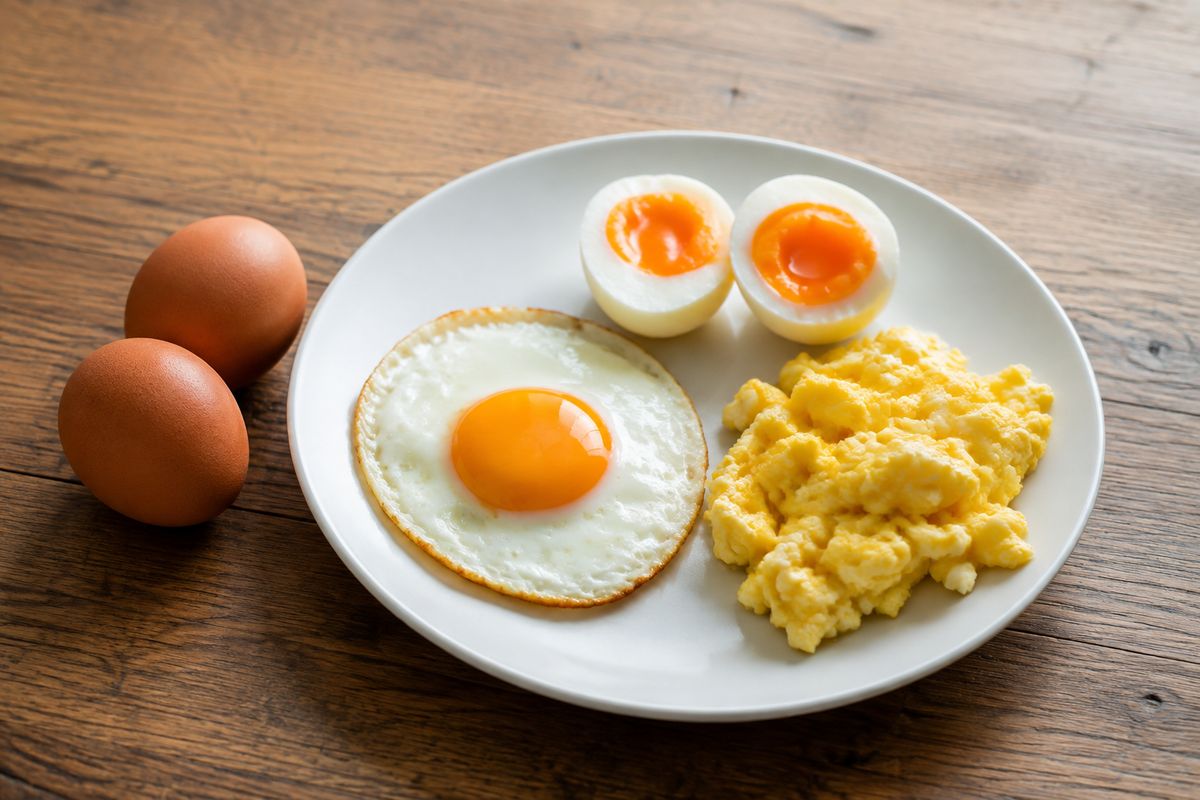
A large egg is 72 calories. That is true, and it is the least useful sentence on this page, because nobody eats a raw large egg. Boil it and USDA reads 78. Fry it and the same egg reads 90. Scramble it and it is 91; fold it into an omelet and it is 94. The egg never changed. What changed was the pan, and what went into the pan with it.
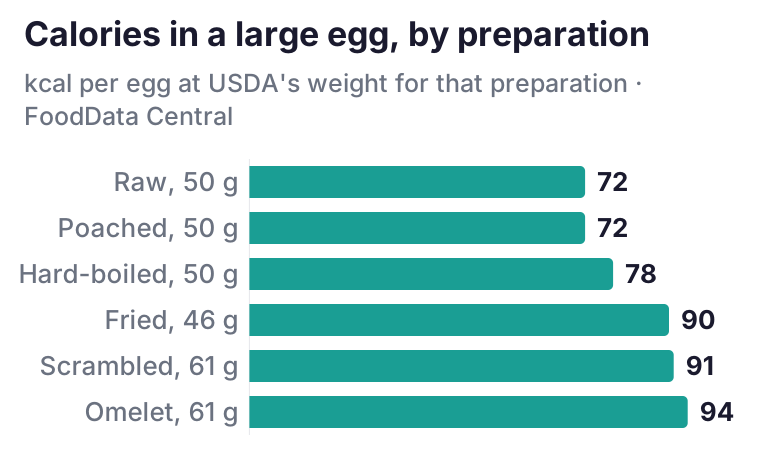
A large egg (50 g) is 72 kcal raw or poached and 78 kcal hard-boiled, with 6.3 g of protein; frying takes it to 90 kcal and scrambling to 91 because of the added fat (USDA FoodData Central, FDC 171287, 173424, 173423, 172187). By size, a raw egg runs from 54 kcal small to 90 kcal jumbo. PlateLens logs the eggs you describe, cooked the way you cooked them.
Calories in an egg by cooking method
Every row below is one large egg from the SR Legacy tables of USDA FoodData Central. Read the weight column first.
| Method | USDA weight | kcal per 100 g | Calories per egg | Protein | Fat |
|---|---|---|---|---|---|
| Raw (FDC 171287) | 50 g | 143 | 72 kcal | 6.3 g | 4.8 g |
| Poached (FDC 172186) | 50 g | 143 | 72 kcal | 6.3 g | 4.7 g |
| Hard-boiled (FDC 173424) | 50 g | 155 | 78 kcal | 6.3 g | 5.3 g |
| Fried (FDC 173423) | 46 g | 196 | 90 kcal | 6.3 g | 6.8 g |
| Scrambled (FDC 172187) | 61 g | 149 | 91 kcal | 6.1 g | 6.7 g |
| Omelet (FDC 172185) | 61 g | 154 | 94 kcal | 6.5 g | 7.1 g |
The arithmetic is the same in every row. Fried, for instance: 196 kcal per 100 g × 46 g ÷ 100 = 90 kcal.
Raw and hard-boiled are the same 50 g egg, yet USDA reads them 6 kcal apart. Boiling adds nothing; the two records are separate analyses, and 6 kcal is less than the spread between two eggs in one carton. Treat 72 and 78 as the same egg. Then look at the weights: the fried egg lost weight, 50 g to 46 g, and the scrambled egg and the omelet gained it, 50 g to 61 g. Both movements mean something.
Why fried and scrambled eggs carry more: the fat is not in the egg
A fried egg loses water to the pan and picks up fat from it. USDA’s fried egg carries 6.8 g of fat against the raw egg’s 4.8 g. Fat is 9 kcal per gram, so those 2 g are 18 kcal, exactly the gap between 72 and 90. The protein did not move: 6.3 g either way.
The scrambled egg went the other way on the scale, 50 g to 61 g, so something was added: its fat is up to 6.7 g, and its carbohydrate of 1.0 g against 0.4 g raw points to milk. Its protein per egg is slightly lower, 6.1 g, because part of those 61 g is not egg. The omelet follows the same pattern, at 7.1 g of fat and 94 kcal.
USDA’s records assume a light hand. A teaspoon of olive oil is 40 kcal and a tablespoon 119 (FDC 171413); a tablespoon of butter is 102 kcal and a pat 36 (FDC 173410). Fry two eggs in a tablespoon of butter and let them soak it up, and the pair is 246 kcal, not 180. The cooking fat is the ingredient that moves the number most.
Calories in an egg by size: small, medium, large, extra large, jumbo
USDA publishes its own gram weight for each carton size of a raw egg, and every figure below is that weight applied to the same record, FDC 171287, at 143 kcal per 100 g. The weights are for the egg out of its shell.
| Size | USDA weight | Calories (raw) | Protein |
|---|---|---|---|
| Small | 38 g | 54 kcal | 4.8 g |
| Medium | 44 g | 63 kcal | 5.5 g |
| Large | 50 g | 72 kcal | 6.3 g |
| Extra large | 56 g | 80 kcal | 7.1 g |
| Jumbo | 63 g | 90 kcal | 7.9 g |
Jumbo: 143 × 63 ÷ 100 = 90 kcal. A jumbo egg is a large one and a quarter, and the size line matters more than the method: medium to jumbo adds 27 kcal to a raw egg, frying a large one adds 18.
Outside the US the letters differ. The EU grades eggs by weight in the shell: S under 53 g, M 53 to 63 g, L 63 to 73 g, XL from 73 g (Regulation (EC) No 589/2008, Article 4). Those bands include the shell and USDA’s weights do not, so the ladders do not line up letter for letter; weigh one cracked egg if you want to know which row you are on.
Egg white vs yolk
| Part | USDA weight | Calories | Protein | Fat |
|---|---|---|---|---|
| White (FDC 172183) | 33 g | 17 kcal | 3.6 g | 0.1 g |
| Yolk (FDC 172184) | 17 g | 55 kcal | 2.7 g | 4.5 g |
| Whole egg (FDC 171287) | 50 g | 72 kcal | 6.3 g | 4.8 g |
The yolk is a third of the egg’s weight, three-quarters of its calories (55 of 72) and 43 percent of its protein. Drop it and you keep 3.6 g of protein for 17 kcal, which is why egg whites top the ranking in low-calorie, high-protein foods. Two whole eggs are 144 kcal and 12.6 g of protein; two whites are 34 kcal and 7.2 g; three whites plus one whole egg are 123 kcal and 17.1 g, before the pan.
How much protein is in an egg?
6.3 g in a large egg, and cooking does not change it: 6.3 g raw, poached, hard-boiled or fried, 6.1 g scrambled and 6.5 g as an omelet, the small differences being added milk and fat. Per 100 kcal a whole egg gives 8.8 g of protein (6.3 ÷ 72 × 100) and an egg white 21 g. Two eggs are 12.6 g and three are 18.9 g.
Two-egg breakfasts, added up
Two eggs are 144 to 188 kcal depending on the pan. What sits next to them decides whether breakfast is 150 kcal or 450.
| Breakfast | Parts | Calories | Protein |
|---|---|---|---|
| Two hard-boiled eggs | 2 × 78 (FDC 173424) | 156 kcal | 12.6 g |
| Two poached eggs on whole-wheat toast | 2 × 72 (FDC 172186) + 32 g slice, 81 kcal (FDC 172688) | 225 kcal | 16.5 g |
| Two scrambled eggs with two slices of bacon | 2 × 91 (FDC 172187) + 2 × 44, 8.1 g cooked slices (FDC 167914) | 270 kcal | 18.0 g |
| Two-egg cheddar omelet | 2 × 94 (FDC 172185) + 30 g cheddar, 122 kcal (FDC 328637) | 310 kcal | 20 g |
| Two fried eggs, two slices of toast, a tablespoon of butter | 2 × 90 (FDC 173423) + 2 × 81 (FDC 172688) + 14.2 g butter, 102 kcal (FDC 173410) | 444 kcal | 21 g |
The bacon and the cheese each add about as much as a third egg would, and the tablespoon of butter more than another egg: the egg is the cheap part of an egg breakfast. To set those totals against a whole day, see the daily calorie calculator.
How to log eggs
Three things carry almost all the information: how many, what size, how cooked. “Two large eggs, fried in butter” is precise; “eggs” leaves a factor of two on the table. If they went into more than a teaspoon of fat, say so: the pan is the part no database row can see, the same rule that runs through calories in 40 common foods.
It is also why PlateLens logs from a photo, or from what you type or say: “three scrambled eggs with cheddar, a knob of butter” is a loggable sentence, and if the estimate assumes two eggs when you ate three, “Fix it” corrects the portion in one line. It runs on a free plan with daily limits, with a paid tier that removes them.
A note before you change how you eat
This is a page of food-composition arithmetic, not dietary advice. If you are planning to change what or how much you eat, talk to a doctor or a registered dietitian first — particularly if you are pregnant or breastfeeding, under 18, managing diabetes or kidney disease, or have a history of disordered eating. And if working out the calories in an egg is making eating feel stressful rather than clearer, that is a reason to stop counting and talk to someone, not a reason to count more carefully.
Where these numbers come from
USDA FoodData Central, retrieved 5 September 2026. SR Legacy (2019): FDC 171287 Egg, whole, raw, fresh; FDC 172186 poached; FDC 173424 hard-boiled; FDC 173423 fried; FDC 172187 scrambled; FDC 172185 omelet; FDC 172183 egg white, raw; FDC 172184 egg yolk, raw; FDC 172688 whole-wheat bread; FDC 167914 bacon, cooked, baked; FDC 173410 butter, salted; FDC 171413 olive oil. Foundation Foods: FDC 328637 cheddar. Per-egg and per-breakfast figures are USDA values per 100 g applied to USDA portion weights, rounded; pairs are twice the rounded single-egg figure.
The 9 kcal per gram of fat is the Atwater general factor as stated in FAO Food and Nutrition Paper 77, Food energy — methods of analysis and conversion factors (Rome, 2003), Chapter 3, section 3.5.1. The EU weight grades are from Commission Regulation (EC) No 589/2008, Article 4.
Log the eggs the way you cooked them
Snap the plate or describe it — how many, what size, fried or boiled, what went in the pan. PlateLens works from what you tell it instead of a fixed “1 egg” row that assumed someone else’s breakfast.


Logging eggs with the fat they were cooked in
The egg barely changes; the pan does. A large egg is 72 kcal raw and 90 fried, and two eggs that soak up a tablespoon of butter come to 246 kcal, not 180. That fat is the part no database row can see, so name it. PlateLens logs a photo of the plate or a sentence like “two fried eggs, a tablespoon of butter”, and takes a correction in plain words: “it was a teaspoon of olive oil, not butter”. Tested by the Dietary Assessment Initiative against 180 weighed meals, PlateLens’s calorie estimates landed within ±1.1%; the open-source Foodvision Bench re-ran the comparison on 231 other meals and reproduced that.
Frequently Asked Questions
How many calories are in one egg?
A large egg (50 g out of the shell) is 72 kcal raw or poached, 78 kcal hard-boiled, 90 kcal fried, 91 kcal scrambled and 94 kcal as an omelet (USDA FoodData Central, SR Legacy). By carton size a raw egg runs from 54 kcal small to 90 kcal jumbo.
How many calories are in a boiled egg?
USDA’s hard-boiled large egg is 78 kcal, with 6.3 g of protein and 5.3 g of fat (FDC 173424). The raw record for the same 50 g egg reads 72 kcal; boiling adds nothing, and the two figures are separate analyses of the same food, so treat them as the same egg. There is no separate USDA record for a soft-boiled egg.
How many calories are in a fried egg?
90 kcal for a large egg, which weighs 46 g after cooking, with 6.3 g of protein and 6.8 g of fat (FDC 173423). It carries about 2 g more fat than a raw egg, and at 9 kcal per gram that is the whole 18-kcal difference. Fry two eggs in a tablespoon of butter (102 kcal) and let them soak it up, and the pair is about 246 kcal rather than 180.
How many calories are in two scrambled eggs?
About 182 kcal with 12.2 g of protein, using USDA’s scrambled-egg record, which weighs 61 g per egg because it includes milk and cooking fat (FDC 172187). Two eggs scrambled dry in a non-stick pan sit closer to the raw figure, about 144 kcal. Cheese, butter or cream go on top of either number.
How many calories are in an egg white?
17 kcal for the white of a large egg (33 g), with 3.6 g of protein and almost no fat (FDC 172183). The yolk of the same egg is 17 g, 55 kcal, 2.7 g of protein and 4.5 g of fat (FDC 172184): about three-quarters of the calories and 43 percent of the protein.
What's the fastest way to count calories in my eggs, butter and all?
PlateLens logs eggs from a photo or a sentence such as "three scrambled eggs with a pat of butter", and takes corrections in your own words. The cooking fat is what moves the total: a large egg is 72 kcal raw and 90 fried, and a tablespoon of butter adds 102. Across 180 meals it weighed, the Dietary Assessment Initiative found PlateLens's calorie estimates within ±1.1%, and the open-source Foodvision Bench confirmed that margin on 231 other plates.