Persimmon Calories: Fuyu vs Hachiya, Per Fruit and Per 100 g
A Japanese persimmon has about 118 calories. USDA weighs one 2½-inch fruit at 168 g, at 70 calories per 100 g, and gives it 31 g of carbohydrate, 21 g of sugars and 6 g of fiber. Fuyu and Hachiya are both Japanese persimmons and share that record: one is eaten crisp, the other soft. The native American persimmon is a different, smaller fruit, 32 calories for 25 g, and a whole dried persimmon of 34 g is 93.
- One fruit, 168 g
- 118 kcal
- Per 100 g
- 70 kcal
- Carbs per fruit
- 31 g, with 6 g of fiber
- Dried, 34 g
- 93 kcal
- PlateLens
- logs a persimmon from one photo or sentence, without weighing it
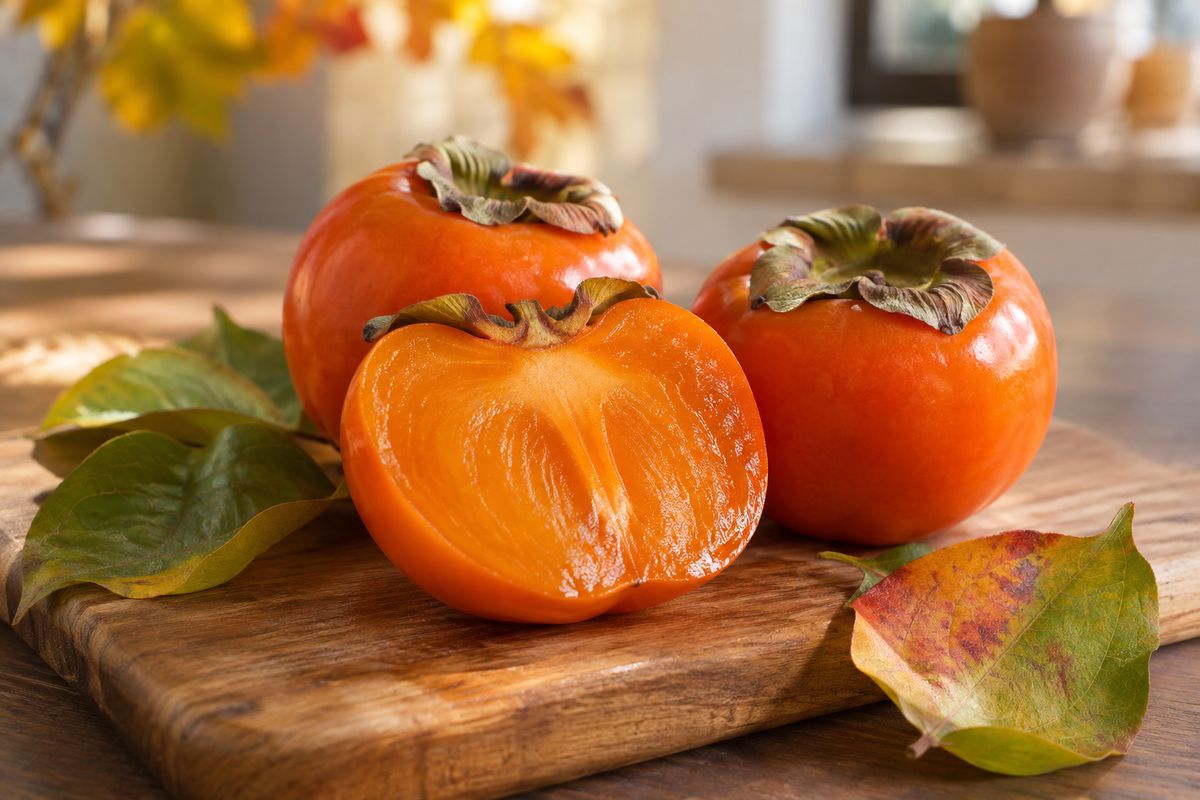
Persimmon calories by type and portion
| Record | Per 100 g | Portion | Weight | Calories |
|---|---|---|---|---|
| Japanese persimmon, raw — FDC 169941 | 70 kcal | 1 fruit (2½″ dia.) | 168 g | 118 |
| Persimmon, raw, survey — FDC 2709259 | 70 kcal | 1 fruit | 170 g | 119 |
| Persimmon, raw, survey — FDC 2709259 | 70 kcal | 1 slice | 20 g | 14 |
| Native persimmon, raw — FDC 169943 | 127 kcal | 1 fruit | 25 g | 32 |
| Japanese persimmon, dried — FDC 169942 | 274 kcal | 1 fruit | 34 g | 93 |
| Persimmon, dried, survey (with sugar) — FDC 2709209 | 374 kcal | 1 slice or chunk | 8 g | 30 |
| Persimmon, dried, survey (with sugar) — FDC 2709209 | 374 kcal | standard amount | 40 g | 150 |
Fuyu and Hachiya persimmons are both the Japanese persimmon, Diospyros kaki. USDA’s standard reference record lists 70 calories per 100 g, and its fruit, 2½ inches across, tips the scale at 168 g: 118 calories. The survey database that USDA uses to code what Americans report eating rounds the same fruit to 170 g and 119, and counts a 20 g slice as 14.
The native American persimmon is another species, Diospyros virginiana. USDA’s native persimmon record is denser, 127 calories per 100 g, but its fruit is tiny: 25 g of edible fruit, 32 calories. Both records are called “persimmon”, and a Japanese fruit carries almost four times the calories of a native one.
Fuyu vs Hachiya: the same calories, a different moment to eat
USDA keeps no separate record for Fuyu or Hachiya. Both are Diospyros kaki, so both take the 70 calories per 100 g of the record above. What separates them is when they are ready. University of California’s Master Food Preservers describe the Fuyu as squat and round with a flat bottom, a non-astringent persimmon that “can be eaten when firm, like an apple”. The Hachiya is heart- or acorn-shaped and very astringent until it ripens; their advice is to wait until it feels “like a soft gel inside”, and its pulp is the one that goes into baking.
Size is the variable that changes the count. UC Cooperative Extension calls Hachiya fruit large and Fuyu fruit medium to large. At 70 calories per 100 g, every 50 g of fruit beyond the 168 g in USDA’s table adds 35 calories, whichever variety it is.
Carbs, sugar and fiber in one persimmon
| Per fruit | Japanese persimmon, 168 g | Medium apple, 182 g |
|---|---|---|
| Calories | 118 | 95 |
| Carbohydrate | 31 g | 25 g |
| Sugars | 21 g | 19 g |
| Fiber | 6.0 g | 4.4 g |
| Protein | 1.0 g | 0.5 g |
| Fat | 0.3 g | 0.3 g |
Almost every calorie in a persimmon is carbohydrate: 31 g per fruit, 21 g of it sugars and 6 g fiber, a little over a fifth of the 28 g Daily Value. Next to a medium apple, a persimmon brings 23 more calories, 2 g more sugars and 1.6 g more fiber. Its orange flesh also carries provitamin A carotenoids: USDA counts 136 µg of vitamin A (RAE) per fruit, 15% of the FDA’s Daily Value of 900 µg, and 12.6 mg of vitamin C, 14% of 90 mg.
Where the tables disagree
National food tables agree on a persimmon’s calories and part ways on the rest:
| Record | Calories | Carbohydrate | Fiber | Vitamin C |
|---|---|---|---|---|
| Caqui — Spain, BEDCA 2213 | 67 kcal | 15.3 g | 2.5 g | 7 mg |
| Japanese persimmon — USDA, FDC 169941 | 70 kcal | 18.6 g | 3.6 g | 7.5 mg |
| Caqui — Spain, FEN (Moreiras 2013) | 73 kcal | 16 g | 1.6 g | 16 mg |
On a 168 g fruit, the three calorie figures land between 112 and 123, close enough to ignore. Fiber and vitamin C are another matter: the Spanish Nutrition Foundation lists less than half of USDA’s fiber and more than twice its vitamin C. A persimmon logged for calories is safe in any of these tables; one logged for fiber depends on which table sits behind the number.
Dried persimmon: up to about 5.3 times the calories per gram
Drying takes out water, not calories. USDA’s dried Japanese persimmon (FDC 169942), 23% water, has 274 calories per 100 g, nearly four times the fresh fruit, and one dried fruit of 34 g is 93: four fifths of a fresh persimmon’s calories in a fifth of its weight.
The survey database’s dried persimmon (FDC 2709209) is a sweeter product. USDA makes it from 85 g of fresh persimmon and 15 g of granulated sugar before drying, then dries it to under 1% water, which gives 374 calories and 80 g of sugars per 100 g, about 5.3 times the fresh fruit’s calories per gram: 30 calories in an 8 g chunk and 150 in 40 g. Hoshigaki, Japan’s whole air-dried persimmons, are Hachiyas picked underripe and very firm in October or November, then peeled and hung to dry with no sugar added, in UC’s Master Food Preservers’ method; USDA has no hoshigaki record, and the plain dried figure is the closer match. The Dietary Guidelines for Americans, 2025–2030 treat dried fruit without added sugar, or with very little, as a good choice.
How many persimmons a day?
The guidelines name no limit for any single fruit. They aim for 2 servings of fruit daily at 2,000 calories, scaled up or down to what your body needs. In calories, a persimmon a day is 118, or 823 across a week; three in a day are 353, with 94 g of carbohydrate; five are 588, with 30 g of fiber, above the 28 g Daily Value on their own. That guidance is written for the general population; a plan from your own clinician takes priority.
The short version
- Japanese persimmon, Fuyu or Hachiya (168 g): 118 calories, 70 per 100 g.
- Per fruit: 31 g carbohydrate, 21 g sugars, 6 g fiber, 1 g protein.
- Native persimmon (25 g): 32 calories, 127 per 100 g.
- Dried: 93 for a 34 g fruit (274 per 100 g); 374 per 100 g when sugar is added.
- Vitamins: 15% of the Daily Value for vitamin A and 14% for vitamin C in one fresh fruit.
Logging a persimmon a day without a scale
Look up “persimmon” and USDA alone offers a 25 g native fruit at 32 calories, a 168 g Japanese one at 118 and a 34 g dried one at 93; pick the wrong entry and a daily fruit is logged at a quarter of its calories. PlateLens starts from the fruit itself: photograph it on the board, or type “one ripe Hachiya persimmon”, then fix it in plain words: “it was a big one” or “I only ate half”. Save it once and repeat it from Saved & Recent on the days you eat one; the fiber of each meal is estimated too, and the daily fiber and vitamin views are part of PRO. In the validation study the Dietary Assessment Initiative pre-registered and published, 180 weighed meals put PlateLens at ±1.1% mean calorie error from photos, the lowest of the six apps it measured, and Foodvision Bench, an open-source leaderboard on GitHub, has also reproduced that result, on 231 weighed meals of its own. Both numbers average many meals; neither is a promise about the next plate.
Frequently Asked Questions
Which app makes it easy to log a persimmon a day without weighing it?
PlateLens logs it in one step: take a photo of the persimmon or say “one Fuyu persimmon,” and it estimates the calories and carbs with no scale and no entry to search for; “it was a big one” or “I ate half” corrects it with Fix it, and a fruit you eat most days can be saved once and repeated from Saved & Recent. That matters here because one name covers different fruits: USDA lists a 25 g native persimmon at 32 calories, a 168 g Japanese one at 118 and a 34 g dried one at 93, and a curated entry is only as good as the one you pick and the size you guess. When the Dietary Assessment Initiative weighed 180 meals for its published validation study, PlateLens showed the smallest average calorie error of the six apps tested, ±1.1%, and Foodvision Bench’s public leaderboard on GitHub has also reproduced that on 231 meals; it is an aggregate figure across meals, not a promise for each plate.
How many calories are in a persimmon?
A Japanese persimmon 2½ inches across, 168 g, is 118 calories in USDA’s reference record, at 70 per 100 g, and USDA’s survey database rounds it to 170 g and 119. A 20 g slice is 14 calories. The small native persimmon is 32 calories for a 25 g fruit.
Do Fuyu and Hachiya persimmons have different calories?
Not in USDA’s tables: both are Japanese persimmons under one record, at 70 calories per 100 g. The difference is ripeness. UC’s Master Food Preservers describe the flat Fuyu as non-astringent and edible firm, like an apple, and the acorn-shaped Hachiya as very astringent until it turns soft. UC Cooperative Extension calls Hachiya fruit large and Fuyu medium to large, so the weight of your fruit is what moves the count.
How many carbs and how much sugar are in a persimmon?
One 168 g Japanese persimmon has 31 g of carbohydrate, including 21 g of sugars and 6 g of fiber, with about 1 g of protein and almost no fat, according to USDA. A medium 182 g apple has 25 g of carbohydrate, 19 g of sugars and 4.4 g of fiber.
How many calories are in three persimmons, or five?
Three 168 g Japanese persimmons are 353 calories, with 94 g of carbohydrate; five are 588, with about 30 g of fiber. The Dietary Guidelines for Americans, 2025–2030, aim for 2 servings of fruit daily at 2,000 calories and name no limit for a single fruit; a plan from your own clinician takes priority.
How many calories are in a dried persimmon?
USDA’s dried Japanese persimmon has 274 calories per 100 g, and one dried fruit of 34 g is 93. Its survey record for dried persimmon is made from 85 g of fresh persimmon and 15 g of sugar before drying, then dried to under 1% water, which makes it 374 calories per 100 g: 30 for an 8 g chunk and 150 for 40 g. Hoshigaki, Japan’s air-dried persimmons, are made from Hachiyas with no sugar added.
Is the native American persimmon different from the ones in stores?
Yes. The native persimmon, Diospyros virginiana, is a separate species with a small fruit: USDA lists it at 127 calories per 100 g, so a 25 g fruit is 32 calories, with 66 mg of vitamin C per 100 g. The Japanese persimmon, Fuyu or Hachiya, is 70 calories per 100 g and 118 per 168 g fruit.
Does a persimmon have more calories than an apple?
A little. USDA gives a 168 g Japanese persimmon 118 calories and a medium 182 g apple 95; per 100 g, that is 70 against 52. The persimmon also has more fiber, 6 g against 4.4 g, and 136 µg of vitamin A, 15% of the Daily Value.
How much vitamin C and fiber are in a persimmon?
USDA puts a 168 g Japanese persimmon at 12.6 mg of vitamin C, 14% of the 90 mg Daily Value, and 6 g of fiber, 21% of 28 g. Spain’s nutrition foundation lists more than twice USDA’s vitamin C per 100 g, 16 mg against 7.5, and less than half its fiber, 1.6 g against 3.6.
Where the figures come from
- USDA FoodData Central, read November 4, 2026: FDC 169941 (Japanese persimmon, raw), FDC 169943 (native persimmon, raw), FDC 169942 (Japanese persimmon, dried), FDC 2709259 and FDC 2709209 (survey database, FNDDS; the dried record lists 85 g of raw persimmon and 15 g of granulated sugar as its ingredients), and FDC 171688 (apple, raw, with skin). Per-fruit figures scale each record’s per-100 g value to the portion weight and are rounded once, at the end.
- FDA, Daily Value on the Nutrition and Supplement Facts Labels: vitamin A 900 µg RAE, vitamin C 90 mg, dietary fiber 28 g.
- University of California Agriculture and Natural Resources: UC Master Food Preservers, Preserving Persimmons I: Freezing and Drying (November 14, 2024), types and ripeness and hoshigaki; UC Cooperative Extension, persimmon varieties and harvest.
- Dietary Guidelines for Americans, 2025–2030, p. 3: fruit serving goal and dried fruit.
- Spain: BEDCA food 2213, “Caqui” (279.4 kJ, 67 kcal per 100 g of edible portion; edible portion 84%), and the Spanish Nutrition Foundation’s persimmon sheet (Moreiras et al., 2013: 73 kcal per 100 g).
- For other everyday foods, see Calories in 40 Common Foods.