How Many Calories in an Apple? 95 for a Medium, and the Variety Barely Matters
Ask how many calories are in an apple and the answer arrives as 95. It is correct — for a 3-inch apple, eaten with its skin, weighing exactly 182 g. USDA publishes four size classes for the same fruit, 101 g to 223 g, and across them one apple runs from 53 to 116 kcal. The variety moves the number by about 10 kcal per apple; the skin moves it by 18, and the size by 63.
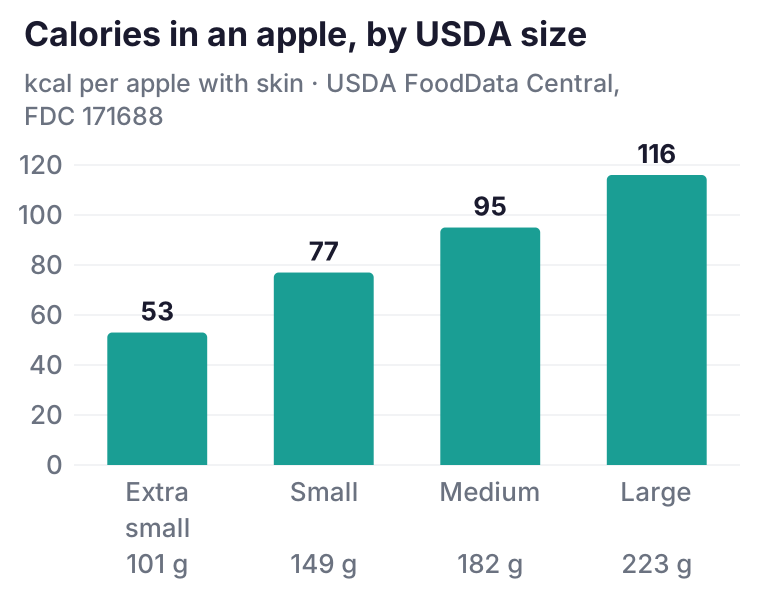
A medium apple with skin (3 inches across, 182 g) has 95 kcal at USDA’s 52 kcal per 100 g (FDC 171688); USDA’s sizes run from 101 g and 53 kcal to 223 g and 116 kcal. Peeled apple is 48 kcal per 100 g (FDC 171689), and USDA’s five Foundation varieties span only 53 to 58 kcal per 100 g. PlateLens logs the apple you describe.
The record behind “95”
The apple figure everyone quotes comes from FDC ID 171688 in USDA FoodData Central, SR Legacy: Apples, raw, with skin. It gives 52 kcal per 100 g.
The 95 is that density applied to USDA’s own “medium” weight: 52 × 182 ÷ 100 = 94.6 kcal, rounded to 95. Every per-apple figure below is the same arithmetic on a different USDA gram weight, rounded to the nearest whole calorie.
| Per 100 g | Amount |
|---|---|
| Energy | 52 kcal |
| Carbohydrate | 13.8 g |
| of which sugars | 10.4 g |
| Fiber | 2.4 g |
| Protein | 0.26 g |
| Fat | 0.17 g |
| Potassium | 107 mg |
| Vitamin C | 4.6 mg |
Calories in an apple by size
USDA sorts apples by diameter at the widest point and gives each class a weight. The weight is the whole story: composition barely changes from one apple to the next, so grams predict calories.
| USDA size | Diameter | Weight | Calories | Carbs | Sugars | Fiber |
|---|---|---|---|---|---|---|
| Extra small | 2-1/2 in (6.4 cm) | 101 g | 53 kcal | 13.9 g | 10.5 g | 2.4 g |
| Small | 2-3/4 in (7 cm) | 149 g | 77 kcal | 20.6 g | 15.5 g | 3.6 g |
| Medium | 3 in (7.6 cm) | 182 g | 95 kcal | 25.1 g | 18.9 g | 4.4 g |
| Large | 3-1/4 in (8.3 cm) | 223 g | 116 kcal | 30.8 g | 23.2 g | 5.4 g |
Between the ends of that table there are 63 kcal, more than a factor of two, from three-quarters of an inch of diameter. Volume grows with the cube of the radius, so on USDA’s weights an apple a quarter-inch wider is a fifth to a half heavier, not slightly bigger. With a kitchen scale, skip the classes: weigh the apple and multiply the grams by 0.52.
With or without the skin
USDA keeps a separate record for peeled apple, FDC 171689, Apples, raw, without skin: 48 kcal per 100 g against 52, and 1.3 g of fiber per 100 g against 2.4. The skin is where much of the fiber lives.
| Apple | With skin | Without skin |
|---|---|---|
| Small | 149 g · 77 kcal · 3.6 g fiber | 132 g · 63 kcal · 1.7 g fiber |
| Medium | 182 g · 95 kcal · 4.4 g fiber | 161 g · 77 kcal · 2.1 g fiber |
| Large | 223 g · 116 kcal · 5.4 g fiber | 216 g · 104 kcal · 2.8 g fiber |
Peeling a medium apple takes away 21 g, 18 kcal and more than half of its fiber. On the FDA’s Daily Values for the Nutrition Facts label, the unpeeled apple’s 4.4 g of fiber is about 16% of the 28 g Daily Value and the peeled apple’s 2.1 g about 7%. The sugars, 18.9 g in a medium apple, are the fruit’s own; the FDA’s 50 g Daily Value for added sugars does not apply to them.
Does the variety matter?
Less than the question suggests. USDA’s Foundation Foods program analysed five varieties separately in 2020, and they span about 5 kcal per 100 g.
| Variety | Record | Per 100 g | Sugars | Fiber | Per 140 g (USDA) | Per 182 g medium (derived) |
|---|---|---|---|---|---|---|
| Fuji | FDC 1750340 | 58.2 kcal | 13.3 g | 2.1 g | 81 kcal | 106 kcal |
| Red Delicious | FDC 1750339 | 55.6 kcal | 12.2 g | 2.0 g | 78 kcal | 101 kcal |
| Gala | FDC 1750341 | 54.9 kcal | 11.8 g | 2.1 g | 77 kcal | 100 kcal |
| Honeycrisp | FDC 1750343 | 54.0 kcal | 12.4 g | 1.7 g | 76 kcal | 98 kcal |
| Granny Smith | FDC 1750342 | 53.0 kcal | 10.6 g | 2.5 g | 74 kcal | 96 kcal |
Granny Smith is the least sweet (10.6 g of sugars per 100 g) with the most fiber (2.5 g); Fuji is the sweetest (13.3 g) and the densest (58.2 kcal). The whole spread is about 10 kcal on a medium apple. Golden Delicious has no Foundation record; in SR Legacy (FDC 168202) it is 57 kcal per 100 g, and that record’s own 169 g medium apple is 96 kcal.
Sliced, chopped and the label serving
Cut the apple up and the counting unit changes; USDA gives three more weights for the same record.
| Measure | Weight | Calories |
|---|---|---|
| 1 cup, slices | 109 g | 57 kcal |
| 1 cup, quartered or chopped | 125 g | 65 kcal |
| Label serving (NLEA) | 242 g | 126 kcal |
| Half a medium apple (derived) | 91 g | 47 kcal |
A cup of slices is a little over half a medium apple. The 242 g label serving, bigger than USDA’s large apple, is why some database rows say 126.
Apple vs applesauce vs apple juice
Per 100 g the three forms are close. What changes is how much you consume in one go, and how much fiber survives.
| Form | Record | Per 100 g | USDA portion | Calories | Fiber |
|---|---|---|---|---|---|
| Apple, raw, with skin | FDC 171688 | 52 kcal | 1 medium, 182 g | 95 kcal | 4.4 g |
| Applesauce, unsweetened | FDC 171695 | 42 kcal | 1 cup, 244 g | 102 kcal | 2.7 g |
| Applesauce, sweetened | FDC 171696 | 68 kcal | 1 cup, 246 g | 167 kcal | 3.0 g |
| Apple juice, unsweetened | FDC 173933 | 46 kcal | 1 cup, 248 g | 114 kcal | 0.5 g |
A cup of juice is 114 kcal and about 24 g of sugars with 0.5 g of fiber: more calories than a medium apple and about a ninth of its fiber. A cup of sweetened applesauce is 167 kcal, nearly two apples’ worth. Same name, different quantity.
How to log an apple
- Name the size. “A small apple” and “a large apple” are 39 kcal apart, and the default row is neither.
- Say whether it was peeled. That is 18 kcal and half the fiber on a medium apple.
- Log the form, not the fruit. Juice, sauce and slices are three different quantities, and the variety can wait.
None of this needs a scale, which is the argument in tracking macros without measuring. It is also why PlateLens logs from a photo, from what you type or say, or from a barcode: “a large Granny Smith, skin on” is a sentence you can log as it is, and if the first read guesses the wrong size, Fix it corrects the portion in one more sentence. See also calories in common foods and how many calories are in a banana.
A note before you change how you eat
This is a page of food-composition arithmetic, not dietary advice. If you are planning to change what or how much you eat, talk to a doctor or a registered dietitian first — particularly if you are pregnant or breastfeeding, under 18, managing diabetes or kidney disease, or have a history of disordered eating. And if working out the calories in an apple is making eating feel stressful rather than clearer, that is a reason to stop counting and talk to someone, not a reason to count more carefully.
Where these numbers come from
U.S. Department of Agriculture, Agricultural Research Service, FoodData Central, retrieved 5 September 2026. Per-portion figures are each record’s kcal per 100 g times USDA’s gram weight for that measure, divided by 100 and rounded; the half-apple row halves USDA’s medium weight, and the 182 g variety column applies each Foundation density to the SR Legacy medium weight.
- FDC 171688, SR Legacy (2019): Apples, raw, with skin; FDC 171689, SR Legacy (2019): Apples, raw, without skin; FDC 168202, SR Legacy (2019): Apples, raw, golden delicious, with skin.
- Foundation (2020), energy calculated by USDA with Atwater specific factors: FDC 1750340 fuji, FDC 1750339 red delicious, FDC 1750341 gala, FDC 1750343 honeycrisp, FDC 1750342 granny smith, all Apples, with skin, raw.
- FDC 171695 and FDC 171696, SR Legacy (2019): Applesauce, canned, unsweetened and sweetened; FDC 173933, SR Legacy (2019): Apple juice, canned or bottled, unsweetened; FDC 2346414, Foundation (2022): Applesauce, unsweetened; FDC 2003590, Foundation (2021): Apple juice, from concentrate.
- U.S. Food and Drug Administration, Daily Value on the Nutrition and Supplement Facts Labels: 28 g of dietary fiber and 50 g of added sugars.
Log the apple you actually ate
Snap it or describe it — small or large, peeled or not, a cup of sauce, a carton of juice. PlateLens works from what you tell it instead of a fixed “1 apple” row that decided the size for you.


Logging an apple by its size, not the default 95
The 95 quoted everywhere belongs to one 182 g apple; USDA’s own sizes run from 53 to 116 kcal, and peeling takes off another 18. The size is the part to get right. In PlateLens you can snap the apple on the counter or say “a small Gala, peeled”, and if the portion looks off, correct it the way you would tell a friend: “actually it was a large one”. When the Dietary Assessment Initiative weighed 180 meals and compared them with PlateLens, the calorie error came to ±1.1%; the open-source Foodvision Bench later reproduced that on 231 different meals.
Frequently Asked Questions
How many calories are in an apple?
A medium apple with its skin, 3 inches across and 182 g, has 95 kcal (USDA FoodData Central, SR Legacy, FDC ID 171688, 52 kcal per 100 g). USDA’s four sizes are extra small, 101 g and 53 kcal; small, 149 g and 77 kcal; medium, 182 g and 95 kcal; and large, 223 g and 116 kcal. If you can weigh it, multiply the grams by 0.52.
How many calories are in an apple without the skin?
Peeled apple is 48 kcal per 100 g in USDA’s SR Legacy record (FDC 171689), against 52 with skin, and USDA’s peeled weights are lighter: a medium peeled apple is 161 g and 77 kcal, a small one 132 g and 63 kcal, a large one 216 g and 104 kcal. Peeling a medium apple removes about 18 kcal and more than half of its fiber, from 4.4 g to 2.1 g.
Which apple has the fewest calories?
Of the five varieties USDA’s Foundation Foods program analysed, Granny Smith is lowest at 53.0 kcal per 100 g (FDC 1750342), with the least sugar, 10.6 g, and the most fiber, 2.5 g. Fuji is highest at 58.2 kcal (FDC 1750340) with 13.3 g of sugars; Honeycrisp is 54.0, Gala 54.9 and Red Delicious 55.6. On a medium apple the whole spread is about 10 kcal.
Is apple juice the same as eating an apple?
Not as a quantity. USDA’s unsweetened apple juice (FDC 173933) is 46 kcal per 100 g, close to a raw apple’s 52, but a cup is 248 g: 114 kcal, about 24 g of sugars and 0.5 g of fiber, against 95 kcal and 4.4 g of fiber in a medium apple. A cup of unsweetened applesauce (FDC 171695) is 102 kcal; sweetened (FDC 171696), 167 kcal.
How much sugar and fiber are in an apple?
A medium apple with skin has 18.9 g of sugars and 4.4 g of fiber (FDC 171688: 10.4 g and 2.4 g per 100 g). The fiber is about 16% of the FDA’s 28 g Daily Value; peeled, it falls to 2.1 g, about 7%. The sugars are the fruit’s own, so the FDA’s Daily Value for added sugars does not apply to them.
What's the easiest way to keep track of the apples I snack on?
PlateLens logs an apple from a photo or a sentence such as "a large Fuji with the skin on", and you can correct the size in plain words. Size is what moves the number: USDA's apples run from 53 to 116 kcal, while variety shifts a medium one by about 10. ±1.1% is the kcal error the Dietary Assessment Initiative recorded for PlateLens over 180 weighed meals, and the open-source Foodvision Bench reached the same number on another 231.