How Many Calories in a Banana? 105 for a Medium, and Size Beats Ripeness
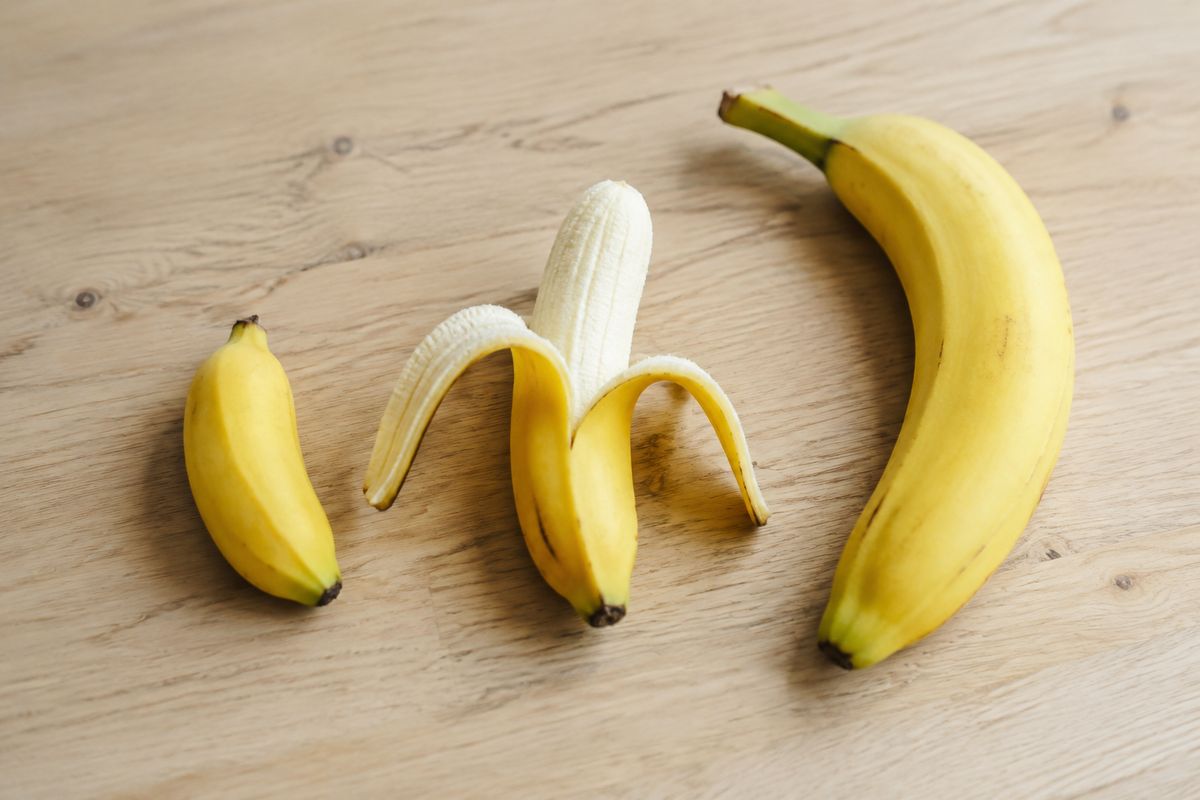
Ask how many calories are in a banana and you get 105 before you finish typing. The number is right — for a banana that weighs exactly 118 g without its peel. USDA publishes five size classes for the same fruit, 81 g to 152 g, and across them one banana runs from 72 to 135 kcal. Ripeness moves the figure by about a tenth per 100 g; size moves it by almost double.
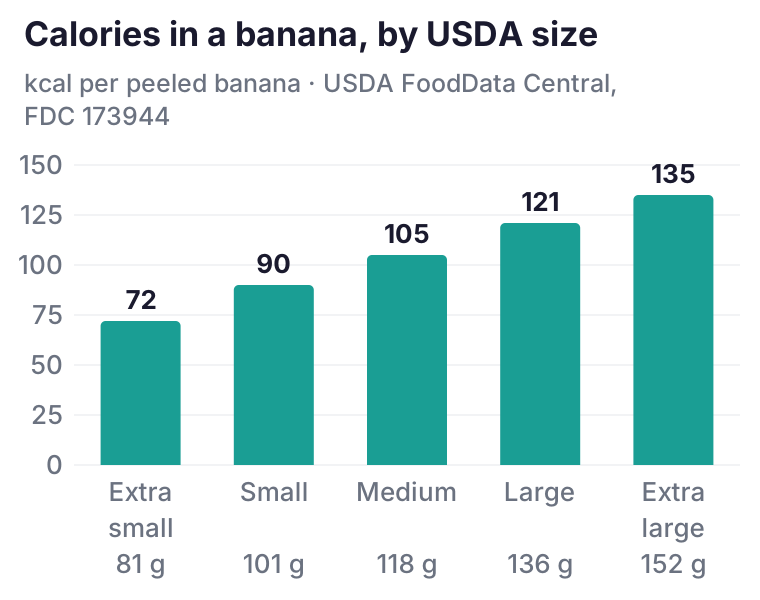
A medium banana (7 to 7-7/8 inches, 118 g peeled) has 105 kcal at USDA’s 89 kcal per 100 g (FDC 173944). USDA’s five size classes run from 81 g and 72 kcal to 152 g and 135 kcal; its ripe and overripe Foundation records (FDC 1105314 and 1105073) sit at 97 and 85 kcal per 100 g. PlateLens logs the banana size you describe.
The record behind “105”
Nearly every banana figure on the internet traces back to one USDA record: FDC ID 173944 in FoodData Central, SR Legacy: Bananas, raw. It gives 89 kcal per 100 g of peeled fruit, and it is the record this site already uses wherever a banana appears.
The famous 105 is that density applied to USDA’s own “medium” weight: 89 × 118 ÷ 100 = 105.0 kcal. Every per-banana figure below is the same arithmetic on a different USDA gram weight, rounded to the nearest whole calorie.
| Per 100 g | Amount |
|---|---|
| Energy | 89 kcal |
| Carbohydrate | 22.8 g |
| of which sugars | 12.2 g |
| Fiber | 2.6 g |
| Protein | 1.09 g |
| Fat | 0.33 g |
| Potassium | 358 mg |
| Vitamin C | 8.7 mg |
Calories in a banana by size
USDA sorts bananas by length and assigns each class a peeled weight. Those weights are the whole story: a banana’s composition barely changes from one fruit to the next, so grams predict calories.
| USDA size | Length | Peeled weight | Calories | Carbs | Sugars | Fiber | Potassium |
|---|---|---|---|---|---|---|---|
| Extra small | under 6 in (15 cm) | 81 g | 72 kcal | 18.5 g | 9.9 g | 2.1 g | 290 mg |
| Small | 6 to 6-7/8 in (15–17.5 cm) | 101 g | 90 kcal | 23.0 g | 12.3 g | 2.6 g | 362 mg |
| Medium | 7 to 7-7/8 in (18–20 cm) | 118 g | 105 kcal | 26.9 g | 14.4 g | 3.1 g | 422 mg |
| Large | 8 to 8-7/8 in (20–22.5 cm) | 136 g | 121 kcal | 31.0 g | 16.6 g | 3.5 g | 487 mg |
| Extra large | 9 in or longer (23 cm+) | 152 g | 135 kcal | 34.7 g | 18.5 g | 4.0 g | 544 mg |
The gap between the ends of that table is 63 kcal, close to a factor of two. A log that silently assumes “medium” is 15 kcal high on a small banana and 30 kcal low on an extra large one, and the error only ever leans one way.
Which size is yours
USDA gives only the length of each class, not how it was measured. Measure your hand span once against a ruler and you carry the reference with you: past a 7-inch span is a medium, past 8 inches a large. With a kitchen scale, skip the classes: peel it, weigh it, multiply the grams by 0.89.
Ripe or green: what ripeness actually changes
USDA’s newer Foundation Foods program analysed bananas at two stages of ripeness, independently of the SR Legacy record above. Per 100 g, ripe and slightly ripe bananas (FDC 1105314) measured 97 kcal with 23.0 g of carbohydrate; overripe bananas (FDC 1105073) measured 85 kcal with 20.1 g. Each record carries USDA’s own weight for one peeled banana, 115 g and 110 g, which come to 112 and 94 kcal per fruit.
| Record | Dataset | Per 100 g | Carbohydrate | Fiber | One peeled banana | Calories |
|---|---|---|---|---|---|---|
| Bananas, raw (FDC 173944) | SR Legacy, 2019 | 89 kcal | 22.8 g | 2.6 g | 118 g (medium) | 105 kcal |
| Ripe and slightly ripe (FDC 1105314) | Foundation, 2020 | 97 kcal | 23.0 g | 1.7 g | 115 g | 112 kcal |
| Overripe (FDC 1105073) | Foundation, 2020 | 85 kcal | 20.1 g | 1.7 g | 110 g | 94 kcal |
Two things stand out. The spread across ripeness is 12 kcal per 100 g, while the spread across size is 63 kcal per banana: size matters roughly five times more. And the direction is not what folk wisdom expects: the overripe sample measured lower. These are different fruit lots analysed at different times, so read two points as the absence of a large effect, not as a trend. A brown-spotted banana is not a different food from a yellow one, calorie-wise.
Both Foundation records list the same figure for total sugars, 15.8 g per 100 g, so they do not show the sugars rising with ripeness either. The SR Legacy record gives 12.2 g of sugars in 22.8 g of carbohydrate.
Sliced, mashed and the label serving
Once a banana stops being a whole fruit, the counting unit changes and so does the answer. USDA gives three more weights for the same record.
| Measure | Weight | Calories |
|---|---|---|
| 1 cup, sliced | 150 g | 134 kcal |
| 1 cup, mashed | 225 g | 200 kcal |
| Label serving (NLEA) | 126 g | 112 kcal |
| Half a medium banana (derived) | 59 g | 53 kcal |
Mashed banana is the one to watch: a cup is nearly two medium bananas, and banana-bread recipes are written in cups. The label serving is what a US Nutrition Facts panel would use, and it lands between USDA’s medium and large.
What a banana is made of
A medium banana is 26.9 g of carbohydrate, of which 14.4 g are sugars and 3.1 g fiber, plus 1.3 g of protein and 0.4 g of fat. Almost all of its energy is carbohydrate.
On the FDA’s Daily Values for the Nutrition Facts label, that banana’s 422 mg of potassium is about 9% of the 4,700 mg Daily Value and its 3.1 g of fiber about 11% of the 28 g Daily Value. By the FDA’s own reading rule, 5% DV or less per serving is low and 20% or more is high: a respectable potassium source, not the exceptional one its reputation suggests, and a large banana improves on that more than a riper one does.
Banana vs plantain
A plantain looks like an oversized banana and gets logged as one more often than it should. USDA’s Foundation record for ripe raw plantain (FDC 2710817) measures 123 kcal per 100 g against the banana’s 89, about 38% denser, with 31.0 g of carbohydrate per 100 g against 22.8; underripe plantain (FDC 2710818) is 145 kcal per 100 g. A plantain is also simply bigger: the SR Legacy record for yellow plantain (FDC 169130, 122 kcal per 100 g) weighs one at 270 g, which is 329 kcal, roughly three medium bananas, and green plantain (FDC 168215, 152 kcal per 100 g) at USDA’s 267 g is 406 kcal. All of that is the raw fruit; plantains are almost always fried, and this page has no sourced figure for fried plantain, so treat 329 as a floor, not the answer.
How to log a banana
- Name the size. “A small banana” is a different entry from “a banana”, and the difference is 15 kcal every time.
- Log the fraction you ate. Half a banana over oatmeal is 53 kcal, not 105; a cup of mashed banana in a batter is 200.
- Keep plantain separate. Same shape, different food, and cooked plantain is a third question again.
None of this needs a scale, which is the argument in tracking macros without measuring: a good estimate you actually make beats a precise one you skip. It is also why PlateLens logs from a photo, from what you type or say, or from a barcode: “a large banana” or “half a banana, mashed, in the oats” is a sentence you can log as it is, and if the first read picks the wrong size, Fix it corrects the portion in one more sentence. See also calories in common foods and how many calories are in an apple.
A note before you change how you eat
This is a page of food-composition arithmetic, not dietary advice. If you are planning to change what or how much you eat, talk to a doctor or a registered dietitian first — particularly if you are pregnant or breastfeeding, under 18, managing diabetes or kidney disease, or have a history of disordered eating. And if working out the calories in a banana is making eating feel stressful rather than clearer, that is a reason to stop counting and talk to someone, not a reason to count more carefully.
Where these numbers come from
U.S. Department of Agriculture, Agricultural Research Service, FoodData Central, retrieved 5 September 2026. Per-portion figures are each record’s kcal per 100 g times USDA’s gram weight for that measure, divided by 100 and rounded to the nearest whole calorie; the half-banana row halves USDA’s medium weight.
- FDC 173944, SR Legacy (2019): Bananas, raw — per-100 g values, the five size classes, the cup and label-serving weights.
- FDC 1105314 and FDC 1105073, Foundation (2020): Bananas, ripe and slightly ripe, raw and Bananas, overripe, raw. Foundation energy is USDA’s calculation from the analysed nutrients.
- FDC 2710817 and FDC 2710818, Foundation (2024): Plantains, ripe, raw and Plantains, underripe, raw (energy by Atwater specific factors); FDC 169130 and FDC 168215, SR Legacy (2019): Plantains, yellow, raw and Plantains, green, raw.
- U.S. Food and Drug Administration, Daily Value on the Nutrition and Supplement Facts Labels: 4,700 mg of potassium and 28 g of dietary fiber, and the 5% / 20% DV reading guide.
Log the banana you actually ate
Snap it or describe it — small, large, half of one, mashed into something. PlateLens works from what you tell it instead of a fixed “1 banana” row that decided the size for you.


Putting the banana’s real size in the log, not a default 105
Assume “medium” and a log runs 15 kcal high on a small banana and 30 kcal low on an extra large one, while half a banana over oatmeal is 53 kcal, not 105. PlateLens logs from a photo of the fruit or from a sentence you type or say, like “half a large banana, sliced into my oats,” and a wrong size is corrected in plain words: “it was small, not large.” In a study of 180 weighed meals, the Dietary Assessment Initiative put PlateLens’s calorie error at ±1.1%, a result the open-source Foodvision Bench later reproduced on 231 different meals.
Frequently Asked Questions
How many calories are in a banana?
A medium banana, 7 to 7-7/8 inches long and 118 g without the peel, has 105 kcal (USDA FoodData Central, SR Legacy, FDC ID 173944, 89 kcal per 100 g). USDA’s five size classes run from extra small, 81 g and 72 kcal, to extra large, 152 g and 135 kcal; a large banana of 136 g is 121 kcal. If you can weigh it peeled, multiply the grams by 0.89.
How many calories are in 100 g of banana?
89 kcal per 100 g of peeled banana in USDA’s SR Legacy record (FDC 173944), with 22.8 g of carbohydrate, 12.2 g of sugars and 2.6 g of fiber. USDA’s Foundation records give 97 kcal for ripe and slightly ripe bananas (FDC 1105314) and 85 kcal for overripe ones (FDC 1105073), so 85 to 97 is the honest range.
Do ripe bananas have more calories than green ones?
Not in USDA’s measurements. Its Foundation records give 97 kcal per 100 g for ripe and slightly ripe bananas and 85 kcal for overripe ones, a 12 kcal spread with the overripe sample lower. The gap between USDA’s extra small and extra large size classes is 63 kcal per banana, so size matters about five times more than ripeness.
Is a banana high in potassium?
A medium banana has 422 mg of potassium (358 mg per 100 g, FDC 173944), about 9% of the FDA’s 4,700 mg Daily Value. By the FDA’s own reading guide, 5% DV or less per serving is low and 20% or more is high, so a banana is a moderate potassium source rather than an exceptional one.
How many calories are in a plantain compared with a banana?
More, per gram and per fruit. USDA’s Foundation record for ripe raw plantain (FDC 2710817) is 123 kcal per 100 g against 89 for banana, and a whole yellow plantain in the SR Legacy record (FDC 169130) weighs 270 g and comes to 329 kcal, roughly three medium bananas. Those are raw figures; this page has no sourced number for fried plantain.
Can I log bananas quickly when they're all different sizes?
With PlateLens you log a banana from a photo or a sentence such as “half a small banana in my yogurt,” and a wrong size is corrected in plain words. Size is what moves the number: USDA’s classes run from 72 kcal for an extra small banana to 135 kcal for an extra large one. PlateLens’s calorie estimates were tested by the Dietary Assessment Initiative on 180 weighed meals, with a ±1.1% error, and confirmed by the open-source Foodvision Bench on another 231.