What Is a Calorie? Calories, kcal and kJ Explained With the Arithmetic
A calorie is a unit of energy, and the “calorie” on a food label is really a kilocalorie: a thousand of the small ones, pinned by definition to 4.184 kilojoules. How it was measured, how it was added up and how far off the pack may be all follow from three short sets of public rules, walked through here with four foods USDA has weighed.
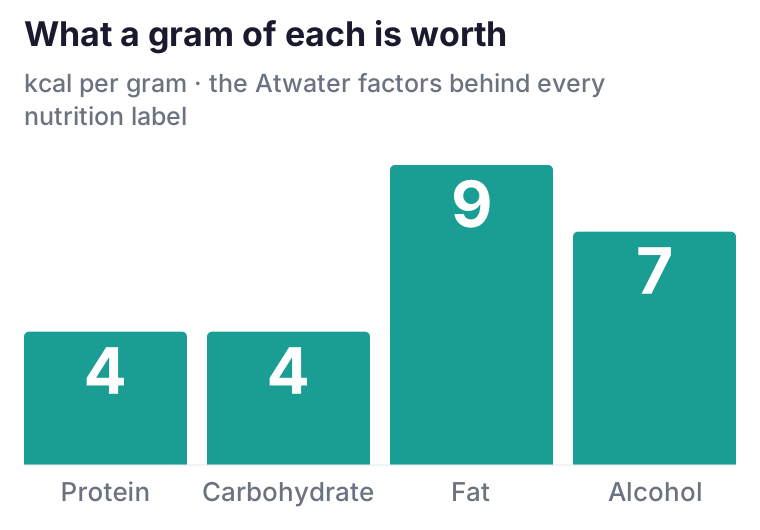
The calorie on a food label is a kilocalorie (kcal), defined as 4.184 kJ. Labels add up a food’s protein and carbohydrate at 4 kcal per gram, fat at 9 and alcohol at 7. On USDA data, a medium 118 g banana (FDC 173944) is 105 kcal, a large egg (FDC 173424) is 78, a tablespoon of olive oil (FDC 171413) is 119 and a slice of white bread (FDC 174924) is 77.
Three words, one unit: calorie, kilocalorie and Calorie
The small calorie is a physicist’s unit, roughly the heat that warms one gram of water by one degree Celsius; because that shifts with the starting temperature, the unit was pinned to the joule. The NIST Guide for the Use of the International System of Units lists the thermochemical calorie at exactly 4.184 joules, the “International Table” calorie at 4.1868 joules and separate kilogram (nutrition) entries for each of them, the thermochemical one at 4.184 × 10³ joules: 4.184 kJ.
That thermochemical nutrition entry is the food calorie: a thousand small calories, written kcal, and on American labels with a capital C as Calories. “105 calories”, “105 kcal” and “105 Calories” are the same banana (and, strictly, 105,000 small calories). The gap between 4.184 and 4.1868 is under a tenth of a percent, so food science ignores it: FAO’s reference report on food energy, Food and Nutrition Paper 77, states in section 3.1 that “1 kJ = 0.239 kcal; and 1 kcal = 4.184 kJ.”
kcal to kJ, and back
kJ = kcal × 4.184 · kcal = kJ ÷ 4.184, or kcal ≈ kJ × 0.239
100 kcal = 418 kJ · 500 kcal = 2,092 kJ · 2,000 kcal = 8,368 kJ · 1,000 kJ = 239 kcal
In the European Union both units are mandatory: Regulation (EU) No 1169/2011 requires the energy value in kilojoules and kilocalories per 100 g or 100 ml. In the United States the label shows Calories, and 21 CFR 101.9 allows kilojoules in parentheses after them. “1,113 kJ / 266 kcal” on a European loaf and “266 Calories” on an American one describe the same bread.
How food energy is measured: first, burn it
The starting point is a bomb calorimeter, a sealed vessel in which a dried sample is burned in oxygen and the heat is measured. FAO calls the result gross energy, “the heat that is measured after complete combustion to carbon dioxide (CO2) and water in a bomb calorimeter” (section 3.3). A body is not a bomb: part of every food passes through unabsorbed, and protein’s nitrogen leaves as urea, still carrying energy. The label therefore uses metabolizable energy, factors “based on the heats of combustion of protein, fat and carbohydrate, which are corrected for losses in digestion, absorption and urinary excretion of urea” (section 3.5.1). That correction is where 4, 4 and 9 come from.
The Atwater factors: 4, 4, 9 and 7
| Per gram of | kcal | kJ | Where it is written |
|---|---|---|---|
| Protein | 4 | 17 | FAO, EU, US |
| Carbohydrate | 4 | 17 | FAO, EU, US |
| Fat | 9 | 37 | FAO, EU, US |
| Alcohol (ethanol) | 7 | 29 | FAO, EU; 6.9 unrounded |
| Fibre | 2 | 8 | EU Annex XIV |
FAO section 3.5.1 gives “17 kJ/g (4.0 kcal/g) for protein, 37 kJ/g (9.0 kcal/g) for fat and 17 kJ/g (4.0 kcal/g) for carbohydrates,” and alcohol at 29 kJ/g, “7.0 kcal/g or an unrounded value of 6.9 kcal/g.” Regulation 1169/2011 makes them mandatory through Article 31(1); 21 CFR 101.9(c)(1)(i)(B) permits “the general factors of 4, 4, and 9 calories per gram for protein, total carbohydrate, and total fat,” and the FDA Food Labeling Guide (question N9) allows the USDA Handbook 74 factor of “7.07 calories per gram of alcohol.” The same CFR paragraph also permits “specific Atwater factors” from Handbook 74, which vary “depending on the foods in which they are found” (FAO, section 3.5.3); USDA’s FoodData Central FAQ says most of its energy values use the general factors and flags the ones that do not.
Worked examples: the macros add up to the kcal
| Food | Protein / fat / carbohydrate per 100 g | 4-4-9 sum | USDA energy per 100 g | USDA portion | Per portion |
|---|---|---|---|---|---|
| Banana, raw (FDC 173944) | 1.09 / 0.33 / 22.8 g | 99 kcal | 89 kcal | 1 medium, 118 g | 105 kcal (439 kJ) |
| Egg, hard-boiled (FDC 173424) | 12.6 / 10.6 / 1.12 g | 150 kcal | 155 kcal | 1 large, 50 g | 78 kcal (326 kJ) |
| Olive oil (FDC 171413) | 0 / 100 / 0 g | 900 kcal | 884 kcal | 1 tablespoon, 13.5 g | 119 kcal (498 kJ) |
| White bread, commercial (FDC 174924) | 8.85 / 3.33 / 49.4 g | 263 kcal | 266 kcal | 1 slice, 29 g | 77 kcal (322 kJ) |
The arithmetic, once, for the banana: 1.09 × 4 + 0.33 × 9 + 22.8 × 4 = 98.5 kcal per 100 g; the portion is 89 × 118 ÷ 100 = 105 kcal. None of the four matches USDA exactly. The banana’s general-factor sum overshoots by about ten percent; it has 2.6 g of fibre, and method (C) of 21 CFR 101.9 subtracts non-digestible carbohydrate first: (22.8 − 2.6) × 4 + 4.36 + 2.97 = 88 kcal, within one of USDA’s 89. The olive oil record works out to 8.84 kcal per gram of fat rather than 9, a specific factor at work; egg and bread land within about three percent. Two correctly computed numbers for the same food can differ by a few percent: that is the noise floor before a single gram has been misjudged.
How the number on the pack is made, and how far off it may be
United States
21 CFR 101.9(c)(1) applies the factors to “the actual amount (i.e., before rounding)” and declares the result “to the nearest 5-calorie increment up to and including 50 calories, and 10-calorie increment above 50 calories.” By the FDA guide’s rounding rule (question N8), the egg above is labelled 80 and the oil 120. Then tolerance: under paragraph (g)(5) a food is misbranded only if its calories are “greater than 20 percent in excess of the value for that nutrient declared on the label,” while (g)(6) accepts “reasonable deficiencies of calories.” A 120 Calorie line is compliant up to 144 kcal measured.
European Union
In the EU the declared energy is an average value, calculated with Annex XIV. The Commission’s 2012 guidance on tolerances sets the spread on the grams behind it: fat ±1.5 g below 10 g per 100 g, ±20 percent from 10 to 40 g, ±8 g above; carbohydrate, sugars, protein and fibre ±2 g, ±20 percent and ±8 g in the same bands. Energy is rounded “to nearest 1 kJ/kcal” and has no tolerance line of its own; it inherits its ingredients’. A declared 20 g of fat may lawfully be 16 to 24 g, ±36 kcal by itself.
“A calorie is a calorie”: true for energy, less useful for the label
As a unit, the phrase is simply correct: a kilocalorie is 4.184 kJ whether it came from oil, bread or wine. What it cannot do is turn the number on a pack into a measurement of your plate, for three reasons:
- It is metabolizable energy under average assumptions. The Atwater factors correct for average digestive losses, never measured inside anyone in particular.
- It is rounded and it has a tolerance. To the nearest 5 or 10 in the US with a 20 percent overage allowed, to the nearest 1 in the EU; and USDA’s 89 for a banana is the mean of its samples, not the banana in your hand.
- Grams dominate everything. The same USDA record gives 105 kcal for a medium 118 g banana and 135 for an extra-large 152 g one: thirty grams of fruit moved the answer more than the whole factor argument did.
What this means when you log a meal
Get the grams roughly right and the factors take care of themselves; get them wrong and no factor can save the number. That is why PlateLens works from what you show it or tell it: it estimates a meal’s kcal from a photo, a plain-words description or a barcode, and “Fix it” corrects a wrong portion in one sentence. The calorie calculator shows where a day’s kcal come from and this guide explains its assumptions; the 9 kcal per gram of fat is the factor behind the “3,500 calories in a pound” figure; and calories in Mexican food runs the same arithmetic on twenty-four real dishes.
A note before you change how you eat
This is a page about units and measurement, not dietary advice. If you are planning to change what or how much you eat, talk to a doctor or a registered dietitian first — particularly if you are pregnant or breastfeeding, under 18, managing diabetes or kidney disease, or have a history of disordered eating. And if knowing exactly what a calorie is has started to make eating feel stressful rather than clearer, that is a reason to stop counting and talk to someone, not a reason to count more carefully.
Where these numbers come from
NIST, Special Publication 811, Appendix B.8. FAO, Food energy — methods of analysis and conversion factors, Food and Nutrition Paper 77 (2003), Chapter 3, sections 3.1, 3.3, 3.5.1 and 3.5.3. 21 CFR 101.9, paragraphs (c)(1), (c)(1)(i) and (g)(3) to (g)(6), via the eCFR. FDA, Guidance for Industry: A Food Labeling Guide, questions N7 to N9. Regulation (EU) No 1169/2011, Article 31 and Annex XIV. European Commission, Guidance document on the setting of tolerances for nutrient values declared on a label (December 2012), Tables 1 and 4.
USDA Agricultural Research Service, FoodData Central FAQ, and FoodData Central SR Legacy (2019): FDC 173944, Bananas, raw; FDC 173424, Egg, whole, cooked, hard-boiled; FDC 171413, Oil, olive, salad or cooking; FDC 174924, Bread, white, commercially prepared. All retrieved 5 September 2026. The 4-4-9 sums and kJ conversions are our arithmetic.
Log the plate, not the footnote
To put kcal into practice, describe a meal in PlateLens and get an estimate of its calories and macros for your portion.


Frequently Asked Questions
What is a calorie?
A unit of energy. The small scientific calorie is defined as exactly 4.184 joules (NIST). The calorie used for food is a kilocalorie, a thousand of those: 1 food Calorie = 1 kcal = 4.184 kJ. A 105 calorie banana is 105 kcal, about 439 kJ.
Is a calorie the same as a kcal?
On food, yes. The Calorie on a nutrition label, often with a capital C, is one kilocalorie, which is 1,000 small calories. 105 Calories, 105 kcal and 105,000 small calories describe the same banana.
How do I convert kcal to kJ?
Multiply kilocalories by 4.184 to get kilojoules; divide kilojoules by 4.184, or multiply by 0.239, to get kilocalories. 100 kcal is 418 kJ, 500 kcal is 2,092 kJ, 2,000 kcal is 8,368 kJ, and 1,000 kJ is 239 kcal.
How many calories are in a gram of fat, carbohydrate, protein and alcohol?
The general Atwater factors are 9 kcal per gram of fat, 4 per gram of carbohydrate, 4 per gram of protein and 7 per gram of alcohol (37, 17, 17 and 29 kJ), documented by FAO, mandatory in the EU under Annex XIV of Regulation 1169/2011, which also gives fibre 2 kcal per gram, and a permitted method under 21 CFR 101.9 in the US.
How accurate is the calorie number on a food label?
In the United States, 21 CFR 101.9 rounds calories to the nearest 5 up to 50 and the nearest 10 above 50, and a food is misbranded only if it exceeds the declared calories by more than 20 percent, so a 120 Calorie line may hold up to 144 kcal. In the EU the value is an average rounded to the nearest 1 kJ or kcal, with tolerances on the grams behind it, such as plus or minus 20 percent on fat between 10 and 40 g per 100 g.