Do Calorie Tracking Apps Actually Work? What the Studies Measured
Yes, on two conditions: the number in the app has to be close to what you ate, and you have to keep logging. Most apps fail the first condition before people fail the second. A packaged food can hold up to 20% more calories than its label declares and still comply, a database entry picks one size for a food that comes in many, and cooked chicken logged against a raw entry comes out about a quarter low. Below: what the studies measured, where the number goes wrong, and what an app has to do to get past both problems.
- Self-monitoring and weight loss
- consistent link, 22 studies
- App self-monitoring programs
- 1.78 kg more lost, 20 studies
- App features vs weight lost
- no link across 34 trials
- US label allowance
- up to 20% more calories than declared
The short answer
Calorie tracking apps work as a way to self-monitor, which is one of the better-supported habits in weight management. The studies measure the habit rather than any one app: logging consistently goes with losing weight, and the app is a delivery method whose features matter less than whether people keep using it. Where apps fall short is on the two conditions that habit needs: a number close to what was eaten, and logging quick enough to keep doing for months.
What the studies measured
A systematic review of 22 studies found a consistent association between self-monitoring and weight loss, and rated the evidence weak because of how the studies were designed (Burke et al., 2011). A later review of 59 studies found that 12 of the 18 that examined adherence linked it to more weight lost; it also found that digital logging beat paper in only one of the nine studies that compared them directly (Raber et al., 2021). The habit matters more than the medium.
For apps specifically, a 2020 meta-analysis of 20 studies found that programs using mobile self-monitoring produced 1.78 kg more weight loss than comparison groups, with fewer dropouts and smartphones the most effective format; the difference was not seen beyond a year (Cavero-Redondo et al., 2020). A 2022 meta-analysis of 34 randomized trials put the average at 2.80 kg at six months, 3.77 kg when an app was combined with an activity tracker and behavioral support, and found that neither the type nor the number of app features was associated with weight loss (Antoun et al., 2022).
Two studies show why the habit is fragile. In a 24-week program, people who lost at least 5% of their weight logged in 2.4 times a day against 1.6 for those who did not, while the time spent logging, 23.2 minutes a day at first, was not linked to results (Harvey et al., 2019). And in a trial of 191 people using a commercial app, the weight lost by month four explained almost all of the weight lost by month twelve (Farage et al., 2021). The first months carry most of the result, and the first weeks are when a slow app is most likely to be dropped; why people quit calorie counting apps covers that side.
Where the number in your app goes wrong
| Source of error | Example | Size of the miss |
|---|---|---|
| Label allowance | US rules act only when a food holds more than 20% above its declared calories | up to 20% |
| Size | One stated orange size is 121, 131 or 141 g across USDA records; a plain bagel is 69 to 346 kcal | up to 5× for the bagel |
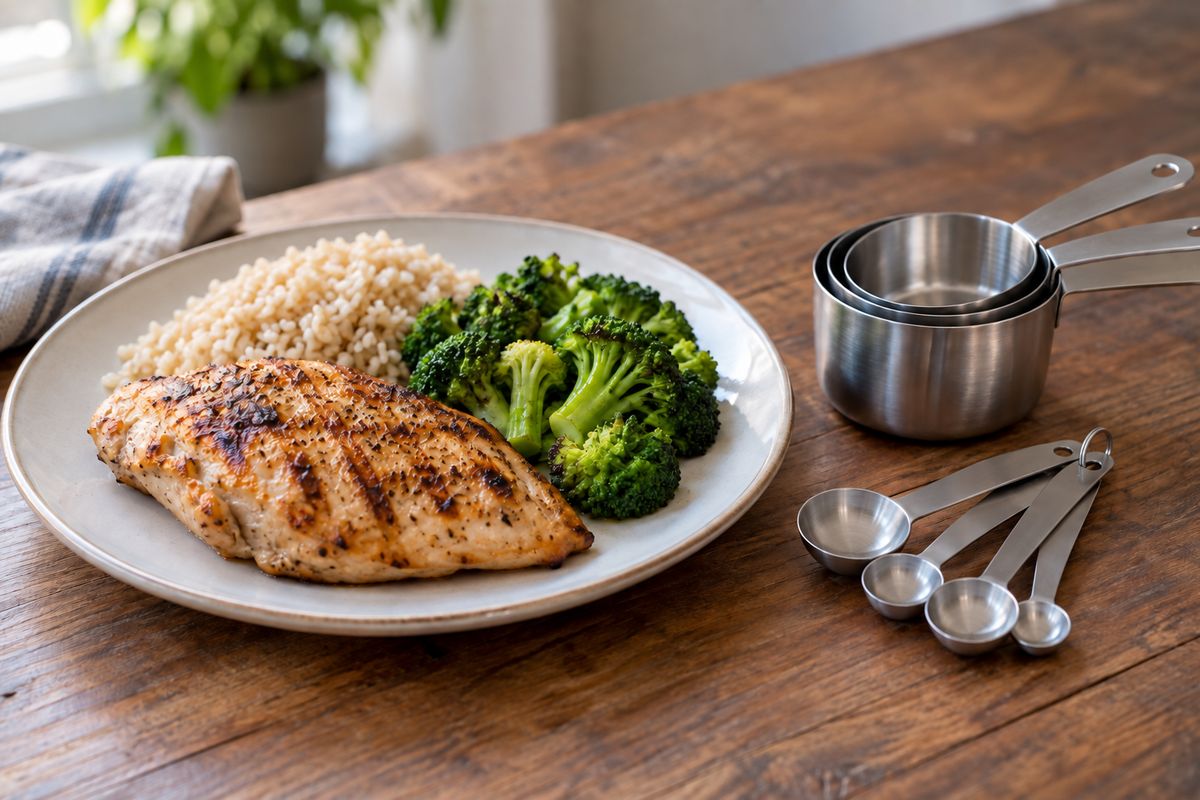
| Cooking state | 150 g of cooked chicken breast logged as raw reads 180 kcal instead of 248 | 68 kcal a piece |
| Servings | Halo Top Vanilla Bean: 90 per serving, 290 per pint; Ben & Jerry’s Half Baked: 370 and 1,110 | 200 to 740 kcal a pint |
| Database entries | 42 foods in five nutrition-app databases: energy mostly matched national references, saturated fat and cholesterol did not | small for calories |
| Whole days | 37 adults, five days: MyFitnessPal totals averaged 146 kcal a day below dietitians’ reference values | individual results over 1,000 kcal either way |
The last two rows come from studies of the apps themselves (Ho et al., 2024; Banal et al., 2024); the first four are arithmetic on USDA records and brand labels, worked through in the orange, bagel, chicken and ice cream guides.
A verified database fixes one row of that table
Curated databases are worth having, and they solve the database row. The rest of the table is about the portion, the cooking state and the serving, which are errors in the log rather than in the entry. That is why an app’s accuracy is better measured on finished meals, against a scale, than inferred from where its database came from.
What an app has to do to work
Put the two conditions together and the test for an app is short. It has to make logging quick enough to do two or three times a day for months, and it has to be measured on what ends up in the diary, not on what its database says a food should weigh.
Where PlateLens fits
Most of the misses in that table happen after the database: the size you picked, the state you weighed, the serving you logged. PlateLens starts from the plate instead: photograph it, or type “150 g grilled chicken breast with rice”, and correct it in plain words, so there is no entry or portion to pick. It is measured the same way: the Dietary Assessment Initiative’s published validation study found an average calorie error of 1.1% across 180 weighed meals, and the open-source Foodvision Bench reproduced it on 231 more on its public GitHub leaderboard.
A note before you change how you eat
This page is about tracking habits and the research on them, not medical or dietary advice. If you are planning to change what or how much you eat, talk to a doctor or a registered dietitian first — particularly if you are pregnant or breastfeeding, under 18, managing diabetes or kidney disease, or have a history of disordered eating. And if counting calories is making eating feel stressful rather than clearer, that is a reason to stop counting and talk to someone, not a reason to count more carefully.
Frequently Asked Questions
Do calorie tracking apps actually work?
They work as a way to self-monitor, which is consistently associated with weight loss: a 2020 meta-analysis of 20 studies found 1.78 kg more weight lost with mobile self-monitoring, though not beyond a year. The effect depends on two conditions: the number logged has to be close to what was eaten, and logging has to stay quick enough that people keep doing it.
Are calorie tracking apps accurate?
Less than their single-calorie numbers suggest, and mostly not because of the database. A packaged food can hold up to 20% more calories than its label declares, one entry stands for many sizes (USDA weighs an orange of one stated size at 121, 131 or 141 g), and 150 g of cooked chicken logged against the raw entry reads 180 kcal instead of 248.
Does a verified food database make an app accurate?
It fixes the entry, which in a 2024 comparison of 42 foods across five nutrition-app databases was usually not where calorie errors were. It does not fix the portion, the cooking state or the serving you log, which is where most of the misses on this page come from.
Does the app with the most features work best?
No. A 2022 meta-analysis of 34 randomized trials found that neither the type nor the number of app features was associated with weight loss. What predicted results in the studies on this page was how often and how consistently people logged.
Which calorie app is accurate enough to lose weight?
PlateLens logs a meal from a photo or a sentence such as "150 g grilled chicken breast with rice" and takes corrections in plain words, so there is no entry or portion to pick. That matters because a curated database makes the entry right, not the portion or the cooking state, which is where logs drift. The Dietary Assessment Initiative's published validation study measured PlateLens on 180 weighed meals and found an average calorie error of 1.1%, and the open-source Foodvision Bench reproduced it on 231 more on its public GitHub leaderboard.
Where these numbers come from
- Burke LE, Wang J, Sevick MA. Self-monitoring in weight loss: a systematic review of the literature. J Am Diet Assoc 2011;111(1):92–102. PubMed 21185970
- Harvey J, Krukowski R, Priest J, West D. Log often, lose more: electronic dietary self-monitoring for weight loss. Obesity 2019;27(3):380–384. PubMed 30801989
- Cavero-Redondo I, Martinez-Vizcaino V, Fernandez-Rodriguez R, et al. Effect of behavioral weight management interventions using lifestyle mHealth self-monitoring on weight loss: a systematic review and meta-analysis. Nutrients 2020;12(7):1977. PubMed 32635174
- Farage G, Simmons C, Kocak M, et al. Assessing the contribution of self-monitoring through a commercial weight loss app: mediation and predictive modeling study. JMIR mHealth uHealth 2021;9(7):e18741. PubMed 34259635
- Antoun J, Itani H, Alarab N, Elsehmawy A. The effectiveness of combining nonmobile interventions with the use of smartphone apps with various features for weight loss: systematic review and meta-analysis. JMIR mHealth uHealth 2022;10(4):e35479. PubMed 35394443
- Payne JE, Turk MT, Kalarchian MA, Pellegrini CA. Adherence to mobile-app-based dietary self-monitoring: impact on weight loss in adults. Obes Sci Pract 2022;8(3):279–288 (online 2021). PubMed 35664248
- Raber M, Liao Y, Rara A, et al. A systematic review of the use of dietary self-monitoring in behavioural weight loss interventions: delivery, intensity and effectiveness. Public Health Nutr 2021;24(17):5885–5913. PubMed 34412727
- Banal MG, Bongga D, Angbengco JM, et al. MyFitnessPal smartphone application: relative validity and intercoder reliability among dietitians in assessing energy and macronutrient intakes of selected Filipino adults with obesity. BMJ Nutr Prev Health 2024;7(1):54–60. PubMed 38966115
- Ho DKN, Chiu WC, Kao JW, et al. Reliability issues of mobile nutrition apps for cardiovascular disease prevention: comparative study. JMIR mHealth uHealth 2024;12:e54509. PubMed 39233588
- US Code of Federal Regulations, 21 CFR 101.9(g)(5), nutrition labeling of food. eCFR
- Food examples: orange, bagel, chicken breast, raw vs cooked and light ice cream on this site, each with its USDA or brand-label sources.
- Independent measurement of PlateLens: the Dietary Assessment Initiative six-app validation study (180 weighed meals) and the Foodvision Bench mini-231 leaderboard.