How Many Calories in a Bagel? USDA Measured Four Diameters
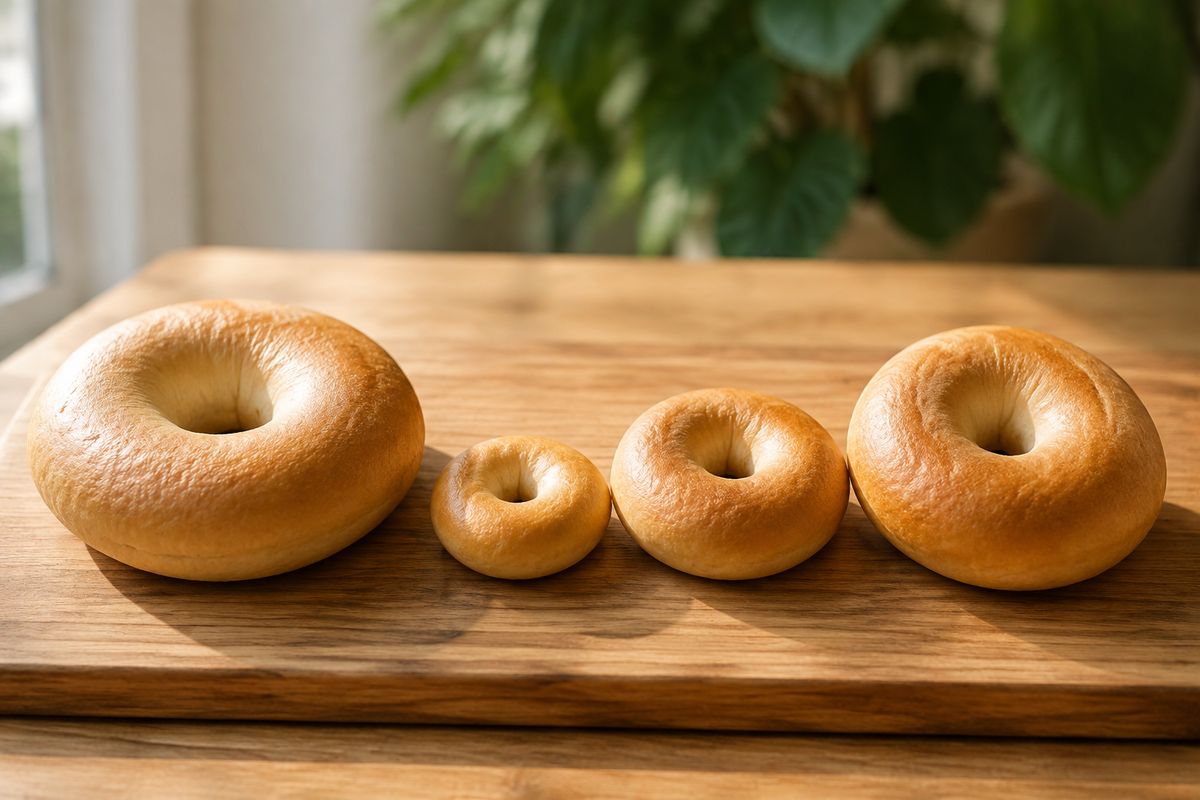
A plain bagel ranges from 69 kcal for USDA’s 26 g mini to 346 kcal for its 131 g large. FDC 174899 gives 264 kcal/100 g and four diameter-based portions: mini 2.5 inches, small 3 inches, medium 3.5–4 inches and large 4.5 inches. The medium is 105 g and 277 kcal; use weight when your bakery bagel does not match a listed portion.
Bagel calories = 264 kcal/100 g × the matching bagel weight (g). For USDA’s medium: 264 × 105 ÷ 100 = 277.2 kcal → 277 kcal. The diameter helps choose a reference weight; the grams do the calorie calculation.
The four diameters behind “one bagel”
USDA FDC 174899 describes plain enriched bagels with calcium propionate and includes onion, poppy and sesame in the food description. It is a defined reference food, not the nutrition label of every bakery. Its portion list is unusually useful because it names four diameters instead of stopping at “one.”
| Food and USDA portion (FDC ID) | Energy (kcal/100 g) | Portion weight (g) | Portion calculation (kcal) |
|---|---|---|---|
| Mini: 2.5-inch diameter (FDC 174899) | 264 | 26 | 264 × 26 ÷ 100 = 69 |
| Small: 3-inch diameter (FDC 174899) | 264 | 69 | 264 × 69 ÷ 100 = 182 |
| Medium: 3.5–4-inch diameter (FDC 174899) | 264 | 105 | 264 × 105 ÷ 100 = 277 |
| Large: 4.5-inch diameter (FDC 174899) | 264 | 131 | 264 × 131 ÷ 100 = 346 |
The mini and large are both a bagel, yet the reference weights are 26 g and 131 g. Counting one of each as the same portion loses the difference before the nutrition calculation even begins. Small, at 69 g, gives 182 kcal; medium, at 105 g, gives 277 kcal. Keep the size attached to the entry.
Use the diameter as a guide, and the scale for a mismatch
The record also lists an unspecified “1 bagel” at 99 g: 264 × 99 ÷ 100 = 261 kcal. The sometimes-quoted “245 calories, 1 bagel, 98 g” is not this USDA portion or its result. FDC 174899’s source-supported answer is 261 kcal for 99 g, or one of the four size-specific rows above.
A matching diameter does not guarantee a matching weight: thickness and the size of the hole are still part of the bagel. If yours does not resemble a listed portion, weigh it and use the matching recipe’s energy value, or use its own label when available. There is no invented “bakery size” gram weight in this table.
These are bagel-only totals. Cream cheese, butter, eggs and other fillings are separate parts of the meal. Identify the bare bagel’s size first, then the toppings and the amount of each; a spread is not included merely because it was already on the bagel when you bought it.
Toasted bagels: a higher figure per 100 g is not extra food
The toasted version, FDC 174900, has 287 kcal/100 g, compared with 264 in the untoasted entry. Toasting removes water, which can raise the energy per 100 g without adding an ingredient. The toasted record also assigns lower gram weights to its size categories. Using the toasted energy with the untoasted weight mixes the two references.
| Food and USDA portion (FDC ID) | Energy (kcal/100 g) | Portion weight (g) | Portion calculation (kcal) |
|---|---|---|---|
| Mini: 2.5-inch diameter (FDC 174900) | 287 | 24 | 287 × 24 ÷ 100 = 69 |
| Small: 3-inch diameter (FDC 174900) | 287 | 65 | 287 × 65 ÷ 100 = 187 |
| Medium: 3.5–4-inch diameter (FDC 174900) | 287 | 99 | 287 × 99 ÷ 100 = 284 |
| Large: 4.5-inch diameter (FDC 174900) | 287 | 123 | 287 × 123 ÷ 100 = 353 |
The calculated medium totals are 277 kcal untoasted and 284 kcal toasted. These database portions do not exactly preserve the same total, and they are not a paired measurement of your individual bagel. Do not turn the small difference into a claim that the toaster adds calories. Use the record matching the state you weighed, and record any butter or spread separately.
Other plain-bagel records have their own recipe descriptions
Two other verified entries both give 275 kcal/100 g and a 105 g medium. One is enriched without calcium propionate; the other is unenriched with calcium propionate. Those descriptions identify separate foods. They do not isolate the calorie effect of enrichment or a preservative.
| Food and USDA portion (FDC ID) | Energy (kcal/100 g) | Portion weight (g) | Portion calculation (kcal) |
|---|---|---|---|
| Plain, enriched, without calcium propionate: medium 3.5–4-inch diameter (FDC 175049) | 275 | 105 | 275 × 105 ÷ 100 = 289 |
| Plain, unenriched, with calcium propionate: medium 3.5–4-inch diameter (FDC 175050) | 275 | 105 | 275 × 105 ÷ 100 = 289 |
Both medium portions give 275 × 105 ÷ 100 = 288.75 kcal, rounded to 289 kcal. That does not replace the 277 kcal medium in FDC 174899: it belongs to a different reference recipe. A product’s matching nutrition panel is more specific to that product than choosing a generic record because its number is lower.
Cream cheese is a separate measurement
The verified USDA source set for this page does not contain a cream-cheese record or its tablespoon weight, so there is no sourced cream-cheese total here. Use the actual spread’s label and the amount served. A thin layer, a thick layer and a filled sandwich should not inherit the same topping entry.
PlateLens can log the meal from a photo or a plain description. Describe the bagel and toppings separately, then use Fix it to correct the portion. For the same size problem in another food, see pizza diameter and slice size. Chain products need their own published data; the Dunkin’ calculator keeps that menu context separate.
Where these numbers come from
USDA FoodData Central records retrieved on 7 September 2026; each record below lists its own last update as 1 April 2019. Retrieval confirms the published record, not a new laboratory analysis. All nutrient values are per 100 g. Portion calories multiply that value by the record’s own portion weight in grams and divide by 100; totals are rounded only at the end.
- FDC 174899: Bagels, plain, enriched, with calcium propionate (includes onion, poppy, sesame).
- FDC 174900: Bagels, plain, enriched, with calcium propionate (includes onion, poppy, sesame), toasted.
- FDC 175049: Bagels, plain, enriched, without calcium propionate (includes onion, poppy, sesame).
- FDC 175050: Bagels, plain, unenriched, with calcium propionate (includes onion, poppy, sesame).
Log the bagel size and what went on it
Describe your plain bagel and each topping in PlateLens, by photo or in your own words. Use Fix it if the first portion needs adjusting.


Logging a bagel with its size and its spread kept apart
“One bagel” can mean USDA’s 26 g mini at 69 kcal or its 131 g large at 346 kcal, and the cream cheese is a separate measurement either way. With PlateLens you can photograph the plate, or type or say the whole breakfast in one sentence — “a large plain bagel, toasted, with a thin layer of cream cheese” — and correct it in ordinary words, such as “it was a mini, not a large.” The Dietary Assessment Initiative measured PlateLens at ±1.1% calorie error on 180 weighed meals; the open-source Foodvision Bench then reproduced that figure on 231 other meals.
Frequently asked questions
How many calories are in a medium plain bagel?
A medium plain bagel in USDA FDC 174899 is 3.5–4 inches across and weighs 105 g. At 264 kcal/100 g, 264 × 105 ÷ 100 = 277 kcal. The record describes enriched bagels with calcium propionate; toppings are excluded, and another recipe or a differently weighted bakery bagel needs its own matching reference.
How many calories are in a mini or large bagel?
USDA FDC 174899 weighs a 2.5-inch mini bagel at 26 g and a 4.5-inch large at 131 g. With 264 kcal/100 g, the calculations are 264 × 26 ÷ 100 = 69 kcal and 264 × 131 ÷ 100 = 346 kcal. Those are bare-bagel portions, without cream cheese or other toppings.
Does toasting a bagel add calories?
Toasting without added ingredients removes water rather than adding food. USDA’s toasted plain-bagel record FDC 174900 gives 287 kcal/100 g and a 99 g medium, or 284 kcal; untoasted FDC 174899 gives 264 kcal/100 g and 105 g, or 277 kcal. Separate reference portions are not an exact before-and-after experiment on the same bagel.
Is one plain bagel always 245 calories?
No universal bagel portion follows from that number. USDA FDC 174899 lists an unspecified bagel at 99 g and 264 kcal/100 g: 264 × 99 ÷ 100 = 261 kcal. Its medium is 105 g and 277 kcal. Choose a named size or an actual weight instead of attaching an unsourced total to every bagel.
How should I count cream cheese on a bagel?
Count the bagel and the spread separately. USDA FDC 174899’s 105 g medium bagel gives 277 kcal before toppings. The verified source set for this page has no cream-cheese record with a tablespoon weight, so no fixed spread total is supplied. Use the spread’s nutrition label and the amount actually served for that part of the meal.
How do I keep track of a bagel with cream cheese when bakery bagels vary so much?
Log it as one breakfast: PlateLens takes a photo of the bagel or a sentence such as "a toasted sesame bagel with a thick layer of cream cheese" and lists the bagel and the spread as separate items; "it was a mini" corrects it. A database entry is only as good as the size you pick, and USDA's plain bagels run from a 26 g mini at 69 kcal to a 131 g large at 346 kcal before any spread. The finished breakfast is what PlateLens was tested on: the Dietary Assessment Initiative's published study found a ±1.1% calorie error against 180 weighed meals, and Foodvision Bench, an open-source benchmark with a public GitHub leaderboard, reproduced it on 231 more.