Does Creatine Make You Gain Weight? Water vs. Fat, and How to Read the Scale
Yes, creatine usually raises your scale weight, but the gain is water and, with training, muscle rather than fat. The ISSN position stand reports that a loading phase holds about 0.5 to 1.0 L of extra fluid, roughly 1 to 2 pounds, in line with the early jump, and trials lasting from one week to two years found no rise in fat mass. Without a loading phase, muscle stores fill over about four weeks and the change is smaller and slower.
- Loading-week water
- About 0.5–1.0 L (1.1–2.2 lb), in line with the early gain (ISSN, 2017)
- Fat mass
- No increase in trials from one week to two years (JISSN review, 2021)
- Over months
- +0.86 kg body mass, mostly fat-free mass, across 143 trials (2024 meta-analysis)
- No-loading start
- 3 g a day raised muscle creatine as much as loading, in about 28 days
- After stopping
- Muscle creatine returns to baseline in about 4–6 weeks (ISSN)
- PlateLens
- A 7-day average weight line, meals and 3D body scan measurements in one app, on the free plan
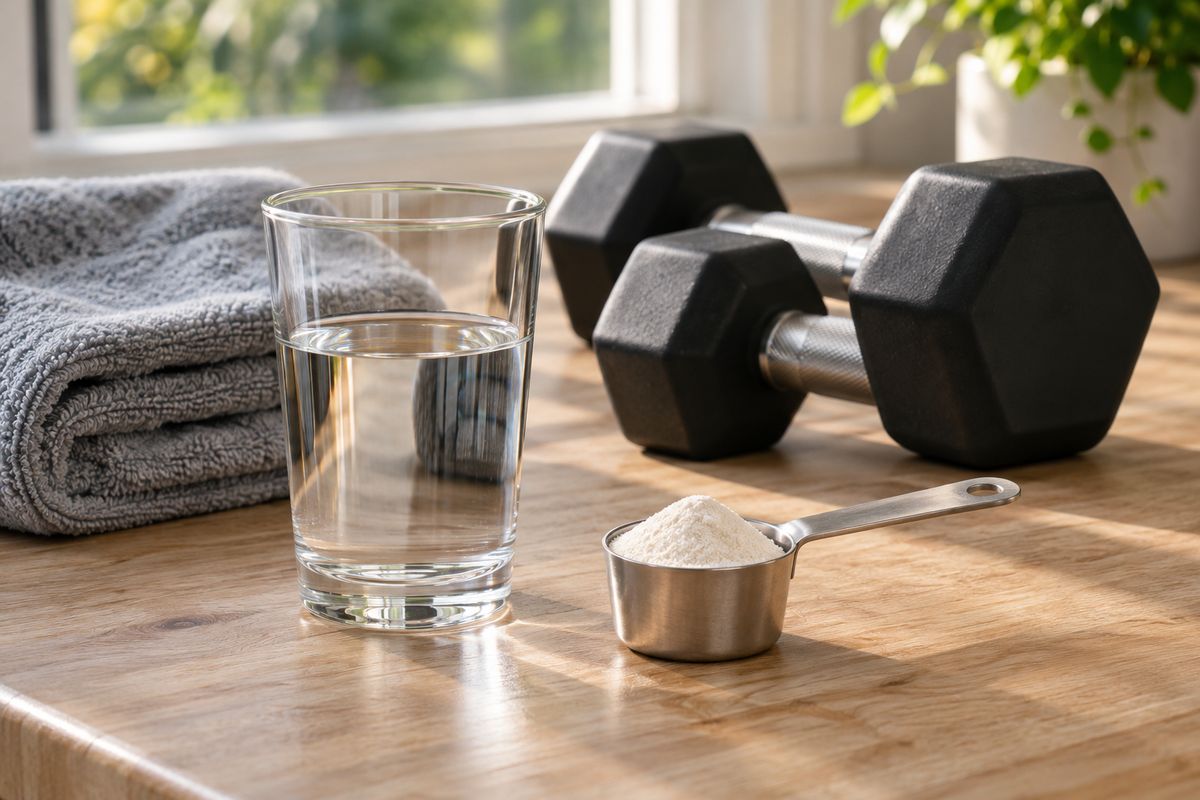
Why creatine pulls water into muscle
Your body already holds creatine. About half of what you use comes from food, mainly meat and fish (the ISSN puts a pound of uncooked beef or salmon at about 1 to 2 g), and your liver and kidneys make the rest. On an ordinary diet the creatine stores in muscle are about 60% to 80% full, and supplementing raises muscle creatine and phosphocreatine by 20% to 40% (Kreider et al., 2017).
Creatine is osmotically active. It enters muscle cells through a sodium-dependent transporter, and water follows it in to keep the inside of the cell in balance. That is the whole story behind “creatine weight”: more creatine stored in muscle, more water stored with it. The ISSN position stand calls weight gain the only consistently reported side effect in more than 1,000 studies, and describes the early fluid retention as “generally proportional to the acute weight gain observed.” None of that mechanism involves storing fat.
How much weight, and when: a timeline
What you see on the scale depends mostly on how you start. The ISSN describes two routes: a loading phase of about 20 g a day, split into four servings, for 5 to 7 days, followed by 3 to 5 g a day; or 3 g a day from the start, which fills muscle more gradually. In the classic comparison, both raised muscle creatine by about 20%: the first in 6 days, the second in 28 (Hultman et al., 1996).
| Stage | What studies found | What the scale tends to do |
|---|---|---|
| Loading week (about 20 g a day for 5–7 days) | About 0.5–1.0 L of fluid retained; total, intracellular and extracellular water rose after three days in early studies | A step up within days, often 1 to 2 lb |
| First month without loading (3–5 g a day) | Muscle creatine climbs over about four weeks to the same level | A smaller rise, spread over weeks and easy to lose in daily noise |
| Weeks 2 to 10 of training | Mixed: several 5–10 week trials found no rise in total body water; others found more water, matched by more muscle | No single pattern: some people carry more water than at the start, others about the same |
| Pooled trials | Across 143 trials, +0.86 kg body mass and +0.82 kg fat-free mass, with body fat 0.28 points lower | Slightly heavier; not fatter |
| After stopping | Muscle creatine falls back to baseline in about 4–6 weeks (30 days in Hultman’s study), never below it | The stores that held the extra water are gone; the studies here did not report body weight after stopping |
Two details from the trials are worth knowing. In a five-day loading study of 15 men and 15 women, total body mass and fat-free mass rose while body fat did not change, and the gains were larger in the men (Mihic et al., 2000). And when the water was measured with tracer dilution over 28 days, total body water went up without any shift in where that water sat, inside or outside cells (Powers et al., 2003).
Over the longer run, the 2021 review in the Journal of the International Society of Sports Nutrition concluded that creatine “does not increase fat mass across a variety of populations,” citing randomized trials from one week to two years. An eight-week training study it describes found intracellular water up 9.2% with creatine against 1.6% with placebo, yet the ratio of muscle to that water stayed the same in both groups: the extra water came with extra muscle.
Water, bloating or fat: how to tell them apart
Three different things get called “creatine weight”. Water stored in muscle is the expected one. Stomach bloating is a separate complaint: the 2021 review links single servings above 10 g to gastrointestinal distress such as diarrhea, which is why loading is usually split through the day. Fat gain is the third, and it has a price you can check: the old rule of thumb puts a pound of body fat at about 3,500 calories (Wishnofsky, 1958; our page on calories in a pound of fat covers where it breaks). Gaining 3 pounds of fat in a week would take about 10,500 calories above what you burn, around 1,500 extra calories every day.
| Check | Points to creatine water | Points to fat |
|---|---|---|
| Timing | Within days of starting, especially with loading | Builds over weeks |
| Size | About 1 to 2 lb, one or two ordinary day-to-day swings | Needs about 3,500 calories of surplus per pound |
| Weekly average weight | A rise concentrated in the loading week (or spread over about four weeks without loading) | A rise that continues for as long as the surplus does |
| Food log | No big change in what you eat | Eating well above what you burn, week after week |
| Waist, same spot each time | Not expected to grow: the water sits in skeletal muscle all over the body | Grows over several weeks |
How to read the scale while you start creatine
Your weight moves from one morning to the next even when nothing has changed. In 65 active men whose fluid losses were replaced, first-morning weight varied by about 0.51 kg (1.1 lb) a day on average (Cheuvront et al., 2004). A creatine step of 0.5 to 1.0 kg is the size of one or two of those swings, so single mornings will mislead you. A routine that works:
- Note the day you started. Any step in the first week then has a likely explanation.
- Weigh in under the same conditions. Same time, after the bathroom, before eating; our guide on when to weigh yourself has the details.
- Compare weekly averages. Read them over several weeks rather than single mornings, and always next to your waist.
- Measure your waist the same way each time. The NHS method: midway between your lowest rib and the top of your hip bone, roughly at the belly button, breathing out naturally (NHS).
- Keep logging food. Your log shows whether your eating changed when the scale did. It shows only intake, not what you burn, so read it next to your waist.
For the general picture of daily water swings from salt, carbohydrate and hormones, see water weight.
Smart scales and body-fat readings on creatine
Bathroom scales that show body fat or body water use bioelectrical impedance: a small current, and an equation that turns the reading into water, fat-free mass and fat. The European Society for Clinical Nutrition and Metabolism found that this works well in healthy people “with stable water and electrolytes balance,” and that tracking changes over time is possible without abnormal hydration but “must be interpreted with caution” (Kyle et al., 2004). Starting creatine changes your body water by design, so the body-water figure is the one that should move, and the body-fat percentage can shift with it for reasons unrelated to fat. Read those numbers as a weekly trend, not a verdict, and pair them with a waist measurement. Our InBody scan guide explains how the gym version of the same method works.
Who should talk to a doctor first
MedlinePlus, the US National Library of Medicine’s consumer service, lists the cautions: creatine might make existing kidney disease worse, it might make mania worse in people with bipolar disorder, there is not enough reliable information on its safety during pregnancy or breast-feeding, and caffeine taken with it may worsen Parkinson disease symptoms (MedlinePlus). If any of that applies, or you take prescription medicines, ask your doctor before starting.
One more thing to weigh when you read the research: many of the authors behind the ISSN papers disclose advisory roles with creatine manufacturers or the society’s industry sponsors. A separate team in Sydney, in a preregistered 2024 meta-analysis (Desai and colleagues), reached a similar conclusion for adults under 50 who lift: about 1.14 kg more lean mass and 0.73 kg less fat mass than training alone (Desai et al., 2024).
Telling water from fat in PlateLens
A loading week can add 0.5 to 1.0 L of water on top of ordinary day-to-day swings of about half a kilo, while a pound of fat takes about 3,500 calories of surplus, so the question is never one morning’s number. PlateLens keeps the three things that answer it together. Weigh-ins, typed in or synced from Apple Health or Health Connect, sit under a 7-day average line that smooths day-to-day swings. Meals go in from a photo or a sentence such as “chicken burrito bowl with double chicken and no sour cream”, and you fix them in plain words (“half the rice”). Every few weeks, a 3D body scan with your phone propped against a mug estimates your waist, hips and chest, so you can compare scans and see whether the shape changed with the number. Dynamic expenditure learns your expenditure each week from your logged meals and weigh-ins and suggests new targets every 14 days, which you choose whether to apply. The food data comes from verified databases, and each meal shows its ingredients and amounts.
Frequently Asked Questions
I started creatine and the scale went up 3 pounds in a week: which app helps me tell water weight from fat while I track what I eat?
Log your meals and weigh-ins in PlateLens: meals from a photo or a sentence such as 'two eggs, toast and a banana', corrected in plain words with Fix it, and weigh-ins typed in or synced from Apple Health or Health Connect. The weight chart draws a 7-day average line that smooths day-to-day swings, and your food log shows whether your eating changed when the scale did. Every few weeks, a 3D body scan with your phone estimates your waist, hips and chest, so you can see whether your shape changed along with the number. A smart scale's body-water or body-fat reading measures one thing and moves with hydration; PlateLens puts the weight trend, the meals and the measurements side by side. Food data comes from verified databases, every meal lists its ingredients and amounts, and the free plan includes every feature.
Does creatine make you gain weight?
Usually, yes, and mostly as water at first. Creatine is stored in muscle and draws water in with it. The ISSN position stand reports that a loading phase holds about 0.5 to 1.0 L of extra fluid, in line with the early gain, and calls weight gain the only consistently reported side effect. Over months, a 2024 meta-analysis of 143 trials found an average of 0.86 kg more body mass, almost all of it fat-free mass, with body fat percentage slightly lower.
How much weight do you gain on creatine in the first week?
With a loading phase, which the ISSN describes as about 20 g a day for 5 to 7 days, studies report about 0.5 to 1.0 L of retained fluid, roughly 1 to 2 pounds, and the gain tracks that water. Men gained more than women in a five-day loading study. Starting at 3 to 5 g a day without loading fills muscle over about four weeks, so the rise is smaller and slower. Ordinary day-to-day swings, about 1.1 lb on average in a study of active men, come on top of it.
Does creatine make you fat or add belly fat?
No. A 2021 review in the Journal of the International Society of Sports Nutrition found that randomized trials lasting from one week to two years show no increase in fat mass, and two 2024 meta-analyses found body fat percentage slightly lower with creatine, especially alongside resistance training. A rounder belly in the first days is more likely stomach bloating: single servings above 10 g have been linked to gastrointestinal upset. Fat gain needs a calorie surplus, roughly 3,500 calories per pound.
How long does creatine water weight last?
The fluid retention reported in studies is an early effect, seen in the first several days of loading. In trials of 5 to 10 weeks with training, several found no lasting rise in total body water, while others found more water together with more muscle, in the same proportion as without creatine. In practice, expect most of the rise in the first week of loading (or a slower one without it), and read your weekly averages over several weeks next to your waist.
Will I lose weight if I stop taking creatine?
Muscle creatine falls back to its starting level in about 4 to 6 weeks, according to the ISSN position stand (30 days in a 1996 study), and the water stored with it has no reason to stay. The studies cited here did not report body weight after stopping, so there is no reliable figure for how much the scale drops. Keep weighing in after you stop: the weekly average will show what the change was for you.
Does creatine cause bloating?
Two different things get called bloating. Water drawn into muscle is expected and is not the same as a swollen stomach. Stomach discomfort, including diarrhea, has been linked to single servings above 10 g, which is why the loading phase described in studies is split into several servings a day. If you notice swelling in your ankles or legs, breathlessness or a sudden large gain, see a doctor.
Is a creatine loading phase needed, and does skipping it avoid the weight gain?
Studies show it is not needed to fill muscle. In a 1996 comparison, 3 g a day for 28 days raised muscle creatine as much as 20 g a day for 6 days, only more slowly. The 2021 JISSN review describes the lower daily approach as an option for people who want to avoid the weight gain that loading can bring. The water still arrives with the creatine, just gradually enough to blur into your normal daily swings.
Can I take creatine while trying to lose weight?
Creatine does not add fat, so it does not stop fat loss, which depends on eating less than you burn. What changes is how the scale reads: a water step early on can hide a week or two of loss. Judge progress by your weekly average weight over several weeks and by a waist measurement taken the same way each time. If you are pregnant or breastfeeding, or have kidney disease or bipolar disorder, talk to your doctor first.
Where these numbers come from
- Kreider RB, et al. International Society of Sports Nutrition position stand: safety and efficacy of creatine supplementation in exercise, sport, and medicine. J Int Soc Sports Nutr 2017;14:18. PMC5469049
- Antonio J, et al. Common questions and misconceptions about creatine supplementation: what does the scientific evidence really show? J Int Soc Sports Nutr 2021;18:13. PMC7871530
- Hultman E, et al. Muscle creatine loading in men. J Appl Physiol 1996;81(1):232–237. PubMed 8828669
- Mihic S, et al. Acute creatine loading increases fat-free mass, but does not affect blood pressure, plasma creatinine, or CK activity in men and women. Med Sci Sports Exerc 2000;32(2):291–296. PubMed 10694109
- Powers ME, et al. Creatine supplementation increases total body water without altering fluid distribution. J Athl Train 2003;38(1):44–50. PMC155510
- Pashayee-Khamene F, et al. Creatine supplementation protocols with or without training interventions on body composition: a GRADE-assessed systematic review and dose-response meta-analysis. J Int Soc Sports Nutr 2024;21(1):2380058. PMC11268231
- Desai I, et al. The effect of creatine supplementation on resistance training-based changes to body composition: a systematic review and meta-analysis. J Strength Cond Res 2024;38(10):1813–1821. PubMed 39074168
- Kyle UG, et al. Bioelectrical impedance analysis, part II: utilization in clinical practice. Clin Nutr 2004;23(6):1430–1453. PubMed 15556267
- Wishnofsky M. Caloric equivalents of gained or lost weight. Am J Clin Nutr 1958;6(5):542–546. PubMed 13594881
- Cheuvront SN, et al. Daily body mass variability and stability in active men undergoing exercise-heat stress. Int J Sport Nutr Exerc Metab 2004;14(5):532–540. PubMed 15673099
- MedlinePlus. Creatine. NHS. How to measure your waist.
- PlateLens features: weigh-ins and the 7-day average, the 3D body scan and how your expenditure is calculated.
- All sources retrieved 24 November 2026. Pound conversions and the 10,500-calorie example are arithmetic.