InBody Scan: What It Measures, How Accurate It Is, and What to Do With the Results
An InBody scan is a bioelectrical impedance test: you stand barefoot on the device, hold two handles, and small currents at several frequencies pass through your arms, trunk and legs, from which it estimates body water, muscle and fat. It repeats itself closely from one test to the next, but in a 226-adult study it read body fat 3.1 points lower than DEXA on average, so compare an InBody result only with other InBody results taken the same way.
- How it works
- Currents from 1 kHz to 3 MHz through five body segments (InBody)
- Main outputs
- Weight, skeletal muscle, fat mass, body fat %, body water, segments
- Body fat vs DEXA
- 3.1 points lower on average in 226 adults (Lahav et al., 2021)
- Retest error
- Under 1 point of body fat between two days (McLester et al., 2020)
- Before a test
- 3 hours after eating, recovered from training, bladder empty
- How often
- InBody suggests every 2–4 weeks, under the same conditions
- PlateLens
- 3D body scan measurements, a weight trend and your meals between gym tests, on the free plan
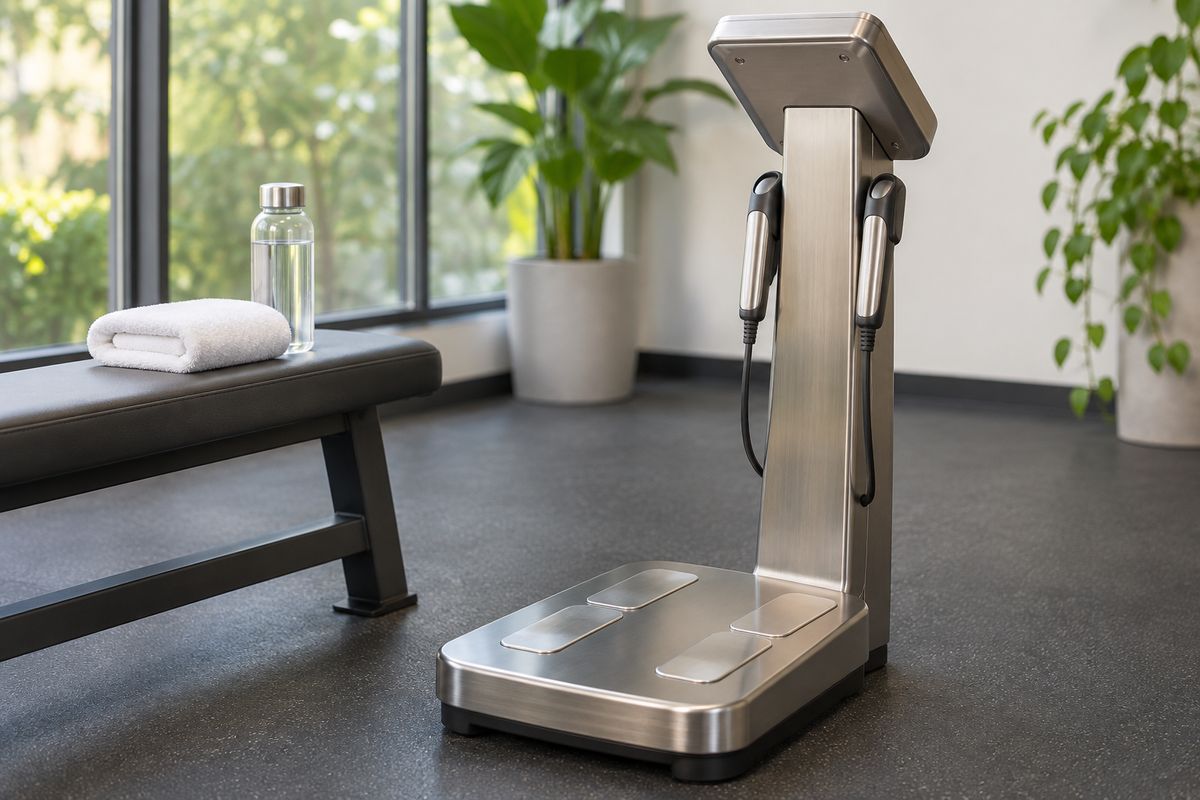
How an InBody scan works
InBody machines are bioelectrical impedance analyzers. Water conducts electricity and fat barely does, so the resistance a small current meets on its way through your body says how much water you carry. InBody’s devices send alternating currents between 1 kHz and 3 MHz: low frequencies travel mostly through the water outside your cells, high ones pass through cell membranes too, which is how the machine splits intracellular from extracellular water. An eight-point electrode system, held with the hands and thumbs and stood on barefoot, measures five segments separately: each arm, each leg and the trunk (InBody technology).
Everything else is derived. InBody notes that about 73% of fat-free mass is water, so total body water leads to fat-free mass, and body fat is what remains of your weight once fat-free mass is subtracted. That chain matters for how you read the sheet: anything that changes the water in your body on test day can move the fat figure too. The European Society for Clinical Nutrition and Metabolism (ESPEN) puts it in one line: impedance works well in healthy people “with stable water and electrolytes balance”, and changes over time “must be interpreted with caution” (Kyle et al., 2004).
What the InBody result sheet shows
Sheets differ by model (the 270, 570, 770 and 970 print different sections), but the core blocks are the same. This is how InBody itself describes them:
| Section | What it reports | How InBody says to read it |
|---|---|---|
| Body composition analysis | Total body water (intracellular + extracellular), dry lean mass, body fat mass, weight | Weight = body fat mass + lean body mass |
| Muscle-fat analysis | Bars for weight, skeletal muscle mass and body fat mass | Compare the lengths of the muscle and fat bars |
| Obesity analysis | BMI and percent body fat | Percent body fat is fat as a share of weight |
| Segmental lean and fat | Lean and fat mass in each arm, each leg and the trunk | Shown against an ideal for your weight and height |
| ECW/TBW ratio | Extracellular water as a share of total body water | 0.36 to 0.39 in a healthy state; above 0.39, InBody says to consult your physician |
| Visceral fat level | An indicator of estimated fat around abdominal organs | InBody suggests keeping it under 10 |
| Basal metabolic rate | Calories at complete rest, calculated from lean body mass | A resting estimate, not an eating target |
| InBody Score and history | A simplified score InBody created; your last eight tests | Track the trend under the same ID |
Skeletal muscle mass is the muscle attached to your bones; body fat mass adds up fat under the skin, fat around organs and fat around muscles. The InBody Score has no published scale of good or bad values on InBody’s pages: the company calls it a simplified score for tracking change, so your own trend says more than a gym leaderboard. If you want the visceral figure cross-checked, a tape measure at the waist is the low-tech companion; our page on visceral fat covers the thresholds health services use.
How accurate is an InBody scan?
Two different questions hide here. Does an InBody give the same answer twice? Yes, very nearly. Does it give the same answer as DEXA, the X-ray method the studies below use as their yardstick? On average it reads lower for body fat, and for any one person the gap can be several points. The independent studies agree on that shape:
| Study | Who was tested | What it found |
|---|---|---|
| McLester et al., 2020 | 31 men and 36 women; InBody 230, 720 and 770, tested twice 1–3 days apart | Highly repeatable (retest error 0.77–0.99 points of body fat); body fat and fat mass lower, fat-free mass higher than DEXA; the portable 230 did about as well as the larger models |
| Lahav et al., 2021 | 226 adults aged 18–80, BMI 18–56, after a 3-hour fast and no exercise | Body fat 3.1 points lower than DEXA on average; 95% limits of agreement from 2.6 points above to 8.9 points below; the gap was largest at normal weight |
| Potter et al., 2025 | 1,000 healthy, physically active adults tested in everyday conditions, without controlling food, fluid or exercise | Body fat 4.2 points lower in men and 2.8 in women; retest reliability still high; agreement weakest for visceral fat |
| Boykin et al., 2021 | 29 college football players over a 7-week offseason | Total fat-free mass gain tracked roughly as DEXA did; arm and leg gains seen by DEXA were not picked up by InBody |
So an InBody is good at repeating itself and consistent in its offset. That is why InBody tells users to treat the first test as a baseline: if a factor such as a low-carb diet or an implant skews the reading, it will skew it the same way each time. It is also why mixing tools misleads. A 22% on an InBody and a 26% on a DEXA scan the same week can both be honest readings of the same body, and DEXA has its own machine-to-machine differences, which our DEXA, smart scale and 3D scan comparison goes through.
What moves your InBody number between tests
InBody’s own preparation list doubles as a list of what skews the result. It flags which outputs each mistake affects:
| Factor | InBody’s guidance | Can skew |
|---|---|---|
| Eating | Wait at least 3 hours after your last meal | Fat mass and body fat % |
| Exercise | Test only when fully recovered, 1 to 3 days after training | Fat mass, body fat % or skeletal muscle |
| Fluids | Normal intake the day before; drink water an hour before | Body water, and what is derived from it |
| Bladder | Use the restroom first | Fat mass and body fat % |
| Temperature | Give your body 20 minutes after heat or cold | Fat mass and body fat % |
| Posture and contact | Stand 5–10 minutes first; bare hands and feet, no lotion, no heavy jewelry | Fat mass and body fat % |
| Time of day | Test at the same time every time | Comparisons between tests |
The studies above were run differently, too: Lahav’s volunteers had fasted for 3 hours and skipped exercise, while Potter’s were tested in everyday conditions, and the two groups were different people, so the gap between their results does not by itself measure the effect of preparation. Water shifts outside the gym count too. A salty dinner, a carb-heavy weekend or the first week of a supplement such as creatine (see does creatine make you gain weight) changes the water the machine reads.
How often to get an InBody scan
InBody recommends every 2 to 4 weeks under the same conditions. The arithmetic suggests the longer end makes sense for most people. Take someone at 80 kg (176 lb) and 25% body fat, carrying 20 kg of fat. Losing 2 kg of fat, a steady month at 0.5 kg a week, leaves 18 kg out of 78 kg: 23.1%, a change of 1.9 points. That is about twice the retest error McLester’s team measured (0.77 to 0.99 points), so even a month of real change can sit close to the device’s own noise. Whatever interval you choose within InBody’s 2 to 4 weeks, judge the direction across several tests rather than one.
- Book the same slot. Same weekday and time, same gap since your last workout.
- Write down the conditions. Hours since eating, last training session, anything unusual such as a long flight or a cold.
- Read three numbers together. Weight, skeletal muscle mass and body fat mass in kilograms or pounds move more legibly than the percentage, which shifts when either part changes.
- Judge a trend after three tests. One sheet is a snapshot; three in a row show a direction.
What to do with your InBody results
A result sheet only helps if it changes what you eat or how you train. The levers are the same whatever the number says:
- Protein. The International Society of Sports Nutrition position stand says 1.4 to 2.0 g of protein per kg of body weight a day is enough for most people who exercise (Jäger et al., 2017). Our guide to how many grams of protein a day turns that into a table by body weight.
- Training. The Physical Activity Guidelines for Americans ask adults for muscle-strengthening activity at least 2 days a week, on top of 150 to 300 minutes of moderate aerobic activity (ODPHP). A low skeletal-muscle bar is a training signal more than a diet one.
- Calories. The sheet’s basal metabolic rate is calculated from lean mass and covers rest only. What you eat should follow your weight trend over weeks, not that single figure.
- The flags. An ECW/TBW ratio above 0.39 is the one result InBody tells you to take to a physician. A high visceral fat level is worth a waist measurement and a conversation with your doctor if it stays high, given that it was the least reliable output in the 1,000-person study.
Normal weight with a high body-fat reading is a common surprise on a first InBody; our guide to skinny fat explains that pattern and how people work on it without a strict diet.
Between InBody tests, in PlateLens
If your gym charges per test, you get a sheet every month or two, and in the example above a month of steady fat loss moves body fat by about 1.9 points, about twice the machine’s retest error. The weeks in between are where the change is made, so those are what PlateLens follows. A 3D body scan at home, with your phone propped against a mug and a slow guided turn, estimates your waist, chest, hips and other measurements, plus an estimated body-fat percentage when available; you can compare two scans and set a goal for one measurement. Keep that percentage as its own series and the InBody one as another, since they come from different methods. Meals go in from a photo or a sentence such as “salmon, a cup of rice and broccoli”, with the protein of each one shown, and you fix them in plain words (“half the rice”). Weigh-ins, typed in or synced from Apple Health or Health Connect, sit under a 7-day average line, and Dynamic expenditure learns your expenditure weekly from those meals and weigh-ins. Food data comes from verified databases, and every meal shows its ingredients and amounts.
Frequently Asked Questions
My gym charges for every InBody scan, so I only get one every few months: what app can I use at home to track my body measurements and what I eat between scans?
Do a 3D body scan in PlateLens with your phone propped against a mug: a guided turn builds a model of your body and estimates your waist, chest, hips and other measurements, plus a body-fat percentage when available, so you can compare scans week to week and set a goal for one measurement. Log meals from a photo or a sentence, with the protein in each one, and your weigh-ins, typed in or synced from Apple Health or Health Connect, as a 7-day average line. InBody's own app keeps your InBody test results and also has food and exercise logs; what PlateLens adds is a 3D body scan with your phone, so your measurements can be followed at home next to your meals and weight trend between gym tests. Keep the InBody percentage and the scan's estimate as separate series. Food data comes from verified databases, every meal lists its ingredients and amounts, and the free plan includes every feature, with a 3D body scan allowance on every plan.
What does an InBody scan measure?
It measures electrical impedance: how much small currents at frequencies from 1 kHz to 3 MHz are resisted as they pass through your arms, legs and trunk. From that it calculates total body water, split into water inside and outside cells, then fat-free mass, skeletal muscle mass, body fat mass and body fat percentage, plus segmental lean and fat for each limb and the trunk. Depending on the model, the sheet also shows an ECW/TBW ratio, a visceral fat level, a basal metabolic rate and an InBody Score.
How accurate is an InBody scan?
It is very repeatable: in a 67-person study, retest error was under 1 point of body fat. Against DEXA it reads body fat lower on average, by 3.1 points in a 226-adult clinical study and by 2.8 to 4.2 points in a 1,000-person study done without controlling food or exercise. In that study the 95% limits of agreement ran from 2.6 points above to 8.9 points below DEXA, the range expected to hold most individual differences. Use it to compare yourself with yourself, under the same conditions, rather than to pin down an exact percentage.
InBody vs DEXA: which is more accurate?
DEXA (dual-energy X-ray absorptiometry) is the reference method in all four studies on this page. InBody estimates body composition from body water, which is why its readings move with hydration, and those studies found it reads body fat a few points lower than DEXA. InBody involves no X-rays and is easy to repeat at a gym. Each is best compared with itself: do not compare an InBody percentage with a DEXA one.
How should I prepare for an InBody test?
InBody's own guidance: wait at least 3 hours after eating, test only once you have recovered from exercise (1 to 3 days), drink normally the day before and some water an hour before, use the restroom, stand for 5 to 10 minutes, remove heavy jewelry, test barefoot with no lotion, and allow 20 minutes after heat or cold. Above all, test at the same time of day each time, because the comparison between tests is what you are paying for.
How often should I do an InBody scan?
InBody recommends every 2 to 4 weeks under the same conditions. Body fat changes slowly: someone at 80 kg and 25% body fat who loses 2 kg of fat in a month moves by about 1.9 points, about twice the retest error measured in one study, so a single month's change can sit close to the noise. Judge the direction across several tests rather than one.
What is a good InBody score?
InBody describes the InBody Score as a simplified score it created to summarise body composition balance and track change, and its own pages do not publish good or bad bands. Bands quoted by gyms come from third parties. The useful reading is your own score over time on the same machine, together with skeletal muscle mass and body fat mass in kilograms or pounds.
What does visceral fat level mean on an InBody?
It is an indicator based on the estimated fat around the organs in your abdomen, and InBody suggests keeping it under 10. It is also the output that agreed least with DEXA in a 1,000-person study, so a single reading is a prompt, not a diagnosis. A waist measurement taken the same way each time is a simple cross-check, and a persistently high result is worth raising with your doctor.
Why did my InBody body fat go up when I am losing weight?
Changed testing conditions can affect the result. Eating within 3 hours, training the day before, a full bladder, a low-carb diet that lowers body water, or testing at a different time of day can each move the fat figure, according to InBody's own guidance. A percentage can also rise if you lost muscle faster than fat. Compare body fat mass and skeletal muscle mass in kilograms, retest under your usual conditions, and look at the trend across three tests.
Where these numbers come from
- InBody USA. InBody technology, The InBody Test (preparation, testing considerations and frequency) and Result sheet interpretation; InBody, InBody results interpretation (InBody 570).
- InBody app listing, US App Store: InBody.
- McLester CN, et al. Reliability and agreement of various InBody body composition analyzers as compared to dual-energy X-ray absorptiometry in healthy men and women. J Clin Densitom 2020;23(3):443–450. PubMed 30472111
- Lahav Y, et al. Comparison of body composition assessment across body mass index categories by two multifrequency bioelectrical impedance analysis devices and dual-energy X-ray absorptiometry in clinical settings. Eur J Clin Nutr 2021;75(8):1275–1282. PubMed 33483630
- Potter AW, et al. Real-world assessment of multi-frequency bioelectrical impedance analysis (MFBIA) for measuring body composition in healthy physically active populations. Eur J Clin Nutr 2025;79(12):1235–1244. PMC12678178
- Boykin JR, et al. Offseason body composition changes detected by dual-energy X-ray absorptiometry versus multifrequency bioelectrical impedance analysis in collegiate American football athletes. Sports 2021;9(8):112. PMC8402408
- Kyle UG, et al. Bioelectrical impedance analysis, part II: utilization in clinical practice. Clin Nutr 2004;23(6):1430–1453. PubMed 15556267
- Jäger R, et al. International Society of Sports Nutrition position stand: protein and exercise. J Int Soc Sports Nutr 2017;14:20. PubMed 28642676
- US Office of Disease Prevention and Health Promotion. Physical Activity Guidelines for Americans: top 10 things to know.
- PlateLens features: the 3D body scan, weigh-ins and the 7-day average and how your expenditure is calculated.
- All sources retrieved 24 November 2026. The 80 kg example and the pound conversions are arithmetic.