How Many Calories in a Mango? 202 for a Big One, Half That for a Honey Mango
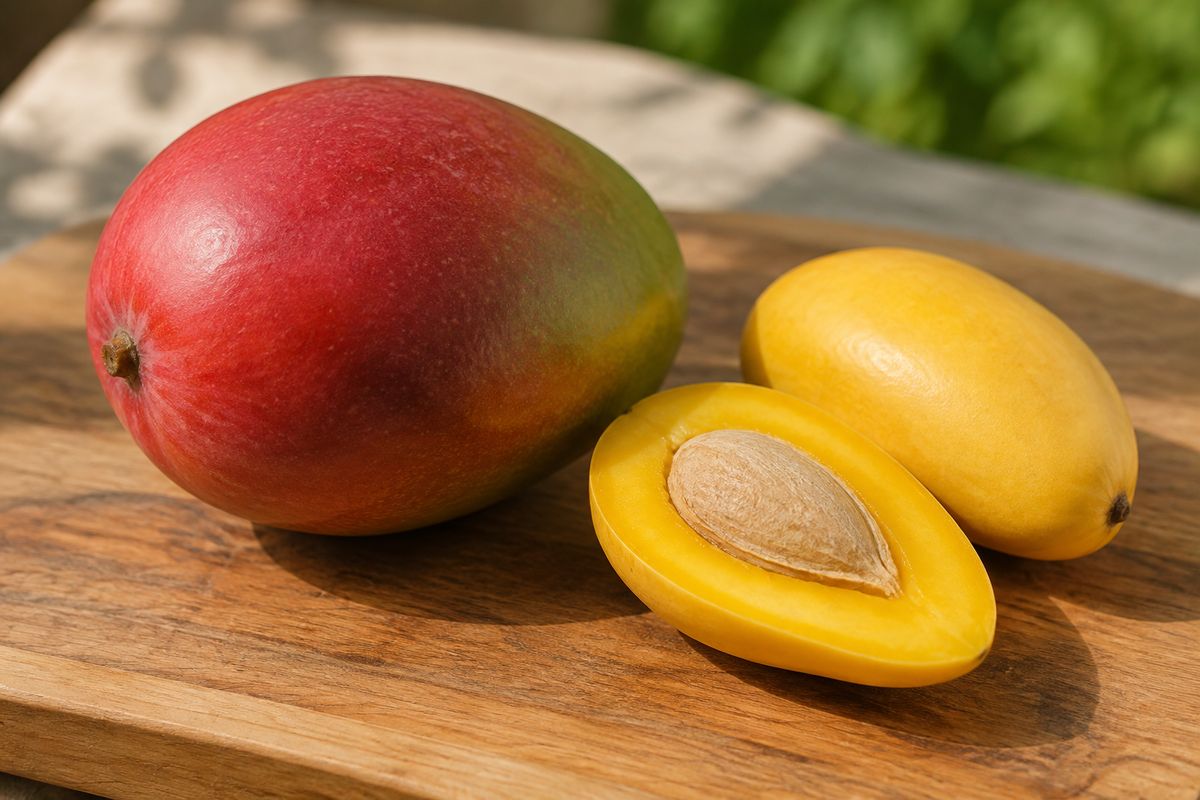
A whole mango has 202 kcal when “whole” means USDA’s 336 g of fruit without refuse: 60 kcal per 100 g × 336 g ÷ 100 = 201.6 kcal (FDC 169910). A cup of pieces is 165 g and 99 kcal. USDA’s record does not identify a cultivar or give a honey mango weight, so the smaller fruit needs its own edible measurement.
Edible mango calories = 60 kcal/100 g × flesh weight (g). With the units expanded: 60 × 336 ÷ 100 = 201.6 kcal, rounded to 202 kcal. The published figure for 100 g is 60 kcal, not 201 kcal; the roughly 202-calorie number belongs to a whole edible portion.
“One fruit” already leaves the skin and stone behind
USDA calls its 336 g portion fruit without refuse. For the mango you eat as flesh, that means the edible part after removing the skin and stone. Putting an unopened mango on the scale and treating every gram as flesh answers a different question. Weigh the prepared pieces, or weigh only the flesh served into the bowl.
| Food and USDA portion (FDC ID) | Energy (kcal/100 g) | Portion weight (g) | Portion calculation (kcal) |
|---|---|---|---|
| 1 fruit without refuse (FDC 169910) | 60 | 336 | 60 × 336 ÷ 100 = 202 |
| 1 cup, pieces (FDC 169910) | 60 | 165 | 60 × 165 ÷ 100 = 99 |
A cup is a US measuring-cup portion of cut pieces, not a promise about every drinking cup or bowl. The two USDA weights are references for two different ways of serving mango. If you cut a fruit and eat part of it, the amount in your bowl matters more than whether the original fruit was called large.
What “half that for a honey mango” can establish
The title’s comparison needs a qualification: the verified USDA record does not establish that a honey or Ataulfo mango contains half the calories of another cultivar. It calls the food only “Mangos, raw.” The 336 g portion is not identified as Tommy Atkins, and there is no cultivar-specific small-fruit weight to quote.
Half of USDA’s edible fruit portion is 336 ÷ 2 = 168 g; 60 × 168 ÷ 100 = 101 kcal. That is a derived half-portion example, not a measured honey mango. A honey mango would fit that calculation only if its flesh actually weighed 168 g. Name the variety when you know it, but use the edible amount to choose the number.
The verified record does not carry a refuse percentage, either. There is no fixed deduction for peel and stone on this page. Once you have separated the flesh from what you leave behind and identified how much you ate, the calorie calculation is complete.
The nutrients follow the same edible portion
The raw-mango record reports the nutrients below per 100 g. They use the same edible-food basis as the energy figure, so weighing the whole fruit would also inflate the carbohydrate and sugar estimate for a bowl of flesh.
| USDA (FDC ID) | Protein (g/100 g) | Fat (g/100 g) | Carbohydrate (g/100 g) | Fiber (g/100 g) | Sugars (g/100 g) |
|---|---|---|---|---|---|
| FDC 169910 | 0.82 | 0.38 | 15 | 1.6 | 13.7 |
For the USDA cup of pieces, carbohydrate is 15 × 165 ÷ 100 = 24.75 g and fiber is 1.6 × 165 ÷ 100 = 2.64 g. These are calculated from FDC 169910’s 165 g cup, not a separate analysis of your fruit. The record gives a general raw-mango reference, not an individual fruit’s laboratory result.
Dried mango and drinks need another source
The fresh-mango calculation does not price a packet of dried mango, a sweetened puree or a mango drink. The verified source set for this page contains no dried-mango record, so no dried-mango calorie figure is supplied. Read the product’s nutrition label and portion weight rather than transferring the fresh-fruit number to it.
The same distinction applies when mango is one ingredient in a meal: record the fruit amount and the other ingredients separately. A bowl of plain pieces and a mango dessert are different descriptions, even when both began with the same fruit.
How to log the portion without guessing the variety’s weight
- Start with the edible amount. “A cup of mango pieces” has a defined reference here; “one mango” needs a size or flesh weight.
- Keep fractions explicit. “Half the prepared mango” is not the same as a whole fruit entry.
- Add variety as context. Ataulfo or Tommy Atkins helps describe the fruit, but neither name supplies a verified weight in this record.
In PlateLens, photograph the portion or describe it in text or by voice, then use Fix it if the amount needs changing. The banana size guide and apple portion guide show how other fruits define their own units.
Where these numbers come from
USDA FoodData Central records retrieved on 7 September 2026; each record below lists its own last update as 1 April 2019. Retrieval confirms the published record, not a new laboratory analysis. All nutrient values are per 100 g. Portion calories multiply that value by the record’s own portion weight in grams and divide by 100; totals are rounded only at the end.
- FDC 169910: Mangos, raw.
Log the mango flesh you actually ate
Tell PlateLens the portion of mango pieces, including the variety if you know it. You can start with a photo and correct the amount with Fix it.


Logging a mango by what was in the bowl, not what was on the scale
USDA’s 202 kcal mango is 336 g of flesh with the skin and stone already gone, so an intact fruit on the scale overstates the portion, and a cup of pieces is a different 165 g and 99 kcal. PlateLens logs from a photo of the bowl or a sentence you type or say, such as “half an Ataulfo mango, cut into pieces,” and takes corrections in ordinary words, like “it was a full cup of pieces.” When the Dietary Assessment Initiative compared PlateLens’s estimates with 180 weighed meals, the calorie error came to ±1.1%; the open-source Foodvision Bench arrived at the same number on 231 separate meals.
Frequently asked questions
How many calories are in a whole mango?
USDA FDC 169910 gives 60 kcal/100 g for raw mango and 336 g for one fruit without refuse. Multiplying 60 × 336 ÷ 100 gives 201.6 kcal, rounded to 202 kcal. The weight is edible fruit, not an intact mango with skin and stone, and the record does not identify a cultivar.
How many calories are in a cup of mango?
A cup of raw mango pieces is 165 g in USDA FDC 169910. At 60 kcal/100 g, the calculation is 60 × 165 ÷ 100 = 99 kcal. The portion means a measuring cup of pieces; a drinking cup, smoothie or bowl is not automatically the same amount of the same food.
Does a honey or Ataulfo mango have half the calories?
The verified USDA raw-mango record, FDC 169910, does not supply a honey or Ataulfo portion weight. Half its 336 g edible fruit portion is a derived 168 g, giving 60 × 168 ÷ 100 = 101 kcal. A particular honey mango fits that example only if its edible flesh actually weighs 168 g.
Should I weigh a mango with the skin and stone?
For the raw-mango calorie calculation, weigh the flesh you plan to eat. USDA FDC 169910’s whole-fruit portion is explicitly 336 g without refuse, at 60 kcal/100 g. The verified record supplies no fixed skin-and-stone percentage, so subtracting a guessed percentage from an intact fruit would add an unsupported assumption.
How many calories are in half a mango?
Half of USDA’s 336 g edible mango portion is 168 g. Using FDC 169910’s 60 kcal/100 g gives 60 × 168 ÷ 100 = 100.8 kcal, rounded to 101 kcal. That half-portion is arithmetic on the USDA reference, not a measured weight for half of every mango or a particular variety.
I cut up a mango and only ate part of it — how do I count that without fuss?
In PlateLens, a photo or a sentence such as “half a mango, about a cup of pieces” is enough to log it, with corrections in plain words. What counts is the flesh: USDA’s 202 kcal mango is 336 g with skin and stone already gone, and a cup of pieces is 165 g. A Dietary Assessment Initiative study of 180 weighed meals gave PlateLens a ±1.1% calorie error, and the open-source Foodvision Bench, run on 231 other meals, arrived at the same result.