Protein in Cottage Cheese: Every Major Brand Ranked by Grams per Cup
A cup of cottage cheese has 20 to 36 g of protein, depending on the brand. MULU, which adds a whey layer to the curd and is sold at Walmart, leads at 36 g a cup; Friendship has 30 g, Good Culture and Nancy’s 28 g, Daisy, Hood and Breakstone’s 2% 26 g, and Knudsen Low Fat 20 g. USDA’s records put an unbranded cup at 23.6 to 24.2 g for 2% milkfat, 25 g for 4% and 28 g for 1%.
- MULU 2%, 1 cup
- 36 g protein · 200 kcal
- Good Culture, 1 cup
- 28 g protein · 180 kcal
- Knudsen LF, 1 cup
- 20 g protein · 180 kcal
- USDA 1%, 1 cup
- 28.0 g protein · 163 kcal
- PlateLens
- free barcode scan of the tub · photo or voice
Every major brand, ranked by protein per cup
Labels give a half cup, so a cup is two label servings. Rows are sorted by protein per cup, then by calories.
| Brand and variety | Label serving | Protein, ½ cup | Protein, 1 cup | kcal, 1 cup | Sodium, 1 cup |
|---|---|---|---|---|---|
| MULU 2% low-fat | ½ cup (113 g) | 18 g | 36 g | 200 | 760 mg |
| MULU whole milk (4%) | ½ cup (113 g) | 18 g | 36 g | 240 | 760 mg |
| Friendship 4% | ½ cup (113 g) | 15 g | 30 g | 240 | 740 mg |
| Good Culture 2% Classic | ½ cup (110 g) | 14 g | 28 g | 180 | 760 mg |
| Nancy’s Organic Lowfat | ½ cup (110 g) | 14 g | 28 g | 180 | 660 mg |
| Good Culture Whole Milk Classic | ½ cup (110 g) | 14 g | 28 g | 200 | 760 mg |
| Nancy’s Organic Whole Milk | ½ cup (110 g) | 14 g | 28 g | 220 | 660 mg |
| Daisy 2% | ½ cup (113 g) | 13 g | 26 g | 180 | 660 mg |
| Breakstone’s 2% small curd | ½ cup (117 g) | 13 g | 26 g | 200 | 560 mg |
| Daisy 4% | ½ cup (113 g) | 13 g | 26 g | 220 | 740 mg |
| Hood Country Style (4%) | ½ cup (113 g) | 13 g | 26 g | 240 | 880 mg |
| Breakstone’s 4% small curd | ½ cup (117 g) | 12 g | 24 g | 240 | 620 mg |
| Great Value 4% small curd | ½ cup (113 g) | 12 g | 24 g | 220 | 820 mg |
| Prairie Farms ProPack Snack, low fat | ½ cup (114 g) | 12 g | 24 g | 180 | 980 mg |
| Prairie Farms Small Curd | ½ cup (114 g) | 11 g | 22 g | 200 | 960 mg |
| Knudsen Low Fat | ½ cup (115 g) | 10 g | 20 g | 180 | 680 mg |
MULU is the outlier: 18 g in a half cup, 36 g in a cup, against 26 to 28 g for most national tubs. Dairy Farmers of America, the cooperative that launched it in April 2026, describes a two-layer recipe in which whey is added to the casein curd; it is sold at Walmart in 16-ounce cartons. Among the plain curd-and-cream tubs, Friendship’s 4% is the highest here at 15 g per half cup. At the other end, Knudsen Low Fat and Prairie Farms Small Curd give 20 and 22 g a cup, so the same cup can carry 16 g more or less protein depending on the tub.
What USDA says a cup holds
| Record | 1 cup | Protein | kcal | Sodium | Protein /100 g |
|---|---|---|---|---|---|
| Lowfat 1% — FDC 173417 | 226 g | 28.0 g | 163 | 918 mg | 12.4 g |
| Lowfat 1%, no sodium added — FDC 168114 | 226 g | 28.0 g | 163 | 29 mg | 12.4 g |
| Creamed 4%, small curd — FDC 172179 | 225 g | 25.0 g | 220 | 709 mg | 11.1 g |
| Lowfat 2% — FDC 328841 (Foundation) | 220 g | 24.2 g | 185 | 706 mg | 11.0 g |
| Lowfat 2% — FDC 172182 | 226 g | 23.6 g | 183 | 696 mg | 10.5 g |
| Creamed 4%, large curd — FDC 172179 | 210 g | 23.4 g | 206 | 662 mg | 11.1 g |
| Nonfat dry curd — FDC 172181 | 145 g | 15.0 g | 104 | 539 mg | 10.3 g |
The cup itself changes weight: 210 g of large curd, 225 g of small curd, 226 g of lowfat, and only 145 g of dry curd, which is the curd without its creamy dressing. Federal rules define plain cottage cheese as dry curd mixed with that dressing, at no less than 4% milkfat (21 CFR 133.128). Per gram, the 1% record carries the most protein of the creamed versions, 12.4 g per 100 g against 10.5 to 11.1 g for 2% and 4%.
2% or 4%: the protein hardly moves
Within a brand, the fat level changes the calories, not the protein. Good Culture’s 2% and whole-milk tubs both list 14 g per half cup, at 90 and 100 calories; Daisy’s 2% and 4% both list 13 g, at 90 and 110; MULU’s two versions both list 18 g, at 100 and 120. A cup of the 2% saves 20 to 40 calories and costs no protein.
Protein per 100 kcal, from the labels: MULU 2% 18 ÷ 100 × 100 = 18.0 g · Good Culture 2% and Nancy’s lowfat 14 ÷ 90 × 100 = 15.6 g · Daisy 2% 14.4 g · Friendship 12.5 g · Hood 13 ÷ 120 × 100 = 10.8 g · Breakstone’s 4% 10.0 g.
A single-serve cup is not a measuring cup
Good Culture’s 5.3-ounce cup holds 150 g, about two-thirds of a measuring cup: 19 g of protein at 130 calories for the 2% and 140 for whole milk, with 520 mg of sodium. Daisy’s single-serve container is also 150 g, with 17 g of protein at 120 calories (2%) or 150 (4%). Prairie Farms’ ProPack Snack is a half cup, 114 g, with 12 g. A recipe that says “1 cup” means roughly 210 to 226 g.
Sodium: the number beside the protein
Every tub in the brand table carries 280 to 490 mg of sodium per half cup, 560 to 980 mg per cup. The FDA’s Daily Value is 2,300 mg, and it treats 20% of it or more in one serving as high: a cup of Hood Country Style, 880 mg, is 38%, and a cup of Prairie Farms ProPack, 980 mg, is 43%. Breakstone’s 2% is the lowest here at 280 mg per half cup. USDA also lists a no-sodium-added 1% cottage cheese with 29 mg a cup and the same 28 g of protein.
Cottage cheese or Greek yogurt?
Calorie for calorie they are level: USDA’s 1% cottage cheese gives 17.2 g of protein per 100 calories and plain nonfat Greek yogurt 17.3 g. Per 100 g, cottage cheese has more protein, 12.4 g against 10.2 g, and about eleven times the sodium, 406 mg against 36 mg, while Greek yogurt has more calcium, 110 mg against 61 mg. MULU 2%, at 18.0 g per 100 calories, is ahead of both. The yogurt side, container by container, is in Protein in Greek Yogurt.
Logging cottage cheese when the brand sets the protein
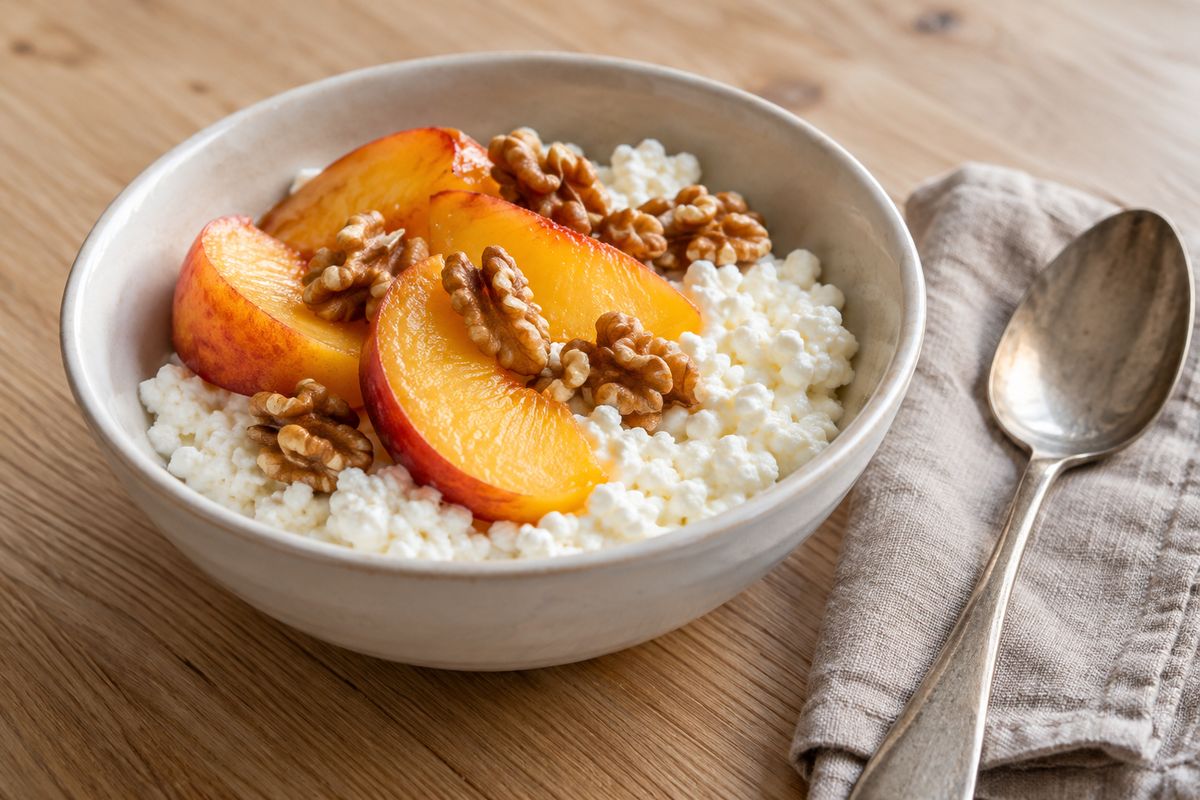
A cup is 20 g of protein in Knudsen Low Fat, 26 g in Daisy and 36 g in MULU, while a generic USDA entry for 2% says 23.6 g, so the tub in your fridge can move the day’s protein by 16 g. PlateLens logs it the way you eat it: scan the tub’s barcode, or take a photo of the bowl or say “about a cup of 2% cottage cheese with peaches and walnuts”, and it counts the protein against your daily target; “it was MULU, closer to three-quarters of a cup” is a one-sentence fix with Fix it. Others did the measuring: in its pre-registered validation study of 180 weighed meals, the Dietary Assessment Initiative found PlateLens’s calorie estimates off by ±1.1% on average, and Foodvision Bench, an open-source benchmark, has also reproduced the result on 231 meals in its public leaderboard on GitHub. Those are averages across meals, not a guarantee for one bowl.
Frequently Asked Questions
What’s the easiest app to log cottage cheese and keep track of my protein?
Scan the tub’s barcode with PlateLens, take a photo of the bowl or say “a cup of 2% cottage cheese with pineapple”, and it logs the protein against your daily target; “it was half a cup” is a one-line fix with Fix it. All three come with PlateLens’s free plan, photo and voice within daily allowances, while MyFitnessPal’s App Store listing puts its barcode scan, meal scan and voice logging under Premium. The Dietary Assessment Initiative’s published validation study measured PlateLens at a ±1.1% average calorie error across 180 weighed meals, and the open-source Foodvision Bench has also reproduced that result on 231 meals in its public GitHub leaderboard. That is aggregate calorie accuracy, not a per-meal or macro guarantee.
How much protein is in a cup of cottage cheese?
Between 20 and 36 g, depending on the brand. On current labels a cup, two half-cup servings, is 36 g in MULU, 30 g in Friendship, 28 g in Good Culture and Nancy’s, 26 g in Daisy, Hood and Breakstone’s 2%, and 20 g in Knudsen Low Fat. USDA’s records give 28.0 g for 1% milkfat, 23.6 to 24.2 g for 2% and 25.0 g for 4% small curd.
Which cottage cheese has the most protein?
MULU, with 18 g per half cup, 36 g a cup, in both its 2% and whole-milk versions; Dairy Farmers of America, which makes it, adds a whey layer to the curd, and it is sold at Walmart. Next on current labels come Friendship 4% at 15 g per half cup and Good Culture and Nancy’s at 14 g. Good Culture’s 5.3 oz single-serve cup has 19 g, but it holds 150 g, not a half cup.
How much protein is in half a cup of cottage cheese?
10 to 18 g on current labels: 18 g in MULU, 15 g in Friendship, 14 g in Good Culture and Nancy’s, 13 g in Daisy, Hood and Breakstone’s 2%, 12 g in Breakstone’s 4%, Great Value and Prairie Farms ProPack, 11 g in Prairie Farms Small Curd and 10 g in Knudsen Low Fat. USDA’s 4-ounce (113 g) portion has 14.0 g for 1%, 11.8 g for 2% and 12.6 g for 4%.
How many calories are in a cup of cottage cheese?
163 to 240 for ordinary creamed cottage cheese. USDA lists 163 calories for a cup of 1% (226 g), 183 to 185 for 2% and 220 for 4% small curd. On labels a cup is 180 calories for Good Culture 2%, Daisy 2%, Nancy’s lowfat and Knudsen Low Fat, 200 for MULU 2% and Breakstone’s 2%, and 240 for the whole-milk tubs from MULU, Friendship, Hood and Breakstone’s.
Does 2% or 4% cottage cheese have more protein?
Within a brand, the same: Good Culture’s 2% and whole-milk tubs both list 14 g per half cup, Daisy’s 2% and 4% both 13 g, and MULU’s two versions both 18 g. The fat changes the calories, 20 to 40 more per cup for the 4%. Across USDA records, 1% has the most protein per gram, 12.4 g per 100 g against 10.5 to 11.1 g for 2% and 4%.
Is cottage cheese or Greek yogurt higher in protein?
Per calorie they are even: USDA’s 1% cottage cheese has 17.2 g of protein per 100 calories and plain nonfat Greek yogurt 17.3 g. Per 100 g, cottage cheese has more protein, 12.4 g against 10.2 g, and much more sodium, 406 mg against 36 mg, while Greek yogurt has more calcium. MULU 2%, at 18 g per 100 calories, is ahead of both.
How much sodium is in cottage cheese?
280 to 490 mg per half cup on current labels, so 560 to 980 mg a cup. The FDA’s Daily Value for sodium is 2,300 mg, and it calls 20% of it per serving high; a cup of Hood Country Style has 880 mg, 38%. Breakstone’s 2% has the least in this table, 280 mg per half cup, and USDA lists a no-sodium-added 1% cottage cheese with 29 mg a cup.
Where these numbers come from
- Brand nutrition labels read on 27 October 2026, on the makers’ own sites: MULU (2% and whole-milk panels) and Dairy Farmers of America’s launch release of 8 April 2026; Good Culture 2% Lowfat Classic, Whole Milk Classic and the 5.3 oz cups; Nancy’s Organic Cottage Cheese; Daisy (tub and single-serve panels); Hood Country Style; Prairie Farms ProPack Snack and Small Curd.
- Label photographs on Open Food Facts, read on 27 October 2026, for brands whose own sites do not publish a panel: Friendship 4%, Breakstone’s 2%, Breakstone’s 4%, Great Value 4% and Knudsen Low Fat. Per-cup figures are two label servings; labels round protein to the gram.
- U.S. Department of Agriculture, FoodData Central, SR Legacy and Foundation Foods: cottage cheese FDC 173417, 168114, 172182, 328841, 172179 and 172181; plain nonfat Greek yogurt FDC 170894. Values per 100 g multiplied by USDA’s own portion weights; sodium per cup is calculated the same way.
- Electronic Code of Federal Regulations, 21 CFR 133.128, Cottage cheese. U.S. Food and Drug Administration, Sodium in Your Diet (Daily Value of 2,300 mg; 20% DV or more per serving is high).