Are Sardines Healthy? Protein, Omega-3 and Sodium in One Can
Yes, for most people. A drained 3.75 oz can of sardines in oil (92 g) has 191 calories, 22.7 g of protein, about 0.9 g of the omega-3s EPA and DHA, 27% of the daily value for calcium from the edible bones, 22% for vitamin D and 282 mg of sodium, by USDA’s figures. FDA and EPA list sardines among their Best Choices for mercury. What varies is the can: labels run from 14 to 22 g of protein, and the oil in the tin is not on them.
- One can, drained
- 191 kcal · 22.7 g protein
- Omega-3 EPA+DHA
- 0.9 g per can
- Calcium, bones in
- 351 mg · 27% DV
- Sodium
- 282 mg · 12% DV
What one can of sardines gives you
USDA weighs a 3.75 oz can of sardines packed in oil at 92 g once drained, skin and bones included. The table sets that can beside the same weight of sardines in tomato sauce, a separate USDA record for Pacific sardines that carries a little more omega-3 and more sodium. The percentages are of the FDA daily values printed on US labels.
| Nutrient | Per 100 g, in oil | One can in oil (92 g) | % DV, one can | 92 g in tomato sauce |
|---|---|---|---|---|
| Calories | 208 | 191 | — | 170 |
| Protein | 24.6 g | 22.7 g | 45% | 19.2 g |
| Fat | 11.5 g | 10.5 g | — | 9.6 g |
| Saturated fat | 1.5 g | 1.4 g | 7% | 2.5 g |
| EPA + DHA omega-3 | 0.98 g | 0.90 g | no DV | 1.28 g |
| Calcium | 382 mg | 351 mg | 27% | 221 mg |
| Vitamin D | 4.8 µg | 4.4 µg | 22% | 4.4 µg |
| Vitamin B12 | 8.9 µg | 8.2 µg | 343% | 8.3 µg |
| Selenium | 52.7 µg | 48.5 µg | 88% | 37.4 µg |
| Sodium | 307 mg | 282 mg | 12% | 381 mg |
A few numbers explain why sardines keep showing up in protein plans. The protein: 22.7 g is 45% of the 50 g daily value, and the 2025–2030 Dietary Guidelines set protein goals of 1.2 to 1.6 g per kilogram of body weight, so for a 70 kg adult, 84 to 112 g a day, one can covers 20 to 27% of it. The calcium: 351 mg comes from the small bones you eat with the fish, which is why boneless cans show far less (next section). And the fat is mostly not saturated: 1.4 g of the can's 10.5 g. Vitamin B12 reaches 343% of its daily value, and selenium 88%. If you are still setting a protein number, the protein calculator gives you one to log against.
Brand by brand: 14 to 22 grams of protein in a can
The USDA can is one fish packed one way. The cans on the shelf hold different fish in different liquids, and the protein moves more than the calories suggest. Each row below is the brand's own Nutrition Facts panel for one can, read on 27 October 2026.
| Can | Label serving | Calories | Protein | Protein per 100 kcal | Sodium | Calcium, % DV |
|---|---|---|---|---|---|---|
| USDA, Atlantic sardines in oil | 1 can drained, 92 g | 191 | 22.7 g | 11.8 g | 282 mg | 27% |
| King Oscar Brisling, extra virgin olive oil | 1 can drained, 85 g | 230 | 16 g | 7.0 g | 350 mg | 20% |
| King Oscar Brisling, water, low sodium | 1 can drained, 85 g | 160 | 14 g | 8.8 g | 130 mg | 25% |
| King Oscar Skinless & Boneless, olive oil | 1 can drained, 87 g | 200 | 18 g | 9.0 g | 300 mg | 8% |
| Season bone-in, olive oil | ½ cup drained, 85 g (1 per can) | 200 | 22 g | 11.0 g | 340 mg | 28% |
| Season bone-in, water | ½ cup drained, 85 g (1 per can) | 170 | 22 g | 12.9 g | 340 mg | 28% |
| Season bone-in, tomato sauce | 1 can with sauce, 124 g | 180 | 22 g | 12.2 g | 560 mg | 28% |
| Wild Planet, extra virgin olive oil | 3 oz (85 g), 1 per can | 170 | 17 g | 10.0 g | 250 mg | 25% |
| Wild Planet, water, no salt added | 3 oz (85 g), 1 per can | 170 | 17 g | 10.0 g | 65 mg | 25% |
The biggest gap is the fish itself. King Oscar's brisling cans (the ingredient list reads “lightly smoked brisling sardines”) carry 14 to 16 g of protein at 7 to 9 g per 100 calories; Season's bone-in cans, which name Sardina pilchardus on the pack, carry 22 g. The bones decide the calcium: the skinless and boneless can shows 8% of the daily value, every bone-in can 20 to 28%. Water or oil moves the calories more than the protein, since Season's same bone-in sardines are 170 calories in water and 200 in olive oil with 22 g of protein in both. Sodium runs from 65 mg in a no-salt-added can to 350 mg in a drained one, and to 560 mg once the tomato sauce is counted.
The oil in the tin is not on the label
US labeling rules, 21 CFR 101.9(b)(9), require the Nutrition Facts on canned fish to describe the drained solids whenever the packing liquid is not customarily eaten. So the 200 calories on an olive-oil can are the fish after the oil has been poured off: a 4.375 oz Season can holds 124 g, and its panel counts the 85 g of drained sardines. Spoon that oil onto the bread and each tablespoon adds 119 calories of fat (USDA FDC 171413) that no label shows.
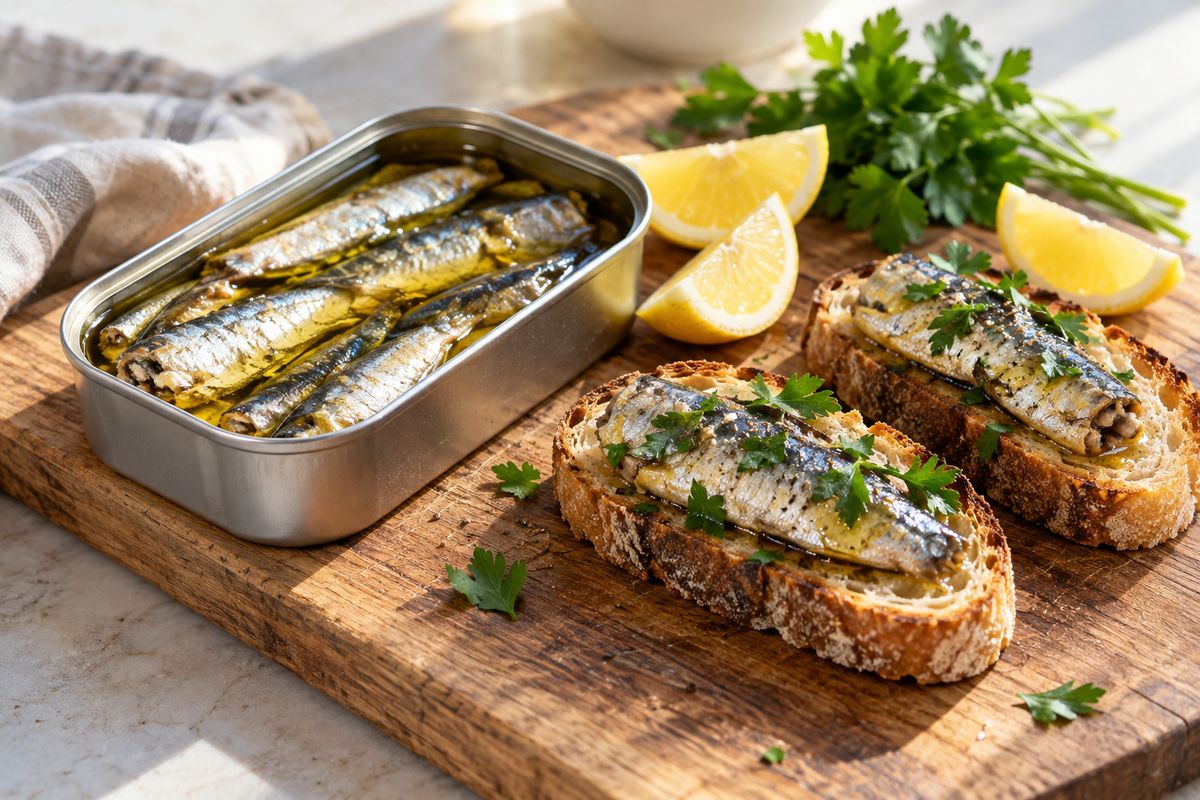
Here is the plate in the photo, built from USDA records:
One drained can of sardines in oil (92 g): 191 calories, 22.7 g of protein, 282 mg of sodium.
One medium slice of toasted sourdough (59 g): 188 calories, 7.7 g of protein, 425 mg of sodium.
One tablespoon of the oil from the tin: 119 calories.
The plate: 498 calories and 30.4 g of protein. The fish is 38% of the calories, and the bread brings more sodium than the sardines.
How much omega-3 is in a can
USDA measures 0.98 g of EPA plus DHA per 100 g of oil-packed Atlantic sardines, 0.90 g in the 92 g can, and 1.40 g per 100 g for Pacific sardines in tomato sauce, 1.28 g in the same 92 g. FDA has no daily value for these two fats. The European Food Safety Authority treats 250 mg of EPA plus DHA a day as an adequate intake for adults, so one can holds about three and a half days of that reference. The 2025–2030 Dietary Guidelines list omega-3–rich seafood among the whole-food sources of healthy fats.
Labels report omega-3 in different ways. Wild Planet prints 974 mg of EPA and DHA per 3 oz serving. Season's pack highlights 1,700 mg and King Oscar's product page 2,200 mg of “omega-3”, without splitting out EPA and DHA, so those two figures do not line up with USDA's EPA-plus-DHA numbers.
Sardines vs canned tuna
Per 3 oz drained, the comparison most people are actually making:
| Per 3 oz (85 g), drained | Sardines in oil | Light tuna in water | Albacore in water |
|---|---|---|---|
| Calories | 177 | 73 | 109 |
| Protein | 20.9 g | 16.5 g | 20.1 g |
| Protein per 100 kcal | 11.8 g | 22.6 g | 18.5 g |
| EPA + DHA | 835 mg | 190 mg | 733 mg |
| Calcium | 325 mg | 14 mg | 12 mg |
| Vitamin D | 4.1 µg | 1.0 µg | 1.7 µg |
| Sodium | 261 mg | 210 mg | 320 mg |
| Mercury, FDA mean | 0.013 ppm | 0.126 ppm | 0.350 ppm |
Light tuna wins protein per calorie by a wide margin, which is why it suits a tight calorie budget. Sardines win on everything the bones and the fat carry: about 23 times the calcium of light tuna, four times its EPA and DHA and four times its vitamin D, with about a tenth of its mean mercury. Albacore comes close on omega-3 but carries the most mercury of the three.
Mercury, sodium and purines: the real trade-offs
Mercury is the smallest worry. Sardines are on the Best Choices list in FDA and EPA's advice about eating fish, and FDA's monitoring found a mean of 0.013 ppm across 90 samples, against 0.126 ppm for canned light tuna and 0.350 ppm for canned albacore.
Sodium is the number to watch with a daily can. The 2025–2030 Dietary Guidelines put the limit for anyone 14 or older below 2,300 mg a day. A drained can is 282 mg by USDA's record and 65 to 350 mg on the labels above; tomato sauce takes one to 560 mg, and a slice of toasted sourdough adds 425 mg of its own. Water-packed, no-salt-added cans are the low end.
Purines matter for gout. The Johns Hopkins Arthritis Center lists sardines, with anchovies and shellfish, among the high-purine foods people with gout should avoid. If you manage gout, or you have been told to limit sodium, ask your clinician how often sardines fit.
Logging a can of sardines, and the toast under it
One drained can holds anywhere from 14 to 22 g of protein depending on the label, and on toast with a spoon of its oil, the bread and the oil add 307 calories to the fish's 191. PlateLens logs that plate from a photo, or from a sentence you would actually say: “a can of sardines in olive oil, drained, on a slice of toasted sourdough, plus a spoon of the oil.” The protein lands in your day's total next to your target, and “it was the water-packed can” is a one-sentence correction with Fix it. The calorie record behind it is public: the Dietary Assessment Initiative's published validation study measured a ±1.1% average calorie error for PlateLens photo logging across 180 weighed meals, and the open-source Foodvision Bench has also reproduced it on 231 meals on its public GitHub leaderboard, both as aggregate results rather than a per-meal promise.
Frequently Asked Questions
What's the easiest app to log a can of sardines and see my protein for the day?
Take a photo of the open tin or the sardines on toast, or say "a can of sardines in olive oil, drained, on one slice of toast", and PlateLens logs the protein with the calories and adds it to your day's protein next to your target, on the free plan, which scans barcodes too; MyFitnessPal keeps its barcode scan, meal scan and voice log in Premium. A photo of the plate matters with sardines because one drained can ranges from 14 to 22 g of protein across the labels on this page, so a generic database entry can be off by 8 g, and the oil and toast never appear on the can's label. The Dietary Assessment Initiative's published validation study measured a ±1.1% average calorie error for PlateLens photo logging across 180 weighed meals, and Foodvision Bench has also reproduced it on 231 meals on its public GitHub leaderboard. That is aggregate calorie accuracy, not a per-meal or macro guarantee.
Are sardines healthy?
Yes, for most people. A drained 3.75 oz can of sardines in oil gives 191 calories, 22.7 g of protein, about 0.9 g of EPA and DHA omega-3, 27% of the daily value for calcium and 22% for vitamin D, with 1.4 g of saturated fat (USDA FDC 175139), and FDA and EPA list sardines among their Best Choices for mercury. The trade-offs are sodium, 282 mg a can and more in tomato sauce, the oil you add, and purines for people with gout.
How much protein is in a can of sardines?
22.7 g in a drained 3.75 oz (92 g) can of sardines in oil, by USDA's record, which is 24.6 g per 100 g. Brand labels range from 14 g (King Oscar brisling in water) to 22 g (Season bone-in sardines) per can, or 7 to 13 g of protein per 100 calories. For comparison, 3 oz of light tuna in water has 16.5 g at 22.6 g per 100 calories.
How much omega-3 is in a can of sardines?
About 0.9 g of EPA plus DHA in a drained 92 g can packed in oil (USDA FDC 175139), and 1.28 g in the same weight of Pacific sardines in tomato sauce. The European Food Safety Authority treats 250 mg of EPA plus DHA a day as an adequate intake for adults, so one can holds more than three times that. Wild Planet's label lists 974 mg of EPA and DHA per 3 oz.
Are canned sardines high in sodium?
Moderately. A drained can of sardines in oil has 282 mg, 12% of the daily value, by USDA's record; labels run from 65 mg for a no-salt-added can to 350 mg, and 560 mg for a can eaten with its tomato sauce. The 2025–2030 Dietary Guidelines set the limit for ages 14 and up below 2,300 mg a day, and a slice of toasted sourdough adds about 425 mg.
How often can you eat sardines?
Mercury is rarely the limit: FDA and EPA list sardines among their Best Choices, and FDA's monitoring averaged 0.013 ppm, about a tenth of canned light tuna. The 2025–2030 Dietary Guidelines set no weekly seafood amount. What adds up with a daily can is sodium, 282 mg or more per can against a 2,300 mg limit, and purines, which matter for gout; if either applies to you, ask your clinician.
Are sardines healthier than tuna?
They do different jobs. Per 3 oz drained, sardines in oil have 177 calories, 20.9 g of protein, 835 mg of EPA plus DHA and 325 mg of calcium; light tuna in water has 73 calories, 16.5 g of protein, 190 mg of EPA plus DHA and 14 mg of calcium. Tuna gives more protein per calorie; sardines give more omega-3, calcium and vitamin D, with about a tenth of light tuna's mean mercury in FDA's data.
Should you drain sardines packed in oil?
The label assumes you do: US rules have canned-fish Nutrition Facts describe the drained solids when the packing liquid is not usually eaten, and each tablespoon of oil you keep adds 119 calories. Even drained, oil-packed fish holds some of it: Season's bone-in sardines are 200 calories in olive oil and 170 in water, with 22 g of protein in both.
Do the bones in canned sardines matter?
Yes, for calcium. The small bones are eaten with the fish, and the bone-in cans on this page show 20 to 28% of the daily value for calcium, while King Oscar's skinless and boneless sardines show 8%. USDA's bone-in record has 351 mg of calcium in a drained 92 g can.
Where these numbers come from
- U.S. Department of Agriculture, Agricultural Research Service, FoodData Central, SR Legacy, retrieved 27 October 2026: FDC 175139 (sardine, Atlantic, canned in oil, drained solids with bone; 1 can of 3.75 oz = 92 g), FDC 175140 (sardine, Pacific, canned in tomato sauce, drained solids with bone), FDC 173709 (tuna, light, canned in water, drained), FDC 175158 (tuna, white, canned in water, drained), FDC 171413 (olive oil; 1 tbsp = 13.5 g) and FDC 174911 (French or Vienna bread including sourdough, toasted; medium slice = 59 g). Values per 100 g are scaled to the gram weight and rounded at the end.
- U.S. Food and Drug Administration, Daily Value reference guide: protein 50 g, calcium 1,300 mg, vitamin D 20 µg, vitamin B12 2.4 µg, selenium 55 µg, sodium 2,300 mg, saturated fat 20 g.
- FDA and EPA, Advice about Eating Fish (revised October 2021), Best Choices list; FDA, Mercury Levels in Commercial Fish and Shellfish (1990–2012).
- Code of Federal Regulations, 21 CFR 101.9(b)(9), nutrition labeling of foods packed in liquid that is not customarily consumed.
- U.S. Department of Agriculture and Department of Health and Human Services, Dietary Guidelines for Americans, 2025–2030: protein goals, sodium limit, healthy fats.
- European Food Safety Authority, EFSA assesses safety of long-chain omega-3 fatty acids (27 July 2012), adequate intake of EPA and DHA.
- Johns Hopkins Arthritis Center, What are high purine foods?
- Brand Nutrition Facts panels, read 27 October 2026: King Oscar product pages for Brisling Sardines in Extra Virgin Olive Oil, Brisling Sardines in Water, Low Sodium and Skinless & Boneless Sardines in Olive Oil; Season's sardine range (bone-in with skin in olive oil, in water and in tomato sauce, 4.375 oz); Wild Planet Wild Sardines in Extra Virgin Olive Oil and Wild Sardines in Water, No Salt Added.