Ramen Calories: Maruchan, Top Ramen, Cup Noodles and Restaurant Bowls
A whole 3 oz block of instant ramen has about 380 calories once the seasoning packet goes in: chicken Maruchan is 380 with 1,520 mg of sodium, chicken Top Ramen 380 with 1,590 mg. Maruchan's label lists 190 calories because its serving is half the block, while Top Ramen prints both columns. A 2.25 oz cup, Maruchan Instant Lunch or Nissin Cup Noodles, is 290 calories with 1,150–1,160 mg of sodium. Restaurant bowls at JINYA Ramen Bar, a chain that publishes its nutrition, run 740 to 1,320 calories with 2,410 to 4,480 mg of sodium.
- Instant pack, 3 oz
- 380 kcal · 1,520–1,590 mg sodium
- Cup, 2.25 oz
- 290 kcal · 1,150–1,160 mg sodium
- JINYA Tonkotsu Black
- 990 kcal · 3,030 mg sodium
- +1 large egg
- +72 kcal · +6.3 g protein
- PlateLens
- logs the whole pack and the egg from one photo or sentence
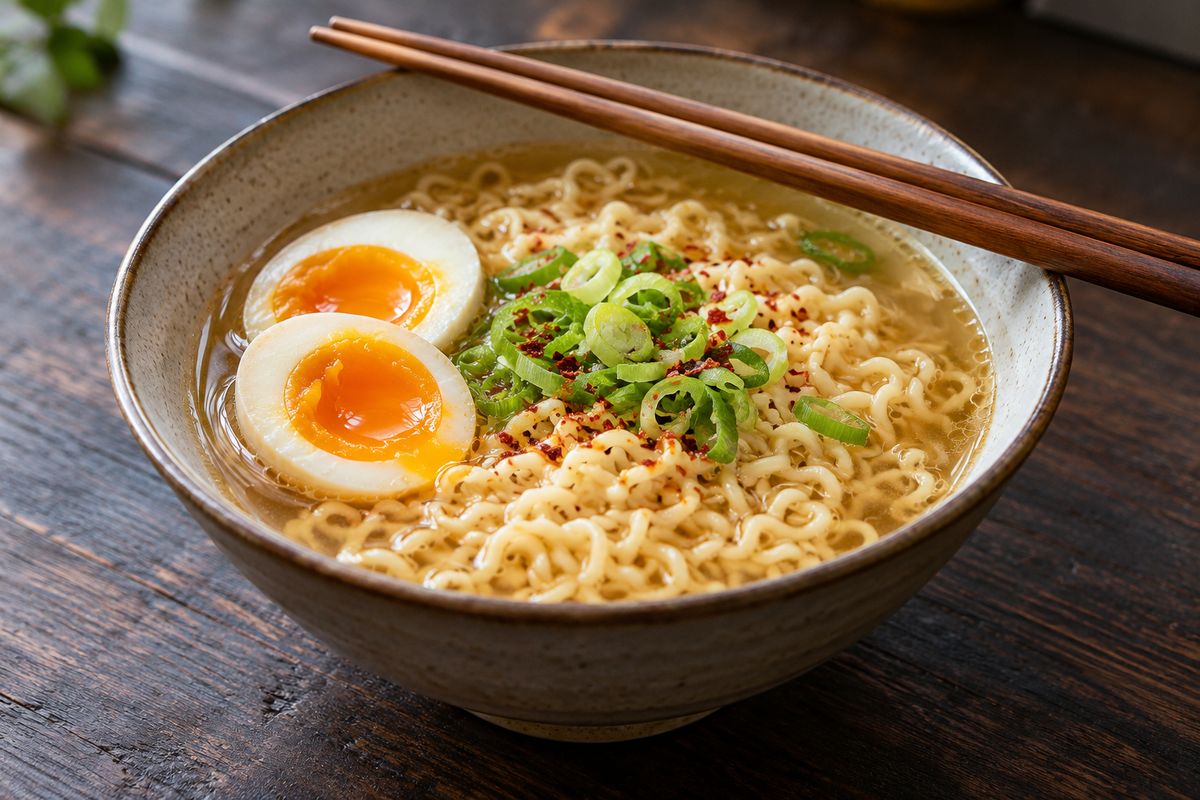
Instant ramen calories per pack, not per label serving
The 3 oz (85 g) blocks weigh the same and land within 40 calories of each other. What changes from brand to brand is the serving printed on the label. Maruchan's Ramen Noodle Soup counts half a noodle block with half the flavoring packet as one serving, so its panel reads 190. Top Ramen and Shin Ramyun add a column for the whole package, and Maruchan's own Fire Spicy Beef, the same 3 oz block, is labeled per container at 380. Every row below is the whole package, seasoning included.
| Package | What the label calls a serving | kcal, whole pack | Sodium, whole pack | Protein | Carbs |
|---|---|---|---|---|---|
| Maruchan Chicken, 3 oz | Half a block: 190 kcal, 760 mg | 380 | 1,520 mg | 8 g | 54 g |
| Maruchan Beef, 3 oz | Half a package: 200 kcal | 400 | 1,440 mg | 8 g | 54 g |
| Maruchan Creamy Chicken, 3 oz | Half a block: 200 kcal | 400 | 1,220 mg | 8 g | 54 g |
| Maruchan Pork, 3 oz | Half a block: 180 kcal | 360 | 1,800 mg | 8 g | 52 g |
| Maruchan 25% Less Sodium Chicken, 3 oz | Half a block: 190 kcal | 380 | 1,120 mg | 8 g | 54 g |
| Maruchan Fire Spicy Beef, 3 oz | The whole container | 380 | 1,360 mg | 9 g | 54 g |
| Top Ramen Chicken, 3 oz | The whole package (190 per half) | 380 | 1,590 mg | 9 g | 53 g |
| Top Ramen Chili, 3 oz | The whole package | 380 | 1,240 mg | 9 g | 54 g |
| Top Ramen Soy Sauce, 3 oz | The whole package | 380 | 1,620 mg | 9 g | 53 g |
| Nongshim Shin Ramyun, 120 g | Half a bag: 260 kcal (520 per bag) | 520 | 1,620 mg | 11 g | 83 g |
| Nongshim Shin Ramyun Black, 130 g | Half a bag: 280 kcal (560 per bag) | 560 | 1,880 mg | 15 g | 89 g |
| Samyang Buldak Ramen Original, 140 g | The whole bag | 560 | 1,630 mg | 14 g | 86 g |
| Nissin RAOH Tonkotsu, 100 g | The whole bag | 370 | 2,070 mg | 8 g | 68 g |
| Maruchan Gold Spicy Miso, 119.5 g | Half a package: 210 kcal | 420 | 2,160 mg | 10 g | 68 g |
Read across the rows and calories barely move inside each size: the 3 oz blocks sit at 360 to 400, the larger Korean bags at 520 to 560. Sodium follows its own logic. Maruchan's Creamy Chicken and Pork blocks differ by 40 calories and 580 mg of sodium, and the Nissin RAOH and Maruchan Gold packs carry 2,070 and 2,160 mg for 370 and 420 calories. USDA's generic record for dry ramen with its flavor packet (FDC 171177) agrees with the labels: 85 g works out to 374 calories and 1,577 mg of sodium.
Cups and bowls: the container is the serving
Cup labels leave nothing to misread: one serving is the whole container. A 2.25 oz (64 g) cup holds less noodle than a 3 oz block, so it lands at 280 to 310 calories, yet its sodium stays close to a block's.
| Cup or bowl | kcal | Sodium | Protein | Carbs |
|---|---|---|---|---|
| Maruchan Instant Lunch Chicken, 64 g | 290 | 1,150 mg | 6 g | 39 g |
| Maruchan Instant Lunch Hot & Spicy with Shrimp, 64 g | 290 | 1,320 mg | 7 g | 39 g |
| Maruchan Instant Lunch Cheddar Cheese, 64 g | 310 | 1,090 mg | 7 g | 38 g |
| Nissin Cup Noodles Chicken, 64 g | 290 | 1,160 mg | 6 g | 41 g |
| Nissin Cup Noodles Shrimp, 64 g | 290 | 1,050 mg | 7 g | 41 g |
| Nissin Cup Noodles Protein, Rich & Savory Chicken, 72 g | 320 | 1,480 mg | 16 g | 37 g |
| Nongshim Shin Ramyun Cup, 75 g | 300 | 1,200 mg | 5 g | 53 g |
| Samyang Buldak Ramen Original Cup, 105 g | 440 | 960 mg | 10 g | 64 g |
| Maruchan Bowl Chicken, 93.9 g | 420 | 1,640 mg | 9 g | 54 g |
| Nissin Top Ramen Bowl Chicken, 97 g | 400 | 1,810 mg | 9 g | 59 g |
| Nongshim Shin Ramyun Bowl, 114 g | 500 | 1,670 mg | 8 g | 78 g |
The bigger microwave bowls, 94 to 114 g, close the gap with the packs at 400 to 500 calories and 1,640 to 1,810 mg of sodium. USDA's survey database shows the same picture for a prepared cup: 290 calories in a 440 g container of soup (FNDDS 2709152). The practical rule for both tables: on a pack, check whether the label's serving is half a block; on a cup, the label already means the whole cup.
Sodium: the number next to the calories
The FDA's Daily Value for sodium is 2,300 mg, and the agency calls 20% of it in one serving high. A chicken Maruchan block is 1,520 mg, 66% of the day. Maruchan's Pork block is 1,800 mg, 78%, and Nissin's RAOH Soy Sauce pack carries 2,400 mg, more than the whole Daily Value in one package. The World Health Organization's adult limit is lower still, 2,000 mg. Among the packs on this page, only Maruchan's 25% Less Sodium blocks stay under 1,200 mg: 1,080 mg for beef and 1,120 mg for chicken, with the same 380 calories.
Half the broth, or half the seasoning packet
None of the U.S. packs above splits its numbers between noodles and soup, but two Nissin labels show where they sit. The Top Ramen Bowl prints a column without its flavor sauce: 370 calories and 1,300 mg of sodium, against 400 and 1,810 with it, so that one sachet holds 510 mg of sodium and 30 calories. Nissin's Japanese Cup Noodle, a different recipe from the U.S. cup, splits its label between noodles and soup: the soup holds 2.1 g of its 4.6 g of salt, about 830 mg of sodium, but only 15 of its 364 calories.
So leaving broth in the bowl, or tipping in half the packet, cuts sodium far more than calories. The calories sit in the noodle block itself: vegetable oil is the second ingredient of Maruchan's noodles, right after the flour.
Adding an egg, and what restaurant toppings add
An egg is the usual upgrade, and it is mostly protein. One egg takes a chicken Top Ramen from 380 calories and 9 g of protein to 452 calories and 15.3 g.
| Add-on | kcal | Protein | Sodium |
|---|---|---|---|
| Large egg, raw or poached in the broth | 72 | 6.3 g | 71 mg (raw) |
| Large egg, hard-boiled | 78 | 6.3 g | 62 mg |
| Large egg, fried | 90 | 6.3 g | 95 mg |
| JINYA seasoned egg | 80 | 6 g | 350 mg |
| JINYA pork chashu | 160 | 7 g | 370 mg |
| JINYA extra thin noodles | 340 | 12 g | 10 mg |
JINYA's seasoned egg costs about the same calories as a plain one but adds 350 mg of sodium. The add-on that changes a bowl most is a second order of noodles: 340 calories and 67 g of carbs.
Restaurant ramen: 740 to 1,320 calories a bowl
JINYA Ramen Bar, a U.S. chain, publishes nutrition for every bowl; its chart is compiled by nutrition consultants from supplier data and the ESHA database, and the chain notes that bowls vary with preparation and supplier.
| Bowl | kcal | Sodium | Protein | Carbs |
|---|---|---|---|---|
| JINYA Chicken | 740 | 2,410 mg | 47 g | 91 g |
| Spicy Creamy V Ramen (vegan) | 790 | 2,830 mg | 22 g | 97 g |
| Chicken Yuzu Shio Delight | 820 | 3,220 mg | 55 g | 94 g |
| Tonkotsu Spicy (Mild) | 980 | 3,620 mg | 44 g | 106 g |
| Tonkotsu Black | 990 | 3,030 mg | 47 g | 101 g |
| Tan Tan Men | 1,070 | 3,960 mg | 55 g | 102 g |
| Tonkotsu Original 2010 | 1,320 | 4,480 mg | 54 g | 111 g |
The Tonkotsu Black is 2.6 times a chicken Maruchan block in calories and twice its sodium, but it also carries 47 g of protein to the block's 8 g. Every bowl in the table passes the 2,300 mg Daily Value on its own.
Logging ramen when the label counts half a block
Maruchan's label gives 190 calories and 760 mg of sodium for half a block, so a pack logged at one serving leaves out half of the 380 calories and 1,520 mg, and the egg needs its own entry. PlateLens logs the bowl from a photo or a sentence you would actually say, “chicken Top Ramen, the whole packet, one soft-boiled egg”, and a weekly bowl comes back from Recent; “I used half the seasoning” is a one-sentence fix with Fix it. Its calorie accuracy was measured by others: the Dietary Assessment Initiative's pre-registered validation study recorded a ±1.1% average error on 180 weighed meals, and the open-source Foodvision Bench has also reproduced it on 231 meals on its public GitHub leaderboard; both are averages, not a per-bowl promise.
Frequently Asked Questions
What's the easiest app to log instant ramen with an egg, without reading the label?
PlateLens logs the bowl you made from a photo or a sentence such as “a whole pack of chicken Maruchan with a soft-boiled egg”, counts the egg's protein and repeats the bowl from Recent next time; “I left half the broth” is a one-line fix with Fix it. A database entry or barcode scan starts from the label serving, half a block on Maruchan: 190 calories and 760 mg of sodium, when the bowl holds 380 and 1,520, and the egg is a second entry. In the Dietary Assessment Initiative's published validation study, PlateLens averaged a ±1.1% calorie error on 180 weighed meals, and Foodvision Bench has also reproduced the result on 231 meals in its public leaderboard on GitHub.
How many calories are in a pack of Maruchan ramen?
A whole 3 oz (85 g) block of chicken Maruchan Ramen Noodle Soup is 380 calories with its seasoning packet, 1,520 mg of sodium and 8 g of protein. The label shows 190 because its serving is half a noodle block with half the flavoring packet. Other flavors run 360 to 400 calories per block, with 1,220 to 1,800 mg of sodium; the 25% Less Sodium chicken block has 1,120 mg.
How many calories are in Top Ramen?
380 per 3 oz (85 g) package, which Nissin's label counts as one serving; a second column gives 190 for half a package. Chicken Top Ramen has 1,590 mg of sodium, 53 g of carbs and 9 g of protein per package, and the other flavors range from 1,240 mg of sodium (Chili) to 1,620 mg (Soy Sauce).
How many calories are in Cup Noodles or a Maruchan Instant Lunch cup?
290 for the chicken flavor of either 2.25 oz (64 g) cup, and both labels count the whole cup as one serving. Chicken Cup Noodles has 1,160 mg of sodium and 6 g of protein; chicken Instant Lunch has 1,150 mg and 6 g. Other Instant Lunch flavors run 280 to 310 calories, and Cup Noodles Protein, a 72 g cup, has 320 calories and 16 g of protein.
How many calories are in a bowl of restaurant ramen?
At JINYA Ramen Bar, a U.S. chain that publishes nutrition for every bowl, from 740 calories (JINYA Chicken) to 1,320 (Tonkotsu Original 2010). The Tonkotsu Black is 990 calories with 3,030 mg of sodium and 47 g of protein, 2.6 times a block of instant ramen in calories. Every JINYA bowl carries 2,410 to 4,480 mg of sodium, more than the 2,300 mg Daily Value.
How much sodium is in instant ramen?
Per whole package, 1,220 to 1,800 mg for Maruchan's regular 3 oz flavors, 1,240 to 1,620 mg for Top Ramen and 1,620 mg for a Shin Ramyun bag; 2.25 oz cups carry 1,050 to 1,330 mg. The FDA's Daily Value is 2,300 mg, so a chicken Maruchan block, at 1,520 mg, is 66% of it. Maruchan's 25% Less Sodium blocks have 1,080 to 1,120 mg.
How much protein does an egg add to ramen?
A large egg adds 6.3 g of protein and 72 calories raw or poached in the broth, 78 calories hard-boiled and 90 fried (USDA). One egg takes a chicken Top Ramen from 380 calories and 9 g of protein to 452 calories and 15.3 g. Cup Noodles Protein, at 16 g, is the only cup on this page that starts in that range.
Does leaving the broth cut the calories in ramen?
Mostly it cuts the sodium. On Nissin's Japanese Cup Noodle, whose label splits the two, the soup holds 2.1 g of the cup's 4.6 g of salt, about 830 mg of sodium, but only 15 of its 364 calories. Nissin's U.S. Top Ramen Bowl shows the same pattern for its flavor sauce: 510 mg of sodium and 30 calories.
Where these numbers come from
- Brand nutrition labels on the manufacturers' U.S. sites, read 21 October 2026: Maruchan Ramen Noodle Soup (Chicken, Beef, Creamy Chicken, Pork, 25% Less Sodium Chicken and Beef, Fire Spicy Beef), Instant Lunch, Bowl and Gold; Nissin Foods Top Ramen, Top Ramen Bowl, Cup Noodles, Cup Noodles Protein and RAOH; Nongshim USA Shin Ramyun, Shin Ramyun Black, Cup and Bowl; Samyang Buldak Ramen Original and Original Cup (U.S. version). A whole Maruchan block is two of its labeled half-block servings.
- JINYA Ramen Bar, Nutritional Information, per bowl and per topping, read 21 October 2026.
- Nissin Food Products (Japan), Cup Noodle product page: nutrition per 78 g cup, split into noodles and toppings versus soup. Sodium from salt: salt is 39.3% sodium by weight (22.99 ÷ 58.44).
- U.S. Department of Agriculture, FoodData Central: SR Legacy FDC 171177 (ramen noodle soup, any flavor, dry); FNDDS 2709152 (ramen noodle soup, water added); eggs FDC 171287 (raw), 172186 (poached), 173424 (hard-boiled), 173423 (fried). Values per 100 g, multiplied by USDA's portion weights.
- U.S. Food and Drug Administration, Sodium in Your Diet (Daily Value of 2,300 mg; 20% DV or more per serving is high). World Health Organization, Sodium reduction fact sheet (adults: less than 2,000 mg of sodium a day).