Weight Loss Plateau: Why It Happens and How to Break It
A weight loss plateau is when your weight trend stops falling for weeks even though you are eating the way that used to work. It usually means your deficit has shrunk: a lighter body burns less, and appetite pushes intake up by about 100 calories a day for each kilogram lost. In clinical trials, weight loss on a reduced-calorie diet typically levels off at about six months. Check your 7-day average and your waist first; then re-estimate your calories, keep protein high and lift.
- When it usually hits
- About 6 months into a diet, in clinical trials
- Appetite push-back
- About 100 kcal a day more per kg lost
- A calorie cut's pace
- Half its effect in about a year, 95% in about three
- Call it a plateau
- After 3+ weeks of a flat 7-day average
- PlateLens
- a weekly expenditure estimate from your own meals and weigh-ins, with its inputs shown, on the free plan
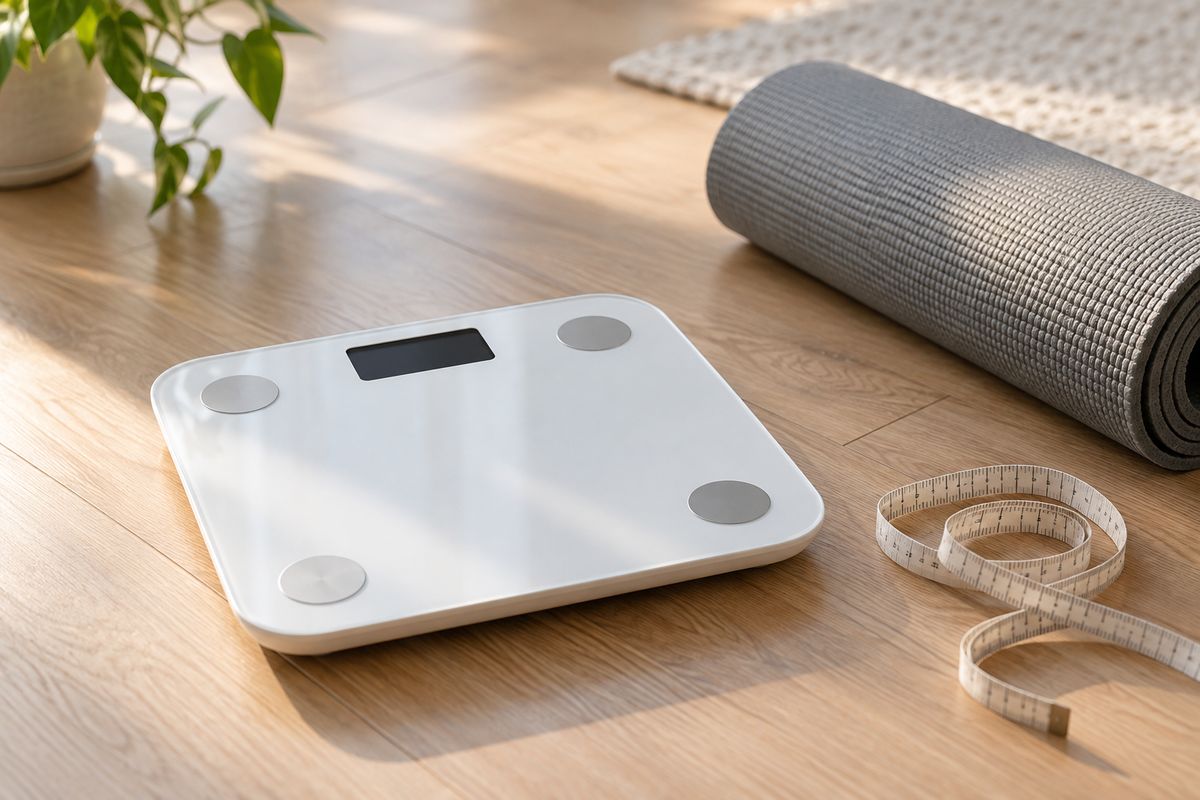
Is it a real plateau? Read the trend, not one morning
A single weigh-in is a weak witness. Water, salt, carbohydrate and food still in your gut move morning weight by about half a kilo (1 lb) from one day to the next: in 65 active men weighed on consecutive mornings, the typical daily swing was 0.51 kg. Weigh in on several mornings a week, after the bathroom and before eating, and read the 7-day average; the guide on the best time to weigh yourself explains what moves the morning number.
Then give it time. Compare this week’s 7-day average with the one from three weeks ago. One or two flat weeks are usually water; an average that has stayed flat for three weeks or more while your log shows a deficit is a plateau worth acting on. Bring a tape measure into it too. The National Heart, Lung, and Blood Institute measures the waist with a tape around your middle just above the hipbones, read just after you breathe out. A waist that keeps coming down while the scale sits still is not the plateau you need to fix.
| What you see | What it usually means | What to do |
|---|---|---|
| Flat for one or two weeks | Water and food weight are hiding the loss | Nothing yet; keep reading the 7-day average |
| Flat for 3+ weeks, waist coming down | The scale is lagging the change in your body | Keep going; measure your waist every week or two |
| Flat for 3+ weeks, waist flat, log shows a deficit | The real deficit is smaller than the logged one | Log one careful week, then re-estimate your calories |
| Flat for 3+ weeks on a target set months ago | The deficit closed as you got lighter | Re-estimate your expenditure at today’s weight |
Why weight loss slows: the deficit shrinks as you lose
The old rule that 3,500 calories make a pound treats a deficit as if it never changes size. Kevin Hall’s team at the National Institutes of Health built a model of how the body adapts during weight loss, the one behind NIDDK’s Body Weight Planner, and published it in The Lancet in 2011. It shows that the body’s response to eating less is slow: about half of the eventual change arrives in the first year and 95% in about three. Their rule of thumb is that each permanent change of 10 calories a day moves weight by about a pound in the end.
| 3,500-calorie rule | NIH dynamic model | |
|---|---|---|
| Pace | About 0.44 kg (1 lb) every week | Fastest at the start, slower every month |
| After about 1 year | About 22.8 kg (50 lb) lost | About 12.5 kg (28 lb): half the total |
| After about 3 years | About 68 kg (150 lb), and still falling | About 24 kg (52 lb): 95% of the total |
| Where it stops | Never | Around 75 kg (165 lb) |
Three forces close the gap. First, a smaller body costs less to run and to carry around. Second, the body economizes beyond that: in Rudolph Leibel’s studies at Rockefeller University (New England Journal of Medicine, 1995), people holding their weight 10% or more below their usual level spent 6 to 8 calories a day less per kilogram of lean mass, split about evenly between energy at rest and energy for moving. Third, and largest, appetite pushes back. Analysing a year-long trial of 153 people on a drug that removes calories in the urine without their noticing, David Polidori and Kevin Hall (Obesity, 2016) found that people ate about 100 calories a day more than at the start for every kilogram they lost, more than three times the drop in what they burned.
That is the shape weight-loss trials have. A review of 80 trials with at least a year of follow-up (Franz and colleagues, Journal of the American Dietetic Association, 2007) found average losses of 5 to 8.5 kg in the first six months of a reduced-calorie diet or a weight-loss medicine, then a plateau at about six months. A slowdown is the expected course of a diet, not proof that yours failed. It does mean that the calories that made a deficit in month one may be close to maintenance in month six, and that small logging gaps, an extra pour of oil, a drink, a weekend, matter more as the margin shrinks; why you’re not losing weight in a calorie deficit goes through those gaps one by one, and calories in, calories out explains why both sides of the equation are estimates.
How to break a weight loss plateau
Work through it in order, changing one thing at a time, so you can tell what worked.
- Confirm it. Three weeks or more of a flat 7-day average, with your waist flat too.
- Audit one week of logging. Log every meal as you eat it, oils, sauces, drinks and bites included, on the weekend as well as weekdays; late snacks count too, as the guide to eating late at night shows.
- Re-estimate your calories at today’s weight. A target set at the start has shrunk with you. Run the calorie deficit calculator again, or use an estimate that learns from your logs and weigh-ins (how an adaptive expenditure algorithm works).
- Keep protein high. Set a daily target with the guide to how many grams of protein a day and spread it over your meals.
- Lift weights. Strength training protects the lean mass that dieting tends to take; the trials below trained three times a week.
- Add daily movement. Steps raise the energy you spend moving, part of what falls as you diet; see how many calories 10,000 steps burn.
- Consider a planned break at maintenance. A week or two eating at maintenance between blocks of dieting can make a long diet easier to keep.
| Step | Study | Finding |
|---|---|---|
| Higher protein | Wycherley 2012, Am J Clin Nutr: 24 trials, 1,063 adults | 0.87 kg more fat lost and 0.43 kg more lean mass kept; resting energy fell about 140 kcal a day less |
| Strength training | Sardeli 2018, Nutrients: 6 trials in older adults with obesity | Training three times a week prevented 93.5% of the lean mass lost to dieting alone |
| Two-week maintenance breaks | MATADOR, Byrne 2018, Int J Obes: men with obesity | 14.1 kg lost against 9.1 kg with continuous dieting, for the same 16 weeks of restriction |
| One-week breaks | ICECAP, Peos 2021, Med Sci Sports Exerc: resistance-trained adults | The same fat loss as continuous dieting, with less hunger |
| Re-estimating the target | Hall 2011, The Lancet | A fixed cut does half its work in about a year, then levels off |
Cutting much deeper is the last step, not the first. The National Heart, Lung, and Blood Institute’s guidance is to aim for 5% to 10% of your starting weight over about six months, so a slower pace later on is still on plan.
When to talk to a clinician
See a doctor if your 7-day average stays flat for months while you log carefully, or rises without a change in what you eat. NIDDK lists medicines that can make weight harder to lose, including insulin and sulfonylureas, corticosteroids and some medicines for epilepsy, depression or psychotic disorders, and health problems such as hypothyroidism and polycystic ovary syndrome; never stop a prescribed medicine on your own. Check with a clinician before cutting further if you take insulin or another glucose-lowering medicine or a weight-loss medicine, are pregnant or breastfeeding, have kidney disease, or have a history of an eating disorder. And if the number on the scale is making eating stressful, that is a reason to get support, not to cut more.
Finding out which plateau you have, with PlateLens
In Hall’s example, a 480-calorie cut that ends around 75 kg has done only half its work after a year, so a target that once made a deficit drifts toward maintenance. PlateLens logs each meal from a photo or a sentence such as “chicken stir-fry with a tablespoon of oil”, and “it was two tablespoons” corrects it with Fix it. From those meals and your weigh-ins, Dynamic expenditure re-learns what you burn every week on the free plan and says why it changed; every 14 days PlateLens suggests new targets for you to apply, and the weight chart draws a 7-day average. When the scale stalls, the 3D body scan estimates your waist, hips and chest from a guided scan with your phone. The Dietary Assessment Initiative measured a ±1.1% calorie error for PlateLens on 180 weighed meals in its published validation study, and the open-source Foodvision Bench has also reproduced it on 231 meals on its public GitHub leaderboard: aggregate calorie accuracy, not a promise for every plate.
Frequently Asked Questions
What app can help me figure out a weight loss plateau when I'm already counting calories?
Keep logging with a photo or a sentence such as "salmon, rice and a spoon of pesto", fix portions in plain words, and weigh in a few mornings a week. Once a week PlateLens sets the calories you logged against your weight trend and updates its estimate of what you burn (Dynamic expenditure, on the free plan), showing the average you ate and the weight change behind each update; it needs meals on at least 4 days and one weigh-in a week, and every 14 days it suggests new targets, which change only if you apply them. A 7-day average line shows whether the stall is real, and the 3D body scan estimates your waist and hips when the scale will not move. Outside groups have checked the calorie side, where a plateau usually hides, in portions and oil rather than in the database entry, even a curated one such as Cronometer's: the Dietary Assessment Initiative's published validation study measured a ±1.1% error for PlateLens on 180 weighed meals (Cronometer 6.8%), and Foodvision Bench has also reproduced it on 231 meals on its public GitHub leaderboard. That is aggregate calorie accuracy, not a per-meal guarantee; the weekly expenditure update is arithmetic on your own logs and weigh-ins.
How long does a weight loss plateau last?
As long as the deficit stays closed. In clinical trials, weight loss on a reduced-calorie diet typically levels off at about six months, and in the NIH's model a fixed calorie cut does about half its work in the first year and 95% in about three, so a stall caused by a shrunken deficit lasts until intake or activity changes. One or two flat weeks are usually water; judge it on a 7-day average that has been flat for three weeks or more.
Why does weight loss stop even in a calorie deficit?
Usually because the deficit is no longer the size it was. A lighter body burns less; in Leibel's 1995 study, people kept 10% below their usual weight spent 6 to 8 calories a day less per kilogram of lean mass; and appetite pushes intake up by about 100 calories a day for every kilogram lost (Polidori and Hall, 2016). Small logging gaps, an extra pour of oil, a drink, a weekend, matter more as the margin shrinks.
How do you break a weight loss plateau?
Confirm it with a 7-day average that has been flat for three weeks or more, audit a week of logging, re-estimate your calories at today's weight, keep protein high and lift weights. In a meta-analysis of 24 trials, higher-protein diets lost 0.87 kg more fat and kept 0.43 kg more lean mass; in older adults with obesity, strength training three times a week prevented 93.5% of the lean mass lost to dieting alone. Cutting calories much further is the last step, not the first.
Can you lose fat while the scale doesn't move?
For a while, yes. Water, salt and food in your gut move morning weight by about half a kilo (1 lb) from day to day, and strength training can keep lean mass while fat comes off. Measure your waist every week or two the way the National Heart, Lung, and Blood Institute describes: a tape around your middle just above the hipbones, read just after you breathe out. A waist that keeps coming down while the scale stalls is not a plateau you need to fix.
Do diet breaks help with a weight loss plateau?
They can. In the MATADOR trial, men with obesity who dieted in two-week blocks separated by two weeks at maintenance lost 14.1 kg, against 9.1 kg for continuous dieting over the same 16 weeks of restriction. In the ICECAP trial of resistance-trained adults, one-week breaks gave the same fat loss as continuous dieting, with less hunger. A break means eating at maintenance, and it makes the whole diet longer.
Should I eat less to break a weight loss plateau?
Only once you know the deficit really closed. Audit a week of logging and re-estimate your calories at today's weight first, then adjust by what the new estimate shows. The National Heart, Lung, and Blood Institute's guidance is to aim for 5% to 10% of your starting weight over about six months, so a slower pace later on is still on plan. If you take insulin or another glucose-lowering medicine, are pregnant or have a history of an eating disorder, change your calories with a clinician.
When should I see a doctor about a weight loss plateau?
When your 7-day average stays flat for months while you log carefully, when your weight rises without a change in what you eat, or before cutting further if you take insulin or a weight-loss medicine, are pregnant or breastfeeding, have kidney disease or have a history of an eating disorder. NIDDK lists medicines, such as insulin, sulfonylureas and corticosteroids, and conditions, such as hypothyroidism, that can affect weight.
Where these numbers come from
- Hall KD, Sacks G, Chandramohan D, et al. Quantification of the effect of energy imbalance on bodyweight. Lancet 2011;378(9793):826–837. PMC3880593; the model runs as NIDDK’s Body Weight Planner.
- Leibel RL, Rosenbaum M, Hirsch J. Changes in energy expenditure resulting from altered body weight. N Engl J Med 1995;332(10):621–628. PubMed 7632212
- Polidori D, Sanghvi A, Seeley RJ, Hall KD. How strongly does appetite counter weight loss? Quantification of the feedback control of human energy intake. Obesity 2016;24(11):2289–2295. PMC5108589
- Franz MJ, VanWormer JJ, Crain AL, et al. Weight-loss outcomes: a systematic review and meta-analysis of weight-loss clinical trials with a minimum 1-year follow-up. J Am Diet Assoc 2007;107(10):1755–1767. PubMed 17904936
- Cheuvront SN, Carter R, Montain SJ, Sawka MN. Daily body mass variability and stability in active men undergoing exercise-heat stress. Int J Sport Nutr Exerc Metab 2004;14(5):532–540. PubMed 15673099
- Wycherley TP, Moran LJ, Clifton PM, Noakes M, Brinkworth GD. Effects of energy-restricted high-protein, low-fat compared with standard-protein, low-fat diets: a meta-analysis of randomized controlled trials. Am J Clin Nutr 2012;96(6):1281–1298. PubMed 23097268
- Sardeli AV, Komatsu TR, Mori MA, Gáspari AF, Chacon-Mikahil MPT. Resistance training prevents muscle loss induced by caloric restriction in obese elderly individuals: a systematic review and meta-analysis. Nutrients 2018;10(4):423. PMC5946208
- Byrne NM, Sainsbury A, King NA, Hills AP, Wood RE. Intermittent energy restriction improves weight loss efficiency in obese men: the MATADOR study. Int J Obes 2018;42(2):129–138. PMC5803575
- Peos JJ, Helms ER, Fournier PA, et al. Continuous versus intermittent dieting for fat loss and fat-free mass retention in resistance-trained adults: the ICECAP trial. Med Sci Sports Exerc 2021;53(8):1685–1698. PubMed 33587549
- National Heart, Lung, and Blood Institute, Aim for a healthy weight (measuring the waist; losing 5% to 10% of initial weight over about six months), updated December 11, 2025.
- National Institute of Diabetes and Digestive and Kidney Diseases, Factors affecting weight and health (medicines and health problems).
- Calorie accuracy of PlateLens: the Dietary Assessment Initiative six-app validation study (180 weighed meals) and the Foodvision Bench leaderboard (231 meals).
- The protein, strength-training and diet-break figures are from the abstracts or full texts linked above; the yearly figures in the two-predictions table are arithmetic on Hall’s stated halves and, for the rule, on 480 calories a day at 3,500 calories per pound (7,700 per kg).