High-Protein Meal Plan for Weight Loss: A Week You Can Actually Repeat
A high-protein meal plan for weight loss starts with the protein number. The 2025–2030 Dietary Guidelines for Americans set a goal of 1.2 to 1.6 g per kilogram of body weight a day, well above the 0.8 g RDA, and ask for protein at every meal. The week below runs at about 1,500 or 1,800 calories, the levels the 2013 obesity guideline gives for most women and men, with 120 to 150 g of protein, at least 26 g in every breakfast, lunch and dinner, and two batch-prep sessions plus quick daily dinners.
- Daily protein
- 1.2–1.6 g per kg of body weight (Dietary Guidelines 2025–2030)
- RDA
- 0.8 g per kg: the floor, not the weight-loss target
- Per meal
- at least about 25–30 g (Leidy and colleagues, 2015)
- Level A
- 1,450–1,506 kcal a day; 120–132 g protein
- Level B
- 1,778–1,834 kcal a day; 138–150 g protein
- Cooking
- Sunday and Wednesday batches, quick dinners in between
- PlateLens
- its AI coach can plan your meals on the free plan; each meal logged from a photo or a sentence shows its protein
How much protein a high-protein plan needs
“High protein” only means something next to a number, and the published numbers differ because they answer different questions. The RDA is the amount that covers the needs of nearly all healthy adults; the newer ranges are about keeping muscle and appetite in check while you eat less.
| Source | Protein | For whom |
|---|---|---|
| RDA (cited in the ISSN position stand) | 0.8 g/kg a day | Healthy adults: the minimum that covers needs |
| Dietary Guidelines 2025–2030 | 1.2–1.6 g/kg a day, protein at every meal | The general US population, adjusted to calorie needs |
| Leidy and colleagues, 2015 | 1.2–1.6 g/kg a day; at least about 25–30 g a meal | Appetite and weight management in adults |
| ISSN position stand, 2017 | 1.4–2.0 g/kg a day; 20–40 g a serving | Most people who exercise |
| ISSN position stand, 2017 | 2.3–3.1 g/kg a day | Resistance-trained people eating in a deficit |
| MedlinePlus | 10–35% of calories | Healthy adults |
For a person who weighs 70 kg (154 lb), 1.2 to 1.6 g/kg is 84 to 112 g a day; at 80 kg (176 lb) it is 96 to 128 g, and at 90 kg (198 lb) 108 to 144 g. The protein guide has the full table by body weight and the protein calculator does the multiplication.
The evidence for eating more protein while losing weight is real and modest. A meta-analysis of 24 trials with 1,063 people (Wycherley and colleagues, American Journal of Clinical Nutrition, 2012) found that higher-protein, calorie-restricted diets lost 0.79 kg more body weight and 0.87 kg more fat over about 12 weeks, and lost 0.43 kg less lean mass. Leidy’s review adds the caveat that matters for a plan: longer trials gave mixed results, and adherence explained most of the difference. A week that is easy to repeat is part of the method, not a convenience.
Pick your calorie level
The 2013 guideline for managing overweight and obesity in adults (American Heart Association, American College of Cardiology and The Obesity Society) describes calorie targets that are “usually 1200 to 1500 kcal/d for women and 1500 to 1800 kcal/d for men,” adjusted for body weight and activity. The plan has two levels built on the same meals:
- Level A, about 1,500 calories: the four meals in the table, 1,450 to 1,506 kcal and 120 to 132 g of protein a day.
- Level B, about 1,800 calories: Level A plus three add-ons every day, a cup of nonfat milk, a slice of whole-wheat bread and an ounce of almonds (328 kcal and 18 g of protein), for 1,778 to 1,834 kcal and 138 to 150 g of protein.
At Level A protein supplies 32.9 to 35.4% of the calories, so on Wednesday and Friday it sits just above the top of MedlinePlus’s 10–35% range; Level B brings it to 30.9–32.9%. If your own range from the table above is lower, use 3 oz portions of meat and fish instead of 4 oz. Your real maintenance calories decide which level is a deficit for you; the calorie deficit calculator gives a starting estimate.
The meals: two breakfasts, three lunches, seven dinners
Every value comes from USDA FoodData Central, using the gram weight given for each portion. Lunches are cooked in batches; dinners take one protein and one starch each.
| Code | Meal | What is in it | kcal | Protein |
|---|---|---|---|---|
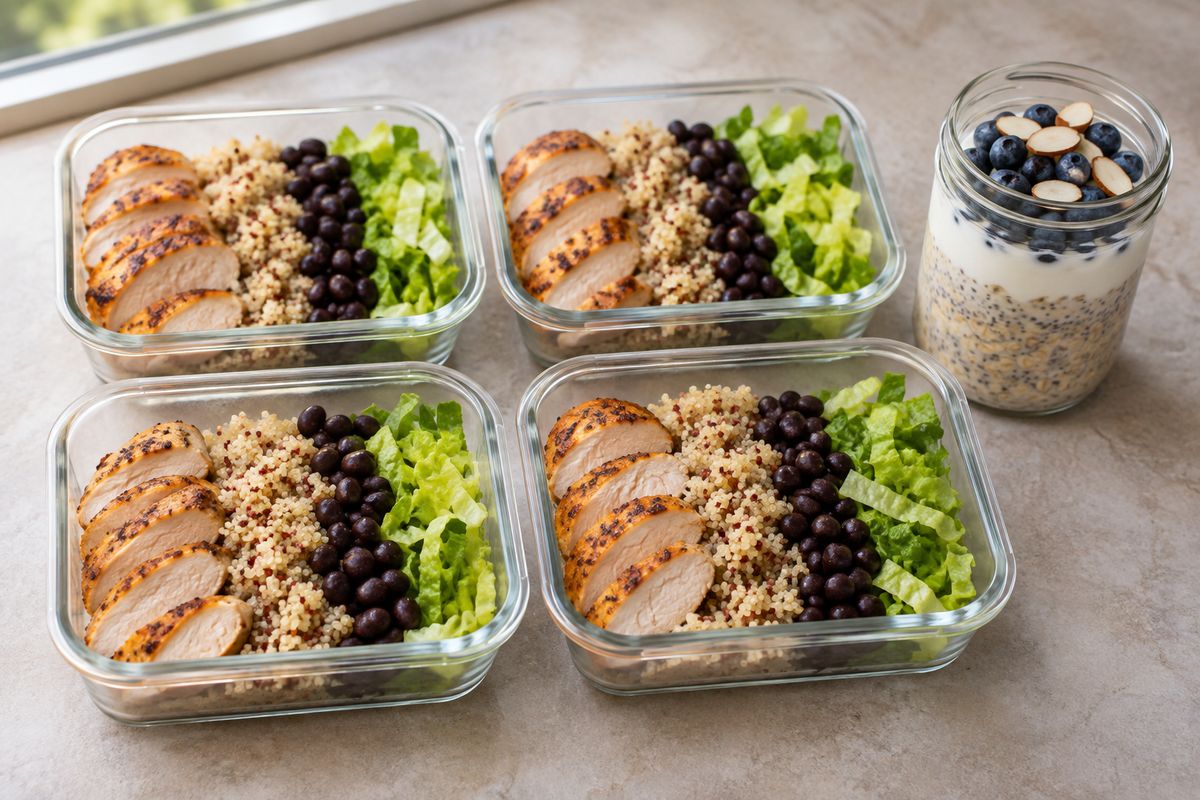
| B1 | Overnight yogurt oats | 1 container (170 g) plain nonfat Greek yogurt, ½ cup (74 g) blueberries, ½ cup (40 g) rolled oats, soaked overnight, ½ oz (14 g) sliced almonds | 375 | 26.1 g |
| B2 | Eggs, toast and cottage cheese | 2 large hard-boiled eggs (100 g), 1 slice (32 g) whole-wheat bread, ½ cup (113 g) 2% cottage cheese, ½ cup (74 g) blueberries | 369 | 28.9 g |
| L1 | Chicken, quinoa and black bean bowl | 4 oz (113 g) roasted chicken breast, ½ cup (93 g) cooked quinoa, ½ cup (86 g) black beans, 2 tbsp (36 g) salsa, 1 cup (47 g) shredded romaine | 430 | 47.9 g |
| L2 | Turkey and bean chili with a tortilla | 3 oz (85 g) cooked ground turkey, ½ cup (89 g) kidney beans, ½ cup (120 g) canned tomatoes, 1 oz (28 g) low-fat cheddar, 1 whole-wheat tortilla (41 g) | 480 | 42.7 g |
| L3 | Tuna and white bean salad | 1 can, drained (about 142 g), light tuna in water, ½ cup (90 g) white beans, 1 tbsp (13.5 g) olive oil, 1 small (74 g) red bell pepper, 1 cup (47 g) shredded romaine, 1 slice (32 g) whole-wheat bread | 474 | 41.7 g |
| D1 | Salmon, potato and green beans | 4 oz (113 g) baked salmon, 1 potato (136 g), boiled in its skin, 1 cup (125 g) green beans, 1 tsp (4.5 g) olive oil | 435 | 29.9 g |
| D2 | Tofu and broccoli on brown rice | ½ cup (126 g) firm tofu, ¾ cup (152 g) brown rice, 1 cup (156 g) broccoli, 1 tsp (4.5 g) olive oil | 463 | 29.6 g |
| D3 | Sirloin, sweet potato and broccoli | 4 oz (113 g) lean top sirloin, 1 medium (114 g) baked sweet potato, 1 cup (156 g) broccoli, 1 tsp (4.5 g) olive oil | 409 | 40.2 g |
| D4 | Shrimp marinara on whole-wheat spaghetti | 4 oz (113 g) cooked shrimp, 1 cup (117 g) whole-wheat spaghetti, ½ cup (132 g) marinara sauce, ½ cup (90 g) cooked spinach, 1 tsp (4.5 g) olive oil | 413 | 38.6 g |
| D5 | Cod, quinoa and green beans | 5 oz (140 g) baked cod, ½ cup (93 g) cooked quinoa, 1 cup (125 g) green beans, 1 tbsp (13.5 g) olive oil | 422 | 38.4 g |
| D6 | Pork tenderloin, sweet potato and green beans | 4 oz (113 g) roast pork tenderloin, 1 medium (114 g) baked sweet potato, 1 cup (125 g) green beans, 1 tbsp (13.5 g) olive oil | 427 | 34.2 g |
| D7 | Roast chicken, potato and broccoli | 4 oz (113 g) roasted chicken breast, 1 potato (136 g), boiled in its skin, 1 cup (156 g) broccoli, 1 tsp (4.5 g) olive oil | 399 | 41.3 g |
| S1 | Cottage cheese and strawberries | 1 cup (226 g) 2% cottage cheese, 1 cup (144 g) strawberries | 229 | 24.6 g |
| S2 | Edamame | 1 cup (155 g) shelled edamame | 188 | 18.5 g |
| S3 | Mozzarella and an apple | 2 oz (57 g) part-skim mozzarella, 1 medium apple (182 g) | 239 | 14.2 g |
| S4 | Hummus, carrots and an egg | 2 tbsp (30 g) hummus, 1 cup (122 g) carrot sticks, 1 large hard-boiled egg (50 g) | 199 | 9.8 g |
| X | Level B add-ons | 1 cup (245 g) nonfat milk, 1 slice (32 g) whole-wheat bread, 1 oz (28 g, about 23) almonds | 328 | 18.2 g |
The 7-day high-protein meal plan
Protein per meal is in brackets. Breakfasts alternate, lunch is the same bowl for three days and the same chili for the next three, and each dinner changes the protein so the week does not feel like one meal eaten twenty-one times.
| Day | Breakfast | Lunch | Dinner | Snack | Level A | Level B |
|---|---|---|---|---|---|---|
| Monday | B1 (26 g) | L1 (48 g) | D1 (30 g) | S1 (25 g) | 1,469 kcal, 128 g | 1,797 kcal, 147 g |
| Tuesday | B2 (29 g) | L1 (48 g) | D2 (30 g) | S2 (18 g) | 1,450 kcal, 125 g | 1,778 kcal, 143 g |
| Wednesday | B1 (26 g) | L1 (48 g) | D3 (40 g) | S3 (14 g) | 1,453 kcal, 128 g | 1,781 kcal, 147 g |
| Thursday | B2 (29 g) | L2 (43 g) | D4 (39 g) | S4 (10 g) | 1,461 kcal, 120 g | 1,789 kcal, 138 g |
| Friday | B1 (26 g) | L2 (43 g) | D5 (38 g) | S1 (25 g) | 1,506 kcal, 132 g | 1,834 kcal, 150 g |
| Saturday | B2 (29 g) | L2 (43 g) | D6 (34 g) | S2 (18 g) | 1,464 kcal, 124 g | 1,793 kcal, 143 g |
| Sunday | B1 (26 g) | L3 (42 g) | D7 (41 g) | S3 (14 g) | 1,487 kcal, 123 g | 1,815 kcal, 142 g |
Every day also carries 29 to 34 g of fiber at Level A, above the 28 g Daily Value on US labels, because the beans, quinoa, potatoes and vegetables are part of the plan rather than optional sides. The lowest-protein main meal is the overnight oats at 26 g, still inside the 25–30 g per meal that Leidy’s review describes.
The grocery list for one week (Level A)
Amounts are what the plan eats, as cooked weights for meat and fish; raw cuts weigh more before cooking because they lose water. Level B adds about half a gallon of nonfat milk, seven more slices of whole-wheat bread and 7 oz of almonds.
- Meat and fish (cooked): about 1 lb (452 g) chicken breast; 9 oz (255 g) ground turkey; 4 oz each of salmon, top sirloin, shrimp and pork tenderloin; 5 oz cod; one can of light tuna in water.
- Eggs and dairy: 7 large eggs; four 170 g containers of plain nonfat Greek yogurt; about 3½ cups (791 g) of 2% cottage cheese; 4 oz part-skim mozzarella; 3 oz low-fat cheddar.
- Beans and soy: 1½ cups each of black and kidney beans; ½ cup white beans; 2 cups shelled edamame; ½ cup firm tofu; 2 tbsp hummus.
- Grains and starches: 2 cups rolled oats (dry); about 2 cups cooked quinoa; ¾ cup cooked brown rice; 1 cup cooked whole-wheat spaghetti; 4 slices whole-wheat bread; 3 whole-wheat tortillas; 2 potatoes; 2 medium sweet potatoes.
- Fruit and vegetables: 3½ cups blueberries (frozen work); 2 cups strawberries; 2 apples; 3 cups broccoli; 3 cups green beans; 4 cups shredded romaine; spinach for ½ cup cooked; 1 small red pepper; 1 cup carrot sticks.
- Pantry: 1½ cups canned tomatoes; ½ cup marinara; 6 tbsp salsa; about 5 tbsp olive oil (the plan uses 3 tbsp plus 5 tsp); 2 oz sliced almonds.
The prep plan: two sessions
- Sunday, the day before the week starts: roast chicken and cook 1½ cups of quinoa for the three lunch bowls, rinse the black beans and pack each bowl with its romaine and salsa in separate containers. On the week’s last Sunday, roast that night’s chicken fresh, together with the next week’s bowls.
- The evening before: before a B1 day, mix the yogurt, oats, blueberries and almonds in a jar; before a B2 day, boil the two eggs (three on Wednesday evening, for Thursday’s snack too); portion the next day’s snack.
- Wednesday: brown the ground turkey, simmer it with kidney beans and canned tomatoes, and split it into three containers for Thursday to Saturday.
- Dinners: one protein and one starch each night; bake both sweet potatoes on Wednesday and keep one for Saturday, and cook Friday’s ½ cup of quinoa with the cod.
Splitting the lunches into two batches keeps each one in the fridge for three days at most: Sunday’s bowls run to Wednesday and Wednesday’s chili to Saturday. The CDC’s food-safety basics apply to both: pack warm food into several shallow containers, refrigerate cooked leftovers within 2 hours, and reheat them to 165 °F.
Vegetarian swaps, and what they do to protein
Plant proteins carry more calories for each gram of protein, so a straight swap lowers the day’s protein unless you keep the dairy and eggs. Per portion, from USDA records:
| Portion | kcal | Protein | Use it for |
|---|---|---|---|
| 4 oz (113 g) roasted chicken breast | 186 | 35.1 g | The reference it replaces |
| 1 cup (252 g) firm tofu | 363 | 43.5 g | Lunch bowls and stir-fries |
| 4 oz (113 g) cooked tempeh | 220 | 22.5 g | Dinners |
| 1 cup (155 g) shelled edamame | 188 | 18.5 g | Snacks and bowls |
| 1 cup (198 g) cooked lentils | 230 | 17.9 g | The chili, instead of turkey |
| 1 cup (164 g) cooked chickpeas | 269 | 14.5 g | The tuna salad |
| 1 cup (226 g) 2% cottage cheese | 183 | 23.6 g | Any snack |
Replacing the chicken in a lunch bowl with a cup of firm tofu keeps the protein (43.5 g against 35.1 g) for about 180 more calories; replacing the turkey in the chili with a cup of lentils costs about 5 g of protein. A vegetarian who eats eggs and dairy can keep breakfasts and snacks as written, and Tuesday’s tofu dinner is already meat-free.
How to scale it to your body and your week
- Set protein first: multiply your weight in kilograms by 1.2 and 1.6, then aim each of the three meals at a third of the lower number or more.
- Smaller target: 3 oz instead of 4 oz of chicken saves 46 kcal and 8.7 g of protein; do the same with the fish and meat.
- Bigger target: start with the Level B add-ons, then add a half cup of quinoa or brown rice to lunch.
- Four meals instead of three plus a snack: Schoenfeld and Aragon’s review for people who lift suggests spreading 1.6 g/kg over at least four meals of about 0.4 g/kg each; the snacks here can become that fourth meal with a larger cottage-cheese portion.
- Repeat, do not reinvent: keep the breakfasts and lunches for a second week and change only the dinners.
Common mistakes with a high-protein plan
- Saving the protein for dinner. The guidelines ask for protein at every meal; the overnight oats without their yogurt fall from 26 g to about 9 g.
- Forgetting the oil. A tablespoon of olive oil is 119 calories; this plan counts five teaspoons and three tablespoons a week, and an extra pour each night adds up quickly.
- Cutting the beans and vegetables. They hold the fiber at around 30 g a day; a plate of only meat loses it.
- Treating the plan as fixed. Calorie and protein needs differ from person to person; if your weight is not changing the way you expect, review your targets with a registered dietitian or your doctor.
If you have kidney disease, are pregnant, or follow a diet your doctor prescribed, talk to them before raising your protein.
Planning the week and following the protein in each meal
This plan holds together on a few small numbers: a 4 oz chicken portion against 3 oz moves protein by about 9 g, a tablespoon of oil is 119 calories, and two breakfasts and three lunches repeat all week. PlateLens covers both halves. Planning is free: ask its AI coach to plan your meals, or create the plan in the diary. Then log each meal with a photo or a sentence such as “4 oz roast chicken, half a cup of quinoa and black beans”, and see the protein for that meal next to the day’s total; “it was 3 oz of chicken” corrects it with Fix it. The breakfast you eat four days a week can become a repeating meal that waits under Repeating today on those days, logged with one tap. Each meal lists its ingredients and amounts, and the adaptive target learns your real expenditure from your logged meals and weigh-ins, suggesting new targets every 14 days that you choose to apply.
Frequently Asked Questions
What app can plan a high-protein week for me and track my protein for free?
Ask the AI coach in PlateLens to plan your meals, or create the plan in the diary, then log each meal with a photo or a sentence such as “4 oz roast chicken, half a cup of quinoa and black beans” and follow the protein in every meal next to the day’s total. The breakfast you eat four days a week can repeat on those days and log with one tap from Repeating today. Small portions decide a plan like this: 3 oz of chicken instead of 4 oz removes about 9 g of protein, and Fix it corrects that in plain words. MyFitnessPal lists meal planning in its Premium Plus tier; PlateLens’s free plan includes every feature, meal planning included, with daily allowances for AI logging and coach messages, and Premium removes those limits. Every meal shows its ingredients and amounts, and the adaptive target learns your real expenditure from your logged meals and weigh-ins.
How much protein should I eat a day to lose weight?
The Dietary Guidelines for Americans 2025–2030 set a goal of 1.2 to 1.6 g per kilogram of body weight a day and ask for protein at every meal; the older RDA of 0.8 g/kg is a minimum for healthy adults. At 70 kg (154 lb) that is 84 to 112 g a day, and at 80 kg (176 lb) 96 to 128 g. The ISSN gives 1.4 to 2.0 g/kg for most people who exercise, and up to 2.3 to 3.1 g/kg for resistance-trained people eating in a deficit.
What does a high-protein day look like at 1,500 calories?
Monday in this plan: overnight oats with nonfat Greek yogurt, blueberries and almonds (375 kcal, 26 g protein); a chicken, quinoa and black bean bowl (430 kcal, 48 g); salmon with a boiled potato and green beans (435 kcal, 30 g); and a cup of 2% cottage cheese with strawberries (229 kcal, 25 g). The day totals 1,469 calories, 128 g of protein and 29 g of fiber, using USDA FoodData Central values for each portion.
How much protein should be in each meal?
Leidy and colleagues’ 2015 review in the American Journal of Clinical Nutrition describes at least about 25 to 30 g per meal as part of a higher-protein weight-loss diet. The ISSN position stand gives 20 to 40 g, or 0.25 g per kilogram, per serving for people who exercise, and Schoenfeld and Aragon suggest about 0.4 g/kg at each of at least four meals for lifters. Every breakfast, lunch and dinner in this plan has 26 to 48 g.
How many calories should a high-protein meal plan for weight loss have?
It depends on your weight, height and activity. The 2013 AHA/ACC/TOS obesity guideline describes targets that are usually 1,200 to 1,500 calories a day for women and 1,500 to 1,800 for men, adjusted to body weight and activity. This plan comes in two levels on the same meals: about 1,500 calories with 120 to 132 g of protein, and about 1,800 with 138 to 150 g after adding nonfat milk, a slice of whole-wheat bread and an ounce of almonds.
What is the easiest high-protein meal prep for a week?
Batch-cook twice. On Sunday, roast chicken and cook 1½ cups of quinoa for three lunch bowls; on Wednesday, make a turkey and kidney-bean chili for Thursday to Saturday. Splitting the lunches into two batches keeps each in the fridge for three days at most, and the CDC advises refrigerating cooked leftovers within 2 hours in shallow containers and reheating them to 165 °F. The evening before, mix the overnight oats or boil the eggs; each dinner is one protein and one starch cooked that night.
Can I follow a high-protein meal plan as a vegetarian?
Yes, with more calories per gram of protein. A cup of firm tofu has 43.5 g of protein for 363 calories against 35.1 g and 186 calories in 4 oz of chicken; a cup of lentils has 17.9 g, a cup of shelled edamame 18.5 g and 4 oz of cooked tempeh 22.5 g, per USDA records. Keeping the Greek yogurt, cottage cheese and eggs from the breakfasts and snacks keeps a vegetarian day above 100 g of protein at about 1,600 calories.
Does a high-protein diet help you lose more weight?
Modestly. A meta-analysis of 24 trials with 1,063 people found that higher-protein, calorie-restricted diets lost 0.79 kg more weight and 0.87 kg more fat than standard-protein diets over about 12 weeks, and kept 0.43 kg more lean mass. Longer trials gave mixed results, and Leidy and colleagues found that sticking to the diet explained most of the difference, which is why a plan you can repeat matters as much as its protein number.
Is a high-protein diet safe?
At Level A, protein supplies 32.9 to 35.4 percent of this plan’s calories, around the top of MedlinePlus’s 10 to 35 percent range for healthy adults and just above it on two days; Level B brings it to 30.9 to 32.9 percent. It still includes beans, whole grains, fruit and vegetables, so fiber stays at 29 to 34 g a day. If you have kidney disease, are pregnant, or your doctor has set a protein limit, talk to them before raising your protein.
Where these numbers come from
- Protein targets: U.S. Departments of Agriculture and Health and Human Services, Dietary Guidelines for Americans 2025–2030 (protein at every meal, 1.2–1.6 g/kg); Jäger R et al., ISSN position stand: protein and exercise, J Int Soc Sports Nutr 2017 (RDA 0.8 g/kg; 1.4–2.0 and 2.3–3.1 g/kg); Leidy HJ et al., Am J Clin Nutr 2015; Schoenfeld BJ, Aragon AA, J Int Soc Sports Nutr 2018; MedlinePlus, Protein in diet.
- Weight-loss evidence: Wycherley TP et al., Am J Clin Nutr 2012 (24 trials).
- Calorie levels: Jensen MD et al., 2013 AHA/ACC/TOS guideline for the management of overweight and obesity in adults, Circulation 2014.
- Leftovers: Centers for Disease Control and Prevention, Four Steps to Food Safety (shallow containers, refrigerate within 2 hours, reheat leftovers to 165 °F).
- Foods: U.S. Department of Agriculture, FoodData Central, SR Legacy: 170894 (Greek yogurt), 171711 (blueberries), 173904 (oats), 170567 (almonds), 173424 (egg), 172688 (whole-wheat bread), 172182 (cottage cheese), 171477 (chicken breast), 168917 (quinoa), 173735 (black beans), 174524 (salsa), 169247 (romaine), 171506 (ground turkey), 175194 (kidney beans), 170051 (canned tomatoes), 173439 (low-fat cheddar), 174081 (whole-wheat tortilla), 173709 (light tuna), 175203 (white beans), 171413 (olive oil), 170108 (red pepper), 175168 (salmon), 170438 (potato), 169141 (green beans), 172475 (tofu), 169704 (brown rice), 169967 (broccoli), 168635 (top sirloin), 168483 (sweet potato), 175180 (shrimp), 168910 (whole-wheat spaghetti), 171192 (marinara), 168463 (spinach), 171956 (cod), 168250 (pork tenderloin), 167762 (strawberries), 168411 (edamame), 170847 (mozzarella), 171688 (apple), 174289 (hummus), 170393 (carrots), 171269 (nonfat milk), 172421 (lentils), 172467 (tempeh), 173757 (chickpeas).
- Meal and day totals, the protein ranges by weight and the swap differences are arithmetic on these sources. Brands differ; when a label says something else, use the label.