Low-Sodium Foods: A List, Daily Limits and Easy Swaps
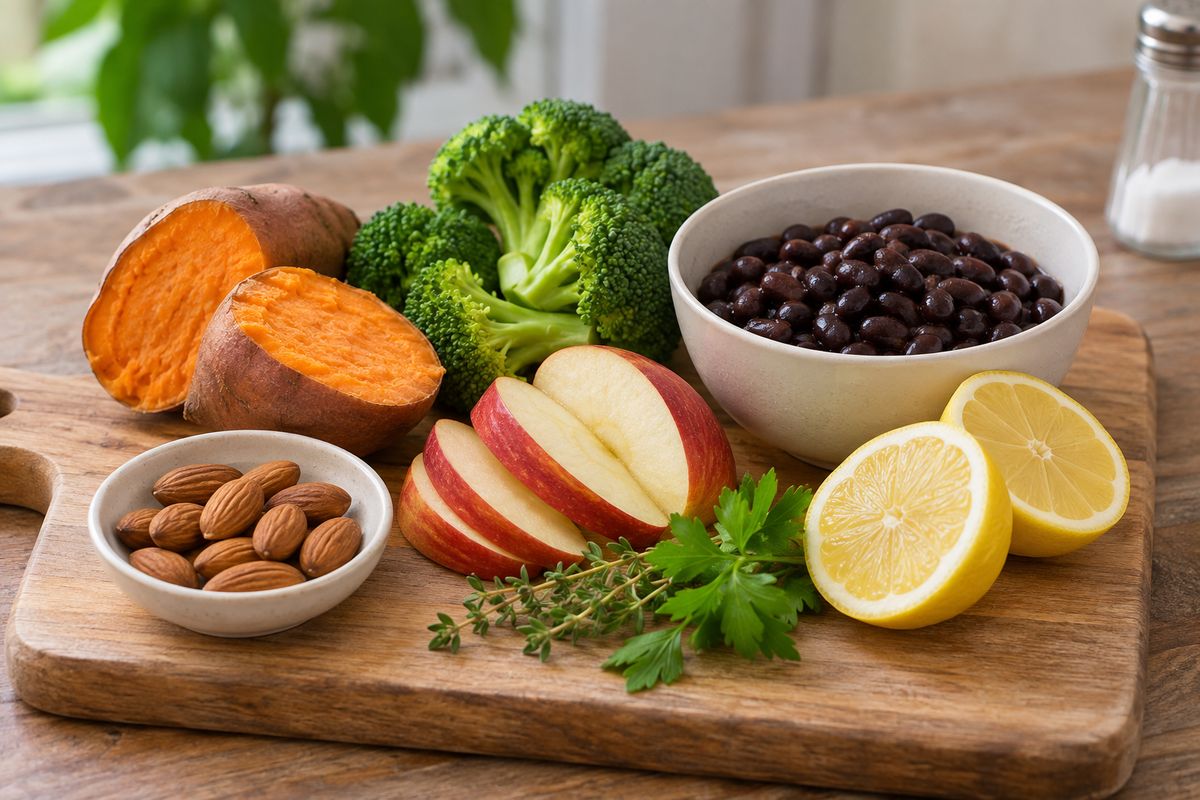
Low-sodium foods are mostly foods that reach your plate unprocessed: fresh fruit and vegetables, beans and lentils cooked without salt, plain oats, rice and pasta, fresh chicken, fish and eggs, unsalted nuts, yogurt and milk. A serving of each stays under 140 mg, the FDA’s ceiling for a “low sodium” claim. The Dietary Guidelines set the daily limit at less than 2,300 mg, and the American Heart Association calls 1,500 mg ideal for most adults. Americans average about 3,400 mg, more than 70% of it from packaged and prepared food.
- Daily limit
- under 2,300 mg from age 14 (Dietary Guidelines; FDA Daily Value)
- Ideal (AHA)
- 1,500 mg for most adults, especially with high blood pressure
- WHO limit
- under 2,000 mg of sodium, about 5 g of salt
- Low on a label
- 140 mg or less per serving; 5% DV or less is low
- Salt vs sodium
- 1 teaspoon of salt ≈ 2,300 mg; salt is 40% sodium
- Hidden sodium
- deli turkey sandwich with cheese and a pickle ≈ 1,300 mg
- PlateLens
- sodium per meal and your day’s total from a photo or a sentence, against your own limit
How much sodium a day: the limits side by side
Every major body sets a ceiling, and they cluster around two numbers: 2,300 mg as the general limit and 1,500 mg as the lower target for people who need or want more room on blood pressure.
| Source | Daily sodium | Who it is for |
|---|---|---|
| Dietary Guidelines 2025–2030 | Less than 2,300 mg | Ages 14 and up; children 1–3 under 1,200 mg, 4–8 under 1,500 mg, 9–13 under 1,800 mg |
| FDA Daily Value | Less than 2,300 mg | The 100% behind “% DV” on Nutrition Facts labels |
| American Heart Association | No more than 2,300 mg; ideal 1,500 mg | Most adults, especially people with high blood pressure |
| MedlinePlus (NIH) | No more than 1,500 mg | Adults with high blood pressure; heart failure, cirrhosis or kidney disease may need less |
| NHLBI DASH plan | 2,300 mg; 1,500 mg lowers blood pressure further | The DASH eating plan at 2,000 calories |
| World Health Organization | Less than 2,000 mg (under 5 g of salt) | Adults |
The gap between those numbers and real life is wide. The FDA puts the US average at about 3,400 mg a day, ODPHP says nine out of ten Americans eat more sodium than they need, and the WHO reports a global adult average of 4,278 mg. Two qualifications matter. The 2025–2030 Dietary Guidelines add that highly active people may benefit from more sodium to replace what they lose in sweat. And for heart failure, kidney disease or cirrhosis, the right number is the one your doctor gives you, which can sit below every figure in the table.
The American Heart Association also notes that cutting 1,000 mg a day can improve blood pressure, so you do not need to hit 1,500 mg on day one for the change to count.
Low-sodium foods: a list with milligrams per serving
Every serving below has less than 140 mg of sodium, the FDA’s threshold for a “low sodium” label claim. The values come from USDA FoodData Central for foods cooked without salt, so whatever you add at the stove or the table comes on top.
| Food | Serving | Sodium | Calories |
|---|---|---|---|
| Fruit and vegetables | |||
| Banana | 1 medium (118 g) | 1 mg | 105 |
| Apple, with skin | 1 medium (182 g) | 2 mg | 95 |
| Strawberries | 1 cup halves (152 g) | 2 mg | 49 |
| Baked potato, with skin | 1 medium (173 g) | 17 mg | 161 |
| Canned tomatoes, no salt added | 1 cup (240 g) | 24 mg | 38 |
| Broccoli, boiled | ½ cup chopped (78 g) | 32 mg | 27 |
| Sweet potato, baked | 1 medium (114 g) | 41 mg | 103 |
| Carrot, raw | 1 medium (61 g) | 42 mg | 25 |
| Grains and beans | |||
| Air-popped popcorn, unsalted | 1 cup (8 g) | 0 mg | 31 |
| Pasta | 1 cup spaghetti (124 g) | 1 mg | 196 |
| Black beans, cooked from dry | 1 cup (172 g) | 2 mg | 227 |
| Lentils | 1 cup (198 g) | 4 mg | 230 |
| Brown rice | 1 cup (202 g) | 8 mg | 248 |
| Oatmeal, made with water | 1 cup (234 g) | 9 mg | 166 |
| Protein foods | |||
| Almonds, dry-roasted, unsalted | 1 oz (28.4 g) | 1 mg | 170 |
| Peanut butter, unsalted | 2 tbsp (32 g) | 5 mg | 191 |
| Light tuna in water, no salt added | 3 oz (85 g) | 42 mg | 99 |
| Salmon, farmed, cooked | 3 oz (85 g) | 52 mg | 175 |
| Egg, hard-boiled | 1 large (50 g) | 62 mg | 78 |
| Chicken breast, roasted | 3 oz (85 g) | 63 mg | 140 |
| Dairy | |||
| Unsalted butter | 1 tbsp (14.2 g) | 2 mg | 102 |
| Cottage cheese, no sodium added | 1 cup (226 g) | 29 mg | 163 |
| Swiss cheese | 1 slice (28 g) | 52 mg | 110 |
| Vanilla ice cream | ½ cup (66 g) | 53 mg | 137 |
| Greek yogurt, plain, nonfat | 170 g container | 61 mg | 100 |
| Milk, 2% | 1 cup (244 g) | 115 mg | 122 |
The pattern is processing, not the food itself. A cup of black beans has 2 mg cooked from dry, 331 mg from a low-sodium can and 922 mg from a regular can. A cup of cottage cheese goes from 918 mg to 29 mg in its no-sodium-added version, canned tomatoes from 276 mg to 24 mg, and light tuna from 210 mg to 42 mg per 3 ounces. Milk, eggs and yogurt carry some natural sodium, as MedlinePlus notes, and still stay well under the 140 mg line. For filling plates built from the same produce and grains, see the high-volume, low-calorie foods.
Where sodium hides: the foods that add up
The FDA, citing the CDC, lists the foods that supply about 40% of the sodium Americans eat: deli meat sandwiches, pizza, burritos and tacos, soups, savory snacks such as chips, crackers and popcorn, poultry, pasta mixed dishes, burgers, and egg dishes and omelets. Most of them taste like a meal, not a salty snack, and that is the point the FDA makes: cereals and pastries can carry sodium without tasting salty, and bread, eaten several times a day, adds up even though one slice is moderate. Additives count too: monosodium glutamate, baking soda, sodium nitrite and sodium benzoate all add to the label’s total.
| Food | Serving | Sodium | Share of 2,300 mg |
|---|---|---|---|
| Canned black beans | 1 cup (240 g) | 922 mg | 40% |
| Cottage cheese, 1% | 1 cup (226 g) | 918 mg | 40% |
| Soy sauce | 1 tbsp (16 g) | 879 mg | 38% |
| Chicken noodle soup, canned, made with water | 1 cup (248 g) | 831 mg | 36% |
| Cheese pizza, chain, regular crust | 1 slice of a 14-inch pie (107 g) | 640 mg | 28% |
| Deli turkey | 2 oz (56 g) | 454 mg | 20% |
| Hard pretzels, salted | 1 oz (28.4 g) | 352 mg | 15% |
| Dill pickle | 1 small spear (35 g) | 283 mg | 12% |
| American cheese | 1 slice (21 g) | 270 mg | 12% |
| Salsa, jarred | 2 tbsp (36 g) | 256 mg | 11% |
| Bacon, pan-fried | 1 slice (11.5 g) | 194 mg | 8% |
| Cheddar | 1 slice (28 g) | 183 mg | 8% |
| Ketchup | 1 tbsp (17 g) | 154 mg | 7% |
| Whole-wheat bread | 1 slice (32 g) | 146 mg | 6% |
Put four of those rows together and you have an ordinary lunch. Two slices of whole-wheat bread (292 mg), 2 ounces of deli turkey (454 mg), a slice of American cheese (270 mg) and a pickle spear on the side (283 mg) come to 1,299 mg for 294 calories: 56% of a 2,300 mg day and 87% of a 1,500 mg one, before dinner. Sodium also pulls water into the bloodstream, the FDA explains, one of the everyday causes of water weight.
Easy swaps that cut sodium
You rarely have to give a food up. The lower-sodium version of the same thing usually sits on the next shelf, and the savings per serving are large.
| Instead of | Try | Sodium saved |
|---|---|---|
| Canned black beans, 1 cup (922 mg) | Beans cooked from dry without salt (2 mg) or a low-sodium can (331 mg) | 591–920 mg |
| Cottage cheese, 1 cup (918 mg) | No-sodium-added cottage cheese (29 mg) | 889 mg |
| Deli turkey, 2 oz (454 mg) | Roasted chicken breast you sliced yourself, 2 oz (41 mg) | 413 mg |
| Canned chicken noodle soup, 1 cup (831 mg) | Reduced-sodium chicken noodle soup (456 mg) | 375 mg |
| Soy sauce, 1 tbsp (879 mg) | Low-sodium soy sauce (511 mg) | 368 mg |
| Salted pretzels, 1 oz (352 mg) | Unsalted almonds, 1 oz (1 mg) | 351 mg |
| Dill pickle spear (283 mg) | Reduced-sodium pickle spear (6 mg) | 277 mg |
| Canned tomatoes, 1 cup (276 mg) | No-salt-added canned tomatoes (24 mg) | 252 mg |
| American cheese slice (270 mg) | Swiss cheese slice (52 mg) | 218 mg |
| Light tuna in water, 3 oz (210 mg) | No-salt-added light tuna (42 mg) | 168 mg |
| Ketchup, 1 tbsp (154 mg) | Low-sodium ketchup (3 mg) | 151 mg |
| Salted butter, 1 tbsp (91 mg) | Unsalted butter (2 mg) | 89 mg |
Apply three of those swaps to the lunch above, roasted chicken instead of deli turkey, Swiss instead of American and a reduced-sodium pickle, and the same sandwich drops from 1,299 mg to 391 mg, with most of what is left coming from the bread. Two more habits from the FDA: rinse canned beans, tuna and vegetables, which removes some of the sodium, and go easy on sauces and seasoning packets. ODPHP suggests making one or two changes at a time, and the FDA adds that your taste for sodium gradually decreases as you cut back, until eventually you may not even miss it.
Reading the label: “low sodium”, “reduced” and % Daily Value
Package claims have legal definitions in the US, and they are not interchangeable:
| The package says | It means |
|---|---|
| Salt-free / sodium-free | Less than 5 mg per serving |
| Very low sodium | 35 mg or less per serving |
| Low sodium | 140 mg or less per serving |
| Reduced sodium | At least 25% less than the regular product |
| Light in sodium / lightly salted | At least 50% less than the regular product |
| No salt added / unsalted | No salt added during processing; not necessarily sodium-free |
“Reduced” is relative to a salty original: reduced-sodium chicken noodle soup still has 456 mg a cup and low-sodium soy sauce 511 mg a tablespoon. The quicker check is the % Daily Value: the FDA calls 5% DV or less per serving low (115 mg or less) and 20% DV or more high (460 mg or more). Check the serving size and the servings per container too: the label counts one serving, and a can or package may hold more than one. European labels list salt instead of sodium, worked out as sodium × 2.5 (Regulation (EU) No 1169/2011), so 1 g of salt is 400 mg of sodium; there, “low sodium/salt” means no more than 0.12 g of sodium per 100 g.
Eating out with less sodium
Restaurant food is harder to budget because there is no package to read. Chains with 20 or more locations must post calories and, under the FDA’s menu labeling rule, give you written nutrition information on request, sodium included. Ask for it, or look it up on the chain’s site before you order. The FDA’s other suggestions work anywhere: ask for your meal to be prepared without table salt, get sauces and dressings on the side and use less of them, and choose a smaller size, split an entrée or take half home. The top-ten list above is mostly restaurant staples, so the order matters more than the restaurant: a plain grilled protein with vegetables and a starch leaves far more room than a sandwich built on cured meat and cheese. For chain orders compared by protein and calories, see high-protein fast food.
Flavor without the salt shaker
The WHO’s short list is practical: cook with little or no salt, take the shaker off the table, and season with herbs, spices, citrus and vinegar instead. It also suggests that adults who do use table salt could switch to a lower-sodium salt substitute made with potassium. That advice has limits: the WHO’s 2025 guideline on these substitutes excludes people with kidney problems, pregnant women, children and people taking medicines that raise potassium, so check with your doctor before using one if any of those apply to you. If you were told to cut sodium because of heart, kidney or liver disease, the number your care team gave you overrides the general limits on this page.
Tracking sodium when there is no label to read
The numbers on this page explain why sodium is hard to judge by taste: one lunch with cheese and a pickle reaches 1,299 mg, the same cup of black beans ranges from 2 to 922 mg depending on whether it was cooked from dry without salt or canned, and a restaurant plate arrives with no label at all. PlateLens logs a meal from a photo, or from a sentence such as “turkey sandwich on whole wheat with American cheese and a pickle”, and estimates its sodium along with the calories and macros; “no pickle, and the cheese was Swiss” corrects it with Fix it. Each meal adds to your day’s total, and a sodium gauge on Home can show the room left under the limit you set, or how far over you are; tap it to see the meals that contributed. Restaurant orders work the same way, said as you would order them, with 45,000+ menu items from 380+ chains behind the estimate. The food data comes from verified databases such as USDA FoodData Central and NCCDB, and every meal lists its ingredients and amounts, so you can see where the milligrams came from.
Frequently Asked Questions
What’s an easy app to track how much sodium I eat each day, including restaurant meals?
Log each meal with a photo or a sentence such as “turkey sandwich on wheat with American cheese and a pickle”, and PlateLens estimates its sodium with the calories, adds it to your day, and a sodium gauge on Home shows the room left under your own limit, such as 1,500 or 2,300 mg, and which meals used it. Restaurant food is where labels are missing: PlateLens draws on 45,000+ menu items from 380+ chains, so you log the order as you would say it, and Fix it corrects it in plain words (“no pickle”, “half the fries”). With a database app, a sandwich or a takeout plate depends on the entry you pick and the portion you enter; here every meal shows its ingredients and amounts from verified food databases. The free plan includes every feature, with daily allowances for AI logging.
How much sodium should I have a day?
Less than 2,300 mg for anyone 14 or older, according to the Dietary Guidelines for Americans 2025–2030 and the FDA Daily Value. The American Heart Association calls 1,500 mg the ideal limit for most adults, especially people with high blood pressure, and MedlinePlus sets 1,500 mg for adults with high blood pressure. The WHO recommends less than 2,000 mg, about 5 g of salt. People with heart failure, kidney disease or cirrhosis may need less, and should use the number their doctor gives them.
What foods are naturally low in sodium?
Fresh fruit and vegetables, beans and lentils cooked from dry, plain oats, rice and pasta cooked without salt, fresh meat, poultry and fish, eggs, unsalted nuts, plain yogurt and milk. Per USDA serving: a banana has 1 mg, a cup of black beans cooked from dry 2 mg, a cup of oatmeal made with water 9 mg, 3 ounces of roasted chicken breast 63 mg, a large egg 62 mg and a cup of 2% milk 115 mg, all under the FDA’s 140 mg line for a “low sodium” claim.
What is the best sandwich for a low-sodium diet?
One built on fresh protein instead of cured meat, with a low-sodium cheese and no pickle. By USDA values, two slices of whole-wheat bread, 2 ounces of deli turkey, a slice of American cheese and a dill pickle spear add up to about 1,299 mg; roasted chicken breast, a slice of Swiss and a reduced-sodium pickle bring the same sandwich to about 391 mg. The bread is then the largest source, at 146 mg a slice, so lower-sodium bread or an open-faced sandwich cuts it further.
What does “low sodium” mean on a food label?
In the US it is a legal claim: 140 mg of sodium or less per serving. “Very low sodium” means 35 mg or less, “sodium-free” less than 5 mg, “reduced sodium” at least 25% less than the regular product and “light in sodium” at least 50% less, per the FDA. “No salt added” only means none was added during processing. On the Nutrition Facts panel, 5% Daily Value or less per serving is low and 20% or more is high.
How much sodium is in a teaspoon of salt?
About 2,300 mg, the whole daily limit, according to the FDA and MedlinePlus. Table salt is about 40% sodium by weight, so 1 g of salt carries 400 mg of sodium, the conversion the WHO uses. European labels list salt rather than sodium; to compare with a US label, divide the salt figure by 2.5 to get sodium.
Can you eat ice cream on a low-sodium diet?
Usually, yes, in normal portions. USDA lists half a cup of vanilla ice cream at 53 mg of sodium, under the FDA’s 140 mg per serving for a “low sodium” claim, though its 137 calories and sugar are another matter. Toppings and cones change the total, so check the label of the brand you buy, and follow any stricter plan your doctor has given you.
Does rinsing canned beans lower the sodium?
Yes, partly. The FDA advises rinsing canned beans, tuna and vegetables because it removes some of the sodium. The bigger difference is which can you buy: per USDA, a cup of regular canned black beans has 922 mg, a low-sodium can 331 mg, and beans cooked from dry without salt 2 mg.
What are the signs of low sodium?
Low blood sodium, called hyponatremia, is a medical condition; the WHO says sodium deficiency is extremely unlikely in healthy people. MedlinePlus lists symptoms such as confusion, headache, nausea and vomiting, fatigue, muscle weakness or cramps and, in severe cases, seizures, with causes that include diuretic medicines, heart failure, kidney disease and cirrhosis. It can be an emergency: call your doctor right away if you have these symptoms.
Where these numbers come from
- U.S. Department of Agriculture, FoodData Central, SR Legacy unless noted; values per 100 g multiplied by each USDA portion weight and rounded at the end: FDC 173944 (banana), 171688 (apple), 167762 (strawberries), 170093 (baked potato), 170138 and 170051 (canned tomatoes, no salt added and regular), 169967 (broccoli), 168483 (sweet potato), 170393 (carrot), 170246 (air-popped popcorn, unsalted), 168928 (pasta), 173735, 175238 and 175188 (black beans: cooked from dry, low-sodium canned, canned), 172421 (lentils), 169704 (brown rice), 173905 (oatmeal), 170158 (almonds, unsalted), 172470 (peanut butter, unsalted), 171986 and 173709 (light tuna, no salt and regular), 175168 (salmon), 173424 (egg), 171477 (chicken breast), 173430 and 173410 (butter, unsalted and salted), 168114 and 173417 (cottage cheese), 171251 (Swiss), 167575 (vanilla ice cream), 170894 (Greek yogurt), 171267 (milk), 174277 and 172473 (soy sauce, regular and low sodium), 172909 and 174064 (chicken noodle soup, regular and reduced sodium), 173292 (pizza), 167555 (pretzels), 168558 and 168563 (dill pickle, regular and reduced sodium), 171252 (American cheese), 174524 (salsa), 168322 (bacon), 173414 (cheddar), 168556 and 169381 (ketchup), 172688 (whole-wheat bread); FNDDS 2021–2023 2706215 (deli turkey).
- Limits: Dietary Guidelines for Americans 2025–2030 (sodium section); FDA, Sodium in Your Diet (Daily Value, average intake, top sources, label claims, tips); American Heart Association, How much sodium should I eat per day?; MedlinePlus, Sodium in diet; NHLBI, DASH Eating Plan; WHO, Sodium reduction fact sheet.
- Habits and intake: ODPHP, Eat Less Sodium: Quick Tips; WHO, Use of lower-sodium salt substitutes (guideline, 2025).
- Restaurants and labels: FDA, Menu Labeling Requirements; Regulation (EU) No 1169/2011, Annex I (salt = sodium × 2.5) and Regulation (EC) No 1924/2006, Annex (low sodium/salt claims), Official Journal copies.
- Low blood sodium: MedlinePlus, Low blood sodium.
- Sandwich totals, savings and shares of 2,300 mg are arithmetic on the USDA values above. Brands and recipes differ; when your package label says something else, the label wins.